
Key Points
- ✓ The Burchell test is the legal framework employment tribunals use to assess whether a misconduct dismissal was fair
- ✓ Employers must satisfy three requirements: genuine belief in guilt, reasonable grounds for that belief, and a reasonable investigation
- ✓ Tribunals do not decide whether the employee actually committed misconduct, only whether the employer’s decision was reasonable
- ✓ The “range of reasonable responses” test from Iceland Frozen Foods v Jones works alongside Burchell to assess whether dismissal was a proportionate sanction
- ✓ Failure to conduct a reasonable investigation is one of the most common reasons employers lose unfair dismissal claims
- ✓ The ACAS Code of Practice sets minimum procedural standards that employers should follow
If you’ve been dismissed for misconduct and are considering an unfair dismissal claim, the Burchell test is one of the most important legal concepts you’ll encounter. Named after the 1978 case of British Home Stores Ltd v Burchell, this three-part test has been applied by employment tribunals for over 45 years to determine whether an employer acted fairly when dismissing an employee for alleged misconduct.

In our experience representing claimants, employers frequently fail one or more parts of this test. Understanding how the Burchell test works can help you assess whether you have grounds for an unfair dismissal claim.
What is the Burchell Test?
The Burchell test originates from the Employment Appeal Tribunal decision in British Home Stores Ltd v Burchell [1978] IRLR 379. It sets out a three-stage framework that employers must satisfy when dismissing an employee for misconduct.
According to the judgment delivered by Mr Justice Arnold, tribunals must ask themselves:
“What the tribunal have to decide every time is, broadly expressed, whether the employer who discharged the employee on the ground of the misconduct in question entertained a reasonable suspicion amounting to a belief in the guilt of the employee of that misconduct at that time.”
This statement breaks down into three distinct elements:
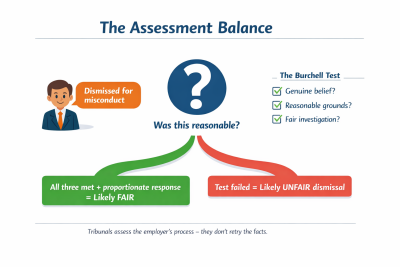
1. Genuine belief: Did the employer genuinely believe the employee was guilty of the alleged misconduct?
2. Reasonable grounds: Did the employer have reasonable grounds upon which to sustain that belief?
3. Reasonable investigation: Had the employer, at the time it formed that belief, carried out as much investigation into the matter as was reasonable in all the circumstances?
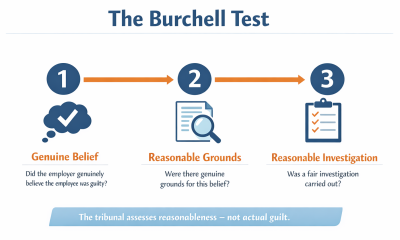
A dismissal will only be fair if the employer can demonstrate all three elements were satisfied at the time of dismissal. Falling short on any one of these tests can render the dismissal unfair.
The Statutory Framework: Section 98 of the Employment Rights Act 1996
The Burchell test operates within the framework established by section 98 of the Employment Rights Act 1996 (ERA 1996). This section provides that for a dismissal to be fair, the employer must show:
First, that the reason for dismissal was one of the five potentially fair reasons, which includes conduct. Under section 98(2)(b), a reason relates to “the conduct of the employee.”
Second, under section 98(4), that the employer acted reasonably in treating that reason as sufficient grounds for dismissal, “having regard to the circumstances (including the size and administrative resources of the employer’s undertaking).”
The statute specifically states that this determination “shall be determined in accordance with equity and the substantial merits of the case.” The Burchell test provides the framework for tribunals to apply this statutory requirement in misconduct cases.
The Original Case: British Home Stores v Burchell

Understanding the facts of the original case helps illustrate how the test works in practice.
Miss Burchell worked as a shop assistant at British Home Stores (BHS). The company operated a staff purchase scheme where employees could buy items at a discount. The system required another staff member to sign a docket confirming the discounted purchase.
A colleague (referred to in the case only as “Mrs L”) purchased polychromatic sunglasses worth £6.99, but the docket showed she had been charged for a cheaper pair worth £2.99. Miss Burchell had signed the docket. During the investigation, Miss Burchell admitted she knew the true price of the sunglasses, and Mrs L alleged that they had colluded together.
There had also been three similar suspicious transactions involving this group of employees. On the balance of probabilities, BHS concluded that Miss Burchell was guilty of dishonesty and dismissed her in October 1977.
The original Industrial Tribunal found the dismissal unfair, but the EAT disagreed. The EAT held that the tribunal had fallen into error by effectively re-trying the question of Miss Burchell’s guilt, rather than asking whether BHS had acted reasonably in concluding she was guilty.
The crucial point established by this case is that tribunals should not substitute their own view for that of the employer. The question is not “was the employee actually guilty?” but rather “did the employer have a genuine and reasonable belief in guilt, formed after a reasonable investigation?”
Element 1: Genuine Belief in Guilt
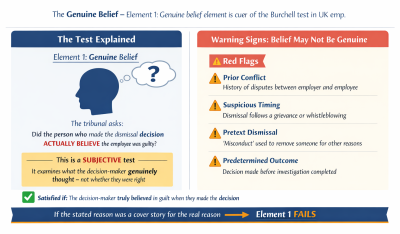
The first limb of the Burchell test requires the employer to establish that they genuinely believed the employee was guilty of the alleged misconduct.
This is a subjective test. The tribunal must examine whether the decision-maker who took the dismissal decision actually believed in the employee’s guilt. If the evidence suggests the stated reason was a pretext and the real reason for dismissal was something else entirely, this element will not be satisfied.
In our experience, genuine belief issues often arise where:
- The employer has a history of conflict with the employee
- The dismissal follows shortly after the employee raised a grievance or made a protected disclosure
- The “misconduct” appears to be a pretext for dismissing someone the employer wants to remove for other reasons
- Different employees who committed similar conduct were treated inconsistently
A common mistake we see is employers who decide the outcome before completing the investigation. If the evidence shows a decision-maker had predetermined the result, the tribunal may find there was no genuine belief formed as a result of the investigation process.
Element 2: Reasonable Grounds for Belief
The second limb requires the employer to have reasonable grounds upon which to sustain their belief in the employee’s guilt.
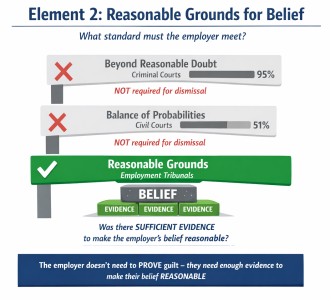
This does not mean the employer must prove guilt beyond reasonable doubt, as in criminal cases, or even on the balance of probabilities in an objective sense. Rather, the employer must show there was sufficient evidence to make their belief reasonable.
Tribunals will examine what material was before the employer at the time of the dismissal decision. Factors that may undermine reasonable grounds include:
- Relying solely on uncorroborated allegations without supporting evidence
- Ignoring evidence that points towards the employee’s innocence
- Failing to take an employee’s previous good record into account
- Drawing conclusions that the evidence does not reasonably support
- Relying on evidence that was obtained unfairly or in breach of the employee’s rights
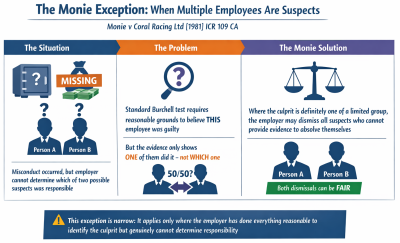
The case of Monie v Coral Racing Ltd [1981] ICR 109 CA established an important exception. Where more than one employee could have committed the same misconduct and the employer cannot identify which one was responsible, the Burchell test may not apply in its usual form. In that case, two employees were the only possible suspects after money went missing, and the employer was entitled to dismiss both when neither could produce evidence to absolve themselves.
Element 3: Reasonable Investigation
The third limb is often where employers fall short. The employer must have carried out as much investigation into the matter as was reasonable in all the circumstances of the case.
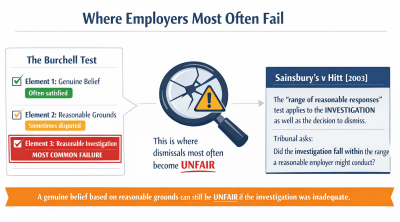
The Court of Appeal in Sainsbury’s Supermarkets Ltd v Hitt [2003] IRLR 23 confirmed that the “range of reasonable responses” test applies to the investigation stage as well as to the decision to dismiss. This means the tribunal must ask whether the investigation fell within the range of approaches a reasonable employer might take, rather than substituting its own view of what investigation should have been conducted.
Nevertheless, a reasonable investigation typically includes:
- Gathering relevant documentary evidence
- Interviewing witnesses
- Giving the employee a fair opportunity to respond to the allegations
- Considering any explanation or defence put forward by the employee
- Looking for evidence that might exonerate the employee as well as evidence of guilt
The ACAS Code of Practice on Disciplinary and Grievance Procedures provides guidance on conducting investigations. Paragraph 5 states: “It is important to carry out necessary investigations of potential disciplinary matters without unreasonable delay to establish the facts of the case.”
The level of investigation required varies according to the circumstances. The more serious the allegations and potential consequences, the more thorough the investigation should be. However, as the Court of Appeal confirmed in Shrestha v Genesis Housing Association Ltd [2015] EWCA Civ 94, an employer does not need to investigate every possible line of defence raised by an employee. An employer must consider defences raised, but whether specific further enquiries are necessary depends on the case as a whole – a tribunal looks at the overall reasonableness of the investigation.
The Range of Reasonable Responses Test
The Burchell test is commonly applied alongside the “range of reasonable responses” test, which comes from the case of Iceland Frozen Foods Ltd v Jones [1982] IRLR 439.
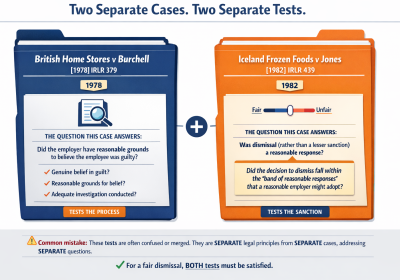
Although often treated as part of the Burchell test, this principle actually derives from a different case and addresses a different question: whether the decision to dismiss (as opposed to impose a lesser sanction) was reasonable.
The key principle from Iceland Frozen Foods is that the tribunal must not substitute its own view for that of the employer. Mr Justice Browne-Wilkinson stated:
“The function of the industrial tribunal, as an industrial jury, is to determine whether in the particular circumstances of each case the decision to dismiss the employee fell within the band of reasonable responses which a reasonable employer might have adopted. If the dismissal falls within the band the dismissal is fair: if the dismissal falls outside the band it is unfair.”
In practice, this means different employers might reasonably take different approaches to the same misconduct. One employer might dismiss for a first offence while another might issue a final written warning, and both responses could be within the range of reasonable responses.
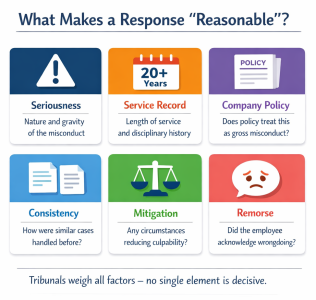
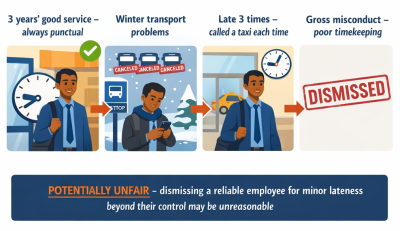
When assessing whether dismissal was within this range, tribunals consider factors such as:
- The nature and seriousness of the misconduct
- The employee’s length of service and previous disciplinary record
- Whether the employer’s disciplinary policy treats the conduct as gross misconduct
- How the employer has treated similar cases in the past (consistency)
- Any mitigating circumstances
- Whether the employee showed remorse
Procedural Fairness and the ACAS Code
Beyond the substantive elements of the Burchell test, a fair dismissal also requires the employer to follow a fair procedure. The ACAS Code of Practice on Disciplinary and Grievance Procedures sets out minimum standards that employers should follow.
The key procedural requirements include:
Investigation: The employer should carry out a reasonable investigation before the disciplinary hearing. Where practicable, different people should conduct the investigation and the disciplinary hearing.
Notification: The employee should be informed in writing of the allegations against them and the evidence being relied upon, in sufficient detail to allow them to prepare their response.
Disciplinary hearing: The employee should be given a reasonable opportunity to put their case, ask questions, and present any relevant evidence or witnesses.
Right to be accompanied: Employees have a statutory right to be accompanied by a colleague or trade union representative at any disciplinary hearing that could result in a formal warning or dismissal.
Decision and notification: The decision should be communicated in writing, setting out the findings, the reasons for the decision, and the right of appeal.
Right of appeal: The employee should be given the opportunity to appeal the decision, ideally to a more senior manager who was not involved in the original decision.
Failure to follow the ACAS Code does not automatically make a dismissal unfair, but tribunals must take it into account. If the employer unreasonably failed to comply with the Code, the tribunal can increase any compensation awarded by up to 25%.
Worked Example: Applying the Burchell Test
To illustrate how the Burchell test works in practice, consider the following scenario:
The facts: Sarah has worked as an accounts manager for eight years with an exemplary record. Her employer receives a complaint from a client alleging that Sarah accepted a £500 gift in exchange for favourable treatment. The client’s manager reports this after falling out with Sarah over an unrelated matter.
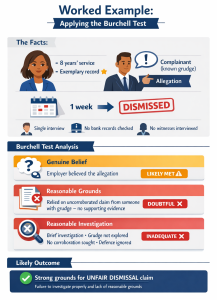
The employer suspends Sarah, conducts a brief investigation consisting only of an interview with the complainant, and dismisses her for gross misconduct at a disciplinary hearing the following week. Sarah denies the allegation and points out that the complainant has a personal grudge against her, but the employer does not investigate this.
Applying the Burchell test:
Element 1 (genuine belief): The employer would likely satisfy this element if the decision-maker genuinely believed Sarah accepted the gift based on the complaint received.
Element 2 (reasonable grounds): This is more doubtful. The employer relied solely on an uncorroborated allegation from someone with a known grudge. Without any supporting evidence (bank records, witness statements, documentation of the alleged favourable treatment), the grounds for belief may be insufficient.
Element 3 (reasonable investigation): The investigation appears inadequate. A reasonable employer would have sought corroborating evidence, investigated Sarah’s defence that the complainant had a grudge, checked whether there was any evidence of the alleged favourable treatment, and given Sarah a proper opportunity to respond with full knowledge of the case against her.
In this scenario, Sarah would have strong grounds for an unfair dismissal claim based on the failure to conduct a reasonable investigation and the lack of reasonable grounds for belief.
Recent Developments in Case Law
Although the Burchell test has been applied for over 45 years, recent case law has refined its application in several ways.
In Reilly v Sandwell MBC [2018] UKSC 16, the Supreme Court applied s98 ERA 1996. The Court noted Burchell’s long-standing use; Lady Hale observed the case might have been an opportunity to consider Burchell’s correctness, but the point wasn’t argued and the law remained unchanged. Lord Wilson suggested that the requirements of Burchell do not necessarily encompass all the requirements of section 98(4), which requires consideration of “equity and the substantial merits of the case.”
More recently, in Rustambekov v Fieldfisher LLP [2024], the tribunal found a dismissal unfair where the employer failed to investigate discrepancies between witness evidence and CCTV footage. This reinforces the importance of thorough investigation.
In Romano v Norwich City Football Club Plc [2025] and Gomes v LHR Airports Ltd [2025], tribunals found dismissals fell outside the range of reasonable responses where employers failed to give proper weight to long service records and applied dismissal as an automatic response to gross misconduct allegations without considering individual circumstances.
NOTE: First-instance ET decisions are fact-specific and not binding; they illustrate, not change, the legal test.
Common Mistakes Employers Make
Based on our experience representing claimants, these are the most common ways employers fail the Burchell test:
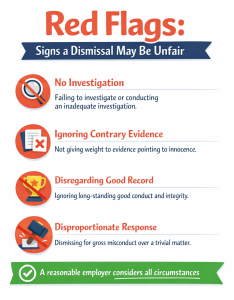
Inadequate investigation: Rushing to judgment without gathering sufficient evidence or properly considering the employee’s explanation. The investigation should be proportionate to the seriousness of the allegations.
Predetermined outcome: Deciding the employee is guilty before completing the investigation, then going through the motions of a procedure that has already been decided. Decision-makers must approach the hearing with an open mind.
Ignoring exculpatory evidence: Focusing only on evidence that supports the allegation while disregarding evidence that points to the employee’s innocence. The investigation should be balanced.
Failure to consider mitigating factors: Dismissing without properly weighing the employee’s length of service, previous good record, or any explanation or mitigating circumstances.
Inconsistent treatment: Dismissing one employee while imposing lesser sanctions on others who committed similar misconduct without clear justification for the difference.
Procedural shortcuts: Failing to follow the ACAS Code, such as not providing adequate notice of hearings, withholding evidence, or denying the right to be accompanied.
What This Means for Employees
If you’ve been dismissed for misconduct, the Burchell test provides several potential grounds to challenge your dismissal.
You should consider whether your employer:
- Conducted a thorough and balanced investigation before the disciplinary hearing
- Gave you adequate notice of the hearing and the evidence against you
- Allowed you to put forward your defence and considered it properly
- Had reasonable grounds to believe you were guilty, not just suspicions
- Considered your length of service and previous record
- Acted consistently compared to how it has treated similar cases
- Followed the ACAS Code of Practice
- Offered a fair appeal process
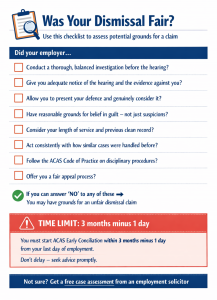
If you can identify failures in any of these areas, you may have grounds for an unfair dismissal claim. The time limit for bringing such a claim is three months minus one day from your effective date of termination, so you should seek advice promptly. A claim must normally be presented before the end of three months beginning with the effective date of termination (EDT), but Early Conciliation can extend time. ALWAYS calculate carefully.
Frequently Asked Questions
What is the Burchell test in employment law?
The Burchell test is a three-part legal framework used by employment tribunals to determine whether a misconduct dismissal was fair. It requires employers to show they genuinely believed the employee was guilty, had reasonable grounds for that belief, and conducted a reasonable investigation before dismissing.
Does the employer have to prove I was actually guilty to dismiss me fairly?
No. The tribunal does not decide whether you were actually guilty of the alleged misconduct. Instead, it asks whether your employer had a genuine and reasonable belief in your guilt, formed after a reasonable investigation. This is a lower threshold than proving guilt.
What constitutes a reasonable investigation under the Burchell test?
A reasonable investigation typically includes gathering relevant evidence, interviewing witnesses, giving the employee an opportunity to respond to the allegations, and considering any defence or explanation they provide. The level of investigation required depends on the seriousness of the allegations.
How does the range of reasonable responses test relate to the Burchell test?
The range of reasonable responses test from Iceland Frozen Foods v Jones addresses whether dismissal (as opposed to a lesser sanction) was a proportionate response. It works alongside Burchell. The tribunal asks whether another reasonable employer might have dismissed in the same circumstances, rather than substituting its own view.
Can I challenge my dismissal if my employer followed a fair procedure?
Yes. Even if the procedure was fair, you may still have grounds for an unfair dismissal claim if your employer lacked genuine belief in your guilt, had inadequate grounds for that belief, or if dismissal was outside the range of reasonable responses given the circumstances.
What is the time limit for bringing an unfair dismissal claim?
You must notify ACAS to start Early Conciliation within three months minus one day from your effective date of termination. During Early Conciliation (which can last up to 12 weeks), the clock on your limitation period is paused. Once ACAS issues your certificate, you will have a minimum of one month from the certificate date to submit your claim to the employment tribunal. However, this is a statutory minimum guarantee, not extra time on top of your remaining limitation period. How much time you actually have depends on when you contacted ACAS relative to your original deadline.
Important: Early Conciliation can end sooner than 12 weeks if ACAS determines that settlement will not be reached. If you contacted ACAS close to the end of your three-month time limit, you may have very little time left once you receive your certificate. Working out the exact deadline can be complicated, and getting it wrong means losing your right to claim. We strongly recommend seeking legal advice as early as possible rather than waiting until the deadline approaches. For a detailed explanation, see our guide to employment tribunal time limits.
Does the Burchell test apply to all dismissals?
The Burchell test specifically applies to misconduct dismissals. Similar principles apply to capability dismissals. For other types of dismissal, such as redundancy or some other substantial reason, different tests apply, although the general requirement of reasonableness under section 98(4) ERA 1996 still applies.
What compensation can I receive if my dismissal is found to be unfair?
Compensation for unfair dismissal consists of a basic award (calculated like statutory redundancy pay, based on a maximum week’s pay of £719) and a compensatory award capped at £118,223 or 52 weeks’ gross pay, whichever is lower. The compensatory award may be increased by up to 25% if your employer unreasonably failed to follow the ACAS Code.
Important: This guide provides general information about the Burchell test and unfair dismissal law. It is not legal advice and should not be relied upon as such. Employment law is complex and the rules may apply differently depending on your circumstances. If you are considering an unfair dismissal claim, we strongly recommend seeking professional legal advice.
Sources and Further Reading
- Employment Rights Act 1996, s.98: legislation.gov.uk
- British Home Stores Ltd v Burchell [1978] IRLR 379: BAILII
- Iceland Frozen Foods Ltd v Jones [1982] IRLR 439
- Sainsbury’s Supermarkets Ltd v Hitt [2003] IRLR 23
- ACAS Code of Practice on Disciplinary and Grievance Procedures: acas.org.uk
- Reilly v Sandwell Metropolitan Borough Council [2018] UKSC 16
- Shrestha v Genesis Housing Association Ltd [2015] EWCA Civ 94

Tom Street
Tom Street is the principal solicitor at Tom Street & Co. Solicitors, specialising in employment law and tribunal claims. He regularly represents claimants in unfair dismissal, discrimination, and whistleblowing cases. View full profile