
Key Points
- ✓ Your employment tribunal list of documents must include all relevant materials, whether they help or harm your case
- ✓ Disclosure is typically ordered 14-28 days before the hearing, with Scotland requiring 14 days for represented parties
- ✓ Your list should be chronological, with each document dated and described (e.g. “Dismissal letter from respondent, 15 March 2025”)
- ✓ You have an ongoing duty to disclose new relevant documents right up to the hearing date
- ✓ Failing to disclose documents properly can result in your claim being struck out or adverse inferences drawn against you
- ✓ Without prejudice settlement discussions and legal advice from your solicitor don’t need to be disclosed
Putting together your employment tribunal list of documents can feel overwhelming, but it’s one of the most important steps in preparing your case. The tribunal will make its decision based on the evidence in front of it, so getting your disclosure right matters enormously.
In our experience representing claimants, we’ve seen strong cases weakened by poor document preparation and weak cases strengthened by thorough disclosure. This guide explains exactly how to compile your list, what documents you need, and how to avoid the common mistakes that trip people up.
What Is Disclosure in Employment Tribunal Cases?
Disclosure is the process where both sides in an employment tribunal claim exchange the documents they hold that are relevant to the case. Under Rule 31 of the Employment Tribunals (Constitution and Rules of Procedure) Regulations 2013, the tribunal can order any person in Great Britain to disclose documents or information to another party.
The crucial point is that you must disclose all relevant documents, not just the ones that help your case. This includes documents that support your employer’s position or undermine your own arguments. The Employment Appeal Tribunal confirmed in Tesco Stores Ltd v Element (2021) that the test for relevance is whether documents are relied upon by a party or are likely to support or be adverse to any party’s case.
Think of disclosure as creating a level playing field. Many of the key documents about your employment (disciplinary records, internal emails, meeting notes) will be in your employer’s possession. Without disclosure, you’d never see them. Equally, your employer is entitled to see documents you hold that relate to the claim.
When Will You Need to Prepare Your List of Documents?
The tribunal will typically order disclosure through case management orders, usually at or shortly after a preliminary hearing. Standard disclosure deadlines in England and Wales typically fall within 14 to 28 days of the order being made.
In Scotland, there’s a specific practice direction requiring legally represented parties to exchange a list of documents they intend to rely on no later than 14 days before the hearing.
You’ll receive written directions from the tribunal setting out exactly what’s required and by when. These directions will specify whether you need to:
- Provide a list of documents only
- Provide copies of the actual documents alongside your list
- Prepare your documents in a specific format
- Exchange documents simultaneously with the other party
Case management orders are formal legal instructions. Missing a disclosure deadline without good reason can result in your claim being struck out, so treat these dates seriously. If you’re struggling to meet a deadline, write to the tribunal immediately explaining why and requesting an extension.
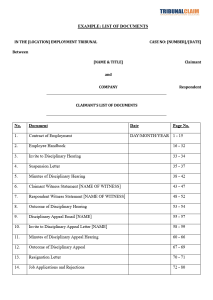
Below you will find an example of what a List of Documents would look like. Feel free to download it and use as a guide when preparing your own.
What Documents Should Go in Your Employment Tribunal List?
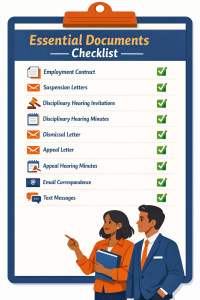
Your list needs to include every document that’s relevant to the issues in your case. Relevance depends on what you’re claiming, but here are the typical categories:
– Your Employment Contract and Terms
Start with your contract of employment, including any amendments or variations made during your employment. If your role changed significantly over time, include documents showing how your responsibilities evolved. Your job description matters too, particularly in constructive dismissal or redundancy cases where the nature of your role is disputed.
Staff handbooks and company policies are crucial, especially sections on grievance procedures, disciplinary policies, equal opportunities, and any policies directly relevant to your claim. In our experience, employers sometimes argue that certain policies didn’t apply to you or that you should have followed a procedure you weren’t aware of. Having these documents in the bundle prevents those arguments.
– Correspondence About the Dispute
Include all letters, emails, text messages, and other communications about the issues in your claim. This covers:
- Grievance letters you submitted and the responses
- Invitations to disciplinary hearings
- Disciplinary outcome letters and dismissal letters
- Appeal letters and outcomes
- Any emails or messages where concerns were raised
- Performance improvement plans or warnings
Email exchanges often form the backbone of employment tribunal evidence. Include relevant emails between you and your employer, colleagues, or HR. This includes both formal communications and informal exchanges that demonstrate workplace culture or problematic behaviour.
– Meeting Notes and Minutes
Gather minutes or notes from any formal meetings, including disciplinary hearings, grievance meetings, performance reviews, and appeal hearings. If you took your own contemporaneous notes during or immediately after meetings or incidents, these can be valuable evidence. Notes written at the time carry more weight than recollections months later.
Pay and Financial Records
Include payslips for at least three months before any issues arose, plus all subsequent payslips showing any changes in your pay or deductions. If you’re claiming for lost earnings, you’ll need your full salary history, including bonuses, commission, and overtime payments.
Your P45 and P60 forms provide official confirmation of your earnings and employment dates. For discrimination cases involving pay disparities, include any records showing differential treatment in pay, bonuses, or benefits compared to colleagues.
– Redundancy and Restructuring Documents
For redundancy claims, you’ll need your employer’s redundancy policy, any consultation documents, scoring matrices used in selection, and documents showing how they decided who would be made redundant. In our experience handling redundancy cases, these documents often reveal flaws in the process that employers would rather not highlight.
– Medical Records and Sickness Documentation
If your claim involves disability discrimination, stress, or health issues caused by work, include relevant medical records (with your consent), fit notes, occupational health reports, and correspondence about sickness absence or reasonable adjustments.
– Evidence of Your Job Search (If Claiming Lost Earnings)
If you’re seeking compensation for lost earnings, you need to show you’ve mitigated your loss by looking for alternative work. Include copies of job applications, interview confirmations, rejection letters, and evidence of any new employment you’ve found.
Documents You Don’t Need to Disclose
Not everything has to go in your list. These categories are protected from disclosure:

– Without Prejudice Communications
Without prejudice privilege protects correspondence or communications made as part of a genuine attempt to settle the dispute. If letters or emails are marked “without prejudice” and were genuinely aimed at reaching a settlement, you don’t need to disclose them.
Be careful though. Simply marking something “without prejudice” doesn’t automatically make it privileged. The communication must actually be part of settlement negotiations. In Meaker v BNP Paribas (2023), the EAT held that a letter marked “without prejudice” could still be used as evidence because it contained clear termination arrangements that weren’t contingent on reaching a settlement.
– Legal Advice Privilege
Communications between you and your solicitor for the purpose of getting or giving legal advice are protected. This includes emails with your lawyer, attendance notes of meetings, and legal advice you’ve received. You can choose to waive this privilege if you want to disclose something, but you’re not required to.
– Litigation Privilege
Documents created specifically for the purpose of the tribunal proceedings are privileged. This includes draft versions of your ET1 claim form, emails to family or friends discussing litigation strategy, and documents prepared in anticipation of the hearing.
– Important Exception: Documents Can’t Become Privileged Later
A document that wasn’t privileged when it was created can’t become privileged later, even if you subsequently send it to your solicitor for advice. In University of Dundee v Chakraborty (2023), the Court of Session confirmed that an investigation report that was originally non-privileged couldn’t be withheld from disclosure just because it had later been sent to solicitors for review.
How to Compile Your Employment Tribunal List of Documents
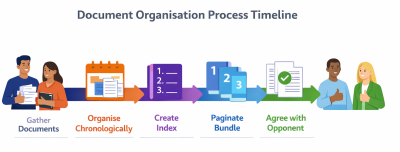
Here’s the practical step-by-step process we recommend to clients:
Step 1: Gather Everything Together
Start by collecting all potentially relevant documents in one place. Don’t be too selective at this stage. It’s better to gather too much and pare it down later than to miss something important.
Check everywhere: your work email (if you still have access), personal email, text messages, any folders where you’ve saved documents, physical files at home. If you keep a work diary or notebook, include relevant entries.
Step 2: Identify Documents You Don’t Have
Make a list of documents you know exist but aren’t in your possession. These might include internal emails between managers about you, notes from meetings you weren’t present at, or HR records you’ve never seen.
Write to your employer requesting these documents, setting out clearly what you want and why it’s relevant to your case. Give them a reasonable deadline (usually 14 days) and state that if they don’t comply, you’ll apply to the tribunal for an order.
If your employer refuses, you can apply to the tribunal for a disclosure order. In your application, explain exactly which documents you’re seeking, why they’re relevant to the issues in the case, and why the employer should have them.
Step 3: Organise in Chronological Order
Once you have your documents, put them in chronological order. This makes them much easier for the tribunal to follow and shows the sequence of events clearly.
If you have multiple documents from the same date, order them logically (for example, put a meeting invitation before the meeting notes, and the meeting notes before any follow-up email).

Step 4: Create Your List
Your list should set out each document with:
- A sequential number (1, 2, 3, etc.)
- The date of the document
- A brief but clear description (for example, “Email from John Smith to HR re: grievance meeting” or “Dismissal letter from respondent”)
You can organise your list into categories if that makes it clearer, but within each category, keep documents in date order. Common categories include: pleadings (ET1, ET3), contracts and policies, correspondence, meeting notes, pay records.
Step 5: Check for Gaps
Before finalising your list, review it carefully. Are there any obvious gaps? If you mention an incident in your claim form but don’t have any documents about it, can you create a contemporaneous note explaining what happened?
Remember, you have an ongoing duty to disclose. If you find additional relevant documents after sending your initial list, you must immediately notify the other side and add them to the bundle.
Employment Tribunal List of Documents Example
Here’s what a properly formatted list looks like for an unfair dismissal case:
LIST OF DOCUMENTS OF [YOUR NAME] (CLAIMANT)
Section 1: Pleadings and Orders
- ET1 Claim Form dated 15 March 2025
- ET3 Response Form dated 10 April 2025
- Case Management Order dated 5 May 2025
Section 2: Contract and Policies
- Contract of Employment dated 1 June 2020
- Job Description: Customer Service Manager dated 1 June 2020
- Staff Handbook (pages 15-28: Disciplinary Procedure)
Section 3: Correspondence
- Email from Claimant to HR re: workload concerns dated 10 January 2025
- Email from Sarah Jones (Line Manager) to Claimant dated 12 January 2025
- Grievance letter from Claimant to HR dated 20 January 2025
- Invitation to disciplinary hearing dated 1 February 2025
- Email from Claimant to HR re: request for documents dated 3 February 2025
Section 4: Meeting Notes
- Disciplinary hearing notes dated 8 February 2025
- Claimant’s own notes of disciplinary hearing dated 8 February 2025
- Dismissal letter from Respondent dated 15 February 2025
- Appeal letter from Claimant dated 20 February 2025
- Appeal hearing notes dated 1 March 2025
- Appeal outcome letter dated 8 March 2025
Section 5: Pay Records
- Payslips October 2024 to February 2025
- P45 dated 28 February 2025
Who Prepares the Hearing Bundle?
After both sides have disclosed their documents, someone needs to prepare the hearing bundle (the single set of all agreed documents that will be used at the hearing). The tribunal usually orders the respondent (your employer) to prepare this bundle because they typically have more resources and most of the documents.
Your employer should send you a draft bundle index for approval before finalising it. Check it carefully. Make sure every document from your list that you want to rely on is included. If anything is missing, ask for it to be added immediately.
The bundle needs to be paginated (page numbered) consecutively from start to finish, with an index at the front. Your witness statement will refer to documents by their page numbers in the bundle (for example, “As stated in my dismissal letter at page 47 of the bundle”), so accurate pagination matters.
For a tribunal with three panel members, you’ll typically need six copies: one for each panel member, one for you, one for your employer, and one for witnesses. For a judge sitting alone, you’ll need four copies. The tribunal’s directions will tell you how many to bring.
Common Mistakes to Avoid
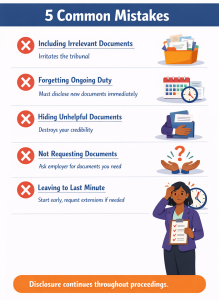
Over the years, we’ve seen the same mistakes trip up claimants again and again:
Including Irrelevant Documents
Don’t pad your list with documents that have nothing to do with your claim. A 400-page bundle full of irrelevant material won’t impress the tribunal, it will irritate them. Every document should have a clear purpose and connection to the issues the tribunal needs to decide.
Forgetting the Duty of Disclosure Is Ongoing
Your obligation to disclose relevant documents continues right up until (and even during) the hearing. If you find a new relevant document or create one (such as notes of a meeting with a potential new employer), you must immediately disclose it to the other side and add it to the bundle.
In Kaur v Sun Mark Ltd (2024), the EAT upheld a tribunal’s decision to strike out the claimant’s claims after she destroyed a notebook and phone containing key evidence during the proceedings. The case is a stark reminder that you must preserve evidence once litigation has commenced.
Trying to Hide Unhelpful Documents
Some claimants are tempted to “forget” to disclose documents that don’t help their case. Don’t do this. If the document is relevant, you must disclose it whether it helps you or not. Tribunals take a dim view of parties who fail to disclose properly, and it can destroy your credibility.
The tribunal can draw adverse inferences from missing documents. If a document obviously should exist but isn’t in the bundle, the tribunal may assume it would have helped the other side.
Not Requesting Documents From Your Employer
Many claimants don’t realise they can request documents from their employer. If you know certain documents exist (internal emails about you, investigation notes, comparator pay data), ask for them in writing. If your employer refuses, apply to the tribunal for an order.
Leaving It to the Last Minute
Putting together your list takes time, especially if you need to request documents from your employer or track down old emails. Start early. If you’re struggling to meet a deadline, don’t just miss it silently. Write to the tribunal explaining the difficulty and asking for extra time.
What Happens If Your Employer Won’t Disclose Documents?

Sometimes employers resist disclosure, particularly of documents that might be damaging to their case. Here’s what to do:
First, write to your employer (or their solicitor) clearly requesting the specific documents you want. Explain why each document is relevant to the issues in the case. Give them a reasonable deadline (14 days is standard) and state that if they don’t comply, you’ll apply to the tribunal for an order.
If they still refuse or don’t respond, apply to the tribunal in writing. Your application should set out:
- Exactly which documents you’re seeking (be as specific as possible)
- Why each document is relevant to your case
- That you’ve asked the employer directly and they’ve refused or not responded
- Why the tribunal should make an order
Send a copy of your application to the employer and tell them that if they object, they must notify the tribunal immediately.
The tribunal has wide powers under Rule 29 to order disclosure. They can order specific documents, categories of documents, or general disclosure of all relevant documents. They can also make “unless orders” stating that unless the employer complies within a set time, their response will be struck out.
Dealing With Confidential or Sensitive Documents
Sometimes documents contain confidential information that isn’t relevant to your case (for example, an email discussing your grievance that also mentions another employee’s medical condition, or commercially sensitive pricing information).
You can apply to the tribunal for permission to redact (black out) the irrelevant confidential parts. However, the tribunal will only allow this if the information genuinely isn’t relevant and has a legitimate need for confidentiality.
Simply marking something “confidential” doesn’t exempt it from disclosure. In Google UK Ltd v Frewer (2022), the EAT considered whether commercially sensitive client names could be redacted and anonymised. The EAT held that tribunals must carefully balance disclosure obligations against confidentiality concerns, and should only restrict disclosure where strictly necessary.
Using Your List at the Hearing
Once your list is finalised and the hearing bundle is prepared, you’ll use it throughout the hearing. Your witness statement will refer to documents by their page numbers in the bundle. When you’re giving evidence or cross-examining witnesses, you’ll direct people to specific pages.
The tribunal judge will have read all the documents in the bundle before the hearing starts. However, they’ll pay closest attention to documents that are specifically referenced in witness statements or highlighted during oral evidence.
This is why it’s crucial that your witness statement cross-references the key documents. Don’t assume the judge will spot something important in a 300-page bundle. Point them to it explicitly.
Frequently Asked Questions
Do I have to include documents in my employment tribunal list of documents that hurt my case?
Yes, you must. The duty of disclosure requires you to include all relevant documents, whether they help or harm your position. Tribunals can draw adverse inferences against you if they discover you’ve withheld relevant documents, and in serious cases, your claim could be struck out entirely.
How long before the hearing do I need to prepare my list of documents?
The tribunal will set a specific deadline in their case management order, typically 14 to 28 days before the hearing in England and Wales. In Scotland, represented parties must exchange their list no later than 14 days before the hearing. Always check your tribunal’s specific directions and comply with the deadline given.
Can I add documents to the bundle after the list has been agreed?
Yes, if new relevant documents come to light. You have an ongoing duty to disclose throughout the proceedings. However, you must notify the other side immediately and explain why the document wasn’t included earlier. Adding documents very close to the hearing may irritate the tribunal, but they’ll usually allow it if you have a good reason and it’s genuinely necessary for a fair hearing.
What if my employer has documents I need but won’t give them to me?
First, request them in writing, clearly explaining why each document is relevant and giving a reasonable deadline. If your employer refuses or doesn’t respond, you can apply to the tribunal for a disclosure order. The tribunal has power under Rule 31 to order any person in Great Britain to disclose documents or information.
Do I need to disclose text messages and WhatsApp conversations?
Yes, if they’re relevant to your case. Text messages, WhatsApp messages, and other electronic communications are documents for disclosure purposes. Take screenshots to preserve them, as they can be easily deleted. Include them in your list with a clear description of who sent them and when.
What’s the difference between a list of documents and the hearing bundle?
Your list of documents is the index you prepare showing all documents you hold that are relevant to the case. The hearing bundle is the final, agreed set of all documents from both sides that will actually be used at the hearing. The respondent usually prepares the hearing bundle by combining documents from both parties’ lists.
Can I include my own notes of meetings and conversations?
Absolutely. Contemporaneous notes (notes made at the time or very shortly after an event) are valuable evidence. Include any notes you made during or after meetings, conversations, or incidents. Make sure they’re dated and explain briefly what they relate to in your list.
What happens if I miss the deadline for disclosure?
Missing a disclosure deadline without good reason can have serious consequences. The tribunal can strike out your claim, award costs against you, or draw adverse inferences. If you’re going to miss a deadline, write to the tribunal immediately explaining why and requesting an extension. Don’t just ignore it.
Important: This guide provides general information about preparing a list of documents for employment tribunal proceedings. It is not legal advice and should not be relied upon as such. Employment tribunal procedure can be complex and the rules may apply differently depending on your circumstances and the tribunal’s specific directions. If you are preparing for an employment tribunal hearing, we strongly recommend seeking professional legal advice tailored to your case.
Sources and Further Reading
- Employment Tribunals (Constitution and Rules of Procedure) Regulations 2013 (legislation.gov.uk)
- Presidential Guidance: General Case Management (judiciary.uk, 22 January 2018)
- Employment Tribunals: Make a Claim (GOV.UK)
- Acas: Employment Tribunals (acas.org.uk)
- Tesco Stores Ltd v Element [2021] UKEAT/0264/20: Test for disclosure relevance
- Kaur v Sun Mark Ltd [2024]: Consequences of destroying evidence

Tom Street
Tom Street is the principal solicitor at Tom Street & Co. Solicitors, specialising in employment law and tribunal claims. He regularly represents claimants in unfair dismissal, discrimination, and whistleblowing cases. View full profile