
Quick Summary
Section 19A of the Equality Act 2010 allows you to claim indirect discrimination even if you don’t personally have a protected characteristic. If an employer’s policy disadvantages people with a protected characteristic (such as women or disabled employees), and you suffer “substantively the same disadvantage” as them, you can now bring a claim. This section came into force on 1 January 2024 and applies to all protected characteristics except pregnancy and maternity.
⚖️ This guide is for general information only and is not legal advice. Every case is different. If you’re unsure, speak to a solicitor.
Key Points
- ✓ Section 19A came into force on 1 January 2024 under the Equality Act 2010 (Amendment) Regulations 2023
- ✓ You can claim indirect discrimination without having the protected characteristic yourself
- ✓ You must show you suffer “substantively the same disadvantage” as those with the characteristic
- ✓ The provision covers age, disability, sex, race, religion, sexual orientation, and gender reassignment
- ✓ The employer can still defend the claim by showing objective justification
- ✓ Time limits remain three months minus one day from the discriminatory act
What Is Section 19A?
Section 19A of the Equality Act 2010 creates a new form of indirect discrimination that allows employees to bring claims even when they don’t personally possess a protected characteristic. This is sometimes called “same disadvantage” indirect discrimination, or colloquially “indirect discrimination by ricochet”.
Before section 19A, the law required claimants to have the protected characteristic themselves. For example, if an employer’s requirement to work full time disproportionately affected women (who statistically bear more childcare responsibilities), only women could bring an indirect sex discrimination claim. A man in the same situation, unable to work full time because of his childcare responsibilities, had no claim under the original section 19 of the Equality Act 2010.
Section 19A changed this position.

Now, anyone who suffers “substantively the same disadvantage” as those with a protected characteristic can bring a claim. The section was introduced by the Equality Act 2010 (Amendment) Regulations 2023 (SI 2023/1425) and came into force on 1 January 2024.
The Legal Background
The CHEZ Razpredelenie Bulgaria Case
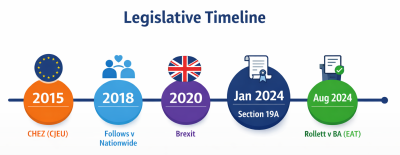
Section 19A codifies the principle established by the Court of Justice of the European Union (CJEU) in CHEZ Razpredelenie Bulgaria AD v Komisia za zashtita ot diskriminatsia (Case C-83/14) [2015] IRLR 746.
In CHEZ, Ms Nikolova ran a grocery shop in a predominantly Roma district of Bulgaria. The electricity company installed meters at a height of six to seven metres in this area (compared to 1.7 metres elsewhere), making it impossible for residents to monitor their electricity consumption. Ms Nikolova was not herself of Roma origin, but she suffered the same disadvantage as her Roma neighbours.
The CJEU held that the EU Race Directive protected not only people with the protected characteristic, but also those who suffered the same disadvantage as a result of a discriminatory practice. This was a significant departure from the previous understanding that indirect discrimination required the claimant to possess the protected characteristic.
Pre-2024 UK Position
Following Brexit, there was uncertainty about whether UK tribunals could continue to apply CHEZ. The original wording of section 19 of the Equality Act 2010 required the claimant to have the protected characteristic. The Retained EU Law (Revocation and Reform) Act 2023 removed the interpretive effects of EU law from 1 January 2024.
To preserve the CHEZ principle in domestic law, the government introduced section 19A through secondary legislation. This ensures that employees who suffer collateral harm from discriminatory practices remain protected.
What Section 19A Says
Under section 19A, a person (A) discriminates against another person (B) if:
- A applies a provision, criterion or practice (PCP) to B
- A also applies, or would apply, the PCP to persons who do not share a relevant protected characteristic
- The PCP puts, or would put, persons with the relevant protected characteristic at a particular disadvantage compared with persons who do not share it
- The PCP puts, or would put, B at substantively the same disadvantage as persons who share the protected characteristic
- A cannot show the PCP is a proportionate means of achieving a legitimate aim
The section applies to all protected characteristics: age, disability, gender reassignment, marriage and civil partnership, race, religion or belief, sex, and sexual orientation. It does not apply to pregnancy and maternity discrimination, which has separate provisions.
Section 19 vs Section 19A: What’s the Difference?
Section 19 and section 19A both deal with indirect discrimination, but they protect different claimants. Understanding which applies to your situation is essential.
In force since
Must claimant have the protected characteristic?
What must claimant prove?
Typical claimant
Justification defence available?
Applies to pregnancy/maternity?
Compensation
Time limit
Which Section Applies to You?
Use section 19 if: You have the protected characteristic and are disadvantaged by the PCP. For example, you are a woman and an inflexible working policy makes it harder for you to balance childcare.
Use section 19A if: You don’t have the protected characteristic but suffer the same disadvantage as those who do. For example, you are a man with primary childcare responsibilities and the same inflexible policy affects you in exactly the same way it affects working mothers.
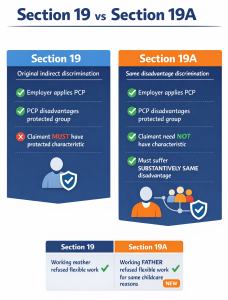
In practice, claimants with the protected characteristic should use section 19 as it is more established. Section 19A exists for those who would otherwise have no claim because they lack the characteristic, despite suffering identical disadvantage.
Same Disadvantage vs Association: An Important Distinction
It’s essential to understand that section 19A creates “same disadvantage” indirect discrimination, not “associative” indirect discrimination in the traditional sense.
Same Disadvantage Discrimination
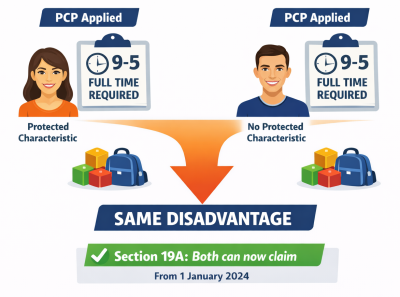
Under section 19A, the claimant must suffer substantively the same disadvantage as those with the protected characteristic. This occurs when both the claimant and the protected group are affected by the PCP in the same way, for the same underlying reason.
The clearest example is a working father with childcare responsibilities. A requirement to work full time disadvantages women (who statistically bear more childcare burdens) and disadvantages him for exactly the same reason: both groups struggle to meet the requirement because of childcare commitments. The disadvantage is the same.
Traditional Associative Discrimination
Traditional associative indirect discrimination, as seen in Follows v Nationwide Building Society ET/2201937/2018, involves a different type of connection. In Follows, a woman caring for her disabled mother was disadvantaged by a requirement to work in the office. She wasn’t disabled herself, nor did she suffer the same disadvantage as disabled employees. Instead, she was disadvantaged because of her association with a disabled person.
There is ongoing uncertainty about whether section 19A covers Follows-type claims. Commentators have noted that section 19A requires the claimant to suffer “substantively the same disadvantage” as people with the protected characteristic. In Follows, the claimant’s disadvantage arose from her caring role, not from having the same impairment as disabled employees. The employment tribunal in British Airways v Rollett [2024] EAT 131 expressly distinguished between these two types of claim.
“The distinction between ‘same disadvantage’ and ‘associative’ indirect discrimination is crucial. Section 19A clearly covers cases where someone suffers the identical disadvantage as a protected group. Whether it extends to carers disadvantaged by their association with disabled relatives is a question tribunals will need to grapple with in the coming years.”

Key Case: British Airways v Rollett
The leading authority on same disadvantage indirect discrimination is British Airways plc v Rollett & Others [2024] EAT 131, decided by Mrs Justice Eady (President of the EAT) on 15 August 2024.
The Facts
Following the Covid-19 pandemic, British Airways restructured its operations, introducing new scheduling practices for Heathrow-based cabin crew. Several employees brought indirect discrimination claims, alleging that the scheduling changes:
- Put non-British nationals who commuted from abroad at a particular disadvantage (race discrimination)
- Put those with caring responsibilities at a particular disadvantage (sex discrimination)
Crucially, some claimants did not have the relevant protected characteristic. For example, Mr Rollett was a man with childcare responsibilities who claimed indirect sex discrimination, and a British national living in France claimed indirect race discrimination alongside her non-British colleagues.
The Decision
The EAT dismissed British Airways’ appeal, holding that:
- Section 19 could be interpreted consistently with CHEZ to allow same disadvantage claims
- The introduction of section 19A by the 2023 Regulations was lawful and not ultra vires
- Claimants who suffer the same disadvantage as a protected group can bring indirect discrimination claims, even without the protected characteristic
The EAT emphasised that this interpretation did not go “against the grain” of the Equality Act’s purpose of strengthening equality protections.
Practical Examples of Section 19A Claims
Working Fathers and Childcare
The most common scenario for section 19A claims involves working fathers. If an employer requires full-time attendance or inflexible working hours, this typically puts women at a disadvantage (because women statistically bear more childcare responsibilities). A father in the same position, unable to meet the requirement because of his childcare commitments, suffers substantively the same disadvantage and can now bring a claim under section 19A.
Temporary Physical Impairment
An employee with a temporary injury (such as a broken leg) may suffer the same disadvantage as disabled employees from certain workplace practices. For example, if an employer requires all staff to use stairs rather than lifts, this puts disabled employees at a disadvantage. An employee with a temporary injury affecting their mobility suffers substantively the same disadvantage and may bring a section 19A claim, without needing to prove their condition meets the Equality Act definition of disability.
Commuting and Nationality
In Rollett, British nationals living abroad suffered the same disadvantage as non-British nationals from scheduling changes that made commuting from overseas more difficult. Both groups faced identical practical difficulties, regardless of their nationality.
Religious Observance
An employer’s requirement to work Friday evenings may disadvantage Jewish employees who observe Shabbat. A non-Jewish employee with caring responsibilities that prevent Friday evening work might argue they suffer substantively the same disadvantage (being unable to work at that time), though this argument is more tenuous as the reason for the disadvantage differs.
How to Bring a Section 19A Claim
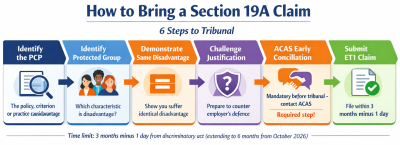
Step 1: Identify the PCP
First, you must identify the provision, criterion or practice (PCP) that causes the disadvantage. This could be a formal policy, an informal practice, or a one-off decision that amounts to a rule. Examples include requirements to work full time, specific shift patterns, office attendance requirements, or physical requirements of the job.
Step 2: Identify the Protected Group
You must show that the PCP puts, or would put, persons with a protected characteristic at a particular disadvantage. This requires identifying which protected group is disadvantaged and understanding why. Statistical evidence is often helpful but not always required.
Step 3: Demonstrate Your Same Disadvantage
You must prove that you suffer “substantively the same disadvantage” as the protected group. This means showing that the PCP affects you in the same way and for the same underlying reason as it affects those with the protected characteristic.
Step 4: Show No Justification
The employer can defend the claim by showing the PCP is a “proportionate means of achieving a legitimate aim.” You should be prepared to challenge both the legitimacy of the aim and whether the means chosen were proportionate.
Step 5: Submit Acas Early Conciliation
Before issuing tribunal proceedings, you must contact Acas for early conciliation. This is a mandatory step. Acas will attempt to help you and your employer reach a settlement without the need for a tribunal hearing.
Step 6: Issue Your ET1 Claim
If early conciliation is unsuccessful, you can submit your claim to the employment tribunal using the ET1 claim form. Your claim must be submitted within three months minus one day from the discriminatory act, though early conciliation extends this period.
Time Limits for Section 19A Claims
Section 19A claims follow the same time limits as other discrimination claims under section 123 of the Equality Act 2010:
- Primary time limit: Three months minus one day from the date of the discriminatory act
- Continuing acts: Where discrimination is ongoing, time runs from the end of the continuing course of conduct
- Extension: The tribunal has discretion to extend time where it is “just and equitable” to do so
- Early conciliation: The time limit is paused during Acas early conciliation
⚖️ Legislation Update
Time Limits Extended to 6 Months from October 2026
The Employment Rights Act 2025 extends most employment tribunal time limits to six months. This change is expected to come into force in October 2026 and will apply to discrimination claims including those under section 19A. Until then, the three-month time limit remains in force.
Compensation for Section 19A Claims
Successful section 19A claims attract the same remedies as other indirect discrimination claims:
Injury to Feelings
Awards for injury to feelings are assessed using the Vento bands, updated annually:
Vento Bands for Injury to Feelings (April 2025)
| Band | Award Range | When Applied |
|---|---|---|
| Lower Band | £1,200 – £12,100 | Less serious cases, isolated or one-off incidents |
| Middle Band | £12,100 – £36,400 | Serious cases not meriting the upper band |
| Upper Band | £36,400 – £60,700 | Most serious cases, prolonged discrimination |
| Exceptional | £60,700+ | Only in the most exceptional circumstances |

Financial Losses
You can claim compensation for financial losses caused by the discrimination, including loss of earnings, loss of benefits, and pension losses. Unlike unfair dismissal, discrimination compensation is uncapped.
Interest
Interest accrues on discrimination awards at 8% simple interest. For injury to feelings, interest runs from the date of the discriminatory act. For financial losses, interest runs from the mid-point between the act and the calculation date.
The Employer’s Defence: Objective Justification
An employer can defend a section 19A claim by showing the PCP was a “proportionate means of achieving a legitimate aim.” This requires the employer to prove:
Legitimate Aim
The aim must be legitimate, which typically means a genuine business need. Examples include ensuring adequate staffing levels, meeting customer requirements, health and safety considerations, or efficient business operations. An aim that is itself discriminatory cannot be legitimate.
Proportionality
Even with a legitimate aim, the employer must show the PCP was proportionate. The tribunal will consider:
- Whether the aim could be achieved by less discriminatory means
- The extent of the disadvantage caused to the claimant
- Whether the employer considered alternatives
- Whether the employer’s assessment was based on evidence or mere assumption
In Follows v Nationwide Building Society, the tribunal rejected Nationwide’s justification because the need for office-based supervision was itself discriminatory and the employer failed to consider less discriminatory alternatives such as hybrid working.
“Employers defending section 19A claims should not assume that any business reason will suffice. Tribunals scrutinise justification arguments closely, particularly where the employer has failed to consider alternatives or engaged in proper consultation with affected employees.”
What Section 19A Does Not Cover
Despite broadening indirect discrimination protection, section 19A has important limitations:
Reasonable Adjustments
The duty to make reasonable adjustments under section 20 of the Equality Act 2010 remains restricted to disabled employees. The Court of Appeal in Hainsworth v Ministry of Defence [2014] IRLR 728 held that a mother of a disabled child could not claim a failure to make reasonable adjustments. This position has not changed.
Victimisation
Interestingly, when Parliament introduced section 19A, it did not make equivalent changes to the victimisation provisions. Section 27 of the Equality Act 2010 still requires the claimant to have done a “protected act” themselves. This may suggest Parliament deliberately chose not to extend associative protection to victimisation claims.
Pregnancy and Maternity
Section 19A does not apply to pregnancy and maternity discrimination, which is covered by separate provisions in section 18 of the Equality Act 2010.
Frequently Asked Questions
Can a man bring an indirect sex discrimination claim?
Yes. Under section 19A, a man can bring an indirect sex discrimination claim if he suffers substantively the same disadvantage as women from an employer’s PCP. The most common example is a working father disadvantaged by inflexible working patterns that also disadvantage working mothers.
Do I need to prove I’m disabled to bring a disability discrimination claim under section 19A?
No. Section 19A allows you to bring an indirect disability discrimination claim if you suffer substantively the same disadvantage as disabled employees, even if you don’t meet the legal definition of disability yourself. This could apply to employees with temporary injuries or conditions that don’t qualify as disabilities under the Equality Act.
Does section 19A apply to all protected characteristics?
Section 19A applies to age, disability, gender reassignment, marriage and civil partnership, race, religion or belief, sex, and sexual orientation. It does not apply to pregnancy and maternity, which has separate discrimination provisions under section 18 of the Equality Act 2010.
What is the time limit for bringing a section 19A claim?
The time limit is three months minus one day from the discriminatory act. You must contact Acas for early conciliation before issuing proceedings, which pauses the time limit. From October 2026, the time limit is expected to extend to six months under the Employment Rights Act 2025.
Can my employer justify indirect discrimination under section 19A?
Yes. The employer can defend a section 19A claim by showing the PCP was a proportionate means of achieving a legitimate aim. The employer must prove both that the aim was legitimate and that the means used were proportionate, having considered less discriminatory alternatives.
Is section 19A the same as associative discrimination?
Not quite. Section 19A creates “same disadvantage” indirect discrimination, where you suffer the identical disadvantage as a protected group. Traditional associative discrimination involves being disadvantaged because of your association with someone who has a protected characteristic (for example, caring for a disabled relative). Whether section 19A covers true associative claims remains uncertain.
What compensation can I get for a successful section 19A claim?
You can claim compensation for injury to feelings (assessed using the Vento bands, currently ranging from £1,200 to £60,700+), financial losses, and interest at 8%. Unlike unfair dismissal, discrimination compensation is not capped. The tribunal can also make declarations and recommendations.
Important: This guide provides general information about section 19A indirect discrimination claims. It is not legal advice and should not be relied upon as such. Employment law is complex and the rules may apply differently depending on your circumstances. If you believe you have been indirectly discriminated against, or if you need to defend a discrimination claim, we strongly recommend seeking professional legal advice.
Sources and Further Reading
Primary Legislation
- Equality Act 2010, section 19 (indirect discrimination)
- Equality Act 2010 (Amendment) Regulations 2023 (section 19A)
- Equality Act 2010, section 123 (time limits)
Official Guidance
- GOV.UK Explanatory Memorandum for SI 2023/1425
- Acas Guidance on Discrimination and the Law
- Presidential Guidance on Vento Bands (April 2025)
Key Case Law
- British Airways plc v Rollett & Others [2024] EAT 131 (section 19A validity)
- Follows v Nationwide Building Society ET/2201937/2018 (associative discrimination)
- CHEZ Razpredelenie Bulgaria (Case C-83/14) (EU law origin)
- Hainsworth v Ministry of Defence [2014] IRLR 728 (reasonable adjustments limitation)
Tom Street
Tom Street is the principal solicitor at Tom Street & Co. Solicitors, specialising in employment law and tribunal claims. He regularly represents claimants in unfair dismissal, discrimination, and whistleblowing cases. View full profile