
Key Points
- ✓ You must contact Acas before bringing most employment tribunal claims
- ✓ The standard time limit is currently 3 months minus 1 day from the act complained of
- ✓ Early conciliation pauses your limitation period (the clock stops)
- ✓ From 1 December 2025, early conciliation can last up to 12 weeks
- ✓ You will always have at least 1 month after receiving your certificate to file your claim
- ✓ From October 2026, most time limits will extend to 6 months
Understanding the early conciliation time limit is essential before bringing an employment tribunal claim. You must notify Acas and go through early conciliation first, and this mandatory step affects your deadline in ways that can work to your advantage, but only if you understand how the system operates.
This guide explains the early conciliation time limit rules, how the process extends your deadline, and what recent changes mean for anyone considering a tribunal claim.
The mandatory requirement
Since 6 April 2014, anyone intending to bring relevant proceedings in an Employment Tribunal must first contact Acas. This requirement is set out in section 18A of the Employment Tribunals Act 1996 and applies to almost all employment claims: unfair dismissal, discrimination, whistleblowing detriment, and unlawful deductions from wages.
You cannot submit an ET1 claim form without an early conciliation certificate number. The tribunal will reject your claim if you try.
There are limited exemptions. These include situations where another claimant in a group claim has already obtained a certificate, certain interim relief applications (where you have only 7 days to apply), and claims where Acas has no power to conciliate. If you are unsure whether your claim is exempt, notify Acas anyway. Doing so protects your position and costs nothing.
Standard time limits before early conciliation
Employment tribunal time limits are strict. For most claims, you have 3 months minus 1 day from the date of the act complained of. In unfair dismissal cases, this runs from the effective date of termination (your last day of employment). In discrimination cases, it runs from the date of the discriminatory act, or the last act in a continuing course of conduct.
The “minus 1 day” matters more than many people realise. If you were dismissed on 15 January, your deadline is 14 April, not 15 April. Getting this calculation wrong by a single day can be fatal to your claim. Tribunals have very limited power to extend time, and “I miscounted” is not a valid excuse.
Some claims have different limits. Redundancy pay claims have 6 months from the relevant date. Equal pay claims have 6 months from termination. Breach of contract claims brought in the tribunal (rather than the county court) have 3 months from termination.
A common and costly misunderstanding: internal grievance or appeal procedures do not pause or extend your early conciliation time limit. If your employer’s HR process takes three months, you will still run out of time. Always calculate your deadline from the act itself, not from when internal processes conclude.
How early conciliation time limit rules extend your deadline
Section 207B of the Employment Rights Act 1996 ensures you are not penalised for the time spent in early conciliation. Equivalent provisions exist in section 140B of the Equality Act 2010 for discrimination claims. The mechanism uses two key dates:
- Day A: the day you contact Acas to start early conciliation
- Day B: the day you receive your early conciliation certificate
The extension works through two provisions, applied in sequence.
The stop the clock rule (s.207B(3)): The period beginning with the day after Day A and ending with Day B is excluded when calculating your deadline. If that period is 19 days, those 19 days are added to your primary deadline.
The minimum one month safety net (s.207B(4)): After applying s.207B(3), if your deadline would still fall during the period from Day A to one month after Day B, it is automatically extended to one month after Day B. This ensures you always have at least one month from receiving your certificate to file your claim.
As confirmed in Luton BC v Haque [2018] UKEAT/0180/17, these provisions apply sequentially. You first apply s.207B(3), then check whether s.207B(4) is triggered. Section 207B(4) is a safety net, not an alternative calculation. It only extends your deadline further if needed.
The December 2025 change: 12 week conciliation period
From 1 December 2025, the maximum early conciliation period increased from 6 weeks to 12 weeks. This change was introduced by the Employment Tribunals (Early Conciliation: Exemptions and Rules of Procedure) (Amendment) Regulations 2025.
The aim is to give parties more time to reach settlement before tribunal proceedings. According to Acas, 9 out of 10 potential claims notified to Acas in 2024/25 were resolved without requiring a tribunal hearing. The extended period may increase this further by allowing more meaningful negotiation.
Crucially, this change does not affect your underlying time limits for bringing a claim. You must still notify Acas within your original 3 month deadline. What changes is how long the conciliation process can last before Acas issues your certificate.
For employers, the extended period creates longer uncertainty. Combined with the proposed 6 month time limit in the Employment Rights Bill, an employer could face up to 9 months before knowing whether a claim will actually be issued.
Calculating your early conciliation time limit: a worked example
Understanding the early conciliation time limit calculation is easier with a concrete example.
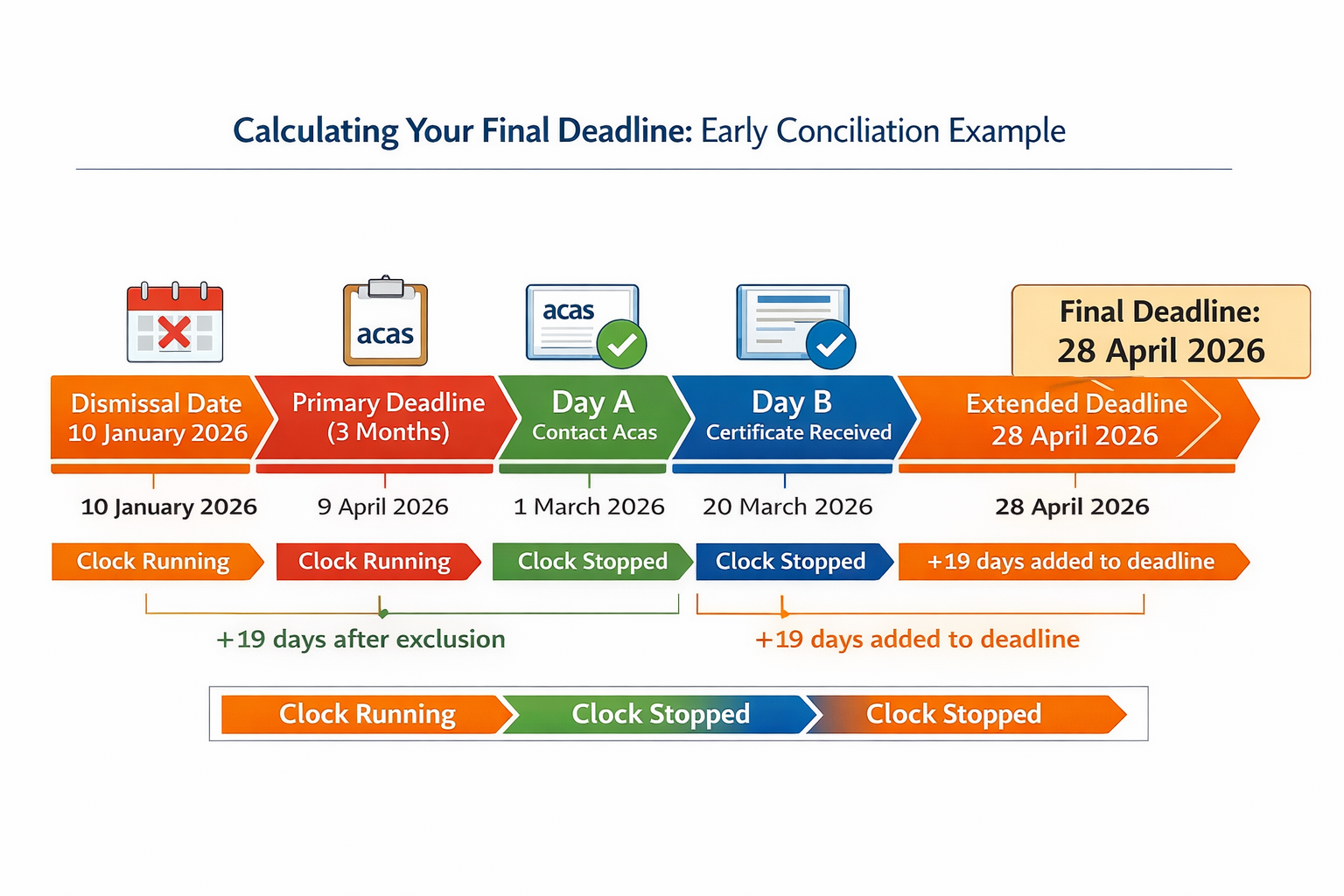
The facts: You were dismissed on 10 January 2026. You contact Acas on 1 March 2026 (Day A). You receive your early conciliation certificate on 20 March 2026 (Day B).
Step 1: Calculate the primary deadline.
Under s.111(2)(a) of the Employment Rights Act 1996, you have 3 months beginning with the effective date of termination. This gives a deadline of 9 April 2026.
Step 2: Apply s.207B(3) (stop the clock).
Section 207B(3) says we exclude the period beginning with the day after Day A and ending with Day B. That means we exclude 2 March to 20 March inclusive, which is 19 days. Adding these to the primary deadline: 9 April + 19 days = 28 April 2026.
Step 3: Check whether s.207B(4) applies.
Section 207B(4) is a safety net. It only applies if the deadline calculated under s.207B(3) would still expire during the period from Day A to one month after Day B. One month after Day B is 20 April 2026. Our s.207B(3) deadline is 28 April 2026, which falls after that window. Therefore s.207B(4) is not triggered on these facts.
Final deadline: 28 April 2026.
As confirmed in Luton BC v Haque [2018] UKEAT/0180/17, sections 207B(3) and (4) are applied sequentially. Section 207B(4) only extends the deadline further if, after applying s.207B(3), you would still be left with a deadline falling within that protected window. It does not create an alternative earlier deadline.
Important note on Day B: The statute defines Day B as the day you receive (or are treated as receiving) the certificate, not necessarily the date Acas issues it. If there is any gap between issue and receipt, your calculation should use the receipt date.
These calculations become more complex with multiple respondents, or where early conciliation started before the cause of action arose. In HMRC v Garau [2017] UKEAT/0348/16, the EAT confirmed that you cannot stop a clock that is not yet running. If you contact Acas before your employment ends, the time between Day A and your termination date does not count towards extending your deadline.
Note on case law currency: Both Luton BC v Haque and HMRC v Garau remain good law. Neither has been overturned by a later EAT or Court of Appeal decision. In Smith v The Restaurant Group (UK) Ltd [2024] EAT 168, the EAT expressly confirmed that Garau remains unaffected by the Court of Appeal’s decision in Sainsbury’s v Clark [2023] EWCA Civ 386. Both authorities continue to be followed and applied in tribunal decisions.
Strategic considerations for your early conciliation time limit
Start early, not late. Contact Acas within the first two months of your limitation period. This gives you maximum flexibility with your early conciliation time limit. If you wait until the final weeks, any administrative delay, difficulty reaching the conciliator, or miscalculation of dates could leave you scrambling or missing your deadline entirely.
You do not have to conciliate. Early conciliation is mandatory in the sense that you must notify Acas. But you are not required to participate in settlement discussions. If you simply want your certificate so you can file your claim, tell Acas you do not wish to engage in conciliation. They will issue the certificate without attempting to broker a settlement.
Consider whether settlement makes sense. If your employer is willing to engage, the 12 week period now provides meaningful time for negotiation. Settlement avoids the stress, cost, and uncertainty of tribunal proceedings. Agreements reached through Acas (known as COT3 agreements) are legally binding and cannot be unpicked later.
Get the respondent names right. If your claim is against more than one respondent (your employer and an individual manager, for example), you need a separate early conciliation certificate for each. The names on your certificates must match exactly with the names on your ET1 form. Mismatches can result in your claim being rejected.
Only your first certificate counts. In HMRC v Garau, the EAT confirmed that only your first early conciliation certificate matters for time limit purposes. If conciliation fails and you obtain a second certificate against the same respondent for the same dispute, it will not restart the clock or give you additional time.
Coming changes: 6 month time limits from October 2026
The Employment Rights Act 2025 received Royal Assent on 18 December 2025. Among other changes, it extends tribunal time limits from 3 months to 6 months for most claims, including unfair dismissal, discrimination, and unlawful deductions.
The 6 month limit is not yet in force. The government’s implementation roadmap confirms that the extended time limits will take effect in October 2026. This delay exists because implementing the change requires secondary legislation (statutory instruments) as well as the primary Act, and these will be brought in on a single commencement date.
Breach of contract claims brought in the tribunal will remain at 3 months. Redundancy pay and equal pay claims already have 6 month limits and are unaffected.
What this means in practice:
- Now (January 2026): Most claims are still 3 months minus 1 day, subject to the s.207B early conciliation extension rules. The 12 week EC period (from 1 December 2025) already applies.
- From October 2026: Most tribunal time limits move to 6 months, plus the usual EC stop the clock mechanism.
The combination of 6 month time limits and 12 week early conciliation will mean employers could face up to 9 months of uncertainty before knowing whether a claim will be issued.
We will update this guide when the new time limits come into force.
Practical next steps
- Calculate your early conciliation time limit carefully using the 3 months minus 1 day rule, then work backwards to identify when you need to contact Acas
- Notify Acas promptly: do not wait until the final weeks of your limitation period
- Keep records of when you contacted Acas (save the automated confirmation email as evidence)
- Decide whether to engage in conciliation discussions or request immediate certification
- Check respondent names match exactly between your early conciliation certificate and ET1 form
- Seek legal advice if you are unsure about early conciliation time limit calculations
Important: This guide provides general information about the early conciliation time limit and employment tribunal deadlines. It is not legal advice and should not be relied upon as such. Time limit calculations can be complex and getting them wrong can be fatal to your claim. If you are considering bringing a tribunal claim, we strongly recommend seeking professional legal advice tailored to your specific circumstances.
Sources and Further Reading
Legislation
- Employment Rights Act 1996, s.207B (legislation.gov.uk)
- Employment Rights Act 1996, s.111 (legislation.gov.uk)
- Employment Tribunals Act 1996, s.18A (legislation.gov.uk)
- Employment Rights Act 2025 (legislation.gov.uk)
Official guidance
- Acas: How early conciliation works
- Acas: Employment tribunal time limits
- GOV.UK: Before you make a tribunal claim
Case law
- Luton Borough Council v Haque [2018] UKEAT/0180/17/JOJ (sequential application of s.207B(3) and (4))
- HMRC v Serra Garau [2017] UKEAT/0348/16/LA (cannot stop a clock not yet running)
- Smith v The Restaurant Group (UK) Ltd [2024] EAT 168 (confirming Garau remains good law)

Tom Street
Tom Street is the principal solicitor at Tom Street & Co. Solicitors, specialising in employment law and tribunal claims. He regularly represents claimants in unfair dismissal, discrimination, and whistleblowing cases. View full profile