
Quick Summary
Victimisation is when your employer treats you badly because you have complained about discrimination, supported someone else’s complaint, or done something else protected under the Equality Act 2010. You do not need a protected characteristic of your own to claim. If you win, compensation is uncapped and can include an award for injury to feelings. The deadline to bring a claim is usually three months minus one day from the act you are complaining about.
⚖️ This guide is for general information only and is not legal advice. Every case is different – if you’re unsure, speak to a solicitor.
Key Points
Key Points
- ✓ Victimisation means being subjected to a detriment because you did, or might do, a “protected act” under the Equality Act 2010.
- ✓ You do not need to have a protected characteristic yourself, so witnesses and supporters are protected too.
- ✓ The four protected acts are set out in section 27 of the Equality Act 2010.
- ✓ Victimisation can happen after your employment ends, for example through a damaging or refused reference.
- ✓ Compensation is uncapped and can include injury to feelings under the Vento bands.
- ✓ The usual time limit is 3 months minus 1 day from the act, extended by Acas early conciliation.
⚖️ Legislation Update
Tribunal time limits set to double to six months
The Employment Rights Act 2025 will extend the time limit for most tribunal claims, including victimisation, from three months to six months. The change is expected no earlier than October 2026 and will apply to acts that happen on or after it comes into force. Until then, the three-month deadline still applies, so do not wait.
What is victimisation under the Equality Act 2010?
Victimisation at work has a precise legal meaning. Under section 27 of the Equality Act 2010, you are victimised when your employer subjects you to a detriment because you have done a “protected act”, or because they believe you have done one or might do one in future.
In plain terms, victimisation is being punished for standing up against discrimination. If you raise a complaint about discrimination, support a colleague who has, or take part in an equality case, the law protects you from being treated badly as a result. That protection covers what you have actually done and what your employer suspects you are about to do.
The law only protects an individual, not a company or organisation, and the unfavourable treatment must be linked to the protected act. If there is no connection between the way you were treated and a protected act, it is not victimisation in the legal sense, even if the treatment feels unfair.
Victimisation is not the same as everyday “being victimised”
People often use “victimisation” to describe any kind of unfair treatment, bullying, or being picked on at work. That everyday meaning is much wider than the legal one. On its own, being singled out or treated harshly by your employer is not automatically unlawful.
Victimisation only becomes a legal claim when the bad treatment is connected to a protected act under the Equality Act 2010. The trigger is the protected act, not the unpleasantness of the behaviour. This is the single most common misunderstanding we see, so it is worth being clear about from the start.
You do not need a protected characteristic to claim
Victimisation works differently from direct discrimination. With direct discrimination, you generally need to show you were treated worse because of a protected characteristic such as race, sex, age, or disability. Victimisation does not work that way.
You do not need to share, or even have, any protected characteristic to bring a victimisation claim. There is no comparator requirement in the way there is for direct discrimination. The protection attaches to the protected act itself, so a colleague who gives a witness statement supporting someone else’s race discrimination claim is protected, even though the case has nothing to do with their own characteristics. Anyone who supports an equality complaint can be a victim of victimisation.
“The point clients most often miss is that you are protected for speaking up, full stop. I have acted for employees who never faced a scrap of discrimination themselves, but who were punished for backing a colleague who did. That is textbook victimisation, and it is unlawful.”

What counts as a protected act?
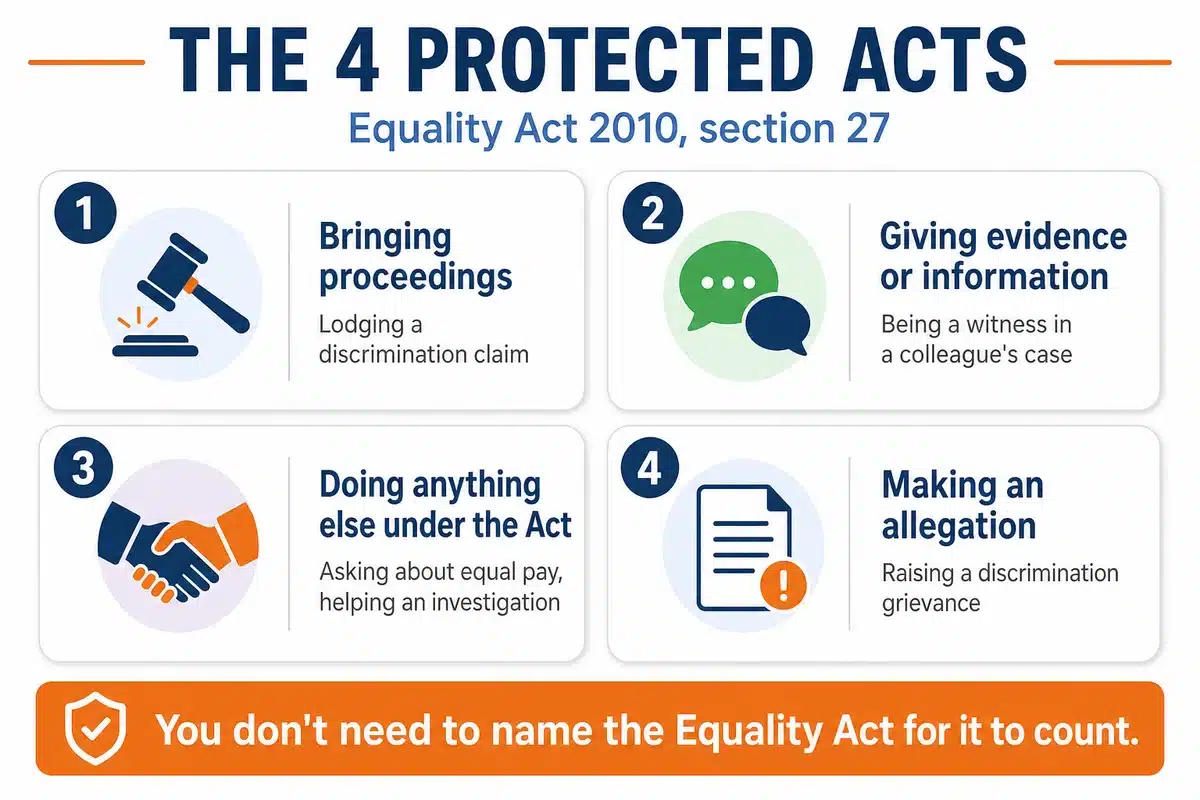
A protected act is the thing you do that triggers the protection. Section 27(2) of the Equality Act 2010 sets out four protected acts:
The four protected acts (section 27(2))
| Protected act | Everyday example |
|---|---|
| Bringing proceedings under the Equality Act 2010 | Lodging a discrimination claim at the employment tribunal. |
| Giving evidence or information in connection with proceedings | Acting as a witness, or providing a statement, in a colleague’s discrimination case. |
| Doing any other thing for the purposes of or in connection with the Act | Asking your employer for equal pay information, or taking part in an internal investigation. |
| Making an allegation that someone has breached the Act | Raising a grievance that you, or someone else, have been discriminated against or harassed. |
Source: Equality Act 2010, section 27(2)
The allegation does not need to use the word “discrimination” or mention the Equality Act by name. As long as the substance of what you raise is about conduct that would breach the Act, it can count. Your employer does not even need to know for certain that you have done a protected act: it is enough that they believe you have, or that you might.
The bad faith exception
There is one important limit. Under section 27(3), giving false evidence or information, or making a false allegation, is not a protected act if you did it in bad faith. Both parts matter. A complaint that turns out to be wrong is still protected if you made it honestly. It only loses protection if it is both false and made in bad faith, for example as a deliberate lie to cause trouble.
This matters in practice. Employees sometimes worry that raising a concern that cannot be proved will count against them. It will not, provided the concern was genuine. The courts have been clear that genuine grievances keep their protection even where they are ultimately unfounded.
What counts as a detriment?
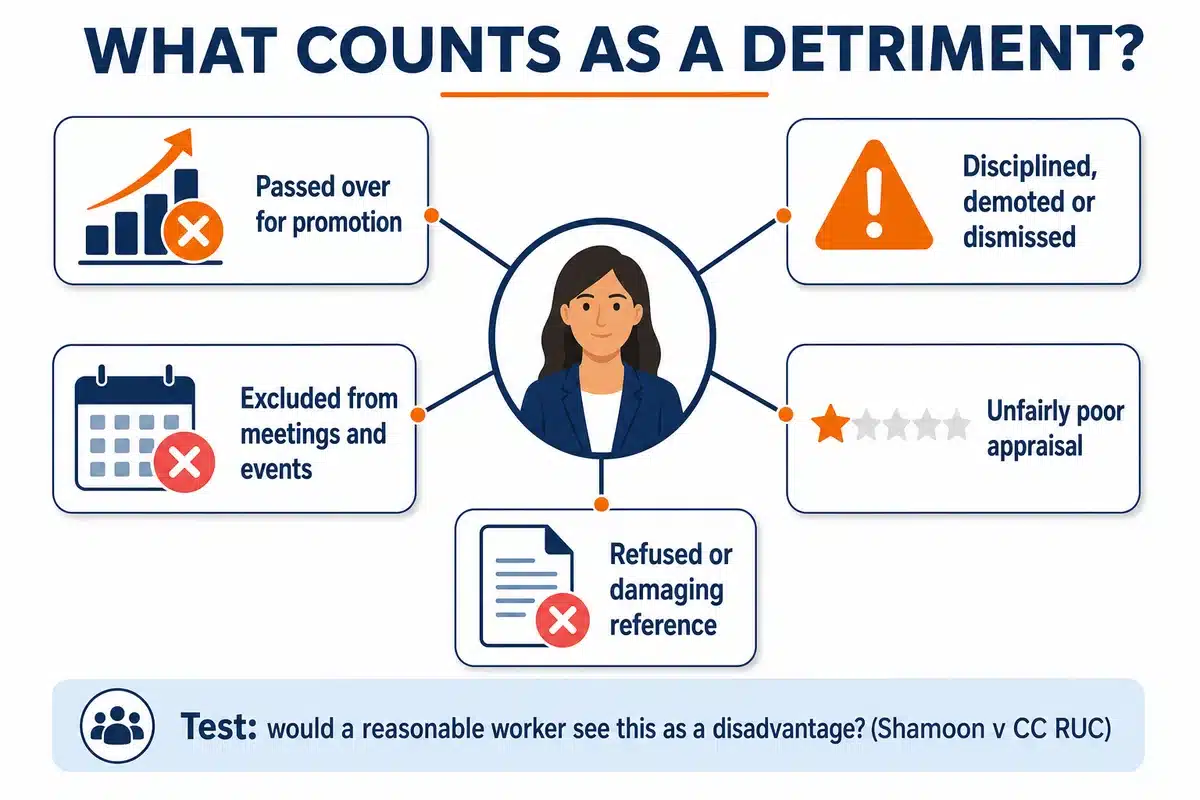
The second ingredient of a victimisation claim is a detriment. A detriment is some form of disadvantage. The test, set out by the House of Lords in Shamoon v Chief Constable of the Royal Ulster Constabulary [2003] UKHL 11, is whether a reasonable worker would or might take the view that the treatment was to their disadvantage in all the circumstances.
You do not need to show financial loss or a physical consequence. A genuine sense of disadvantage is enough, although an unjustified grievance with no real basis is not. The Employment Appeal Tribunal confirmed in Warburton v Chief Constable of Northamptonshire Police [2022] EAT 42 that “detriment” is interpreted broadly.
Common examples of a detriment include:
- Being passed over for promotion or training.
- Being disciplined, demoted, or dismissed.
- Being excluded from meetings, projects, or workplace social events.
- Being given an unfairly poor appraisal or unwarranted criticism.
- Being refused a reference, or given a damaging one.
Real-world examples of victimisation at work
The clearest way to understand victimisation is through examples. Each of these follows the same pattern: a protected act, followed by a detriment, with a link between the two.
The denied promotion. An employee raises a grievance that her manager has been making sexist remarks. A few weeks later she applies for a promotion she is well qualified for and is turned down without proper explanation, while a less experienced colleague is appointed. The timing and the lack of a credible reason point towards victimisation.
The witness who paid the price. A worker gives a statement supporting a colleague’s race discrimination claim. Shortly afterwards he finds himself the subject of a sudden disciplinary process over minor issues that were previously ignored. He has no race discrimination claim of his own, but he is protected because giving evidence is a protected act.
The exclusion after raising equal pay. An employee asks why the men in her team are paid more for the same work. Management stops inviting her to key meetings and freezes her out of decisions. Being sidelined in this way is a detriment connected to her protected act.
The bad reference. A former employee who brought a discrimination claim is later refused a reference by her old employer, costing her a job offer. As explained below, victimisation can still apply even though she has left.
Can you claim victimisation after leaving your job?
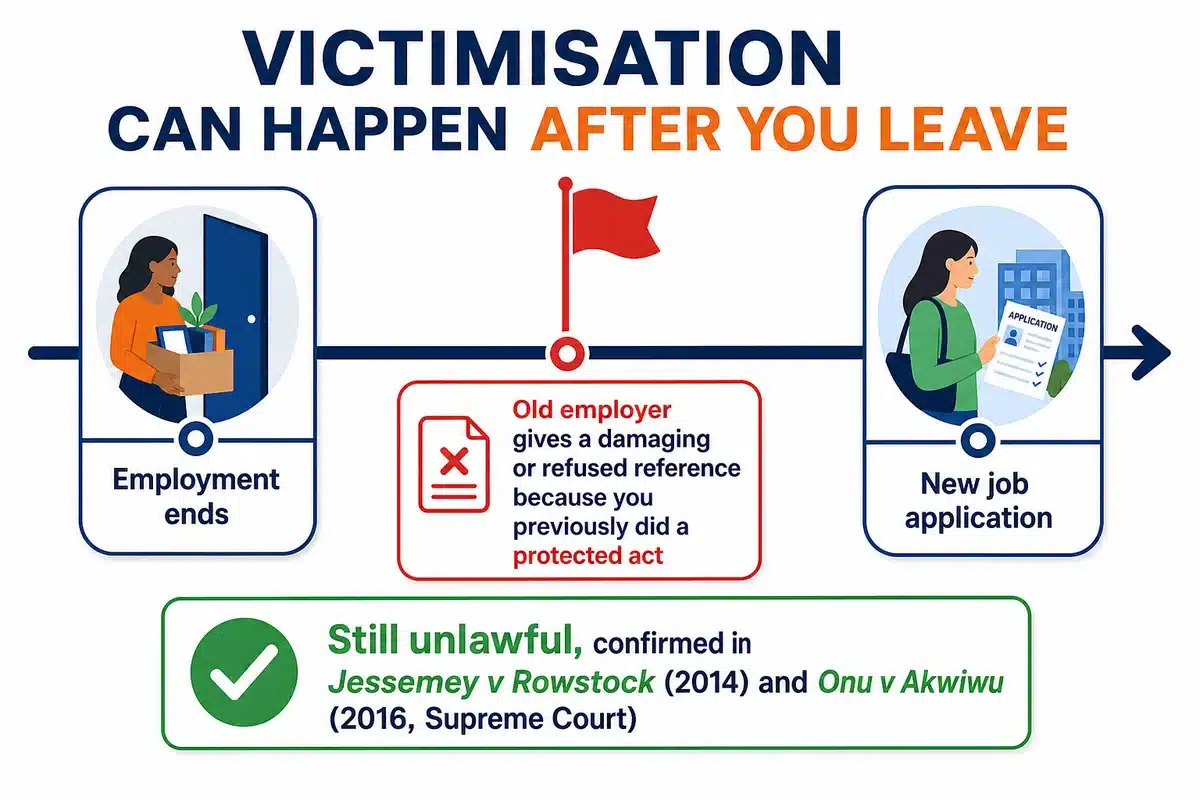
Yes. Victimisation can happen after the working relationship has ended. The most common example is a reference. If an employer refuses to give a reference, or gives a deliberately damaging one, because you previously did a protected act, that can be unlawful victimisation.
The point was settled by the courts in Jessemey v Rowstock Ltd [2014] EWCA Civ 185. The Court of Appeal held that the apparent gap in the Equality Act, which seemed to leave post-employment victimisation unprotected, was a drafting error, and that the Act must be read as covering it. The Supreme Court confirmed the same position in Onu v Akwiwu [2016] UKSC 31.
How do you prove victimisation?
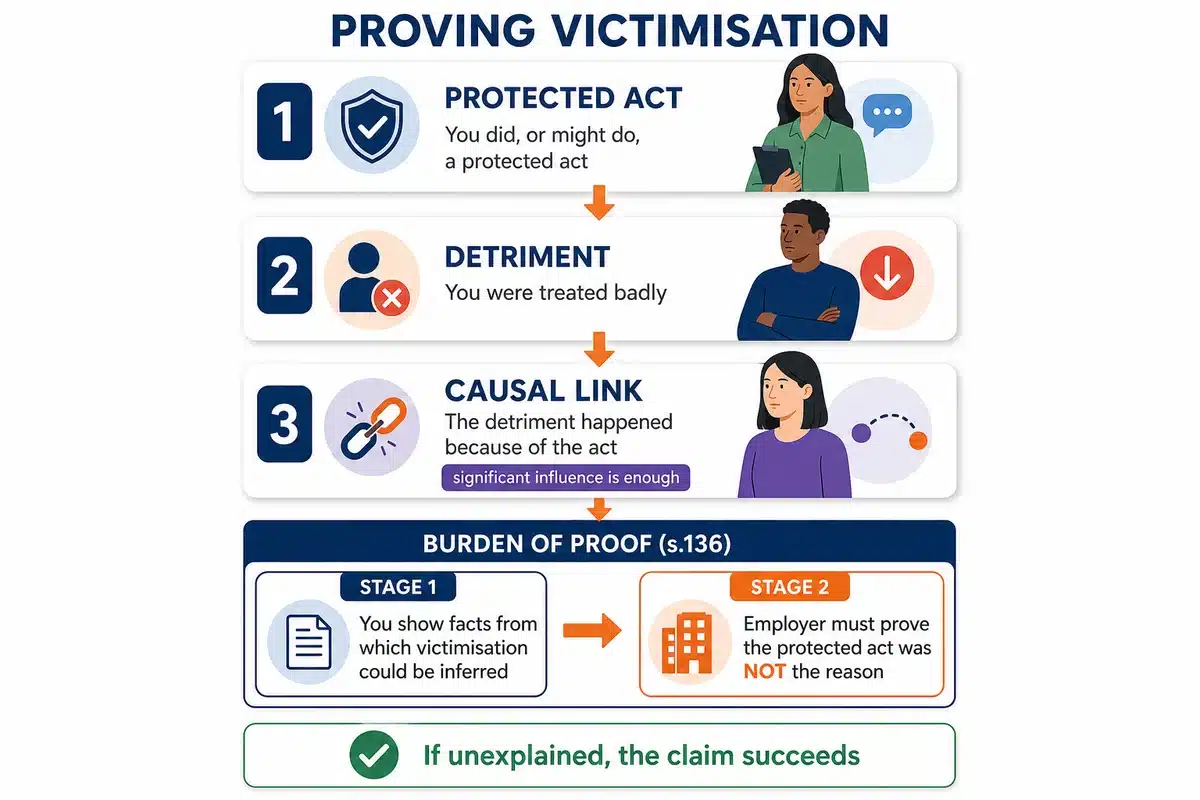
To succeed, you generally need to show three things:
- You did a protected act, or your employer believed you had or might.
- You suffered a detriment.
- The detriment happened because of the protected act.
The third element, causation, is usually where cases are won or lost. You do not have to show the protected act was the only reason for the treatment. It is enough that it had a significant influence on the employer’s decision.
The burden of proof
The Equality Act gives claimants real help here. Under section 136, there is a two-stage burden of proof. First, you must prove facts from which a tribunal could conclude, in the absence of any other explanation, that victimisation occurred. If you clear that hurdle, the burden shifts to your employer to prove that the protected act was not the reason for the detriment.
This shifting burden recognises that employers rarely admit their real reasons. Evidence such as suspicious timing, a sudden change in how you were treated, or inconsistent explanations can be enough to shift the burden across. The Supreme Court confirmed in Efobi v Royal Mail Group Ltd [2021] UKSC 33 that you still need to establish those initial facts.
The separability principle
Employers sometimes argue they acted not because of the protected act, but because of something separable from it, such as the abusive manner in which a complaint was made. In Martin v Devonshires Solicitors [2011] ICR 352, the Employment Appeal Tribunal accepted that an employer can lawfully act on a genuinely separable feature.
That argument is treated as exceptional, not a routine defence. In Woodhouse v West North West Homes Leeds Ltd [2013] UKEAT/0007/12, the tribunal warned that Martin must not be used as a template, and that dismissing someone simply for making numerous genuine complaints is still victimisation. An honest grievance does not lose protection just because the employer finds it inconvenient or has heard it before.
Time limits for a victimisation claim
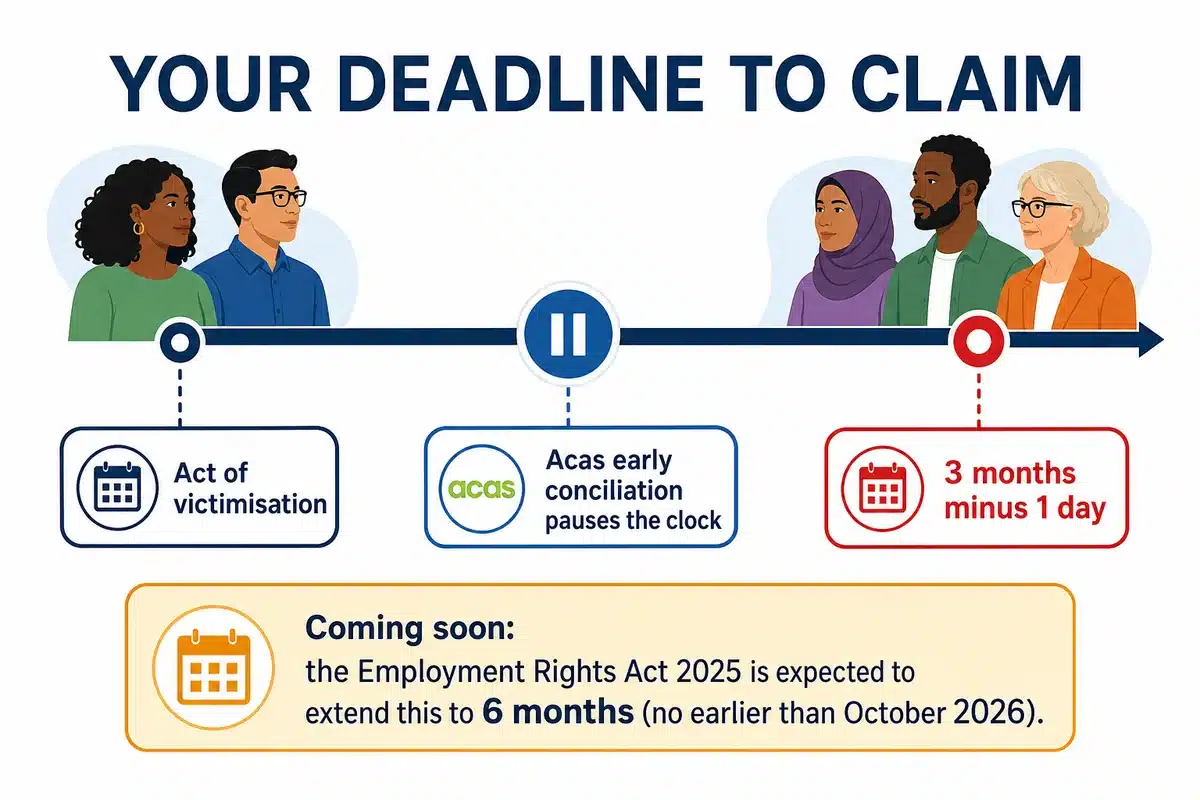
The time limit is strict. You normally have 3 months minus 1 day from the act of victimisation to bring a claim. Where there is a series of connected acts, time can run from the last of them, and a deliberate failure to act counts from when the employer decided not to act.
Before you can issue a claim, you must notify Acas (the Advisory, Conciliation and Arbitration Service) and go through early conciliation. This early conciliation process pauses the clock, which gives you extra time. Tribunals also have a discretion to extend the deadline where it is “just and equitable” to do so, a wider test than the one that applies to unfair dismissal, but you should never rely on it. Miss the deadline and you usually lose the right to claim.
Compensation and remedies for victimisation
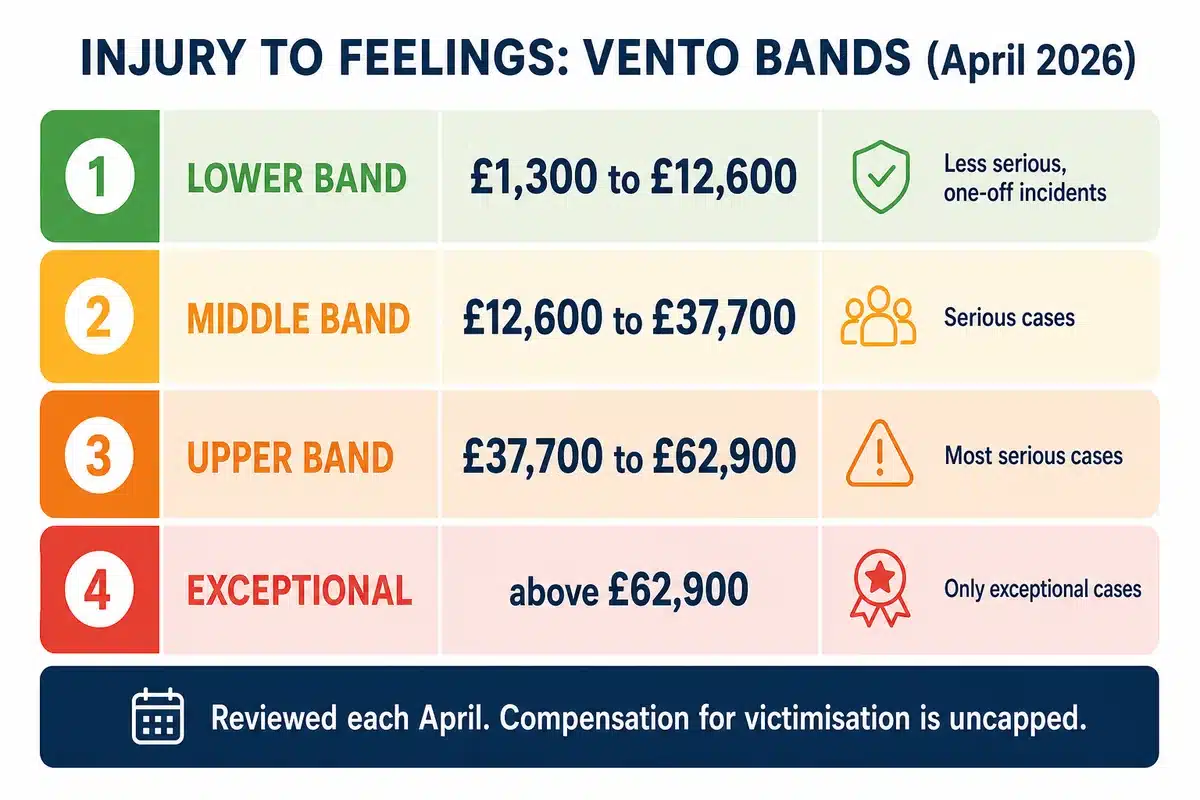
If your claim succeeds, the tribunal has a range of powers under section 124 of the Equality Act 2010. It can make a declaration that you were victimised, award compensation, and make a recommendation that the employer take steps to reduce the impact on you.
Crucially, compensation for victimisation is uncapped. Unlike ordinary unfair dismissal, there is no statutory ceiling. An award can include your financial losses, such as lost earnings and benefits, plus an amount for injury to feelings, plus interest.
Injury to feelings is assessed using the Vento bands, which are reviewed each April:
Vento bands for injury to feelings ()
| Band | Range | When it applies |
|---|---|---|
| Lower | Less serious cases, such as a one-off incident. | |
| Middle | Serious cases that do not merit the upper band. | |
| Upper | The most serious cases, such as a lengthy campaign. | |
| Exceptional | Only the most exceptional cases. |
Source: Presidential Guidance on Vento bands, updated annually each April.
How we can help
Victimisation claims turn on detail: what you did, what happened next, and the link between the two. Getting that evidence in order early makes a real difference. At Tom Street & Co. Solicitors we assess victimisation and discrimination claims, advise you on the strength of your case, and can often act on a no win, no fee basis.
If you think you have been punished for raising or supporting a discrimination complaint, the sooner you take advice the better, because of the strict time limit.
Frequently Asked Questions
What is victimisation at work?
Victimisation at work is when your employer subjects you to a detriment because you did, or might do, a protected act under the Equality Act 2010. In plain terms, it is being punished for complaining about discrimination or supporting someone who has.
Is victimisation a form of discrimination?
Yes. Victimisation is one of the types of prohibited conduct under the Equality Act 2010, alongside direct and indirect discrimination, harassment, and others. It is dealt with separately because it protects you for what you have done, rather than for a protected characteristic.
Do I need a protected characteristic to claim victimisation?
No. Unlike direct discrimination, you do not need to have a protected characteristic of your own. Protection attaches to the protected act, so witnesses and colleagues who support someone else’s complaint are also covered.
What is an example of victimisation at work?
A typical example is being denied a promotion shortly after raising a discrimination grievance, or being disciplined after giving evidence in a colleague’s tribunal claim. The key feature is a detriment that follows from a protected act.
What’s the difference between victimisation, bullying and harassment?
Ordinary workplace bullying is not automatically unlawful. Harassment under the Equality Act must be linked to a protected characteristic. Victimisation is different again: it must be linked to a protected act, such as making or supporting a discrimination complaint.
Can I claim victimisation after I’ve left my job?
Yes. Victimisation can occur after employment ends, most commonly through a refused or damaging reference. The courts confirmed this in Jessemey v Rowstock Ltd and the Supreme Court in Onu v Akwiwu.
How much compensation can I get for victimisation?
Compensation is uncapped. It can include lost earnings, an award for injury to feelings under the Vento bands ( up to ), and interest. The amount depends on your financial losses and the seriousness of the treatment.
What is the time limit for a victimisation claim?
The usual time limit is 3 months minus 1 day from the act of victimisation, extended by Acas early conciliation. The Employment Rights Act 2025 is expected to extend this to six months no earlier than October 2026.
💬 Been punished for speaking up?
We can help you understand your rights and the compensation you may be entitled to. Speak to our employment law team for a free initial consultation.
Get Free Initial Advice →Important: This guide provides general information about victimisation under the Equality Act 2010. It is not legal advice and should not be relied upon as such. Employment law is complex and the rules may apply differently depending on your circumstances. If you believe you have been victimised at work, we strongly recommend seeking professional legal advice before the time limit expires.
Sources and Further Reading
Primary Legislation
- Equality Act 2010, section 27 (definition of victimisation and protected acts)
- Equality Act 2010, section 123 (time limits)
- Equality Act 2010, section 124 (remedies)
- Equality Act 2010, section 136 (burden of proof)
Official Guidance
Key Case Law
- Shamoon v Chief Constable of the RUC [2003] UKHL 11 (test for detriment)
- St Helens MBC v Derbyshire [2007] UKHL 16 (detriment and victimisation)
- Jessemey v Rowstock Ltd [2014] EWCA Civ 185 (post-employment victimisation)
- Onu v Akwiwu [2016] UKSC 31 (post-employment victimisation confirmed)
- Warburton v CC Northamptonshire Police [2022] EAT 42 (detriment and causation)
- Efobi v Royal Mail Group Ltd [2021] UKSC 33 (burden of proof)
Tom Street
Tom Street is the principal solicitor at Tom Street & Co. Solicitors, specialising in employment law and tribunal claims. He regularly represents employees in discrimination and victimisation cases, including claims by witnesses and colleagues who were punished for supporting others. View full profile