
Key Points
- ✓ The Polkey principle allows tribunals to reduce compensation in unfair dismissal cases where the employee would have been dismissed anyway had a fair procedure been followed
- ✓ A Polkey deduction applies to the compensatory award only, not the basic award
- ✓ Reductions can range from 0% to 100%, expressed either as a percentage or a cap on future loss
- ✓ The burden of proof lies with the employer to demonstrate that dismissal would have occurred regardless
- ✓ Tribunals must consider Polkey deductions based on evidence, not speculation, using their common sense and experience
- ✓ The principle applies to all types of unfair dismissal: redundancy, misconduct, capability, and constructive dismissal
The Polkey principle is one of the most important concepts in unfair dismissal compensation. Named after the landmark House of Lords case Polkey v AE Dayton Services Ltd [1987] UKHL 8, it determines how much compensation a successful claimant actually receives.
In practice, winning an unfair dismissal claim does not guarantee full compensation. If your employer can demonstrate that you would have been dismissed anyway, even with a fair procedure, the tribunal will reduce your award accordingly. Understanding how Polkey deductions work is essential for anyone bringing or defending an unfair dismissal claim.

What is the Polkey Principle?
The Polkey principle establishes that procedural failings in a dismissal make that dismissal unfair, but compensation should reflect the reality of what would have happened had the employer acted properly. Where evidence suggests the employee would have been dismissed regardless, the compensatory award is reduced to account for this.
Under section 123(1) of the Employment Rights Act 1996, the compensatory award must be “such amount as the tribunal considers just and equitable in all the circumstances having regard to the loss sustained by the complainant.” A claimant should not be compensated beyond their actual loss. If dismissal was inevitable, the loss flows from the dismissal itself rather than the procedural failings.
The practical effect is this: an employee can win their unfair dismissal claim on liability but receive substantially reduced compensation, or in some cases, no compensatory award at all.
The Original Polkey Case
Dennis Polkey worked as a van driver for AE Dayton Services Ltd from June 1978 until August 1982. The company needed to reduce costs and decided to replace its four van drivers with three van salesmen. Without any prior warning or consultation, Mr Polkey was called into his manager’s office and told he was being made redundant, effective immediately.
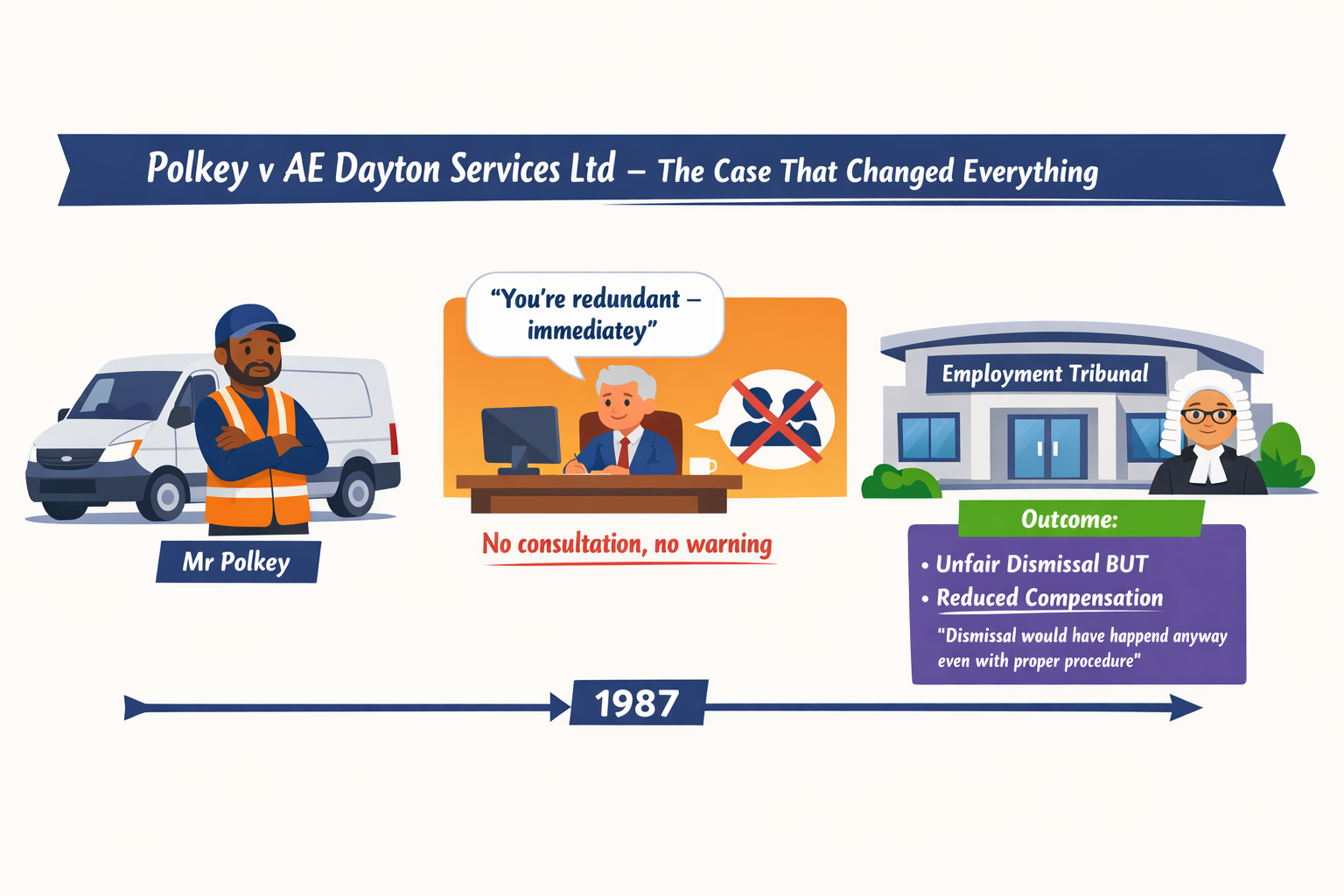
The industrial tribunal described this as a “heartless disregard of the provisions of the code of practice” but found the dismissal fair under the then-applicable “no difference” rule from British Labour Pump Co Ltd v Byrne [1979]. This earlier case had established that procedural failings did not make a dismissal unfair if following proper procedures would have made no difference to the outcome.
The House of Lords overturned this approach. Lord Bridge held that the question of whether an employer acted reasonably must be judged at the time of dismissal, based on what the employer knew then. An employer cannot justify a procedural failure by showing, after the event, that it would have made no difference.
The critical distinction the House of Lords drew was between liability and remedy. Procedural unfairness affects liability: the dismissal is unfair. But the hypothetical question of what would have happened with a fair procedure goes to remedy: how much compensation should be awarded.
How Polkey Deductions Work in Practice
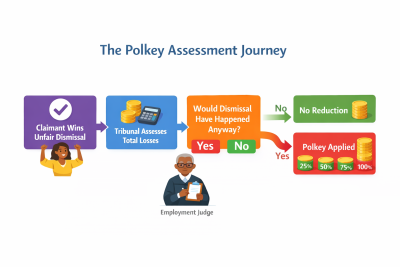
When a tribunal finds a dismissal procedurally unfair, it must then consider compensation. The employer may argue that even with a proper process, the outcome would have been the same. If the tribunal accepts this argument, either wholly or partly, it will reduce the compensatory award.
There are three possible outcomes:
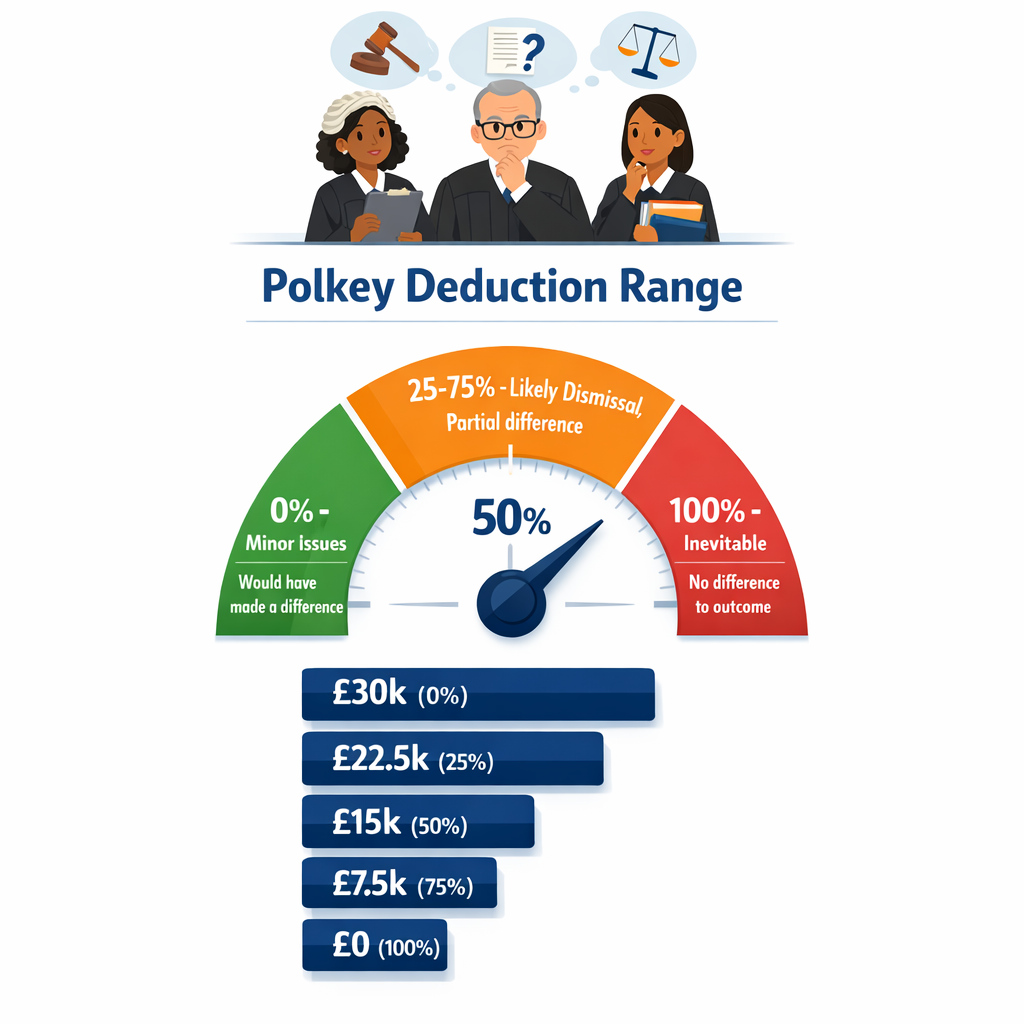
No reduction: The tribunal concludes there was no realistic chance the employee would have been dismissed had the employer followed a fair procedure. The claimant receives full compensation for their losses.
Partial reduction: The tribunal finds some chance, but not certainty, that dismissal would have occurred anyway. It expresses this as a percentage and reduces compensation accordingly. For example, a 60% Polkey reduction means the claimant receives 40% of what they would otherwise have been awarded.
100% reduction: The tribunal is satisfied that dismissal was inevitable regardless of any procedural failings. The claimant receives no compensatory award, retaining only their basic award.
Two Methods of Applying Polkey Reductions
Tribunals can apply Polkey in two distinct ways, and the choice matters significantly for claimants.
Percentage reduction: This is the more common approach. The tribunal assesses the probability that dismissal would have occurred and reduces the entire compensatory award by that percentage. A 50% Polkey reduction halves all future loss calculations.
Time-limited award: Where the tribunal is certain that dismissal would have happened at a specific point, it can cap compensation at that date. For example, if an employee was dismissed without consultation but the employer’s business was closing in three months, the tribunal might limit compensation to three months’ loss.
The EAT clarified in Zebrowski v Concentric Birmingham Ltd [2017] UKEAT/0245/16 that a tribunal cannot use both methods simultaneously. A time-limited award is only appropriate where the tribunal is 100% confident dismissal would have occurred by that date. If any uncertainty remains, a percentage reduction is the correct approach.
The Burden of Proof
The employer bears the burden of proving that a Polkey reduction is appropriate. In Software 2000 Ltd v Andrews [2007] ICR 825, the EAT set out the key principles:
Where an employer claims dismissal was inevitable even with fair procedures, it must adduce evidence to support this. A tribunal should not refuse to make a reduction simply because the exercise involves speculation. Using common sense, experience, and a sense of justice, tribunals should assess the evidence and reach a conclusion.
Only in exceptional cases, where the evidence is so unreliable that “one cannot sensibly reconstruct the world as it might have been,” should a tribunal decline to make any assessment at all. The Court of Appeal confirmed this in Thornett v Scope [2007] ICR 236, emphasising that tribunals must grapple with the available evidence rather than avoid difficult questions.
When Polkey Applies: Different Dismissal Scenarios
Redundancy
Redundancy cases were the original context for Polkey and remain common territory for these deductions. Typical scenarios include failure to consult with employees, inadequate warning of impending redundancy, failure to consider alternative employment, or unfair selection criteria or their application.
If the tribunal finds these failures rendered the dismissal unfair but accepts that the employee would have been selected for redundancy anyway under a fair process, it will reduce compensation. In Contract Bottling Ltd v Cave [2014] UKEAT/0100/14, the EAT assessed a 33% Polkey reduction where the selection process was fundamentally flawed but there was evidence the claimants were at genuine risk of redundancy.
Misconduct
In misconduct dismissals, Polkey arises where the investigation or disciplinary process was inadequate but the employee’s conduct genuinely warranted dismissal. A common example is failure to allow an appeal. If the tribunal concludes that a properly conducted appeal would not have changed the outcome, it may reduce compensation accordingly.
In Kular v Lenlyn UK Ltd [2016] UKEAT/0108/16, the tribunal applied a 75% Polkey reduction in a constructive dismissal case, finding the claimant would very likely have been dismissed through a fair disciplinary process that was about to commence.
Capability
Capability dismissals often involve Polkey where the employer failed to give adequate warnings or support before dismissing. If evidence shows the employee’s performance was genuinely unsatisfactory and unlikely to improve, a reduction may be appropriate even where the procedural steps were deficient.
Constructive Dismissal
Polkey applies to constructive dismissal claims, though the analysis differs slightly. In Shittu v South London & Maudsley NHS Foundation Trust [2022] EAT 18, the EAT confirmed that tribunals must assess what would have happened but for the employer’s fundamental breach. If the employee would have resigned anyway, or would have been fairly dismissed through other means, compensation can be reduced or eliminated.
The Software 2000 Principles
The EAT’s decision in Software 2000 Ltd v Andrews [2007] provides the authoritative guidance on applying Polkey. Elias J (as he then was) summarised the principles tribunals must follow:
The tribunal’s task is to assess the loss flowing from the dismissal, using common sense, experience, and a sense of justice. In the normal case, this means assessing how long the employment would have continued but for the dismissal.
If the employer contends that the employee would have ceased to be employed anyway, it must adduce evidence to support this. If there is no evidence, the tribunal will have no basis for reducing the compensatory award.
Where there is evidence, the tribunal should have regard to all relevant matters, including any evidence from the employee. It should not simply accept the employer’s assertion.
Uncertainty is not a reason to refuse to engage with the evidence. The tribunal must make the best assessment it can. An assessment that dismissal would have occurred is still valuable, even if expressed as a percentage chance.
A tribunal may only decline to make any reduction where the exercise is so speculative that reliable assessment is genuinely impossible.
Polkey and Contributory Fault: Avoiding Double Counting
It is possible for both a Polkey reduction and a reduction for contributory fault to apply in the same case, but tribunals must be careful not to penalise the claimant twice for the same conduct.
Contributory fault under section 123(6) of the Employment Rights Act 1996 reduces compensation where the employee’s own conduct contributed to their dismissal. Unlike Polkey, which focuses on what would have happened procedurally, contributory fault focuses on the employee’s blameworthiness.
In Rao v Civil Aviation Authority [1994] ICR 495, the Court of Appeal confirmed that both reductions can apply, but the factors considered must be distinct. If a tribunal makes a Polkey reduction because the employee would have been dismissed for misconduct, it should not then make a large contributory fault reduction for the same misconduct, as this would amount to double counting.
The order of deductions also matters. The tribunal first calculates the compensatory award, then applies the Polkey reduction, then applies any reduction for contributory fault. Applied sequentially, these deductions compound. A 50% Polkey reduction followed by a 50% contributory fault reduction leaves the claimant with just 25% of the original figure.
Worked Example: Calculating a Polkey Reduction
Consider an employee unfairly dismissed for misconduct. The tribunal finds the investigation was inadequate and the employee was denied an appeal, making the dismissal procedurally unfair. However, the evidence of misconduct was strong.
Pre-Polkey compensation calculation:
- Loss of earnings: 6 months at £3,000 per month = £18,000
- Loss of statutory rights: £500
- Total compensatory award before deductions: £18,500
The tribunal concludes there was a 70% chance the employee would have been dismissed anyway following a proper process. It applies a 70% Polkey reduction.
After Polkey reduction:
£18,500 × 30% = £5,550
The claimant also contributed to their dismissal through their conduct. The tribunal assesses contributory fault at 25%.
After contributory fault reduction:
£5,550 × 75% = £4,162.50
The final compensatory award is £4,162.50. The claimant also receives their basic award, calculated separately, though this too may be reduced for contributory fault.

Alternative Method: Time-Limited Compensation
In some cases, the tribunal may limit compensation to a specific period rather than applying a percentage. This is appropriate only where the tribunal is certain dismissal would have occurred by a particular date.
For example, if an employee was dismissed during a redundancy exercise but without proper consultation, and the tribunal is satisfied the employer would have completed consultation within two weeks, it might limit compensation to two weeks’ loss rather than applying a percentage reduction.
As confirmed in Zebrowski, the tribunal must be 100% confident about the date of dismissal to use this approach. If any doubt remains, a percentage reduction is more appropriate.
Common Mistakes by Employers
From our experience, employers often misunderstand how Polkey works, leading to weaker arguments at tribunal. Relying solely on assertion is a common error. Claiming “we would have dismissed anyway” without evidence is unlikely to succeed. Employers need concrete evidence: documents showing the decision was already made, evidence of the employee’s poor performance, or proof that redundancy was genuine and the employee would have been selected.
Conflating Polkey with fairness is another frequent mistake. The fact that the outcome would have been the same does not make the dismissal fair. Employers cannot use Polkey to argue that their actions were reasonable. The dismissal remains unfair; Polkey only affects the remedy.
Ignoring the burden of proof also undermines employer arguments. The employer must prove its case for a Polkey reduction. If the tribunal has no evidence to work with, it will make no reduction.
Common Mistakes by Employees
Employees also make strategic errors regarding Polkey. Assuming full compensation after winning liability is dangerous. Success on liability does not guarantee full compensation. Employees and their advisers must prepare for Polkey arguments at the remedy stage.
Failing to challenge the employer’s evidence weakens the employee’s position. If the employer presents evidence that dismissal was inevitable, the employee should challenge it. Was the selection process actually fair? Would consultation have made a difference? Were there alternative roles available?
Overlooking the distinction between percentage and time-limited reductions can also be costly. If the employer argues for a time-limited award, consider whether a percentage reduction would be more favourable. A 50% reduction across ongoing loss may result in higher compensation than a time-limited award.
Current Compensation Limits (2025/26)
When calculating unfair dismissal compensation, the following limits apply from 6 April 2025:
- Maximum compensatory award: £118,223 (or 52 weeks’ gross pay, whichever is lower)
- Maximum basic award: £21,570
- Maximum week’s pay for calculation purposes: £719
These caps apply after any Polkey or contributory fault reductions. However, the compensatory award cap is due to be abolished under the Employment Rights Act 2025, with the change expected to take effect from January 2027.
Upcoming Changes Under the Employment Rights Act 2025
The Employment Rights Act 2025, which received Royal Assent in December 2025, makes significant changes to unfair dismissal law. The statutory cap on the compensatory award will be removed entirely, meaning compensation will be uncapped as it currently is for discrimination and whistleblowing claims. This change is expected to take effect from January 2027.
The removal of the cap will make Polkey deductions even more significant in practice. Without a ceiling, high earners dismissed unfairly could claim substantial sums in ongoing loss. Employers will have greater incentive to argue for Polkey reductions, and the amounts at stake in remedy hearings will increase considerably.
The qualifying period for unfair dismissal claims is also being reduced from two years to six months, effective from January 2027. More employees will therefore have access to unfair dismissal claims, and Polkey arguments will arise in a wider range of cases.
Frequently Asked Questions
Does a Polkey deduction affect the basic award?
No. The Polkey principle applies only to the compensatory award. The basic award is calculated using a statutory formula based on age, length of service, and weekly pay. However, the basic award can be reduced separately for contributory fault under section 122(2) of the Employment Rights Act 1996.
Can the tribunal apply a 100% Polkey reduction?
Yes. If the tribunal is satisfied that the employee would certainly have been dismissed even with a fair procedure, it can reduce the compensatory award by 100%. The claimant would then receive only their basic award. This typically occurs where the evidence of misconduct or redundancy was overwhelming and the procedural failings were the sole reason for the finding of unfairness.
Who decides what percentage Polkey deduction to apply?
The employment tribunal decides, exercising its judgment based on the evidence. There is no formula. The tribunal assesses the likelihood that dismissal would have occurred and expresses this as a percentage. Appeals against Polkey percentages are difficult to succeed on because the assessment is a matter of judgment for the first instance tribunal.
Can Polkey apply in discrimination cases?
The Polkey principle itself does not apply directly to discrimination cases, but an equivalent principle does. In Chagger v Abbey National & Hopkins [2010] ICR 397, the EAT confirmed that tribunals must assess the chance a claimant would have been dismissed anyway when calculating discrimination compensation. The same percentage reduction approach applies.
What evidence supports a Polkey deduction?
Evidence may include documents showing the employer’s decision-making, the employee’s performance records, evidence of genuine redundancy situations, witness evidence about what would have happened, and comparator evidence showing how other employees in similar circumstances were treated. The employer must present concrete evidence rather than mere assertion.
When is a Polkey deduction raised in the tribunal process?
Polkey is usually addressed at the remedy stage, after the tribunal has determined liability. However, the employer should raise Polkey in their response to the claim and present relevant evidence during the main hearing. If liability and remedy are heard separately, Polkey will be considered at the remedy hearing. It is important for both parties to prepare for Polkey arguments from the outset.
Can the employee challenge a Polkey reduction on appeal?
Yes, but appeals are limited to questions of law. The claimant would need to show the tribunal made an error of law, such as applying the wrong legal test, failing to consider relevant evidence, or reaching a conclusion no reasonable tribunal could reach. Simply disagreeing with the percentage applied is unlikely to succeed on appeal.
Important: This guide provides general information about the Polkey principle and how compensation deductions work in unfair dismissal cases. It is not legal advice and should not be relied upon as such. Employment law is complex and the rules may apply differently depending on your circumstances. If you are considering an unfair dismissal claim or facing a Polkey argument, we strongly recommend seeking professional legal advice.
Sources and Further Reading
- Employment Rights Act 1996, section 123: Statutory basis for compensatory awards
- Polkey v AE Dayton Services Ltd [1987] UKHL 8, [1988] ICR 142: The original House of Lords decision establishing the principle
- Software 2000 Ltd v Andrews [2007] ICR 825, EAT: Key guidance on applying Polkey deductions
- Thornett v Scope [2007] ICR 236, CA: Court of Appeal guidance on the obligation to assess Polkey
- Zebrowski v Concentric Birmingham Ltd [2017] UKEAT/0245/16: Guidance on percentage vs time-limited reductions
- Contract Bottling Ltd v Cave [2014] UKEAT/0100/14: Application of Polkey in redundancy cases
- Employment Rights Act 2025: Upcoming changes to compensation caps

Tom Street
Tom Street is the principal solicitor at Tom Street & Co. Solicitors, specialising in employment law and tribunal claims. He regularly represents claimants in unfair dismissal, discrimination, and whistleblowing cases. View full profile