
Quick Summary
A schedule of loss is the document that tells the employment tribunal exactly how much compensation you’re claiming. For unfair dismissal, you’ll typically claim a basic award (up to £21,570) plus a compensatory award (capped at £118,223 or 52 weeks’ pay). Discrimination and whistleblowing claims are uncapped and can include injury to feelings awards using the Vento bands (£1,200–£60,700+).
⚖️ This guide is for general information only and is not legal advice. Every case is different – if you’re unsure, speak to a solicitor.
Key Points
- ✓ A schedule of loss is a document setting out all the compensation you’re claiming from the employment tribunal
- ✓ For unfair dismissal, it typically includes a basic award, compensatory award, and loss of statutory rights
- ✓ The compensatory award is currently capped at £118,223 or 52 weeks’ gross pay, whichever is lower (2025/26 rates)
- ✓ Discrimination and whistleblowing claims have no compensation cap and can include injury to feelings awards
- ✓ You must demonstrate you have mitigated your losses by actively seeking new employment
- ✓ The schedule is a “living document” that you can update as circumstances change
⚖️ Legislation Update
Compensation Cap to be Abolished from January 2027
The Employment Rights Act 2025 removes the statutory cap on unfair dismissal compensation. Currently, awards are limited to £118,223 or 52 weeks’ gross pay. From 1 January 2027, there will be no upper limit on compensatory awards. The qualifying period for unfair dismissal claims will also reduce from two years to six months on the same date. These changes significantly increase the potential value of claims, making an accurate schedule of loss more important than ever.
💡 Want to calculate your claim automatically?
Use our free calculator with current 2025/26 figures
Try the Calculator →Your schedule of loss is one of the most important documents in your employment tribunal claim. It sets out precisely how much compensation you’re seeking and forms the basis for any settlement negotiations or the tribunal’s eventual award if you win your case.
Getting it right matters. A well-prepared schedule of loss demonstrates to the tribunal that you understand your claim and have carefully calculated your losses. It can also strengthen your negotiating position with your former employer’s legal team, potentially leading to a better settlement offer.
In this guide, we explain exactly what to include in your schedule of loss, how to calculate each element, and the common mistakes that can undermine your claim.

What is a Schedule of Loss?
A schedule of loss is a written document that itemises all the financial losses you’ve suffered as a result of your employer’s actions. When you add up all the figures, the total represents the amount you’re asking the tribunal to award if your claim succeeds.
The tribunal will usually order you to produce a schedule of loss at a fairly early stage, often at the preliminary hearing. You’ll typically be given a deadline to submit it, and your former employer will then have the opportunity to prepare a counter-schedule setting out their position on the figures.
Your schedule of loss is not set in stone. You can update it as your circumstances change, for example if you find a new job or if the hearing date is pushed back. Many claimants produce several versions during the course of their claim. For this reason, it’s good practice to include the words “The Claimant reserves the right to serve an amended Schedule of Loss” at the end of your document.
Structure of a Schedule of Loss for Employment Tribunal
The structure of your employment tribunal schedule of loss depends on the type of claim you’re bringing. An unfair dismissal schedule looks quite different from a discrimination schedule, though there’s often overlap where claims are combined.
Opening Information
Every schedule of loss should begin with key background information that helps the tribunal and the respondent understand the basis for your calculations. This typically includes your name and the case number, your employment start and end dates, your age at the date of dismissal (relevant for basic award calculations), your gross and net salary, and the value of any benefits such as pension contributions, private health insurance, or a company car.
Components of an Unfair Dismissal Schedule
For a standard unfair dismissal claim, your schedule will typically contain three main elements.

The Basic Award
The basic award is a statutory entitlement calculated using a formula identical to statutory redundancy pay. The calculation depends on your age, length of service, and weekly pay (subject to a cap).
The formula works as follows: you receive half a week’s pay for each complete year of service when you were under 22, one week’s pay for each complete year between ages 22 and 40, and one and a half weeks’ pay for each complete year when you were 41 or over. The maximum service that counts is 20 years, and weekly pay is capped at £719 for the 2025/26 tax year. This means the maximum basic award is currently £21,570.
If you’ve already received a statutory redundancy payment, this will usually be deducted from your basic award.
The Compensatory Award
Under section 123 of the Employment Rights Act 1996, the compensatory award should be “such amount as the tribunal considers just and equitable in all the circumstances having regard to the loss sustained by the complainant in consequence of the dismissal.”
This means you can claim for past loss of earnings from dismissal to the hearing date, future loss of earnings if you haven’t yet secured equivalent employment, loss of pension contributions, loss of other benefits such as health insurance or a company car, and expenses incurred as a result of the dismissal, such as job search costs.
The compensatory award is currently capped at £118,223 or 52 weeks’ gross pay, whichever is lower (2025/26 rates). Tribunals cannot award more than this in ordinary unfair dismissal claims, regardless of your actual losses.
When calculating loss of earnings, use your net pay (after tax and national insurance), not your gross pay. You should give credit for any earnings you’ve received since dismissal, including income from a new job or self-employment, and relevant benefits such as Universal Credit or Jobseeker’s Allowance.

Loss of Statutory Rights
The tribunal recognises that when you start a new job, you’ll need to work for two years before you qualify for unfair dismissal protection again. A conventional award of between £350 and £500 is typically made to compensate for this loss. Most claimants include £500 in their schedule, though the judge has discretion to award a different amount.
Calculating Your Losses: A Worked Example
To illustrate how these elements fit together, consider the following example.
Sarah, aged 45, was dismissed on 1 September 2025 after 8 years’ service. Her gross salary was £45,000 per year (£3,750 per month), and her net salary was £2,950 per month. Her employer contributed 5% of salary (£187.50 per month) to her pension. The hearing is scheduled for 1 March 2026, and she has not yet found new employment.

Basic Award Calculation:
Sarah was aged 37-44 during most of her service, so she receives one week’s pay per year for those years. For the year she was 45, she receives 1.5 weeks’ pay. Her weekly pay (£3,750 × 12 ÷ 52) is £865, but this is capped at £719.
Her basic award calculation works out as: 7 years × £719 = £5,033, plus 1 year × £719 × 1.5 = £1,078.50. Total basic award: £6,111.50.
Compensatory Award Calculation:
Past loss of earnings: 6 months from 1 September 2025 to 1 March 2026 equals £2,950 × 6 = £17,700.
Past loss of pension: £187.50 × 6 = £1,125.
Future loss of earnings: Sarah estimates it will take another 4 months to find equivalent work, so £2,950 × 4 = £11,800.
Future loss of pension: £187.50 × 4 = £750.
Loss of statutory rights: £500.
Her total compensatory award comes to £31,875.
Total Claim:
Basic award of £6,111.50 plus compensatory award of £31,875 equals £37,986.50.
Discrimination and Whistleblowing Claims

If your claim includes discrimination or whistleblowing, your schedule of loss will include additional elements, and the compensation cap does not apply.
Injury to Feelings
In discrimination and certain whistleblowing cases, you can claim an award for injury to feelings. This compensates you for the hurt, humiliation, and distress caused by the unlawful treatment.
In whistleblowing cases, injury to feelings is generally associated with whistleblowing detriment claims (for example, being subjected to treatment short of dismissal), rather than the unfair dismissal compensatory award.
Tribunals assess injury to feelings awards using the Vento bands, named after the 2003 Court of Appeal case that established them. These bands are updated annually for inflation and are correct as of April 2025. For claims presented on or after 6 April 2025, the bands are as follows.

The lower band, from £1,200 to £12,100, applies to less serious cases such as isolated or one-off incidents. The middle band, from £12,100 to £36,400, applies to serious cases that don’t merit the upper band. The upper band, from £36,400 to £60,700, applies to the most serious cases involving prolonged campaigns of discriminatory harassment. Only in exceptional circumstances can awards exceed £60,700.
When deciding which band applies, the tribunal considers factors such as the nature and severity of the discrimination, whether it was a single incident or a pattern of behaviour, the impact on your health and wellbeing, and any aggravating features such as the employer’s response to complaints.
NOTE: Discrimination claims are uncapped and can include injury to feelings. In whistleblowing cases, the usual unfair dismissal compensation cap does not apply to automatic unfair dismissal for protected disclosures — and injury to feelings may be available for whistleblowing detriment claims (not as part of unfair dismissal compensation).
In whistleblowing automatic unfair dismissal claims, the usual unfair dismissal compensatory award cap does not apply (ERA 1996 s124(1A) read with s103A)
Vento Bands for Injury to Feelings (April 2025)
| Band | Award Range | When It Applies |
|---|---|---|
| Lower Band | £1,200 – £12,100 | Less serious cases, isolated or one-off incidents |
| Middle Band | £12,100 – £36,400 | Serious cases that don’t merit the upper band |
| Upper Band | £36,400 – £60,700 | Most serious cases, prolonged campaigns of harassment |
| Exceptional | £60,700+ | Only in the most exceptional circumstances |
Interest on Discrimination Awards
In discrimination cases, tribunals can award simple interest on (a) financial loss and (b) injury to feelings. Financial loss interest typically runs from the mid-point date between the discriminatory act and the day of calculation. Injury to feelings interest runs from the date of the discriminatory act to the day of calculation. The rate is linked to the statutory judgment rate (currently 8% per annum). Important: This is different from post-judgment interest that can accrue if a tribunal award is not paid on time (which is governed by separate rules).

Personal Injury
If the discrimination or detriment caused you psychiatric injury (such as depression, anxiety, or PTSD), you may be able to claim personal injury damages in addition to injury to feelings. This typically requires medical evidence, often in the form of a report from a psychiatrist or clinical psychologist.
Potential Deductions and Reductions
Your schedule of loss should show the gross figures you’re claiming, but be aware that the tribunal may make various deductions when calculating the final award.
Mitigation of Loss
Under section 123(4) of the Employment Rights Act 1996, you have a duty to mitigate your losses. This means you must take reasonable steps to find alternative employment and reduce your financial losses. The tribunal will want to see evidence that you’ve been actively job hunting.
To demonstrate mitigation, you should keep records of all job applications, copies of job advertisements you’ve responded to, correspondence with recruitment agencies, details of interviews attended, and records of any training undertaken to improve employability.
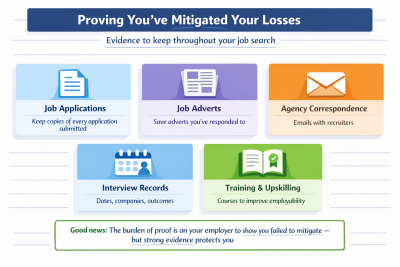
If the tribunal finds you haven’t taken reasonable steps to mitigate, it can reduce your compensation accordingly. The burden of proving failure to mitigate lies with your former employer, not you, but having good evidence of your job search efforts puts you in a much stronger position.
Polkey Reductions
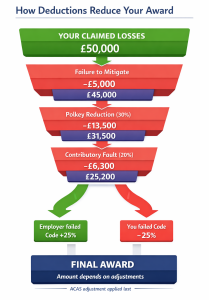
Named after the 1987 House of Lords case Polkey v AE Dayton Services Ltd, a Polkey reduction applies where the dismissal was procedurally unfair but a fair procedure would likely have resulted in dismissal anyway. The tribunal estimates the percentage chance that you would have been fairly dismissed and reduces the compensatory award accordingly.


For example, if the tribunal decides there was a 70% chance you would have been fairly dismissed had proper procedures been followed, your compensatory award would be reduced by 70%.
Contributory Fault
If your own conduct contributed to your dismissal, the tribunal can reduce both the basic award and the compensatory award by a percentage it considers just and equitable. This might apply, for example, if you committed an act of misconduct that partly justified the employer’s decision.
ACAS Code Adjustments
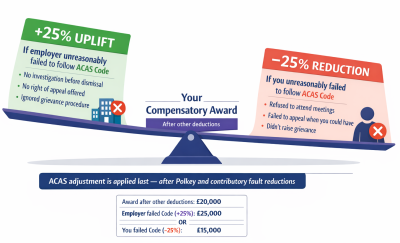
If your employer unreasonably failed to follow the ACAS Code of Practice on Disciplinary and Grievance Procedures, the tribunal can increase your compensatory award by up to 25%. Conversely, if you unreasonably failed to follow the Code, perhaps by refusing to attend meetings or failing to appeal, your award can be reduced by up to 25%.
The ACAS uplift or reduction is applied after other calculations, including any Polkey reduction.
Pension Loss
Pension loss can be one of the most valuable elements of your claim, particularly if you were a member of a defined benefit (final salary) scheme. Calculating pension loss properly requires careful attention.
For defined contribution schemes (where your employer pays a percentage of salary into a pension pot), the calculation is relatively straightforward: you claim the value of employer contributions you would have received during the period of loss.
For defined benefit schemes, the calculation is more complex. Employment tribunals use guidance called “Employment Tribunals: Principles for Compensating Pension Loss” which sets out two main approaches.
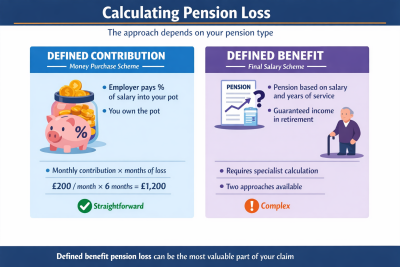
The simplified approach calculates employer contributions from dismissal until the expected date of finding equivalent employment. The substantial loss approach uses actuarial tables to value the pension rights you would have accrued until retirement. This approach is generally only used in cases involving long-serving employees who are close to retirement or who have limited prospects of finding equivalent pension benefits elsewhere.
In complex pension loss cases, particularly those involving defined benefit schemes or career-long loss claims, expert actuarial evidence may be needed.
Grossing Up for Tax
Some termination payments can be paid free of income tax up to a £30,000 threshold, but many tribunal award components are taxable as earnings (for example wages, holiday pay and some notice pay). If your award includes taxable elements, you may need to consider grossing up so the net figure reflects the tribunal’s intended compensation.
For example, if your total award is £50,000, the first £30,000 is tax-free, but the remaining £20,000 will be subject to income tax. If you’re a basic rate taxpayer (20%), you would need to gross up this £20,000 to £25,000 to receive £20,000 net after tax.
Grossing up calculations can be complex, particularly for higher-rate taxpayers or where there are multiple tax years involved. Professional advice is often worthwhile in larger claims.
Other Losses to Consider
Depending on your circumstances, you may be able to claim for additional losses including unpaid wages or notice pay, accrued but untaken holiday pay, unpaid bonuses or commission, loss of a company car or car allowance, loss of private medical insurance, loss of share options or long-term incentive plans, and job search expenses such as travel to interviews.

If you’re starting a business as a way of mitigating your losses, you may be able to claim reasonable start-up costs, though tribunals will scrutinise such claims carefully.
“The most common mistake I see in schedule of loss documents is underestimating future losses. Clients often assume they’ll find equivalent work within weeks, but in reality, replacing a senior role with matching salary and benefits can take 6-12 months. A realistic assessment strengthens both your tribunal case and your negotiating position in settlement discussions.”

Practical Tips for Your Schedule of Loss
Based on our experience representing claimants, here are some practical points to keep in mind.
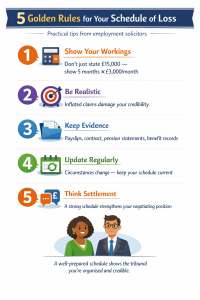
Show your workings. Don’t just state a figure; explain how you’ve calculated it. For example, rather than simply claiming £15,000 for loss of earnings, show that this represents 5 months at £3,000 per month net.
Be realistic. Tribunals look unfavourably on inflated claims. If you claim losses that seem unreasonable, it can undermine your credibility on other issues. Consider what a realistic period to find equivalent work might be in your industry and location.
Keep evidence. Gather payslips, your contract of employment, pension statements, benefit records, and any documents supporting the amounts you’re claiming. You’ll need to disclose these to the respondent and may need them at the hearing.
Update regularly. Your schedule of loss should reflect your current circumstances. If you find a new job, your losses change. If the hearing is delayed, your losses may increase. Keep your schedule up to date and serve amended versions when appropriate.
Consider settlement value. Your schedule of loss helps set the parameters for settlement negotiations. A well-prepared, properly evidenced schedule can strengthen your negotiating position considerably.
Download Our Schedule of Loss Templates
To help you get started, we’ve created two example schedules of loss that you can download and use as a guide. These show how to structure your document and present your calculations clearly.
Free Schedule of Loss Templates
Example 1: Standard Unfair Dismissal
A straightforward schedule for an unfair dismissal claim covering basic award, compensatory award, and loss of statutory rights.
Download PDF (95KB)Example 2: Detailed Schedule
A more comprehensive example showing how to present multiple heads of loss with detailed calculations and workings.
Download PDF (97KB)Note: These templates are provided as examples only. The figures and rates shown may be out of date. Always check the current statutory limits and adjust your schedule to reflect your specific circumstances.
Frequently Asked Questions
When do I need to prepare my schedule of loss for employment tribunal?
The tribunal will usually order you to produce a schedule of loss at an early stage, often at or following the preliminary hearing. You’ll typically be given a deadline, and it’s wise to start preparing your schedule well in advance so you have time to gather supporting documents.
Is there a standard schedule of loss employment tribunal template?
There’s no official prescribed format, but schedules generally follow a common structure. You should clearly set out your background information, then list each head of loss with calculations showing how you’ve arrived at each figure. We provide example schedules you can use as a starting point.
Can the tribunal award more than I’ve claimed in my schedule of loss?
Tribunals usually decide compensation based on the heads of loss you plead and evidence. If your losses increase (for example, because the hearing is delayed) you should update and serve an amended schedule so the respondent and tribunal have clear notice of the figures you’re seeking.
What if my former employer disputes my schedule of loss?
Your employer will usually serve a counter-schedule setting out their position on the figures. This is normal and expected. The tribunal will consider both documents, hear evidence on disputed points, and make its own assessment of what compensation is appropriate.
Do I need to include benefits I’ve received in my schedule of loss?
Yes. You must give credit for relevant state benefits you’ve received since dismissal, such as Universal Credit or Jobseeker’s Allowance. These are deducted from your loss of earnings. Some benefits, like Child Benefit or Personal Independence Payment, are not deducted as they’re not dependent on employment.
How long can I claim future loss of earnings for?
For ordinary unfair dismissal claims, the compensatory award cap effectively limits future loss. In discrimination and whistleblowing claims where no cap applies, the tribunal will assess how long it’s likely to take you to find equivalent work. In most cases, tribunals award future loss for somewhere between 6 months and 2 years, though career-long loss can be awarded in exceptional circumstances.
What happens to the compensation cap after the Employment Rights Act 2025?
The Employment Rights Act 2025 introduces reforms expected to take effect around January 2027 (subject to commencement regulations), including reducing the qualifying period for unfair dismissal protection and removing the current compensatory award cap. The timing is best assessed by reference to the relevant commencement provisions and official guidance.
Important: This guide provides general information about preparing a schedule of loss for an employment tribunal claim. It is not legal advice and should not be relied upon as such. Employment law is complex and the rules may apply differently depending on your circumstances. If you are preparing a schedule of loss or considering an employment tribunal claim, we strongly recommend seeking professional legal advice.
Sources and Further Reading
Primary Legislation
- Employment Rights Act 1996, s.123 (compensatory award and mitigation)
- Employment Rights Act 1996, s.124 (limit of compensatory award)
- Employment Rights Act 1996, s.47B (whistleblowing detriment)
- Trade Union and Labour Relations (Consolidation) Act 1992, s.207A (ACAS Code uplift/reduction)
- Employment Rights (Increase of Limits) Order 2025 (current compensation caps)
Interest on Awards
- Employment Tribunals (Interest on Awards in Discrimination Cases) Regulations 1996
- Employment Tribunals (Interest on Awards in Discrimination Cases) (Amendment) Regulations 2013
- Employment Tribunals (Interest) Order 1990
- Judgments Act 1838, s.17 (statutory interest rate)
Official Guidance
- Presidential Guidance: Vento Bands (April 2025)
- Employment Tribunals: Principles for Compensating Pension Loss (4th Ed, 2021)
- ACAS Code of Practice on Disciplinary and Grievance Procedures
- Citizens Advice: Preparing a Schedule of Loss
Key Case Law
- Polkey v AE Dayton Services Ltd [1987] UKHL 8 (procedural unfairness and compensation reduction)
- Vento v Chief Constable of West Yorkshire Police (No 2) [2002] EWCA Civ 1871 (injury to feelings bands)
- Dunnachie v Kingston-upon-Hull City Council [2004] UKHL 36 (scope of compensatory award)
- South Yorkshire Fire & Rescue Service v Mansell [2018] UKEAT/0151/17 (injury to feelings in detriment claims)
Schedule of Loss Templates
- Schedule of Loss Example 1 (standard unfair dismissal)
- Schedule of Loss Example 2 (detailed schedule with workings)
Tom Street
Tom Street is the principal solicitor at Tom Street & Co. Solicitors, specialising in employment law and tribunal claims. He regularly represents claimants in unfair dismissal, discrimination, and whistleblowing cases. View full profile