
Quick Summary
If you have reported wrongdoing at work and your employer has treated you badly as a result, you have strong legal protection. Whistleblowing claims are day-one rights, meaning you do not need two years’ service to bring a claim. Compensation is uncapped, unlike most other employment claims, and dismissal for whistleblowing is automatically unfair under the Employment Rights Act 1996.
⚖️ This guide is for general information only and is not legal advice. Every case is different – if you’re unsure, speak to a solicitor.
Key Points
- ✓ Whistleblowing protection is a day-one right: no minimum length of service required
- ✓ Dismissal for whistleblowing is automatically unfair under section 103A ERA 1996
- ✓ Compensation is uncapped, unlike the £123,543 cap on ordinary unfair dismissal awards
- ✓ Protection extends beyond employees to workers, agency staff, trainees and contractors
- ✓ Gagging clauses in contracts and settlement agreements cannot prevent a protected disclosure
- ✓ From 6 April 2026, sexual harassment is an express qualifying disclosure under ERA 2025 s.23
- ✓ The time limit to bring a claim is three months minus one day from the dismissal or detriment
What Is Whistleblowing?
Whistleblowing means reporting wrongdoing that affects others, not just yourself. In law, it is called making a “protected disclosure.” The legal framework sits in Part IVA of the Employment Rights Act 1996 (ERA 1996), inserted by the Public Interest Disclosure Act 1998 (PIDA) and later strengthened by the Enterprise and Regulatory Reform Act 2013.
The protection exists because people who speak up about serious wrongdoing often face significant personal risk. Before PIDA came into force in 1999, there was no statutory protection for whistleblowers at all. An employer could dismiss someone for raising legitimate concerns with no legal consequences beyond an ordinary unfair dismissal claim, subject to the usual qualifying period and compensation cap.
The law now takes a very different approach. Dismissing a whistleblower is automatically unfair, there is no compensation cap, and you can bring a claim from your first day of employment. Your employer cannot protect itself from a tribunal finding simply by arguing it genuinely believed your disclosure was not protected – if it meets the legal test, it is protected regardless of what the employer thought.
What Counts as a Protected Disclosure?
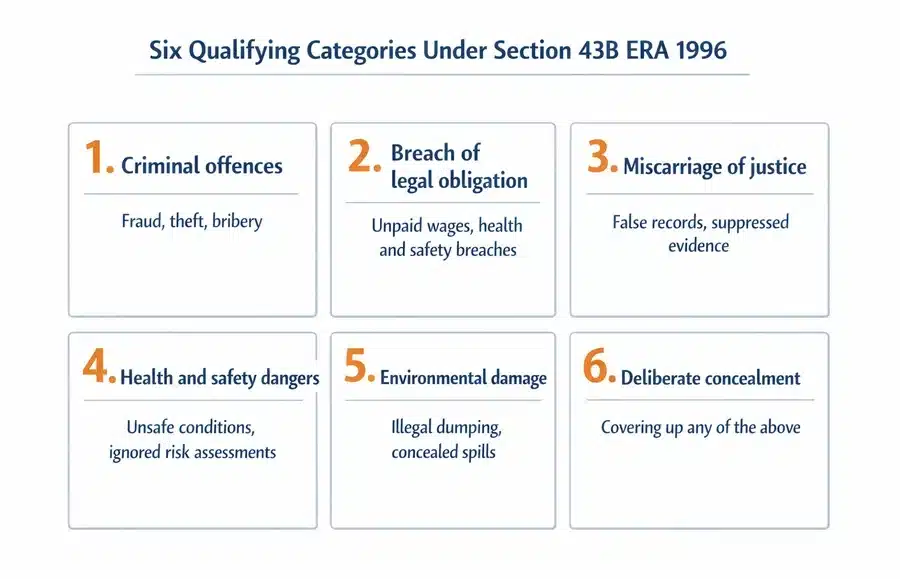
Not every workplace complaint qualifies. For a disclosure to be protected, it must satisfy three conditions.
1. The disclosure must relate to a qualifying category of wrongdoing
Under section 43B ERA 1996, you must reasonably believe your disclosure shows that one of the following has happened, is happening, or is likely to happen:
| Category | Examples |
|---|---|
| Criminal offences | Fraud, theft, bribery, dangerous driving by a company vehicle |
| Failure to comply with a legal obligation | Unpaid wages, unlawful discrimination, breach of health and safety regulations |
| Miscarriages of justice | Evidence suppression, false records, wrongful prosecution of a third party |
| Health and safety dangers | Unsafe working conditions, failure to provide proper equipment, ignored risk assessments |
| Environmental damage | Illegal dumping, unreported pollution, concealed spills |
| Deliberate concealment | Covering up any of the above categories |
⚖️ New From 6 April 2026
Sexual Harassment Is Now a Qualifying Disclosure
Section 23 of the Employment Rights Act 2025 amends section 43B of ERA 1996 to add sexual harassment as an express qualifying category. From 6 April 2026, a worker who discloses that sexual harassment has occurred, is occurring, or is likely to occur — whether directed at themselves or a colleague — is protected from detriment and dismissal in the same way as any other qualifying disclosure. The usual conditions still apply: the worker must reasonably believe the disclosure is made in the public interest and must disclose to an appropriate person. Previously, a worker would have had to fit a harassment complaint within an existing category such as breach of a legal obligation; the 2025 Act removes that uncertainty entirely.
A personal grievance about your own treatment, such as being passed over for promotion or having a dispute over your holiday entitlement, will not qualify on its own unless it also discloses wider wrongdoing affecting others.
2. The disclosure must be in the public interest
Since the 2013 reforms, your disclosure must be in the public interest. This does not mean it needs to affect the general public directly – it means the concern must go beyond your purely personal employment situation. Courts have interpreted this broadly. In Chesterton Global Ltd v Nurmohamed [2017] EWCA Civ 979, the Court of Appeal confirmed that a concern affecting a group of around 100 colleagues was sufficient to satisfy the public interest test.
The purpose of this requirement was to prevent employees from using whistleblowing law to pursue ordinary contractual disputes by dressing them up as public interest concerns. If your disclosure is genuinely about serious wrongdoing at your workplace, you are unlikely to struggle with this test.
3. You must reasonably believe the information is likely to be true
You do not need to be right. If you turn out to be mistaken but had a reasonable basis for believing the concern was true at the time, you are still protected. Nor do you need to prove wrongdoing – you just need to show you genuinely believed there was reason to think wrongdoing had occurred, was occurring, or was likely to occur.
“One of the biggest misconceptions I encounter is that people think they need cast-iron proof before they say anything. You don’t. If you have a genuine, reasonable belief that something is wrong, the law protects you even if you turn out to be mistaken. What matters is whether your belief was reasonable at the time you made the disclosure.”

Who Is Protected?
Whistleblowing protection extends well beyond the standard definition of “employee.” Under section 43K ERA 1996, the following categories of workers are protected:
- Employees (including those on fixed-term and zero-hours contracts)
- Workers in the broader statutory sense
- Agency workers
- Trainees and those on work experience placements
- NHS practitioners (doctors, dentists, pharmacists, opticians)
- Homeworkers who carry out work personally
- Former workers, where the detriment is closely connected to the employment relationship
The definition is intentionally broader than other areas of employment law. This means that even if you are not a standard employee, you may still have protection.
Those who are generally not protected include the genuinely self-employed (where the business relationship is truly client/contractor rather than worker/employer), volunteers, and non-executive directors. If you are unsure about your status, take advice before you do anything – getting this wrong can leave you without any protection at all.
How to Make a Protected Disclosure
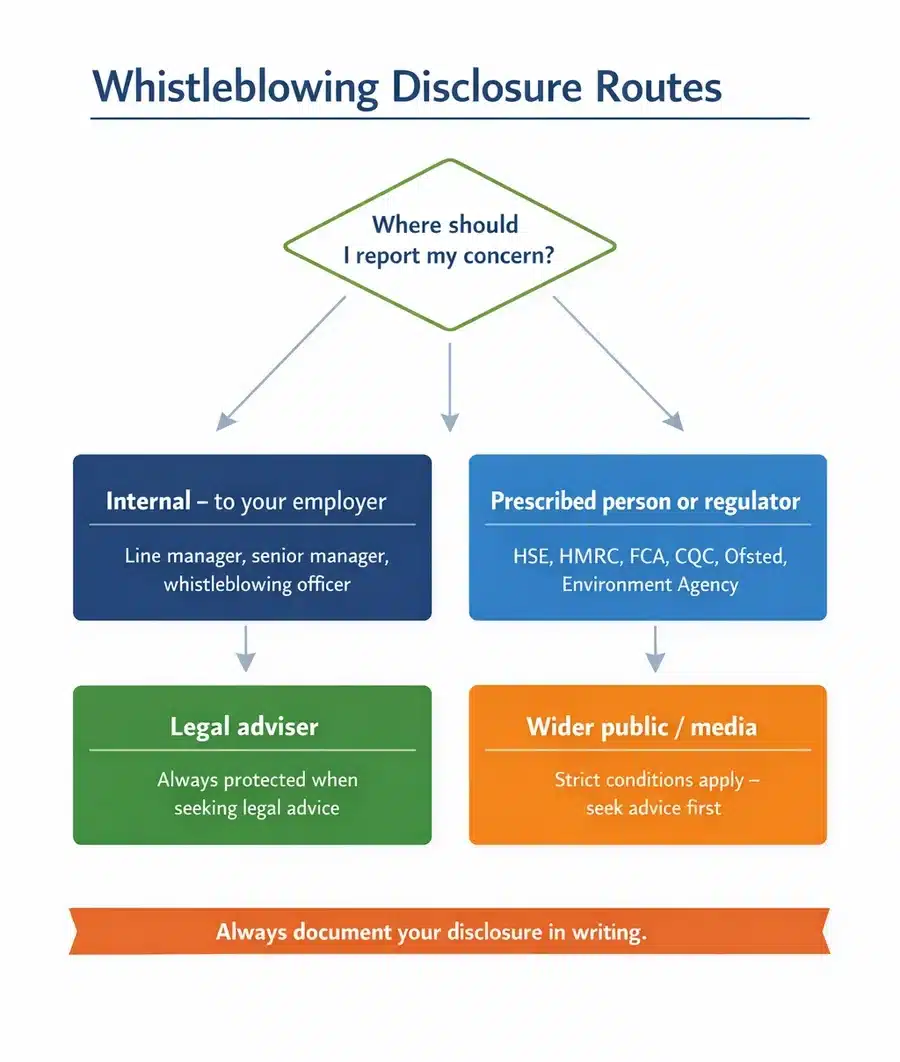
Making a protected disclosure is not just about what you say – it also matters who you say it to. The law sets out a hierarchy of disclosure routes, and using the wrong one in the wrong circumstances can affect your protection.
Internal disclosure to your employer
The first and most straightforward route is raising concerns with your employer. This can be to your line manager, a more senior manager, a director, or a dedicated whistleblowing officer if your employer has one. PIDA encourages internal disclosure first, where it is safe to do so, because it gives organisations the chance to address the problem directly.
You should keep a record of when you made the disclosure and to whom, ideally in writing. If you raise a concern verbally, follow it up in writing to create a paper trail.
Disclosure to a prescribed person or regulator
You can also report concerns directly to a prescribed person – a regulator with responsibility for the subject matter of your concern. Common examples include:
- Health and Safety Executive (HSE) for workplace safety concerns
- HM Revenue and Customs (HMRC) for tax fraud or evasion
- Financial Conduct Authority (FCA) for financial misconduct
- Care Quality Commission (CQC) for concerns in health and social care
- Ofsted for education and childcare concerns
- Environment Agency for environmental damage
To be protected when disclosing to a prescribed person, you must reasonably believe the information is substantially true and that it falls within the regulator’s remit.
Disclosure to a legal adviser
Seeking legal advice about your concerns is always protected under section 43D ERA 1996, regardless of who your concerns are about or how serious they are. This is an important first step if you are uncertain about your position.
Wider disclosure (to the media or public)
Going to the press, a campaigning organisation, or the general public is only protected if strict additional conditions are satisfied. The concern must be exceptionally serious, you must not have raised it for personal gain, and you must reasonably believe internal or regulatory routes are not viable, or that raising it externally is reasonable in the circumstances. This is a high bar, and you should take legal advice before going to the media.
What Protection Do You Have?
The law protects you in two distinct ways: protection against detriment and protection against dismissal. The distinction matters because different rules apply to each.
Protection against detriment
Under section 47B ERA 1996, you have the right not to be subjected to any detriment because you have made a protected disclosure. Detriment covers a wide range of treatment, including:
- Denial of promotion or pay increases you would otherwise have received
- Exclusion from meetings, projects, or communications
- Unjustified disciplinary action
- Changes to your working conditions or role
- Harassment or bullying by colleagues or management
- Deliberately unfavourable performance reviews
- Being given an inaccurate or harmful reference after you leave
Since 2013, you can bring a detriment claim not just against your employer but against individual colleagues or agents who subjected you to unfavourable treatment. Your employer may also be vicariously liable for what co-workers did to you, unless it can show it took all reasonable steps to prevent the behaviour.
Protection against dismissal
If you are dismissed and the reason, or principal reason, is that you made a protected disclosure, your dismissal is automatically unfair under section 103A ERA 1996. There is no qualifying period. You do not need to have worked for your employer for two years. You can bring an automatic unfair dismissal claim from your first day of employment.
The test the tribunal applies is objective. Your employer cannot escape liability by arguing it genuinely believed your disclosure did not qualify as protected. If the tribunal finds it was protected, the dismissal is automatically unfair regardless of what the employer thought at the time.
“I see a lot of cases where employers dismiss someone and try to construct a different reason – performance, misconduct, redundancy – to cover up what really happened. Tribunals are wise to this. If the evidence points to the whistleblowing being the real reason, the label the employer puts on it will not save them.”
Interim relief
One important remedy available in whistleblowing dismissal cases that is not available in ordinary unfair dismissal is interim relief. If you apply to the tribunal within seven days of your effective date of termination, the tribunal can order that your employment continues pending the final hearing. This is a powerful remedy but the application window is extremely tight. If you have been dismissed for whistleblowing, take legal advice immediately.
What Compensation Can You Claim?
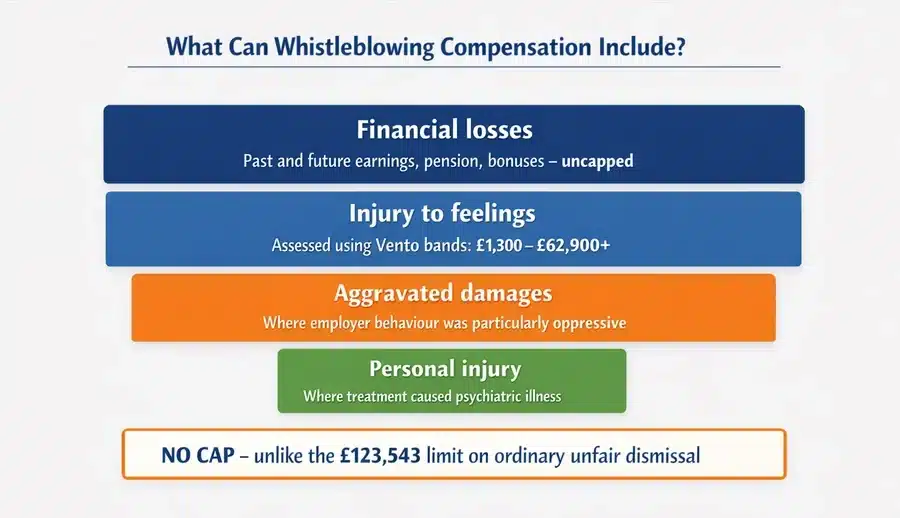
Compensation in whistleblowing cases is uncapped. This is one of the most significant differences from ordinary unfair dismissal, where the compensatory award is currently capped at £123,543 (or 52 weeks’ gross pay, whichever is lower). There is no such cap for whistleblowing claims.
That distinction will become less significant from 1 January 2027, when the Employment Rights Act 2025 is expected to abolish the compensatory award cap for ordinary unfair dismissal altogether, aligning it with the uncapped position that already applies in whistleblowing and discrimination claims. Until then, the cap remains in force and the advantage of an uncapped whistleblowing claim over an ordinary unfair dismissal claim is real and material.
The tribunal can award:
- Past financial losses: lost wages, bonuses, pension contributions from dismissal to the hearing
- Future financial losses: projected earnings losses if you are unlikely to find comparable employment quickly
- Injury to feelings: compensation for the distress caused by the detriment or dismissal
- Aggravated damages: in cases where the employer’s behaviour was particularly high-handed or oppressive
- Personal injury damages: where the treatment caused a psychiatric injury
Injury to feelings awards are assessed using the Vento bands, updated by Presidential Guidance each April. The current bands, effective from 6 April 2026, are as follows:
Injury to Feelings: Vento Bands (from 6 April 2026)
| Band | Award Range | Applies To |
|---|---|---|
| Lower | £1,300 – £12,600 | Less serious cases, isolated acts |
| Middle | £12,600 – £37,700 | Cases not meriting the upper band |
| Upper | £37,700 – £62,900 | Serious and sustained campaigns |
| Exceptional | Above £62,900 | Only the most exceptional cases |
Source: Employment Tribunal Presidential Guidance: Ninth Addendum (March 2026, effective 6 April 2026)
What can reduce your compensation?
Two things can reduce an otherwise successful award. First, if the tribunal finds your disclosure was not made in good faith – for example, if your primary motive was personal gain rather than concern about wrongdoing – it can reduce your compensation by up to 25% under section 49(6A) ERA 1996. Second, if you contributed to your own dismissal or the detriment in some way, the tribunal may make a contributory fault reduction. Neither of these prevents a claim, but they can affect the final figure.
Gagging Clauses and NDAs
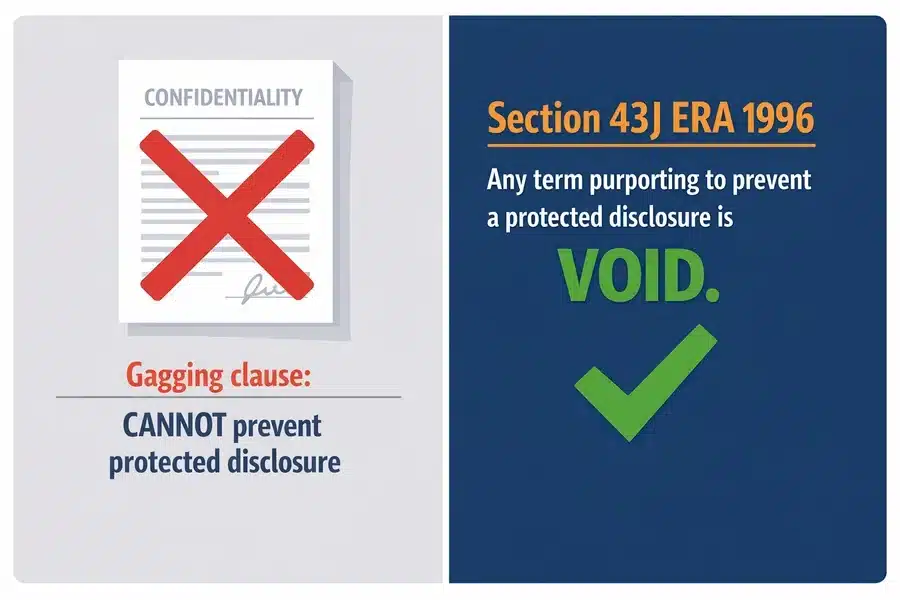
Many employers include confidentiality clauses in employment contracts and settlement agreements. These are sometimes called gagging clauses or NDAs (non-disclosure agreements). Their purpose is typically to prevent employees from discussing what happens at work, including any concerns about wrongdoing.
Under section 43J ERA 1996, any contractual term that purports to prevent a worker from making a protected disclosure is void. It has no legal effect. If you have been asked to sign a settlement agreement with a confidentiality clause that could prevent you from reporting genuine concerns about wrongdoing, that clause cannot bind you.
This is an area where legal advice is particularly important. Settlement agreements often contain confidentiality provisions that are perfectly lawful when they relate to commercial information, personal disputes, or the terms of the agreement itself – but cross a line if they attempt to prevent a protected disclosure. A solicitor can advise on which provisions are enforceable and which are not.
What to Do If You Have Blown the Whistle and Been Treated Badly
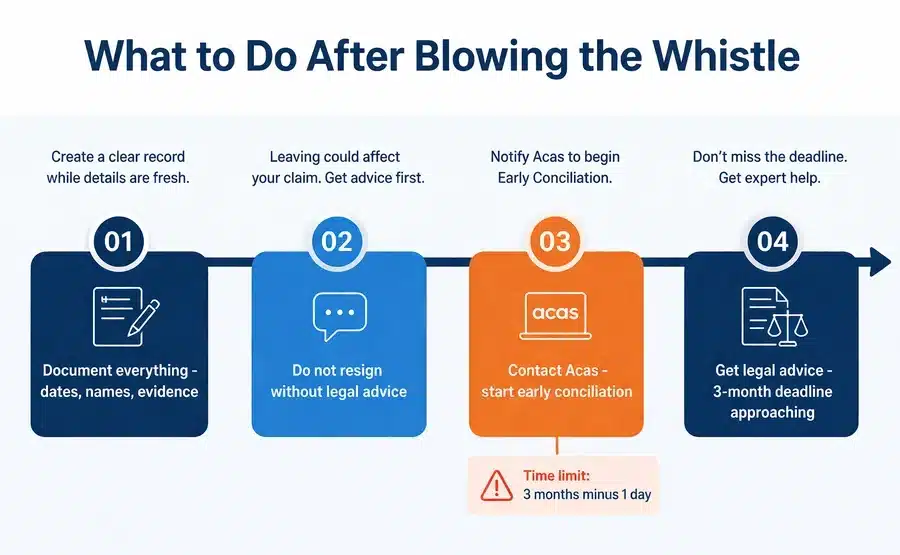
Steps to Take Immediately
Document everything. Keep a detailed record of what you disclosed, to whom, and when. Save any emails, messages, or documents relating to the disclosure. Note down any incidents of detrimental treatment with dates, times, and names.
Do not resign without advice. If your employer is making your life difficult following a disclosure, resigning impulsively could harm your position. There may be a constructive dismissal claim available to you, but the legal test is strict and needs careful consideration.
Watch the time limit. You have three months minus one day from the date of dismissal or the last act of detriment to start Acas early conciliation. This deadline can feel distant when you are going through a difficult time, but it passes quickly.
Get legal advice early. Whistleblowing cases are complex. The interplay between detriment claims, dismissal claims, and potential co-worker liability means the right strategy depends on the specific facts. An employment solicitor can assess your position and advise on the strongest route forward.
Time Limits for Whistleblowing Claims
The standard time limit for both whistleblowing dismissal and detriment claims is three months minus one day from the date of the dismissal or the act of detriment. Before you can lodge a tribunal claim, you must first notify Acas (the Advisory, Conciliation and Arbitration Service) and go through the early conciliation process. The conciliation period can last up to 12 weeks, and the time during which early conciliation is ongoing does not count towards your three-month limit.
⚖️ Upcoming Change
Time Limit Extension Expected From October 2026
The Employment Rights Act 2025 is expected to extend most employment tribunal time limits from three months to six months. This change is expected no earlier than October 2026, subject to commencement regulations. The three-month limit applies now. Once the extension commences, it will apply to whistleblowing claims in the same way as other tribunal claims.
In practice, this means you need to contact Acas promptly. If you wait until the last few weeks before your three-month deadline and then enter conciliation, you may find your effective deadline for issuing the claim is closer than you realised. Do not leave it late.
Where detriment takes the form of a series of acts rather than a single event, the time limit runs from the last act in the series. However, do not rely on this without advice – the rules on what counts as a series of acts are not always straightforward.
💬 Suffered detriment for whistleblowing?
Our solicitors can assess your claim and advise on your options, including whether you have a detriment claim, an automatic unfair dismissal claim, or both.
Get Free Initial Advice →Common Employer Tactics in Whistleblowing Cases
Employers facing a whistleblowing claim will often try to reframe the situation. It is worth knowing what to expect.
“The real reason was your performance”
The most common defence is that the dismissal or detrimental treatment had nothing to do with the disclosure – it was about something else entirely. Tribunals look at the evidence carefully here. If the performance concerns only materialised after the disclosure, if the process was rushed or inconsistent, or if colleagues in similar situations were treated differently, those facts will matter.
“You didn’t make a qualifying disclosure”
Employers sometimes argue that the concern raised was not a protected disclosure – perhaps because it was a personal grievance rather than a matter of public interest, or because the wrongdoing alleged does not fall within the six categories. Whether a disclosure qualifies is an objective question for the tribunal to decide. The employer’s view on the matter is not determinative.
“You acted in bad faith”
Since the removal of the good faith requirement in 2013, bad faith no longer defeats a claim – it can only reduce the award by up to 25%. An employer arguing bad faith is fighting for a discount on the compensation, not a full defence.
Frequently Asked Questions
Do I need to have worked for my employer for two years to bring a whistleblowing claim?
No. Whistleblowing protection is a day-one right. You can bring a claim from your first day of employment. This is different from ordinary unfair dismissal claims, where you generally need two years’ continuous service.
Can I be dismissed for whistleblowing if I used to work there?
Former workers can still be protected in certain circumstances, particularly where the detriment is closely connected to the employment relationship. Post-employment detriments such as a deliberately damaging reference can give rise to a claim under section 47B ERA 1996, as confirmed by the Employment Appeal Tribunal in Day v Lewisham and Greenwich NHS Trust [2017] IRLR 623 (EAT).
What if my employer is the one doing the wrongdoing I want to report?
This is the most common scenario. You can report concerns to your employer (even when the employer itself is involved), to an appropriate regulator such as the HSE, HMRC, or FCA, or to a legal adviser. Which route is safest depends on the nature of the concern and your circumstances.
Is there a compensation cap on whistleblowing claims?
No. Unlike ordinary unfair dismissal, whistleblowing compensation is uncapped. The tribunal can award full past and future financial losses, injury to feelings, and in appropriate cases, aggravated damages and personal injury compensation. High-value cases often run to six figures where the claimant has been unable to find equivalent employment following dismissal.
Can I report concerns anonymously and still be protected?
You can report anonymously, but it is harder to establish you made a protected disclosure without being identified. The legal protection under PIDA applies to the person making the disclosure, so if anonymity means the employer cannot connect the disclosure to you, it may be difficult to prove the employer treated you badly because of it.
What if a colleague, not just my employer, is victimising me for blowing the whistle?
Since the 2013 reforms under the Enterprise and Regulatory Reform Act 2013, you can bring a detriment claim directly against a co-worker or agent who subjects you to unfavourable treatment. Your employer may also be vicariously liable unless it can show it took all reasonable steps to prevent the behaviour.
Can a settlement agreement stop me from whistleblowing?
No. Any contractual term, including a confidentiality clause in a settlement agreement, that purports to prevent you from making a protected disclosure is void under section 43J ERA 1996. It has no legal effect. You should still take independent legal advice before signing any settlement agreement to understand what you are and are not agreeing to.
How long do I have to make a whistleblowing claim?
Three months minus one day from the date of dismissal or the last act of detriment. Before issuing a claim, you must first notify Acas and complete the early conciliation process, which pauses the time limit. Do not wait until the deadline is close: contact Acas and a solicitor as soon as possible.
💬 Concerned about your whistleblowing situation?
Speak to our employment law team. We act for employees and workers on a no win, no fee basis and can give you a clear view of your position from the outset.
Get Free Initial Advice →Important: This guide provides general information about whistleblowing rights and protected disclosures under UK employment law. It is not legal advice and should not be relied upon as such. Employment law is complex and the rules may apply differently depending on your specific circumstances, employment status, and the nature of the concerns you have raised. If you believe you have been subjected to detriment or dismissed following a protected disclosure, we strongly recommend seeking professional legal advice before taking any action.
Sources and Further Reading
Primary Legislation
- Employment Rights Act 1996, Part IVA (sections 43A-43L) (protected disclosures framework)
- Public Interest Disclosure Act 1998 (original whistleblowing legislation)
- Enterprise and Regulatory Reform Act 2013 (public interest test, co-worker liability, removed good faith requirement)
- Employment Rights Act 2025, section 23 (sexual harassment added as qualifying disclosure, from 6 April 2026)
Official Guidance
- Acas: Whistleblowing at work
- GOV.UK: List of prescribed persons for whistleblowing disclosures
- Employment Tribunal Presidential Guidance: Ninth Addendum (March 2026, effective 6 April 2026)
Key Case Law
- Chesterton Global Ltd v Nurmohamed [2017] EWCA Civ 979 (public interest test: concerns affecting a group of co-workers can be sufficient)
- Beatt v Croydon Health Services NHS Trust [2017] EWCA Civ 401 (employer’s belief about protected status is irrelevant)
- Timis and another v Osipov [2018] EWCA Civ 2321 (co-workers personally liable for losses flowing from dismissal)
Tom Street
Tom Street is the principal solicitor at Tom Street & Co. Solicitors, specialising in employment law and tribunal claims. He regularly represents claimants in unfair dismissal, discrimination, and whistleblowing cases. View full profile