
Quick Summary
In Pal v Accenture (UK) Ltd [2026] EAT 12, the Employment Appeal Tribunal overturned key parts of a tribunal decision involving an employee dismissed under a “progression based” or “up or out” model while suffering from endometriosis. The EAT found the original tribunal’s analysis of whether endometriosis amounted to a disability was “wholly inadequate,” criticised a 100% Polkey reduction, and raised serious doubts about dismissing employees for not being “promotion ready.” The case has been sent back for a complete rehearing.
⚖️ This guide is for general information only and is not legal advice. Every case is different – if you’re unsure, speak to a solicitor.
Key Points
- ✓ The EAT ruled that the original tribunal’s reasoning on whether endometriosis amounted to a disability was “wholly inadequate” and could not stand
- ✓ Dismissing employees for not being “promotion ready” may not qualify as a fair capability dismissal under section 98 of the Employment Rights Act 1996
- ✓ A 100% Polkey reduction was overturned because the tribunal applied the wrong test, asking what it would have done rather than what the employer would have done
- ✓ Employers using “up or out” models common in consulting, law and financial services should review their dismissal procedures
- ✓ Employees with chronic health conditions like endometriosis may have stronger disability discrimination protections than previously recognised
Why This Case Matters
Pal v Accenture (UK) Ltd [2026] EAT 12 is one of the most significant employment law decisions of 2026 so far. It tackles three issues that affect thousands of employees: how tribunals assess disability for people with endometriosis, whether “up or out” dismissals are lawful, and how compensation should be calculated when employers breach their own procedures.
The case is particularly important for anyone working in professional services, consulting, law firms, or financial services where progression based models are standard practice. If you’ve been dismissed because your employer decided you weren’t ready for promotion, this judgment could change how your claim is assessed.
The Facts
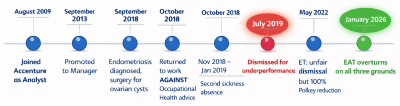
Sanju Pal worked at Accenture for 10 years, joining in 2009 as an Analyst and being promoted to Consultant in 2011 and Manager in 2013. She was a high achiever who had won awards, met the late Queen Elizabeth, and been invited to 10 Downing Street.
Accenture operates a “progression based performance model” in its consulting division. Under this system, employees are expected to demonstrate continuous development toward the next level of seniority. If they don’t show readiness for promotion within a set period, the company treats this as underperformance, even if the employee is performing well in their current role.
In September 2018, Ms Pal was diagnosed with severe endometriosis and had surgery to remove a 7.5cm cyst on her left ovary and a smaller cyst on the right. She was off work for about a month and returned against occupational health advice, which had recommended a six week phased return. She had a second period of sickness from November 2018 to January 2019 and completed a phased return by 4 March 2019.
Just three months after her phased return ended, Accenture dismissed Ms Pal in July 2019 for underperformance linked to not being “promotion ready.” At the time, her chargeability was low, but this was largely because of her surgery and phased return. In March 2019, a consultant found a recurrent 3cm endometrioma on her left ovary.
The Original Tribunal Decision
The employment tribunal in May 2022 found that Ms Pal had been unfairly dismissed because Accenture failed to follow its own Disciplinary and Appeals Policy. The people who carried out the investigation were the same people who made the dismissal decision, and a procedure designed for misconduct was used for what was a capability issue.
Despite finding the dismissal unfair, the tribunal applied a 100% Polkey reduction, concluding that even with a fair procedure, Ms Pal would still have been dismissed. She was awarded only £4,275 as a basic award. The tribunal also found that Ms Pal was not disabled under the Equality Act 2010, rejecting her disability discrimination claim entirely.
What the EAT Decided
HHJ James Tayler, sitting with members at the Rolls Building on 9 December 2025, allowed Ms Pal’s appeal on all three grounds. The judgment, handed down on 19 January 2026, addressed each issue in turn.
The Polkey reduction was wrong
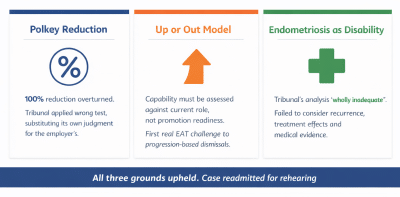
The EAT held that a Polkey reduction must be based on what the actual employer would or might have done if it had the chance to correct the procedural failing. The tribunal had instead asked what it thought should have happened, effectively substituting its own judgment for the employer’s. Since Accenture provided no evidence about what it would have done differently, a 100% reduction was unsound.
“This case is a reminder that a Polkey reduction isn’t a free pass for employers who get their procedures wrong. If you’ve been unfairly dismissed but told you’d have been sacked anyway, it’s always worth questioning whether the tribunal applied the right test.”

The “up or out” model and capability
The EAT examined whether dismissal under a progression based model amounts to a capability dismissal under section 98 of the Employment Rights Act 1996. Capability must be assessed by reference to “work of the kind which [the employee] was employed by the employer to do” under the contract of employment.
The EAT found that dismissing someone for failing to demonstrate readiness for promotion may not relate to their capability for their current contractual duties. While a contract could require an employee to demonstrate promotion readiness, the employer would still need to show it acted fairly. This is a significant finding for the entire professional services sector, where “up or out” models are standard.
Endometriosis and disability
The EAT found that the original tribunal’s analysis of disability was “wholly inadequate.” The tribunal had formed an extremely negative view of Ms Pal’s credibility and then effectively ignored her disability impact statement, despite medical evidence supporting her account. Specifically, the tribunal failed to consider whether surgical recovery constituted a substantial adverse effect arising from the impairment, whether endometriosis was likely to recur (despite medical evidence of a recurrence in March 2019), and what the position would be without medical treatment.
During Ms Pal’s internal appeal, the appeal manager was sufficiently concerned about the endometriosis to raise it with HR, but no occupational health referral was made. The EAT held the tribunal had not properly assessed whether Accenture had constructive knowledge of disability.
What This Means for You
If you have endometriosis or another chronic condition
This case strengthens the position of employees with endometriosis who believe they have been discriminated against. The EAT made clear that tribunals must properly engage with medical evidence and disability impact statements, even where they have concerns about a claimant’s credibility on other matters. Around 1.5 million women in the UK have endometriosis, and this ruling should encourage proper consideration of the condition as a potential disability under the Equality Act 2010.
If you’ve been dismissed while managing a chronic health condition and your employer failed to refer you to occupational health or make reasonable adjustments, you may have both an unfair dismissal claim and a disability discrimination claim.
If you were dismissed under an “up or out” policy
The judgment raises real questions about whether “up or out” dismissals can be fair under the heading of capability. If your employer dismissed you because you weren’t “promotion ready” rather than because you were unable to do the job you were actually employed to do, this case could help your claim.
“The ‘up or out’ model has been an accepted part of professional services for decades. This case is the first real challenge to it in the EAT, and it could change how consulting firms, law firms and banks handle underperformance dismissals.”
If you received a 100% Polkey reduction
The EAT’s clarification on Polkey reductions is important. Tribunals must assess what the specific employer would have done, not what the tribunal thinks should have happened. If your employer didn’t give evidence about what it would have done differently, a 100% reduction may not be justified.
What Happens Next
The case has been remitted to a freshly constituted tribunal for a complete rehearing on the issues of disability, discrimination arising from disability, the Polkey reduction, and whether dismissal under the progression based model was for a potentially fair reason. The rehearing tribunal will need to assess whether Accenture would have fairly dismissed Ms Pal had it followed its own procedures, and whether the “up or out” model amounts to capability or “some other substantial reason” for dismissal.
We will update this page when the rehearing outcome is known.
Frequently Asked Questions
Is endometriosis automatically a disability under the Equality Act 2010?
No. Endometriosis is not automatically classified as a disability. Each case must be assessed individually. To qualify, the condition must have a substantial and long term adverse effect on your ability to carry out normal day to day activities. The Pal v Accenture judgment makes clear that tribunals must properly consider the medical evidence, the likelihood of recurrence, and the effects of the condition without medical treatment.
What is the “up or out” model?
The “up or out” or “progression based” model is used widely in consulting, law firms and financial services. Employees are expected to demonstrate readiness for promotion within a set timeframe. If they don’t, the employer treats them as underperforming and they may be dismissed. The EAT in Pal questioned whether this amounts to a fair capability dismissal under the Employment Rights Act 1996.
What is a Polkey reduction?
A Polkey reduction (from Polkey v AE Dayton Services Ltd [1987] UKHL 8) allows a tribunal to reduce compensation where it finds that the employee would have been dismissed anyway, even if a fair procedure had been followed. The reduction is assessed as a percentage. In Pal, the 100% reduction meant Ms Pal received no compensatory award despite winning her unfair dismissal claim.
Can I be dismissed for not being promotion ready?
It depends on your contract and the circumstances. The EAT in Pal held that capability must be assessed against the work you were actually employed to do under your contract. Dismissal purely for not being ready for the next level up may not be fair under the “capability” heading, although it could potentially amount to “some other substantial reason.” Your employer would still need to show it acted reasonably.
How long do I have to bring a disability discrimination claim?
You must contact Acas for early conciliation within three months minus one day of the discriminatory act. For dismissal cases, the clock starts from the effective date of termination. If you’ve been dismissed while managing a health condition, get legal advice quickly to protect your time limits.
💬 Dismissed while managing a health condition?
Our solicitors can assess whether you have a claim for unfair dismissal and disability discrimination
Get Free Initial Advice →Important: This case note provides general information about the EAT’s decision in Pal v Accenture (UK) Ltd [2026] EAT 12. It is not legal advice and should not be relied upon as such. Employment law is complex and the rules may apply differently depending on your circumstances. If you believe you have been unfairly dismissed or discriminated against because of a disability, we strongly recommend seeking professional legal advice.
Sources and Further Reading
Judgment
- Pal v Accenture (UK) Ltd [2026] EAT 12 (full EAT judgment)
Primary Legislation
- Employment Rights Act 1996, section 98 (fair reasons for dismissal, capability)
- Equality Act 2010, section 6 (definition of disability)
- Equality Act 2010, section 15 (discrimination arising from disability)
Key Case Law
- Polkey v AE Dayton Services Ltd [1987] UKHL 8 (the Polkey reduction principle)
Further Reading
Tom Street
Tom Street is the principal solicitor at Tom Street & Co. Solicitors, specialising in employment law and tribunal claims. He regularly represents claimants in unfair dismissal, discrimination, and whistleblowing cases. View full profile