
Quick Summary
Understanding settlement agreement clauses is critical before you sign. Settlement agreements contain 12 standard clauses that affect your legal rights, finances, and future employment. The waiver of claims clause is the most critical, as you’re giving up the right to bring a tribunal claim in exchange for compensation. Many clauses are negotiable, but you must receive independent legal advice before signing. Red flags include unreasonably low offers, overly broad confidentiality clauses, and pressure to sign quickly without proper consideration time.
⚖️ This guide is for general information only and is not legal advice. Every case is different. If you’re unsure, speak to a solicitor.
Key Points
- ✓ Settlement agreements must meet strict legal requirements under section 203 of the Employment Rights Act 1996 to be valid
- ✓ You’re waiving your right to bring tribunal claims in exchange for compensation, so understanding each clause is critical
- ✓ Independent legal advice is a legal requirement before signing, and employers typically contribute £250 to £500 towards your costs
- ✓ Most clauses are negotiable, including the settlement amount, reference wording, and restrictive covenants
- ✓ Acas recommends at least 10 calendar days to consider an offer, and you can request more time if needed
- ✓ Red flags include pressure to sign quickly, unreasonably low offers, and confidentiality clauses that appear to prevent whistleblowing
When you’re handed a settlement agreement, you’re holding a legal document that could affect your finances, your career, and your rights for years to come. Yet many employees sign without truly understanding settlement agreement clauses or which terms they can negotiate.

Settlement agreements aren’t standard forms. They’re negotiable contracts designed to resolve employment disputes by waiving your right to bring tribunal claims in exchange for compensation. Understanding settlement agreement clauses is critical because every clause has legal significance, and some contain hidden risks that could cost you thousands of pounds or restrict your future employment.
This guide breaks down the 12 standard settlement agreement clauses you’ll find in most agreements, explains which ones are negotiable, and flags the warning signs that should make you pause before signing. Whether you’ve just received your first settlement offer or you’re reviewing a revised version, understanding these clauses will help you make an informed decision about your rights and your future.
How to Read Your Settlement Agreement
Before examining individual settlement agreement clauses, you need to understand how settlement agreements are structured and what makes them legally binding under UK employment law.
The Structure of a Settlement Agreement
Settlement agreements follow a consistent structure. They begin with the parties (you and your employer) and definitions of key terms like “Termination Date” and “Settlement Payment”. The main body contains numbered settlement agreement clauses setting out the terms you’re agreeing to.
At the back, you’ll find annexes. Annex A typically lists the particular complaints or proceedings being settled. Annex B contains the legal provisions governing settlement agreements (usually section 203 of the Employment Rights Act 1996). Annex C is your agreed reference wording, if applicable.
The final page contains the legal advice certificate. Your independent adviser signs this to confirm they’ve advised you on the terms and effect of the agreement, and that their advice is covered by professional indemnity insurance.

What Makes a Clause Legally Binding
For a settlement agreement to be legally valid, it must meet specific statutory conditions. Under section 203 of the Employment Rights Act 1996, the agreement must be in writing and relate to particular complaints or proceedings. You cannot waive your employment rights through a vague or general agreement.
You must receive advice from a relevant independent adviser (usually a solicitor) on the terms and effect of the agreement, particularly how it affects your ability to pursue rights before an employment tribunal. The adviser must be identified in the agreement, and their advice must be covered by insurance.
The agreement must state that the statutory conditions regulating settlement agreements have been satisfied. Without meeting all these requirements, the agreement may be unenforceable, meaning you could potentially bring tribunal claims despite having signed.
Your Right to Negotiate
Settlement agreements are contracts, which means the terms are negotiable. Your employer may present the agreement as a final offer, but you have every right to request changes before signing.
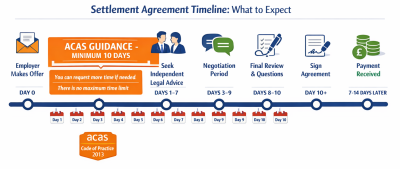
Acas recommends that employers give you at least 10 calendar days to consider a settlement offer. This isn’t just to read the document. It’s time to obtain independent legal advice, discuss the terms with your adviser, and negotiate improvements. If you need more time, you can request it. Reasonable adjustments apply if you’re disabled and need longer to obtain appropriate advice.
Most employers contribute towards your legal costs, typically £300 to £600 plus VAT. This isn’t a legal requirement, but it’s standard practice. The contribution ensures the agreement is legally binding, as you cannot validly waive your rights without independent advice.
12 Standard Clauses Explained
Every settlement agreement contains certain standard clauses. Understanding these settlement agreement clauses and how they affect your position is essential before you sign. Here’s what each one means.
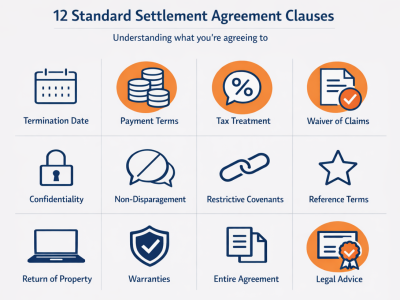
1. Termination Date and Employment End
The termination clause defines when your employment ends. This date is crucial because it affects your statutory rights, continuous service, and various payments.
Your agreement may provide for you to work your notice period, go on garden leave (staying employed but not working), or receive payment in lieu of notice (PILON). Garden leave keeps you employed until the termination date, so you continue accruing benefits and service. PILON means you leave immediately but receive payment equivalent to your notice period.
When you join a new employer, your continuous service usually breaks. This matters because many employment rights depend on continuous service. For example, you currently need two years’ continuous service to claim ordinary unfair dismissal, though this is changing soon.
If you start with a new employer, you begin counting again from zero. Check this clause carefully if you’re close to a service milestone. An extra week of employment could mean qualifying for statutory protections you wouldn’t otherwise have.
Check this clause carefully if you’re close to a service milestone. An extra week of employment could mean qualifying for statutory protections you wouldn’t otherwise have.
2. Payment Terms
The payment clause is one of the most scrutinised settlement agreement clauses. It breaks down exactly what you’ll receive and when. Settlement payments typically have several components, each with different tax treatment.
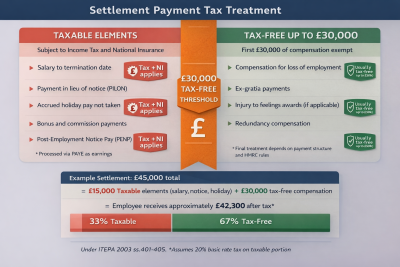
Taxable elements include your salary up to the termination date, accrued but untaken holiday pay, any earned bonus or commission, and notice pay (whether worked or paid in lieu). These go through payroll with normal tax and National Insurance deductions.
The ex-gratia or compensation payment is potentially tax-free up to £30,000. This is genuine compensation for loss of your job, paid under sections 401 to 405 of the Income Tax (Earnings and Pensions) Act 2003. Anything above £30,000 is taxable.
Post-Employment Notice Pay (PENP) changed the rules. HMRC now requires employers to calculate the value of your notice pay and tax it, even if you don’t work the notice. This reduces the amount available for tax-free treatment. Your agreement should clearly state which payments are taxable and which aren’t.
Payment timing matters too. Most agreements provide for payment within seven to 14 days of the agreement becoming legally binding. Some employers pay through payroll on your usual pay date. Others make a separate payment directly to your bank account.
3. Tax Treatment Clause
Nearly every settlement agreement contains a tax indemnity clause. This is one of the most important settlement agreement clauses to understand. It states that if HMRC challenges the tax treatment and demands additional tax, you’ll reimburse your employer for any amounts they have to pay, including interest and penalties.
This clause exists because HMRC scrutinises the £30,000 tax-free allowance. If your employer has incorrectly characterised taxable pay (like notice pay or bonuses) as tax-free compensation, HMRC can issue a demand years later. The indemnity protects the employer by passing that risk to you.
The problem is that you’re often indemnifying your employer for their own mistakes in structuring the payment. If they’ve incorrectly labelled notice pay as tax-free to make the overall package look better, you end up liable when HMRC corrects it.
Good legal advice involves reviewing whether the tax treatment is correct from the start. Your adviser should ensure that PENP has been properly calculated, that genuine holiday pay isn’t being disguised as tax-free compensation, and that the characterisation of each payment element is defensible.
You can sometimes negotiate better wording. For example, limiting the indemnity to actual HMRC demands (not theoretical liabilities), requiring reasonable notice before your employer can make a claim against you, or excluding liability where the employer’s own tax advice was wrong.
4. Waiver of Claims (The Big One)
This is the heart of the settlement agreement and one of the most critical settlement agreement clauses. You’re agreeing not to bring any tribunal or court claims against your employer in exchange for the settlement payment.
Under section 203 of the Employment Rights Act 1996, the waiver must identify the “particular complaints” or “particular proceedings” being settled. This means the agreement needs to list specific claim types: unfair dismissal, discrimination, breach of contract, unlawful deductions from wages, and so on.
Typical waivers cover all claims arising from your employment or its termination. This includes unfair dismissal (ordinary and automatic), all forms of discrimination under the Equality Act 2010, whistleblowing detriment, breach of contract, unauthorised deductions, and failure to pay notice, holiday, or other sums.
You cannot waive certain rights. Accrued pension rights are protected. Personal injury claims are usually excluded (though some agreements try to include them). Future claims arising after you sign the agreement cannot be waived. If tomorrow your employer breaches a term of the settlement agreement itself, you have a claim for that breach.
Typical waivers cover all claims arising from your employment or its termination. This includes unfair dismissal (ordinary and automatic), all forms of discrimination under the Equality Act 2010, whistleblowing detriment, breach of contract, unauthorised deductions, and failure to pay notice, holiday, or other sums.
You cannot waive certain rights. Accrued pension rights are protected. Personal injury claims are usually excluded (though some agreements try to include them). Future claims arising after you sign the agreement cannot be waived. If tomorrow your employer breaches a term of the settlement agreement itself, you have a claim for that breach.
The phrase “full and final settlement” appears in most agreements. This confirms that once you sign, you cannot come back for more money or bring additional claims based on events that happened before signing.
Why specificity matters: vague waivers like “the employee waives all claims” without identifying particular proceedings may be invalid. The law requires precision to ensure you understand exactly what rights you’re giving up.
“The waiver clause is where employees most often underestimate what they’re signing away. I’ve seen people give up potentially strong discrimination claims worth tens of thousands for settlements that barely cover a few months’ salary. Once you’ve signed, there’s usually no going back. That’s why understanding the value of what you’re waiving is absolutely critical.”

5. Confidentiality Obligations
Confidentiality clauses are among the most common settlement agreement clauses. They typically prevent you from disclosing the terms of the agreement, the amount you received, the existence of the agreement itself, and the reasons for your departure.
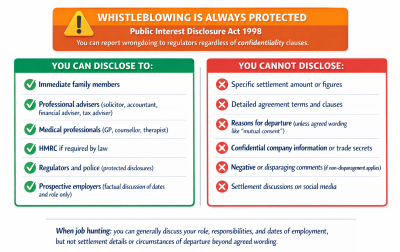
What can be kept confidential varies by agreement. Some are tightly drafted, prohibiting any discussion of the settlement. Others permit disclosure to immediate family and professional advisers (your solicitor, accountant, tax adviser). Most allow disclosure to HMRC if required for tax purposes.
What cannot be silenced: confidentiality clauses must not prevent protected disclosures under the Public Interest Disclosure Act 1998. You can always blow the whistle about wrongdoing in the public interest. You can report crimes to the police. You can comply with regulatory investigations. Any clause attempting to prevent this is unenforceable.
Acas guidance is clear: confidentiality clauses should not give the impression that they affect the protection provided to whistleblowers or prevent reporting of wrongdoing. The wording should include explicit carve-outs for protected disclosures.
The practical challenge is explaining your departure to recruiters. You need to be able to discuss your role, responsibilities, and reasons for leaving without breaching confidentiality. Most well-drafted agreements permit factual discussion of your employment and an agreed reason for leaving (like “redundancy” or “left by mutual agreement”). You simply can’t disclose the settlement amount or specific agreement terms.
You can negotiate broader exceptions. For example, explicitly allowing discussion with medical professionals, therapists, or support services. Or confirming that factual discussion of your skills, experience, and reason for leaving with prospective employers is permitted.
6. Non-Disparagement Clause
Non-disparagement clauses prevent you from making negative or derogatory comments about your employer, its directors, employees, or the settlement agreement itself. These clauses usually apply to both parties.
The scope defines what counts as disparagement. Typically, it covers public statements, social media posts, comments to the press, or discussions that could damage the employer’s reputation. Factual statements are usually permitted. Negative opinions or criticisms are not.
Social media creates particular risks. A frustrated tweet about your former employer or a negative Glassdoor review could breach a non-disparagement clause. The line between factual commentary and disparagement can be unclear, which is why these clauses are often difficult to enforce. But breach could result in legal action and potential repayment of your settlement sum.
Non-disparagement differs from confidentiality. Confidentiality prevents disclosure of information. Non-disparagement prevents negative characterisation of information you can disclose. You might be allowed to say you left your employer (no confidentiality breach) but not allowed to say you left because management was incompetent (potential disparagement).
These clauses work both ways. Your employer agrees not to disparage you either. This offers some protection against negative references or public criticism after you’ve left.
7. Restrictive Covenants
Restrictive covenants are common settlement agreement clauses that limit what you can do after your employment ends. Your settlement agreement may restate restrictions already in your employment contract or introduce new ones.
Common types include non-compete clauses (preventing you working for competitors), non-solicitation of clients (preventing you approaching the employer’s clients), non-solicitation of employees (preventing you recruiting former colleagues), and non-dealing provisions (preventing you doing business with clients you dealt with).
For restrictions to be enforceable, they must be reasonable. Courts assess whether the restriction is necessary to protect legitimate business interests, reasonable in duration and geographic scope, and not so broad that it prevents you earning a living in your field.
Durations beyond 12 months are uncommon outside senior roles. Geographic restrictions must relate to where the employer actually operates. Restrictions preventing any work in your entire industry are likely unenforceable.
If your settlement agreement introduces new restrictions (beyond what’s already in your employment contract), you should receive separate taxable consideration. This makes the restriction more enforceable and protects the tax-free status of your main settlement payment.
Before signing, review your employment contract. You may already be bound by restrictive covenants that continue after termination. Your settlement agreement might simply restate these existing obligations rather than imposing new ones.
Negotiation is possible. You can request shorter durations, narrower geographic scope, or exclusions for particular types of work. If restrictions would prevent you taking a role you’ve already been offered, this strengthens your negotiating position significantly.
8. Reference Terms
Most settlement agreements include agreed reference wording, usually in an annex. Your employer commits to providing only this agreed wording when responding to reference requests.
This prevents future disputes about references. Without agreed wording, you’re reliant on your employer’s goodwill. A negative or lukewarm reference could scupper job opportunities months or years later. An agreed reference locks in specific wording that you’ve approved.
References typically fall into two categories. Factual references confirm your dates of employment, job title, and salary. They avoid subjective opinions. These are safe for employers but may lack the detail that helps you secure your next role.
More detailed references include information about your responsibilities, achievements, and skills. These are more valuable but harder to agree because they involve subjective assessments. The key is ensuring the reference accurately reflects your contributions without including anything that could harm your prospects.
What about verbal references? Some agreements state that if a prospective employer contacts your former employer directly, they’ll provide information consistent with the written reference. Others limit the employer to providing only the written wording. Clarify this if verbal references are common in your industry.
9. Return of Company Property
This clause requires you to return all company property by the termination date or another specified deadline. The list typically includes laptops, mobile phones, access cards, keys, company vehicles, documents, and any other items belonging to the employer.
The clause usually gives your employer the right to deduct the cost of unreturned items from your final pay or settlement payment. Some go further, allowing the employer to withhold the entire settlement payment until property is returned.
You may also have to delete confidential information from personal devices. If you’ve emailed work documents to your personal email account, or saved files to your personal laptop, the agreement may require you to delete these and certify that you’ve done so.
This seems straightforward but can cause problems. If you’re working remotely, coordinating return of equipment takes time. If you need your laptop to complete handover work, you can’t return it until you’ve finished. If the employer demands immediate return but withholds payment pending receipt, you’re caught in the middle.
Ensure the timeline is realistic. Confirm how you’ll return items (courier collection, post, drop-off). Get written confirmation when items are received. Keep proof of postage if you’re mailing equipment. These small details prevent disputes over whether you’ve complied.
10. Warranties and Representations
Warranty clauses require you to confirm certain facts about your employment. You typically warrant that you haven’t breached your employment contract, haven’t been dishonest, haven’t concealed any misconduct, and aren’t aware of any circumstances that would entitle your employer to dismiss you.
You may also warrant that you don’t have any expectation of income from other sources, haven’t been offered alternative employment, and aren’t receiving state benefits that would be affected by the settlement payment.
The purpose is to protect the employer. If they discover serious misconduct after paying your settlement, they may attempt to recover the money. Some agreements explicitly state that if the employer later discovers undisclosed misconduct, you must repay the settlement sum.
Repayment clauses can be problematic. A clause requiring automatic repayment of the entire settlement for any breach may be an unenforceable “penalty clause”. Courts consider whether the sum is a genuine pre-estimate of loss or a penalty designed to deter breach.
Be honest about the facts you’re warranting. If you’re aware of issues that could be considered misconduct, disclose them before signing. Your adviser can help you assess whether disclosure is necessary and how to handle it.
Don’t warrant facts you’re unsure about. If you don’t know whether you’re entitled to a bonus, don’t warrant that you aren’t. If there’s any doubt, qualify the warranty or seek clarification before signing.
11. Entire Agreement Clause
The entire agreement clause is one of the most overlooked settlement agreement clauses. It states that the written settlement agreement contains all the terms you and your employer have agreed. It supersedes any previous arrangements, promises, or understandings.
This clause prevents you from relying on verbal promises or side agreements. If your manager verbally agreed that you’d receive next quarter’s bonus, but it’s not in the settlement agreement, the entire agreement clause typically voids that promise.
This is a critical risk. Employees sometimes sign settlement agreements believing that certain benefits or payments are still coming, only to discover that the entire agreement clause has wiped them out.
Before signing, ensure every agreement is in writing within the settlement agreement itself. Don’t rely on verbal assurances. Don’t assume that separate agreements about bonuses, commissions, or benefits will survive. Get everything documented in the settlement agreement or in a separate written agreement that explicitly survives the settlement.
If there are ongoing obligations that should survive (like a bonus scheme that pays out after termination, or a share option that vests later), the agreement should explicitly preserve these. Your adviser should identify these risks and ensure appropriate carve-outs.
12. Legal Advice Certificate
The final element is the legal advice certificate, usually on the last page or in an annex. Your independent adviser signs this to confirm they’ve advised you on the terms and effect of the agreement.
The certificate must identify the adviser by name, confirm they’re a relevant independent adviser (typically a qualified solicitor), and state that they have professional indemnity insurance covering the risk of loss arising from their advice.
The certificate confirms that the statutory conditions in section 203 of the Employment Rights Act 1996 have been satisfied. Without a valid certificate from a properly qualified and insured adviser, the settlement agreement may be unenforceable.
Your adviser must not be employed by your employer or acting on their behalf. Independence is crucial. That’s why employers typically contribute towards your legal costs rather than providing advice directly. The separation ensures you receive genuine independent advice.
The contribution is usually £250 to £500 plus VAT, though amounts vary. Some advisers charge fixed fees within this range. Others charge more, with you responsible for the difference. Clarify costs upfront so there are no surprises.
📋 Want a printable checklist for your agreement?
Our free clause-by-clause guide covers all 12 clauses with red flag warnings and negotiation tips.
Get Your Free Checklist ↓Red Flag Clauses to Watch For
Not all settlement agreements are fair. Some settlement agreement clauses contain warning signs that should make you pause and seek advice immediately. Here are the red flags to watch for.
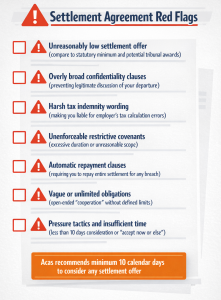
Unreasonably Low Settlement Offers
The most common red flag is a settlement payment that’s disproportionately low compared to what you could recover through a tribunal claim.
To assess whether an offer is fair, compare it to your potential tribunal awards. Consider your statutory redundancy entitlement (if applicable), notice pay you’re owed, potential basic and compensatory awards for unfair dismissal, and potential discrimination awards (which are uncapped).
If you’ve been discriminated against, your potential award could be substantial. Injury to feelings awards for discrimination use the Vento bands (2025/26):
- Lower band: £1,200-£13,900 (minor, one-off incidents)
- Middle band: £13,900-£41,700 (serious cases)
- Upper band: £41,700-£60,700 (most serious cases)
Source: Presidential Guidance on Vento Bands 2025
Financial losses are uncapped. A settlement offer of £5,000 to waive a strong discrimination claim worth potentially £40,000 is a red flag.
Length of service matters too. If you’ve worked for 15 years and are being offered a settlement equivalent to two months’ pay, that’s likely unfair unless your potential claims are genuinely weak.
Pressure to accept quickly compounds the problem. If your employer insists you must decide today or the offer is withdrawn, that’s improper behaviour. Acas guidance is clear: you should have at least 10 days to consider and obtain advice.
Overly Broad Confidentiality Clauses
Confidentiality is one of the most scrutinised settlement agreement clauses. Clauses that attempt to prevent you discussing the reasons for leaving at all should raise concerns. You need to be able to explain your departure to recruiters without breaching the agreement.
Clauses that appear to restrict whistleblowing are unenforceable but concerning. If the wording doesn’t explicitly carve out protected disclosures, or worse, if it suggests you cannot report wrongdoing, the agreement may not comply with the Public Interest Disclosure Act 1998.
Excessive restrictions on who you can tell are another warning sign. While confidentiality from the public makes sense, preventing you from discussing the agreement with immediate family or your therapist is unreasonable. Most agreements permit disclosure to family, professional advisers, and medical professionals.
Acas guidance and government policy emphasise that confidentiality clauses must not be used to cover up wrongdoing. If your agreement lacks appropriate carve-outs, request amendments before signing.
Harsh Tax Indemnity Wording
Tax indemnity is one of the settlement agreement clauses that varies most in harshness. The worst versions give your employer unlimited rights to reclaim money from you years later, without notice, even if the tax issue arose from the employer’s own poor advice.
Red flags include no time limit on potential claims (meaning your employer could demand repayment five years later), no requirement for reasonable notice before making a claim against you, and making you liable even where the employer’s tax adviser made the error.
Better wording limits the indemnity to actual HMRC demands (not theoretical liabilities), requires reasonable advance notice before your employer can enforce the indemnity, excludes liability where the employer’s own advice was wrong, and provides a time limit (say, six years) after which claims cannot be made.
Your adviser should review the tax treatment carefully. If PENP has been calculated incorrectly, or if taxable pay has been mischaracterised as tax-free, you’re taking on liability for the employer’s mistakes. Correcting the characterisation upfront protects you from future liability.
Unenforceable Restrictive Covenants
Restrictive covenants must be reasonable to be enforceable. Clauses with excessive duration, unreasonably broad geographic scope, or restrictions that prevent you earning a living are likely unenforceable but still create uncertainty.
Durations beyond 12 months are uncommon unless you’re in a senior role with access to genuinely sensitive information. Clauses preventing you from working for any competitor anywhere in the UK (or globally) for two years would rarely be upheld by a court.
New restrictions without separate payment are another issue. If your settlement agreement introduces restrictions that weren’t in your employment contract, you should receive additional taxable consideration. Without this, the restrictions may lack the necessary consideration to be enforceable.
Even if restrictions are unenforceable, they create a chilling effect. You may avoid taking a role you’re entitled to take because you’re worried about breach. That’s why negotiating reasonable restrictions before signing is preferable to challenging them later.
Penalty Clauses for Breach
Some agreements include clauses requiring you to repay the entire settlement sum if you breach any term. Courts are reluctant to enforce such clauses if they operate as penalties rather than genuine pre-estimates of loss.
A clause stating “if you breach confidentiality, you must repay £50,000” may be unenforceable if the actual loss to your employer from breach is minimal. Courts ask whether the sum is a genuine pre-estimate of loss or a penalty designed to deter breach.
That said, you shouldn’t sign an agreement expecting to breach it and rely on unenforceability. The uncertainty and potential litigation risk aren’t worth it. If you can’t live with a term, negotiate it out before signing.
Vague or Unlimited Obligations
Clauses requiring “future cooperation” or “reasonable assistance” without defining scope or time limits create open-ended obligations. You could find yourself required to attend meetings, provide witness statements, or assist with legal proceedings months or years after leaving, with no compensation.
Better wording defines what cooperation means, limits the time commitment (say, a maximum of five days per year), specifies that assistance will be at mutually convenient times, and provides for payment if cooperation extends beyond a minimal level.
Without clear boundaries, these clauses can be used to pressure you into ongoing unpaid work long after your employment has ended.
Pressure and Insufficient Time
If you’re being given less than 10 days to consider the offer, that’s a red flag. Acas recommends a minimum of 10 calendar days. If your employer is pushing for signature within 48 hours, they may be hoping you’ll sign without proper advice.
“Take it or leave it” ultimatums are another warning sign. While employers can withdraw offers, threatening to do so if you seek legal advice or ask questions may constitute improper behaviour under section 111A of the Employment Rights Act 1996.
Any attempt to discourage you from seeking independent legal advice is a serious concern. The law requires you to receive advice precisely because settlement agreements waive important rights. An employer who suggests you don’t need advice, or that seeking advice will delay things, is not acting in good faith.
“When employers pressure employees to sign quickly, it’s often because they know the offer won’t stand up to scrutiny. I’ve negotiated settlements where the revised offer was 200 to 300 per cent higher than the initial proposal, simply because we took the time to assess the true value of the claims being waived. Never let urgency override proper consideration.”
Which Clauses Are Negotiable?
Settlement agreements are contracts, and most settlement agreement clauses can be negotiated. Understanding what’s flexible and what isn’t helps you focus your energy on winnable changes.
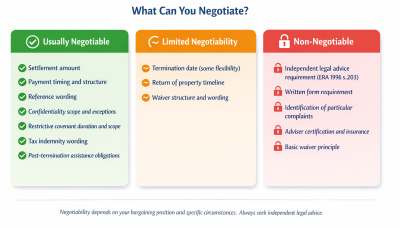
Usually Negotiable
Most settlement agreement clauses offer room for negotiation. The settlement amount is often the most negotiable element. If your potential tribunal claims are strong, or if the offer doesn’t account for your length of service and statutory entitlements, there’s room to negotiate upwards.
Payment timing and structure can often be adjusted. If you need funds sooner, you can request payment within a shorter timeframe. If tax treatment concerns you, restructuring how the payment is characterised (within legal limits) may be possible.
Reference wording is almost always negotiable. Your employer may start with a bare-bones factual reference. You can request more detail about your responsibilities and achievements. Negotiating fair reference wording is one of the most valuable outcomes of the settlement process.
Confidentiality scope and exceptions are negotiable. If the draft is overly restrictive, you can request broader exceptions for family, professional advisers, and discussing your role with future employers. You can negotiate explicit confirmation that factual discussion of your work is permitted.
Restrictive covenant scope and duration are often flexible. If the restrictions would prevent you taking a role you’ve been offered, that strengthens your position significantly. Employers may agree to shorter durations, narrower geographic limits, or specific carve-outs.
Tax indemnity wording can be improved. Request time limits on potential claims, requirements for reasonable notice, and exclusions where the employer’s advice was wrong. Better wording protects you from open-ended liability.
Post-termination assistance obligations should be defined. Request clarity on scope, time commitment, compensation, and time limits. Open-ended cooperation clauses can be tightened to protect your time.
Limited Negotiability
Termination date has some flexibility. You may be able to negotiate staying employed longer (to reach a service milestone or vesting date) or leaving sooner if you’ve secured alternative employment. The range of movement is usually limited, but asking doesn’t hurt.
Return of property is largely standard. You’ll need to return company items regardless. You can negotiate reasonable timelines and logistics, but the core obligation isn’t going away.
Waiver of claims structure must meet section 203 requirements. The employer needs certainty that potential claims are resolved. You can negotiate the settlement amount in exchange for the waiver, but the waiver itself is usually non-negotiable in structure.
Non-Negotiable Legal Requirements
Independent legal advice is a legal requirement under section 203 of the Employment Rights Act 1996. You cannot waive this. The agreement must be in writing. It must relate to particular complaints or proceedings. Your adviser must be identified and insured. The agreement must state that statutory conditions are satisfied.
These requirements protect you. Don’t try to negotiate them away. Without them, the agreement may be unenforceable, which creates uncertainty for both parties.
How to Negotiate Effectively
Work through your qualified independent adviser. They negotiate settlement agreement clauses on your behalf, which removes emotion from the process and brings professional expertise to the discussion.
Identify your priorities. You likely can’t change everything. Focus on what matters most. For most people, that’s the settlement amount, reference wording, and any restrictions that would affect future employment.
Gather evidence of potential claim strength. If you can demonstrate that your discrimination claim has merit, or that your unfair dismissal case is strong, you’re negotiating from a position of strength. Your adviser will assess the evidence and present it to the employer’s side.
Research comparable settlement amounts. Your adviser can tell you what similar cases typically settle for. This informs expectations and provides benchmarks for negotiation.
Be prepared to walk away if terms are unfair. Sometimes the best negotiation tactic is credibly showing you’re willing to reject the offer and pursue tribunal proceedings. If your claims are strong and the offer is insulting, pursuing the claim may be the right choice.
Request time to consider any revised offer. If your employer improves the offer after negotiation, don’t feel pressured to accept immediately. You’re entitled to consider revised terms carefully, just as you were with the initial offer.
Complete Clause-by-Clause Checklist
Download our comprehensive PDF guide covering all 12 settlement agreement clauses with red flag warnings, negotiation strategies, and expert advice
✓ What’s Included:
- Detailed explanation of all 12 standard clauses
- Red flag warning signs for each clause type
- Negotiation strategies and talking points
- Questions to ask your legal adviser
- Settlement amount comparison calculator
- Tax treatment breakdown worksheet
- Common employer tactics and responses
No email required • Instant access • Updated for 2025/26
When You Need More Than a Guide
- A comprehensive guide is valuable, but it’s not a substitute for independent legal advice. Understanding settlement agreement clauses is important, but there are situations where professional advice isn’t just recommended but essential.
- If you’re facing a complex discrimination claim, the potential awards are substantial and uncapped. A guide can’t assess the strength of your evidence or calculate a fair settlement amount. You need a solicitor with discrimination law expertise.
- If the settlement offer seems unfairly low compared to your length of service or potential claims, professional negotiation can significantly increase the offer. Many settlements improve by thousands of pounds through skilled negotiation.
- If your employer is pressuring you to sign quickly without proper consideration time, that’s a sign something’s wrong. A solicitor can protect your interests and push back against improper pressure.
- If restrictive covenants would prevent you from working in your field or taking a specific role you’ve been offered, you need legal advice on challenging or negotiating those restrictions.
- Remember, you have a legal right to independent advice before signing. Your employer typically contributes £250 to £500 towards your costs. Take advantage of this. The advice could be worth thousands of pounds in improved settlement terms.
📞 Need Help with Your Settlement Agreement?
We provide fixed-fee settlement agreement advice across the UK. Call us for a free initial discussion about your situation.
Get Free Initial Advice →Frequently Asked Questions
Can my employer force me to sign a settlement agreement?
No. Settlement agreements and their clauses are entirely voluntary. Your employer cannot discipline or dismiss you simply for refusing to sign one. If they dismiss you after you refuse a settlement offer, that could strengthen any unfair dismissal claim you bring. That said, your employer may proceed with alternative actions (such as a disciplinary process) if you refuse. The settlement agreement is an offer to resolve matters by agreement. If you decline, the underlying issues may still be addressed through other means.
What if I’ve already signed but now regret it?
Settlement agreements are generally binding once signed, provided you received proper independent legal advice. There are limited grounds to set aside an agreement: duress, undue influence, misrepresentation, or lack of capacity. If you didn’t receive proper independent advice, the agreement may be unenforceable under section 203 of the Employment Rights Act 1996. These are narrow exceptions. If you’re concerned, seek legal advice immediately. Time limits apply to challenging agreements, so don’t delay.
Do I have to tell future employers I signed a settlement agreement?
No. There’s no legal requirement to disclose that you signed a settlement agreement. Most confidentiality clauses permit factual discussion of your role, responsibilities, and an agreed reason for leaving. You can usually say you “left by mutual agreement” or were made redundant (if that’s the reason). What you cannot do is disclose the settlement amount or specific terms of the agreement. Check your agreement’s confidentiality clause to confirm what you can say about your departure.
What happens if I breach the confidentiality clause?
Breach of a confidentiality clause is breach of contract. Your employer can sue for damages. Some agreements include repayment clauses requiring you to return the settlement sum if you breach confidentiality. Your employer would need to prove actual loss from the breach. Protected disclosures (whistleblowing) cannot constitute breach. If you report wrongdoing to a regulator or the police, that’s protected under the Public Interest Disclosure Act 1998, and the confidentiality clause cannot prevent it.
Can I negotiate after receiving the first offer?
Yes. Settlement agreements are negotiable contracts. Your independent adviser will negotiate on your behalf. Common areas for negotiation include the settlement amount, reference wording, restrictive covenants, and confidentiality scope. Your employer may reject counter-offers, but they cannot punish you for negotiating. The negotiation process is normal and expected. Many initial offers improve significantly through negotiation.
How long do I have to decide?
Acas recommends that employers give you at least 10 calendar days to consider a settlement offer. This is guidance, not law, but it’s widely followed. You can request more time if needed. Reasonable adjustments apply if you’re disabled and need longer to obtain appropriate advice. If you’re given insufficient time, that may constitute “improper behaviour” under section 111A of the Employment Rights Act 1996, potentially allowing settlement discussions to be used as evidence in tribunal proceedings.
Who pays for my legal advice?
Employers typically contribute towards your legal costs, usually £250 to £500 plus VAT. This isn’t a legal requirement, but it’s standard practice. The contribution ensures the agreement is legally binding, as you must receive independent legal advice under section 203 of the Employment Rights Act 1996. You’re responsible for any costs exceeding the employer’s contribution. Some solicitors offer fixed fees within the contribution amount. Others charge more, with you covering the difference. Clarify costs upfront.
Can I change my mind after signing?
Generally no. Settlement agreements are binding immediately upon exchange. There’s no statutory cooling-off period. Limited circumstances permit setting aside the agreement: lack of capacity, misrepresentation, duress, or lack of proper independent advice. These are narrow exceptions. Once you’ve signed with proper advice, the agreement is binding. This is why taking time to consider the terms carefully before signing is so important. Don’t sign unless you’re certain you understand and accept the terms.
Full Disclaimer
This guide provides general information about settlement agreement clauses under UK employment law. It is not legal advice and should not be relied upon as such.
Every settlement agreement and every employment situation is different. The information in this guide may not apply to your specific circumstances. Settlement agreements are legally binding contracts that waive important employment rights. You should always seek independent legal advice from a qualified solicitor before signing.
Under section 203 of the Employment Rights Act 1996, you must receive advice from a relevant independent adviser for a settlement agreement to be legally valid. This guide does not constitute that advice.
Tom Street & Co. Solicitors is authorised and regulated by the Solicitors Regulation Authority (SRA No. 566718). We provide specialist employment law advice to employees across England, Wales, and Scotland.
If you have received a settlement agreement and need advice, please contact us for a free initial discussion.
Sources and Further Reading
Primary Legislation
- Employment Rights Act 1996, section 203: Legal requirements for valid settlement agreements
- Employment Rights Act 1996, section 111A: Protected conversations and pre-termination negotiations
- Public Interest Disclosure Act 1998: Whistleblowing protections (cannot be waived by settlement agreements)
- Income Tax (Earnings and Pensions) Act 2003, sections 401-405: £30,000 tax-free allowance for termination payments
Official Guidance
- Acas Settlement Agreement Template: Standard template showing typical clause structure
- Acas: How to Use Our Settlement Agreement Template: Clause-by-clause guidance
- Acas: Using Settlement Agreements: Best practice guidance, including 10-day consideration period
- Acas: Confidentiality in Settlement Agreements: What can and cannot be kept confidential
- GOV.UK: Employment Tribunal Limits 2025/26: Current statutory caps
Legal Commentary
- DavidsonMorris: Settlement Agreements 2026: Current practice and typical clauses
- Pembridge Solicitors: Five Warning Signs: Red flags in settlement agreements
- THP Solicitors: Confidentiality Clauses: Limits on confidentiality and when clauses are unenforceable
About the Author
Tom Street, Principal Solicitor
Tom Street is the principal solicitor at Tom Street & Co. Solicitors (SRA No. 566718), specialising in employment law for employees. He has extensive experience advising on settlement agreements, tribunal claims, and workplace disputes. Tom provides fixed-fee settlement agreement advice to employees across England, Wales, and Scotland.