

Settlement Agreement Solicitors
Been offered a settlement agreement? Get expert legal advice within 24 hours. Your employer pays our fees – it costs you nothing.
- ✓ Your employer pays – no cost to you
- ✓ Expert negotiation – we often increase offers by 20-50%
- ✓ Clear advice within 24 hours
- ✓ Tax advice – first £30,000 is tax-free
£500K+
Negotiated in increases
300+
Agreements reviewed
24-48hrs
Typical turnaround
Free Tools: No Sign-Up Required
Assess Your Settlement Agreement Before You Call Us
Three specialist tools to help you understand your offer, your tax position, and your agreement. Use them free, right now.
Should I Accept This Settlement Agreement?
Four key questions to ask before signing:
Is the amount fair?
Compare to your salary, length of service, and what you could win at tribunal
Can I negotiate more?
Most offers have room for negotiation. We typically increase offers by 20-50%
What am I signing away?
Restrictive covenants can prevent you working in your industry for 6-12 months
Is the tax treatment correct?
First £30,000 should be tax-free. Incorrect tax can cost you thousands
Don’t sign without advice. You can’t undo a settlement agreement once signed.
How Our Settlement Agreement Service Works
From first contact to signed agreement in three simple steps
Send Us Your Agreement
Upload your agreement or call 020 3835 3940. We respond within 24 hours (usually same day) to arrange a consultation.
Expert Review & Negotiation
We review every clause, check the tax treatment, assess whether the amount is fair, and identify areas for negotiation. If appropriate, we negotiate improved terms directly with your employer.
Clear Advice Certificate
Once you’re happy with the terms, we issue your advice certificate. This makes the agreement legally binding and triggers payment of our fees by your employer.
Your employer pays our fees. Independent legal advice is a legal requirement, not optional.
Want to understand settlement agreements in detail? Keep reading for the complete guide.
Quick Summary
A settlement agreement is a legally binding contract ending your employment in exchange for compensation. Your employer must pay for independent legal advice (typically £300-£750 plus VAT). The first £30,000 is tax-free. You typically have 10 days to get advice and respond. Expert negotiation often increases offers by 20-50%. Once signed, you can’t usually bring employment tribunal claims.
⚖️ This guide is for general information only and is not legal advice. Every settlement agreement is different. Always get independent legal advice before signing.
Key Points
- ✓ Your employer must pay for your independent legal advice (usually £300-£750 plus VAT)
- ✓ The first £30,000 is tax-free (compensation for loss of office under section 403 ITEPA 2003)
- ✓ You typically have 10 days to consider the offer, get advice, and respond
- ✓ Most offers have room for negotiation – we typically increase offers by 20-50%
- ✓ Once signed with legal advice, you waive your right to bring tribunal claims
- ✓ Restrictive covenants can prevent you working for competitors for 6-12 months
- ✓ You can negotiate the reference, notice period, and other non-financial terms
What Is a Settlement Agreement?
A settlement agreement (formerly called a compromise agreement) is a legally binding contract between you and your employer that ends your employment on agreed terms. In exchange for waiving your right to bring employment tribunal claims, your employer pays you compensation and agrees to other terms such as a reference.

Settlement agreements are governed by section 203 of the Employment Rights Act 1996 and equivalent provisions in other employment legislation. To be valid, a settlement agreement must meet strict legal requirements.
Why Do Employers Use Settlement Agreements?
Employers typically offer settlement agreements in four situations:
Redundancy situations where the employer wants to avoid the risk of unfair dismissal claims, particularly where selection or consultation processes may be vulnerable to challenge.
Performance or conduct issues where the employer prefers a clean break rather than running a disciplinary process that might end in dismissal and a potential tribunal claim.
Discrimination or whistleblowing concerns where the employer faces significant legal risk and wants to settle before an employment tribunal claim is lodged.
Restructuring or TUPE transfers where the employer needs to reduce headcount but wants certainty that dismissed employees won’t bring claims.
In all these situations, the employer benefits from certainty. Once you sign a valid settlement agreement, you can’t usually bring tribunal claims about the matters covered.
Legal Requirements for Valid Settlement Agreements
Under section 203 ERA 1996, a settlement agreement is only valid if it meets all of these conditions:
The agreement must be in writing and relate to specific complaints or proceedings. It must identify the employee and employer clearly. The employee must have received advice from a relevant independent adviser (usually a qualified solicitor). The adviser must have professional indemnity insurance covering the risk of a claim by the employee. The agreement must state that the statutory conditions regulating settlement agreements are satisfied.
If any of these conditions aren’t met, the agreement isn’t binding and you could still bring tribunal claims despite signing it.
“The requirement for independent legal advice isn’t optional paperwork. It’s a fundamental protection ensuring employees understand what they’re signing. Without proper advice, settlement agreements can be challenged. That’s why your employer must pay for a qualified solicitor to review the agreement and explain it to you.”

Who Pays for Settlement Agreement Advice?
Your employer pays for your independent legal advice. This isn’t optional or negotiable. The law requires you to receive advice from a qualified solicitor or other authorised adviser before the agreement becomes binding, and your employer must fund this.
Typical legal fees for settlement agreement advice range from £300 to £750 plus VAT, depending on the complexity of the agreement. Most employers offer a fixed contribution (often £300-£500 plus VAT) regardless of the solicitor’s actual fees. If your solicitor’s fees exceed the contribution, you can either pay the difference yourself or find a solicitor who works within the contribution amount.
What the Legal Fee Covers
For the legal fee, your solicitor should provide:
A thorough review of every clause in the settlement agreement. Clear advice on whether the financial offer is fair based on your circumstances. Identification of any problematic terms, particularly restrictive covenants. Explanation of the tax treatment and how much you’ll actually receive. Assessment of whether you have stronger claims that might justify rejecting the offer. Negotiation with your employer to improve the terms where appropriate. Advice on alternatives if the offer is inadequate. A certificate of independent legal advice that makes the agreement binding.
If your solicitor simply rubber-stamps the agreement without proper analysis and advice, you’re not receiving the independent legal advice the law requires.
Can I Choose My Own Solicitor?
Yes, you can choose any qualified solicitor to advise you. Your employer might suggest solicitors, but you’re not obliged to use them. Many employees prefer to instruct their own solicitor to ensure complete independence.
The solicitor must be independent of your employer. If your employer’s usual solicitor offers to advise you, decline. The same firm cannot advise both employer and employee on a settlement agreement because of the obvious conflict of interest.
Can I Negotiate a Settlement Agreement?
Yes, most settlement agreements are negotiable. The initial offer is rarely the employer’s final position. With expert negotiation, we typically increase settlement offers by 20-50%, though the potential for negotiation depends on several factors.
What Determines Negotiating Power?
Your negotiating position depends on the strength of any potential tribunal claims, your length of service and seniority, the employer’s reason for offering settlement, the employer’s appetite for risk and legal costs, and any weaknesses in the employer’s position.
If you have strong discrimination claims or whistleblowing claims, you have significant negotiating leverage. These claims have no compensation cap and can result in substantial awards including injury to feelings compensation. If the employer’s procedures have been flawed, this also strengthens your position.
Conversely, if you’ve been employed for less than two years and have no discrimination or whistleblowing claims, your negotiating position is weaker because you have limited tribunal rights.
Real Negotiation Examples
Example 1: Disability discrimination
Initial offer: £12,000
Our assessment: Strong discrimination claim given employer’s failure to make reasonable adjustments
Negotiated settlement: £28,000
Increase: £16,000 (133% increase)
Example 2: Redundancy with flawed consultation
Initial offer: £15,000 (statutory redundancy plus 3 months’ salary)
Our assessment: Selection process vulnerable to challenge, inadequate consultation
Negotiated settlement: £22,500
Increase: £7,500 (50% increase)
Example 3: Whistleblowing dismissal
Initial offer: £25,000
Our assessment: Protected disclosures made, clear detriment and dismissal linked to disclosures
Negotiated settlement: £45,000 plus tax indemnity
Increase: £20,000+ (80% increase)
What Can Be Negotiated?
Beyond the compensation amount, several other terms are often negotiable:
The reference – You can negotiate an agreed wording that your employer must provide to prospective employers. This gives you certainty about what will be said.
Payment timing – Standard agreements require payment within 28 days of signing. You might negotiate earlier payment if you need immediate funds.
Notice period – Whether you work your notice or leave immediately on garden leave affects when you can start a new job.
Restrictive covenants – Non-compete clauses and non-solicitation clauses can be narrowed in scope or duration if they’re unreasonably restrictive.
Benefits continuation – Medical insurance, pension contributions, and other benefits might continue during any garden leave period.
Return of property – Company car, laptop, phone – you might negotiate keeping some items or having more time to return them.
Announcement of departure – Agreed wording for informing colleagues and clients about your departure protects your reputation.
Tax Treatment of Settlement Agreements
How your settlement payment is taxed can significantly affect how much you actually receive. Understanding the tax treatment is essential before accepting any offer.
The £30,000 Tax-Free Rule
Under section 403 of the Income Tax (Earnings and Pensions) Act 2003, the first £30,000 of compensation for loss of office is exempt from income tax and National Insurance. This is often called termination payment or ex-gratia payment in the settlement agreement.
This exemption applies to genuine compensation for loss of employment, not to payments you were already entitled to.
What Is Taxable?
Several components of settlement payments are always taxable:
Payment in lieu of notice (PILON) – If your contract allows the employer to make a payment instead of requiring you to work your notice, this payment is fully taxable as earnings. Even if your contract doesn’t have a PILON clause, payments covering the statutory notice period are now taxable following changes in Finance Act 2018.
Accrued but untaken holiday pay – You’re entitled to be paid for any holiday you’ve accrued but not taken. This is taxable as normal earnings.
Bonus payments you’re entitled to – If your contract entitles you to a bonus and it’s included in the settlement, this element is taxable.
Salary up to termination date – Obviously, any normal salary up to your last day is taxed as earnings.
Any amounts above £30,000 – Once the tax-free £30,000 threshold is exceeded, all additional compensation is subject to income tax (but not usually National Insurance).
💡 Check your settlement agreement tax breakdown
Enter the figures from your offer and see exactly what is tax-free, what is taxable, and what you will take home. Uses current 2025/26 rates.
Calculate Your Take-Home Pay →Settlement Agreement Tax Examples
Example 1: Simple termination payment
Settlement offer: £25,000
Contractual notice: 3 months (employer paying in lieu of notice)
Gross monthly salary: £3,500
Breakdown:
PILON (3 months × £3,500): £10,500 (taxable as earnings)
Ex-gratia payment: £14,500 (tax-free under £30,000 threshold)
Tax payable on PILON: approximately £4,200 (at 40% tax rate)
Net receipt: approximately £20,800
Example 2: Large settlement above £30,000 threshold
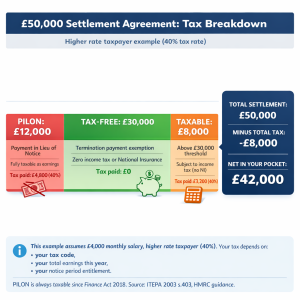
Settlement offer: £50,000
Contractual notice: 3 months
Gross monthly salary: £4,000
Breakdown:
PILON (3 months × £4,000): £12,000 (taxable as earnings)
Ex-gratia payment: £38,000
First £30,000 of ex-gratia: £30,000 (tax-free)
Remaining £8,000: Taxable at marginal rate (40% = £3,200)
Tax on PILON: approximately £4,800
Total tax: approximately £8,000
Net receipt: approximately £42,000
Tax Indemnities
Sometimes settlement agreements include a tax indemnity clause. This means if HMRC later determines that more tax should have been paid on the settlement, your employer will cover the additional tax bill.
Tax indemnities are particularly relevant where there’s genuine uncertainty about whether specific payments fall within the £30,000 exemption. Your solicitor should identify where a tax indemnity would be appropriate and negotiate for one if needed.
“I’ve seen employees lose thousands because they didn’t understand the tax treatment. A £40,000 settlement sounds great until you realise £12,000 is taxable PILON and another £10,000 is taxable because it’s above the £30,000 threshold. Suddenly your take-home is £28,000, not £40,000. Getting this right at the negotiation stage is crucial.”
What Claims Do You Waive?
When you sign a settlement agreement, you waive (give up) your right to bring employment tribunal claims about the matters covered by the agreement. Understanding exactly what you’re giving up is essential before signing.
Typical Claims Waived
Most settlement agreements require you to waive all possible claims arising from your employment and its termination, including:
Unfair dismissal claims under the Employment Rights Act 1996. Discrimination claims under the Equality Act 2010 (covering age, disability, gender reassignment, marriage and civil partnership, pregnancy and maternity, race, religion or belief, sex, and sexual orientation). Whistleblowing claims (automatically unfair dismissal for making protected disclosures). Unlawful deduction of wages claims. Breach of contract claims. Redundancy payment claims. Working time regulation claims. National minimum wage claims. Claims relating to TUPE transfers.
The agreement will typically state that you waive “all and any claims whether under statute, common law or in equity” that you have or may have against the employer, known or unknown at the date of the agreement.
What Claims Can’t Be Waived?
Some rights can’t be waived in a settlement agreement, even if the agreement tries to exclude them:
Personal injury claims – You cannot waive claims for personal injury unless the injury is known and specifically detailed in the settlement agreement. If you develop a work-related injury after signing, you can still bring a claim.
Pension rights – Settlement agreements cannot waive claims relating to pension benefits, except where specifically permitted by pensions legislation.
Accrued statutory rights – Rights that have already crystallised, such as accrued holiday pay you’re entitled to, cannot be waived for less than their full value.
Future discrimination – You cannot waive claims about future events. If your employer discriminates against you after the settlement agreement is signed, you can bring a new claim about those events.
Should I Accept If I Have Strong Claims?
This is the key strategic question your solicitor should help you answer. If you have strong tribunal claims worth potentially more than the settlement offer, rejecting the offer and pursuing a tribunal claim might be the better option.
Factors to consider include the strength and value of your potential claims, the risk and stress of tribunal litigation, how long a tribunal claim will take (typically 9-18 months), whether you have evidence to support your claims, your financial situation and need for immediate payment, and your appetite for confrontation with your former employer.
Your solicitor should provide an honest assessment of your chances of success at tribunal and potential compensation, enabling you to make an informed decision about whether settlement is the right choice.
Restrictive Covenants in Settlement Agreements
Most settlement agreements include restrictive covenants – clauses that restrict what you can do after leaving the company. These can significantly affect your ability to work in your industry.
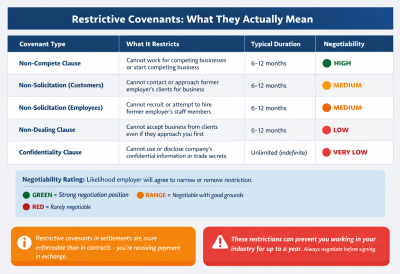
Common Restrictive Covenants
Non-compete clauses prevent you from working for competing businesses for a specified period (typically 6-12 months) after leaving. These are often geographically limited.
Non-solicitation of clients prevents you from approaching the company’s clients for business, even if you’re working for a non-competitor.
Non-solicitation of employees prevents you from recruiting or attempting to recruit the company’s staff.
Non-dealing with clients prevents you from accepting business from clients who approach you, even if you don’t solicit them.
Non-use of confidential information prohibits using the company’s confidential information or trade secrets in your next role.
Are Restrictive Covenants Enforceable?
Restrictive covenants in settlement agreements are more likely to be enforceable than those in employment contracts because settlement agreements are freely negotiated contracts where you receive consideration (the settlement payment) in exchange for accepting restrictions.
However, restrictive covenants must still be reasonable to be enforceable. A covenant is only reasonable if it’s necessary to protect the employer’s legitimate business interests and goes no wider than necessary in terms of duration, geographical scope, and scope of activity.
Negotiating Restrictive Covenants
If proposed restrictive covenants would seriously affect your ability to earn a living, negotiate them. Options include:
Reducing the duration from 12 months to 6 months or 3 months. Narrowing the geographical scope. Limiting the definition of competing business more precisely. Excluding specific clients or employees from non-solicitation clauses. Removing restrictions altogether in exchange for lower settlement payment.
Remember that restrictive covenants in settlement agreements are negotiable. If your employer insists on restrictions that would prevent you working in your industry, the settlement payment should reflect this significant restriction on your future earning capacity.
Time Limits and Deadlines
Settlement agreements usually include deadlines for response and signing. Understanding these time limits is important.
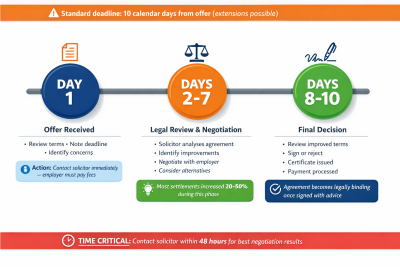
The Standard 10-Day Period
Most settlement agreements give you 10 calendar days to consider the offer, get legal advice, and respond. This isn’t a legal requirement but it’s standard practice.
The 10-day period starts from when you receive the draft agreement, not from when you first discuss settlement. Your employer should give you a reasonable period to consider the offer before the deadline expires.
Can I Extend the Deadline?
Yes, deadlines are usually negotiable. If you need more time to consider the offer, instruct a solicitor, or negotiate terms, ask your employer for an extension. Most employers will agree to reasonable extensions, particularly if you’re actively engaging with the process.
What Happens If I Miss the Deadline?
If you don’t respond by the deadline, the employer might withdraw the offer. Alternatively, they might extend the deadline or take that as rejection and proceed with whatever they were planning (usually dismissal).
Don’t rush to sign just because a deadline is approaching. If you need more time for proper legal advice, request an extension rather than signing without fully understanding the terms.
The Reference
The reference clause in a settlement agreement determines what your employer will say about you to prospective employers. This can be one of the most valuable elements of the agreement.
Types of References
Agreed reference – The settlement agreement includes an agreed wording that your employer must provide when asked for a reference. This gives you certainty and control.
Basic/factual reference – The employer agrees to provide only dates of employment, job title, and salary. No commentary on performance or conduct.
Positive/neutral reference – The employer agrees the reference will be positive or neutral in tone, without specifying exact wording.
Negotiating the Reference
If your departure relates to performance concerns or conduct issues, negotiate an agreed reference wording that presents your employment positively. Draft your ideal reference and ask your employer to agree to it as part of settlement.
Key points for a good reference include confirmation of your job title and dates, positive statements about your skills and contributions, neutral wording about reason for leaving (often “left by mutual agreement as part of workforce restructuring” or similar), and no negative or qualified statements.
Breaching the Reference Obligation
If your employer agrees to provide a specific reference in the settlement agreement but then provides a different or more negative reference to a prospective employer, they’ve breached the settlement agreement. You can bring a breach of contract claim in the civil courts.
This is why agreed references in settlement agreements are valuable: they create a binding contractual obligation to say specific things about you, rather than leaving it to the employer’s discretion.
Common Settlement Agreement Mistakes
These are the most common mistakes we see employees make with settlement agreements:
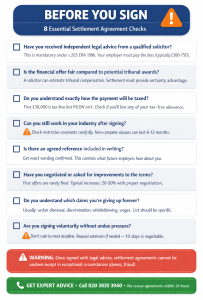
Signing Without Independent Legal Advice
Never sign a settlement agreement without getting independent legal advice from a qualified solicitor. Without a solicitor’s certificate, the agreement isn’t binding anyway, but more importantly, you need to understand what you’re signing and whether the terms are fair.
Some employees think they can save time by signing quickly and getting advice afterwards. This doesn’t work. Once you’ve signed without proper advice, you’ve lost your negotiating position even if the agreement isn’t technically binding.
Accepting the First Offer
The initial settlement offer is almost never the employer’s best offer. Employers expect negotiation and usually have room to increase the offer, particularly if you have strong potential claims.
Always have a solicitor assess whether the offer is fair and whether negotiation is likely to improve terms before accepting.
Not Understanding the Tax Treatment
Accepting an offer without understanding the tax implications means you might be surprised when you receive less than expected. Make sure your solicitor explains clearly how much you’ll actually receive after tax.
Ignoring Restrictive Covenants
Many employees focus entirely on the financial offer and ignore restrictive covenants that might prevent them working in their industry for 12 months. These clauses can be more costly than a few thousand pounds difference in settlement amount.
Not Negotiating the Reference
Leaving employment without an agreed reference means your employer can say whatever they like (as long as it’s truthful). If there have been performance concerns or difficult circumstances, not having an agreed reference can harm your job prospects.
Missing the Deadline Through Inaction
Some employees are paralysed by the decision and miss deadlines without either accepting, rejecting, or negotiating. This usually results in the offer being withdrawn and you losing the opportunity to negotiate better terms.
How We Help With Settlement Agreements
Our settlement agreement service provides comprehensive advice and negotiation to ensure you get the best possible outcome.
What Our Service Includes
Full review of every clause – We read every word of your settlement agreement, not just the financial offer. This includes checking restrictive covenants, confidentiality clauses, the reference, tax treatment, and any unusual terms.
Assessment of fairness – We assess whether the financial offer is fair based on your length of service, salary, potential tribunal claims, and comparable settlements. If the offer is inadequate, we’ll tell you.
Identification of problems – We identify any problematic terms that might cause you difficulties, particularly overly restrictive covenants that would limit your ability to work.
Negotiation – Where appropriate, we negotiate with your employer to increase the financial offer, improve the reference, narrow restrictive covenants, or improve other terms. Most of our clients see improved offers after negotiation.
Tax advice – We explain exactly how the settlement will be taxed and how much you’ll receive after tax. If the tax treatment seems incorrect, we negotiate with your employer to structure the payment more favourably.
Clear recommendations – We provide clear advice on whether to accept, reject, or seek to negotiate the offer, with honest assessment of your alternatives.
Certificate of independent legal advice – Once you’re happy with the terms, we provide the certificate that makes the agreement legally binding.
Our Fees
Our fees for settlement agreement advice are typically £495 plus VAT for standard agreements. For complex agreements or those requiring significant negotiation, fees may be higher, but we’ll agree this with you upfront.
Your employer pays our fees up to the amount of their contribution (usually £300-£750 plus VAT). If our fees exceed their contribution and you’re happy with the settlement offer, you pay the difference. If we negotiate an increased settlement, the increase usually far exceeds any shortfall in legal fees.
How to Instruct Us
To instruct us for settlement agreement advice:
Use our form to upload your agreement, we will get back to you the same working day. Include details of your employment (start date, job title, salary, circumstances of the offer). We’ll respond within 24 hours (usually same day) to arrange a telephone consultation. We’ll review the agreement in detail and discuss it with you by phone, explaining every clause and what it means for you. If negotiation is appropriate, we’ll handle this directly with your employer or their solicitors. Once you’re happy with the final terms, we’ll issue your certificate of independent legal advice.
Call us on 020 3835 3940 to discuss your settlement agreement today.
📄 Upload Your Settlement Agreement
Secure online upload – we’ll respond within 24 hours
Upload Agreement Now →Settlement Agreement: Frequently Asked Questions
What is a settlement agreement?
A settlement agreement is a legally binding contract between you and your employer that ends your employment on agreed terms. In exchange for compensation, you waive your right to bring employment tribunal claims about matters covered by the agreement.
Who pays for settlement agreement legal advice?
Your employer pays for your independent legal advice. This is a legal requirement, not optional. Employers typically contribute £300-£750 plus VAT towards your solicitor’s fees. If your solicitor’s fees exceed this amount, you may need to pay the difference.
Is the first £30,000 really tax-free?
Yes, the first £30,000 of genuine compensation for loss of office is tax-free under section 403 ITEPA 2003. However, this doesn’t include payments you’re already entitled to (like payment in lieu of notice, accrued holiday pay, or contractual bonuses), which are taxed as normal earnings.
Can I negotiate my settlement agreement?
Yes, most settlement agreements are negotiable. With expert negotiation, we typically increase settlement offers by 20-50%. You can negotiate the financial amount, restrictive covenants, the reference, payment timing, and other terms. The initial offer is rarely the employer’s final position.
How long do I have to consider a settlement agreement?
Most settlement agreements give you 10 calendar days to consider the offer, get legal advice, and respond. This isn’t a legal requirement but is standard practice. You can usually request an extension if you need more time.
What happens if I don’t sign?
If you reject the settlement agreement, the employer will usually proceed with whatever they were planning – typically dismissal in redundancy, performance, or conduct situations. You could then bring employment tribunal claims about your dismissal if you have grounds to do so.
Can I still go to tribunal after signing?
Generally no. Once you sign a valid settlement agreement with proper legal advice, you waive your right to bring tribunal claims about the matters covered. This is the whole point from the employer’s perspective – they get certainty that you won’t sue them.
What are restrictive covenants?
Restrictive covenants are clauses that restrict what you can do after leaving – typically preventing you from working for competitors, soliciting clients or employees, or using confidential information. These can last 6-12 months and can significantly affect your ability to work in your industry.
Should I sign without legal advice?
No, never sign a settlement agreement without independent legal advice from a qualified solicitor. Without proper advice, you might accept an inadequate offer, agree to overly restrictive covenants, or misunderstand the tax treatment. Your employer must pay for advice, so there’s no reason not to get it.
How quickly can you review my settlement agreement?
We respond to settlement agreement enquiries within 24 hours (usually same day). We can typically provide full advice and issue your certificate within 24-48 hours of instruction, or faster if your deadline is urgent.
What if my employer’s contribution doesn’t cover your fees?
If there’s a shortfall between our fees and your employer’s contribution, you can pay the difference if you’re happy with the settlement. Alternatively, we can discuss ways to work within the contribution amount. If we negotiate a significantly increased settlement, the increase usually far exceeds any fee shortfall.
Can I get an agreed reference in my settlement agreement?
Yes, and you should. An agreed reference clause specifies exactly what your employer will say about you to prospective employers. This gives you certainty and control, particularly if your departure relates to performance or conduct concerns. We always negotiate for an agreed reference where appropriate.
⚠️ Important Disclaimer
This guide provides general information about settlement agreements in the UK. It is not legal advice and should not be relied upon as such.
Every settlement agreement is different, and the terms that are right for one person may not be right for another. Whether you should accept, reject, or negotiate a settlement agreement depends on your specific circumstances, the strength of any potential tribunal claims you might have, and your financial situation.
If you’ve been offered a settlement agreement, we strongly recommend seeking professional legal advice before signing. Do not sign a settlement agreement without independent legal advice from a qualified solicitor. Contact us for expert advice on your settlement agreement.
Sources and Further Reading
Primary Legislation
- Employment Rights Act 1996, section 203 (settlement agreements)
- Equality Act 2010
- Income Tax (Earnings and Pensions) Act 2003, section 403 (termination payments)
Official Guidance
Further Reading
Tom Street
Principal Solicitor, Tom Street & Co. Solicitors
Tom Street is the principal solicitor at Tom Street & Co. Solicitors, specialising in settlement agreement advice and employment tribunal representation. With over 15 years’ experience in employment law, Tom has advised on hundreds of settlement agreements and negotiated improved terms for employees across all sectors. He is regulated by the Solicitors Regulation Authority (SRA No. 566718).