
8 July 2026 • By Tom Street, Solicitor
Disclaimer: This article contains Tom Street’s personal opinion and commentary on employment law. It is not legal advice for your specific circumstances. For advice on your individual situation, please contact us directly. Tom Street is a solicitor regulated by the Solicitors Regulation Authority (SRA No. 566718).
Key Facts
- Rachael Bews, co-founder and CEO of textile business Nu Coton, was accepted onto Amazon’s free Innovation Accelerator course in Dunfermline.
- She told Amazon in advance she would need to breastfeed her 20-week-old daughter, with her husband minding the baby on site between sessions.
- Only while she was already travelling did Amazon call to say children under six are banned from its fulfilment centre sites, so the plan collapsed.
- She was, in her words, left “in tears” after spending almost £80 on train tickets, and could not take part.
- Bews wasn’t an employee, so this specific incident isn’t an employment case. But employers who pull the same move on staff have been losing at tribunal for years.
The tidy version of this story is that Amazon made an administrative slip, said sorry, and offered a do-over. Everyone moves on. And on the face of it, that is what happened.
I want to be straight about one thing before I go further. Rachael Bews was a guest on a business course, not an Amazon employee, so this particular incident isn’t strictly an employment law case at all. It sits in the consumer and services side of the Equality Act. But the barrier she hit, “we can’t accommodate a breastfeeding mother, so you can’t come in”, is one I see land on employees again and again. And when it lands at work, employers keep losing.
What actually happened
Rachael Bews runs Nu Coton and had been accepted onto Amazon’s Innovation Accelerator, a programme meant to help small businesses grow. She feeds her five-month-old daughter herself, so she did the sensible thing and told the organisers ahead of time. Her plan was modest: her husband would look after the baby on the campus, and she’d feed during breaks.
The problem only surfaced when she was on the train. Amazon rang to explain that under-sixes aren’t allowed on its fulfilment centre sites, a long-standing safety rule. With nowhere for her husband and baby to wait, she couldn’t attend. Amazon has since apologised for the poor communication and offered her a place at a later event.
For completeness on the law that actually applies to her: under section 17 of the Equality Act 2010, treating a woman unfavourably because she is breastfeeding is unlawful when you provide a service to the public, and that protection runs for 26 weeks from the birth. Her daughter is around 20 weeks old, which puts the outcome inside that window. That’s a consumer question, though, and not my field. The reason this story matters to me is what it tells us about the workplace.
At work, the tribunals have already spoken
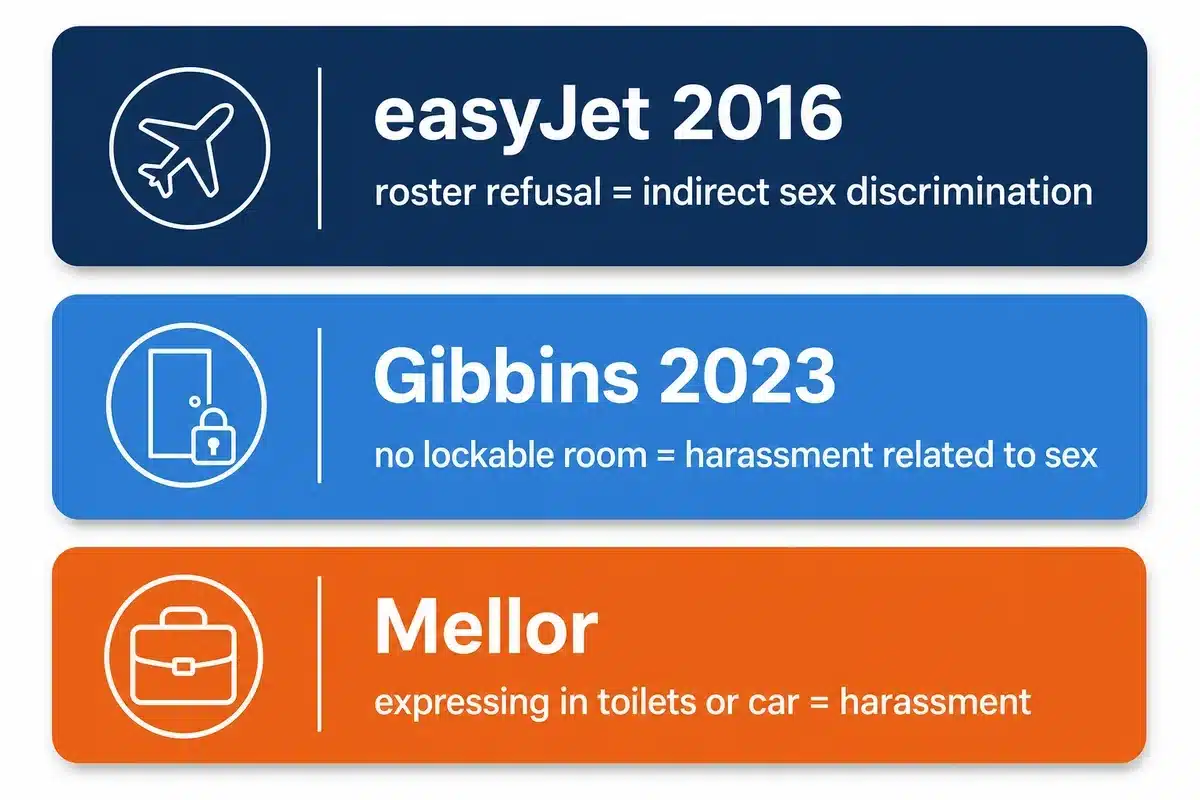
Swap the accelerator course for a mandatory training day, a client conference, or a shift pattern an employee has to work, and you have a scenario the employment tribunals have ruled on repeatedly. The pattern is consistent, even though each case turns on its own facts.
The landmark is McFarlane and another v easyJet Airline Company Ltd. Two cabin crew came back from maternity leave still breastfeeding and asked, with GP support, to be rostered for no more than eight hours so they could express milk and avoid mastitis. easyJet refused, then offered ground duties for six months only, treating breastfeeding beyond that as a lifestyle choice it needn’t accommodate. In 2016 an employment tribunal held that the long-shift requirement was indirect sex discrimination. The tribunal was scathing that easyJet had ignored four GPs and skipped the risk assessments it should have carried out.
More recently, in Gibbins v Cardiff and Vale University Local Health Board, a healthcare support worker returning from maternity leave asked for a private, lockable room to express milk. Instead she was handed a sign for the door and told to wedge a chair against it. A male colleague walked in on her. A £5.50 lock was eventually fitted, months late. The tribunal found she had suffered harassment related to sex. The failure was almost absurdly small and cheap to fix, and it still cost the employer.
It isn’t a guaranteed win, and I won’t pretend it is. In Mellor v MFG Academies Trust, a teacher left to express milk in toilets or her car succeeded on harassment but not on every claim she ran. Outcomes vary with the facts. What doesn’t vary is the theme: employers who treat a breastfeeding employee’s needs as an optional extra are the ones ending up in front of a judge.
Tom Street’s View
A blanket rule is not a defence. It’s usually the start of the problem.
“No children on site” and “everyone flies the same rosters” both sound neutral because they apply to everyone. But a rule that treats everyone the same can still be discriminatory when it quietly shuts out one group, and a nursing mother is almost always that group, because only women breastfeed. The employer who never asks “who does this actually exclude, and could we do it another way?” is the employer easyJet turned out to be.
Why breastfeeding is a sex discrimination issue
People still talk about accommodating a breastfeeding employee as though it were a nicety. Legally, it’s nothing of the sort. Once maternity leave ends, the specific pregnancy and maternity protection largely falls away, and breastfeeding at work is handled through sex discrimination law instead. A rule or requirement that disadvantages breastfeeding women, and can’t be properly justified, can amount to indirect sex discrimination, exactly as in easyJet. Denying a private space, or exposing a woman while she expresses, can be harassment related to sex, exactly as in Gibbins.
On top of that, employers have concrete health and safety duties. The Workplace (Health, Safety and Welfare) Regulations 1992 require suitable rest facilities for breastfeeding and pregnant workers, and a toilet does not count. There’s a genuine gap worth naming: the UK still has no standalone statutory right to paid breastfeeding breaks. But “no specific right to a break” is a world away from “we can lawfully shut you out.”
Health and safety is a reason to plan, not a reason to refuse
I want to be fair to the safety point. A fulfilment centre is full of heavy machinery, and keeping small children off the operational floor is entirely legitimate. Nobody sensible is arguing a baby belongs next to the conveyor lines.
But in discrimination law, having a legitimate aim is only half the test. You also have to show that what you did was a proportionate way of achieving it, which means asking whether a less exclusionary option would have worked just as well. A meeting room away from the floor. A quiet space for a partner and baby to wait. Running the session somewhere other than a live warehouse. That is precisely the reasoning that sank easyJet: the tribunal rejected the claim that bespoke arrangements were impossible, given how few people were affected. Safety explains why a baby can’t be on the packing floor. It does not explain why a mother and infant couldn’t be anywhere on a large corporate campus for a few hours.
Tom Street’s View
An apology is not the same thing as compliance.
Amazon’s response was gracious, and I don’t doubt it was sincere. But saying sorry for bad communication reframes a substantive problem as a clerical one. easyJet and Cardiff and Vale would both have been happy to communicate their arrangements clearly. The problem was never the communication. It was that the arrangement itself shut a breastfeeding woman out, and no amount of earlier, more polite notice fixes that.
The cost of getting it wrong is real, too. Compensation in discrimination claims isn’t capped the way ordinary unfair dismissal awards are, and it includes an award for injury to feelings assessed under the Vento bands, currently from at the lower end up to for the most serious cases, with the most exceptional cases going higher still. Being humiliated, or left “in tears”, is exactly the harm those awards exist to recognise.
If this happens to you
What to do if you’re sidelined at work for breastfeeding
Put your needs in writing early. Email your employer before the event, shift change or return date. A written request is your evidence that you flagged it and gave them a chance to plan, and it’s what the successful claimants did.
Ask for the adjustment, and get any refusal in writing. Propose something workable: a private lockable room, restricted hours, a remote option. If it’s refused, ask them to explain in writing why no adjustment was possible. That refusal is often the heart of a claim.
Get any medical evidence. A GP note on the health risks of not expressing, as in the easyJet case, makes it far harder for an employer to dismiss your needs as a personal choice.
Act quickly. Employment tribunal claims usually have a strict time limit of three months minus one day from the act complained of. If you think you’ve been treated unfairly because you’re breastfeeding, don’t sit on it.
Treated differently because you’re a mother?
If you’ve been sidelined, excluded or penalised at work because you’re pregnant, on maternity leave or breastfeeding, we can tell you where you stand. The first conversation is free and confidential.
Related Reading
- Maternity and pregnancy discrimination – Your rights during pregnancy, maternity leave and the return to work.
- Discrimination at work – How direct and indirect discrimination claims work under the Equality Act 2010.
- Sex discrimination – When a workplace rule that looks neutral unlawfully disadvantages women.
- The employment tribunal process – Time limits, steps and what to expect if you bring a claim.
Sources
- Sky News: Amazon apology after breastfeeding boss barred from business course over safety
- Ms R Gibbins v Cardiff and Vale University Local Health Board (1602976/2023)
- Maternity Action: breastfeeding at work, the easyJet case (McFarlane v easyJet)
- Equality Act 2010, section 17 (pregnancy and maternity: non-work cases)
- Acas: pregnancy and maternity discrimination
- Workplace (Health, Safety and Welfare) Regulations 1992, regulation 25

About Tom Street
Tom Street is a solicitor who acts for employees, not employers, in discrimination and dismissal disputes. He regularly advises women who have been sidelined, overlooked or treated unfairly around pregnancy, maternity leave and the return to work, including cases where breastfeeding needs were dismissed as an inconvenience rather than a legal duty.
SRA Number: 566718 | LinkedIn →