
16 January 2026 • By Tom Street
An employment tribunal has found that eight nurses were unlawfully harassed by their NHS employer over its policy on single-sex changing facilities. The 134-page ruling, delivered after a 16-day hearing with 24 witnesses and some 4,500 pages of evidence, is one of the first significant workplace decisions since the Supreme Court confirmed that “sex” under the Equality Act 2010 means biological sex.

What the tribunal decided
Employment Judge Seamus Sweeney ruled that County Durham and Darlington NHS Foundation Trust subjected the nurses to harassment related to both sex and gender reassignment. The tribunal found the Trust created a “hostile, intimidating, humiliating and degrading environment” for the claimants.
The claims of indirect discrimination and harassment succeeded. However, the tribunal rejected the nurses’ complaints about the conduct of Rose Henderson, the trans colleague who used the female changing room, finding those allegations “not well founded.” The claims of victimisation against the Trust were also dismissed.
Critically, the panel made clear that Rose had done nothing unlawful. The judgment stated: “Rose was simply doing what the Trust permitted Rose to do, to act as, and to be treated as a trans woman which for all intents and purposes meant regarding Rose as a woman.”
The liability rested entirely with the employer for permitting the arrangement without providing suitable alternative facilities.
The background
Rose Henderson, an operating theatre practitioner, had been using the female changing room at Darlington Memorial Hospital since 2019. The nurses first raised complaints in August 2023, some four years later.
The tribunal found that no one from management or HR ever had any discussion with Rose about the “appropriateness of using the female changing facilities”, either during Rose’s time as a student or after becoming an employee. From the outset, the judgment noted, “it was simply accepted by management that Rose would use the changing room of Rose’s choice.”
The concerns were not limited to the eight claimants. The tribunal heard that 26 nurses signed a letter complaining about the policy, suggesting this was a widespread concern among staff on the Day Surgery Unit.
How the Trust got it wrong
The Trust’s failings went beyond the changing room policy itself. When the nurses raised concerns, the tribunal found they were dismissed rather than taken seriously.
At no point, the judgment found, did anyone in management or HR “seriously consider that the policy of permitting a trans woman to use the female changing rooms might constitute some form of discrimination against female employees.” When discrimination was discussed, it was only ever in relation to Rose, never the nurses.
The panel found that head of workforce Tracy Atkinson told the nurses they needed educating and training about “the rights of trans employees in the workplace.” The tribunal concluded these comments “served to highlight to the nurses that they were not being taken seriously, reinforcing the feeling that they were seen as transphobic or bigoted.”
“If nothing else, it demonstrated a prioritisation of one group over another,” the panel said.
One of the nurses told a press conference after the ruling that she felt “gaslighted” by the Trust and made to feel she was “such a terrible person for having the audacity to complain.”
Another nurse added: “We feel like we’ve been penalised, that there’s been black marks put above our names, that we can’t progress within the NHS.”
What the tribunal said about trans rights
The panel was careful to acknowledge the vulnerability of transgender people and the legitimate purpose behind the Trust’s policy.
“We are only too aware that transgender people are vulnerable to exclusion, abuse, mistreatment, lack of respect and misunderstanding in society,” the judgment stated. “Nothing we say in this judgement should detract from that or be seen as diminishing the values that the Trust espouses in supporting its transgender staff.”
The Transitioning in the Workplace policy had an “admirable and noble purpose”, the tribunal acknowledged: to create an environment giving transgender employees “comfort and reassurance that they would be accepted and supported in the workplace.”
However, despite that admirable purpose, the policy as implemented had the effect of “violating the dignity” of the nurses and creating a hostile environment for them. The employer’s failure was in not finding a way to support all its staff.
The legal background
This case arrives after the Supreme Court’s landmark ruling in For Women Scotland Ltd v The Scottish Ministers [2025] UKSC 16, handed down in April 2025. That judgment confirmed that references to “sex” in the Equality Act 2010 mean biological sex, not gender identity.
The Trust’s policy, which allowed staff to use single-sex facilities based on the gender with which they identified, has since been withdrawn. However, the nurses’ claims related to events before the Supreme Court ruling. The judgment makes clear its conclusions are rooted in that ruling.
A similar case last month saw Scottish nurse Sandy Peggie achieve a partial victory against NHS Fife over comparable issues at Victoria Hospital in Kirkcaldy.
What this means in practice
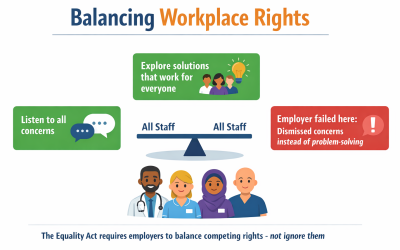
For employers, this case underlines the importance of getting single-sex facility policies right. Balancing the rights of different employees is not straightforward, but simply telling one group to accept a situation they find uncomfortable is not the answer.
The Equality and Human Rights Commission has made clear following the Supreme Court ruling that “single-sex services like changing rooms must be based on biological sex.” Employers who maintain policies based on self-identification risk harassment claims from staff affected by those policies.
For employees, the case confirms that concerns about single-sex facilities should be taken seriously. If your employer dismisses your concerns or suggests you simply need “educating”, that response may itself give rise to a claim.
My view
This case is ultimately about an employer failing everyone. The Trust had a duty to balance the rights of all its staff, and instead it created a situation where both the nurses and their trans colleague were left in an impossible position.
Rose Henderson was not found to have done anything unlawful. She was simply following the policy her employer had in place. The tribunal rightly placed responsibility where it belongs: with the Trust, which failed to think through how its policy would work in practice or to provide suitable alternatives when concerns were raised.
What made things worse was the dismissive response to the nurses’ concerns. Telling employees they need to “broaden their mindsets” when they raise legitimate workplace issues is never acceptable. Good employers find solutions that respect everyone’s dignity. They do not lecture one group of staff into silence while leaving another without proper support.
The tribunal’s acknowledgment that trans people face genuine vulnerability in society is important. This ruling is not, and should not be read as, a green light for discrimination against transgender employees. It is a reminder that employers cannot simply prioritise one protected characteristic over another. Both require thoughtful accommodation.
The law in this area has now been clarified by the Supreme Court, and employers need to get their policies right. That means providing single-sex facilities based on biological sex, but it also means ensuring trans employees have access to appropriate facilities too. These are not competing aims if employers approach them thoughtfully.
Bethany Hutchison, president of the Darlington Nursing Union and lead claimant in this case, said after the judgment: “This is a victory for common sense and for every woman who simply wants to feel safe at work.” She is right. But a better outcome for everyone would have been an employer who got this right from the start.
A remedy hearing will follow to determine what compensation the nurses are entitled to.
Sources
- BBC News: Live reporting on Darlington nurses tribunal judgment
- GB News: Victory for NHS nurses who complained about trans colleague using single-sex changing rooms
- House of Commons Library: Supreme Court judgment on the meaning of “sex” in the Equality Act 2010
- EHRC: UK Supreme Court ruling on meaning of sex in Equality Act

Tom Street
Principal Solicitor, Tom Street & Co.