
Quick Summary
In Thompson v Scancrown Ltd, an employment tribunal awarded nearly £185,000 to a sales manager whose employer refused her request to finish work at 5pm instead of 6pm after returning from maternity leave. The tribunal found the employer’s blanket requirement to work until 6pm constituted indirect sex discrimination. This case demonstrates that employers must genuinely consider flexible working requests and cannot simply rely on citing business reasons without proving proportionality.
⚖️ This guide is for general information only and is not legal advice. Every case is different – if you’re unsure, speak to a solicitor.
Key Points
Key Points
- ✓ Total compensation awarded: £184,961.32 for indirect sex discrimination
- ✓ The claimant requested to finish at 5pm instead of 6pm to collect her child from nursery
- ✓ Even small employers (10 employees) can be required to accommodate flexible working
- ✓ Simply citing business reasons is not enough; employers must prove proportionality
- ✓ Injury to feelings: £13,500 (middle Vento band)
- ✓ Claims for pregnancy discrimination, harassment and unfair dismissal all failed
The Facts of the Case
Alice Thompson was employed as a sales manager by Scancrown Ltd, trading as Manors, a small independent estate agency based in Marylebone, London. The company had around 10 employees and specialised in the prime central London property market, catering to wealthy overseas clients.

Mrs Thompson started work in October 2016 and was considered a highly competent employee. Her employer, Paul Sellar, had praised her contribution, telling her “thanks to you, the office is doing well.” Her contractual hours were 9am to 6pm, Monday to Friday, with an annual salary (including commission) of approximately £120,000.
The pregnancy and maternity leave
In the spring of 2018, Mrs Thompson announced her pregnancy. The tribunal heard evidence that her relationship with her employer began to deteriorate around this time. Mr Sellar allegedly remarked to a colleague’s partner: “Why is she pregnant when we are doing so well? I was warned about employing a married woman of her age.” Mr Sellar denied making this comment.
Mrs Thompson took maternity leave from October 2018 to October 2019. Before returning to work, she met with Mr Sellar and made a flexible working request asking to work four days a week instead of five, and to finish at 5pm instead of 6pm so she could collect her daughter from nursery.
The flexible working refusal
Mr Sellar refused both requests. He cited five statutory business reasons for the refusal: the burden of additional costs, detrimental effect on ability to meet customer demand, inability to reorganise work among existing staff, inability to recruit additional staff, and planned structural changes. He also said that clients “expect consistency in the sales manager they deal with.”
Mrs Thompson appealed but was unsuccessful. In December 2019, she resigned, unable to balance her working hours with the need to collect her daughter from nursery by 6pm.
The Claims Brought
Mrs Thompson filed multiple claims against her former employer: pregnancy and maternity discrimination, harassment related to sex, indirect sex discrimination in respect of the flexible working request, unfair dismissal, and unlawful deduction of commission payments from wages.
The only claim that succeeded was the indirect sex discrimination claim relating to the flexible working request.
Why the other claims failed
The harassment claim failed because, while the tribunal found some conduct was “less than friendly,” it did not reach the threshold of harassment. The pregnancy discrimination claim was not upheld on the facts. The unfair dismissal claim failed because the tribunal found Mrs Thompson had resigned rather than being constructively dismissed. As the tribunal put it, “the reason for resignation was not any breach of the implied term to act with mutual trust and confidence, but that she did not want or was not able to work the contracted hours.”
The Legal Test for Indirect Discrimination
Indirect discrimination under section 19 of the Equality Act 2010 requires four elements to be established.
First, the employer must apply a provision, criterion or practice (PCP) to all employees. In this case, the PCP was the requirement for sales managers to work 9am to 6pm, Monday to Friday.
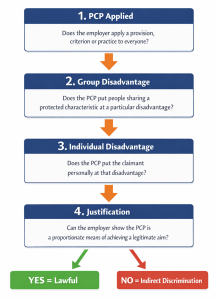
Second, the PCP must put people sharing a protected characteristic at a particular disadvantage compared to those who do not share it. The tribunal accepted that women still shoulder a greater proportion of childcare responsibilities than men. A 2018 national survey had shown that 64% of mothers, compared to 36% of fathers, are the primary childcarers. The requirement to work until 6pm, when nurseries typically close, therefore put women at a particular disadvantage.
Third, the PCP must put the individual claimant at that disadvantage. Mrs Thompson clearly suffered this disadvantage because she could not collect her daughter from nursery if she worked until 6pm.
Fourth, the employer must be unable to show that the PCP is a proportionate means of achieving a legitimate aim. This is where the case was decided.
The justification defence
The employer’s stated aim was maintaining successful relations with customers. While this was accepted as a legitimate aim, the tribunal found that refusing flexible working was not a proportionate means of achieving it.
The tribunal found that the team could effectively operate when covering the periods Mrs Thompson was not working. It noted that Mrs Thompson had accepted her pay and commission would be reduced pro rata, making the arrangement cost-neutral. Even a small company like Manors was considered capable of accommodating the request.
“This case demonstrates that even small employers cannot simply cite business reasons and expect that to be enough. The tribunal will look at whether you genuinely tried to make it work. Here, a one-hour adjustment could have saved the employer nearly £200,000.”

The Compensation Awarded
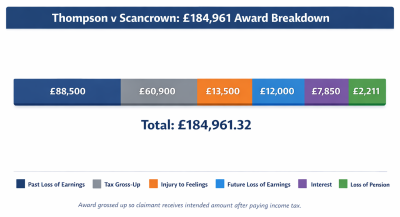
The total award was £184,961.32. This substantial figure reflected Mrs Thompson’s high earnings and the significant financial impact of losing her job.
Breakdown of the award
The award comprised several elements. Past loss of earnings covered the period from her resignation in December 2019 until the remedy hearing in August 2021. This was calculated on the basis of what she would have earned had she returned on the flexible working pattern she had requested, meaning a 29% reduction from her full-time salary.
The tribunal made allowances for the COVID-19 pandemic, including periods when she would have been furloughed or on reduced hours. Future loss of earnings was awarded for a further period until October 2021, when the tribunal expected Mrs Thompson would find comparable employment as the job market recovered.
Loss of pension contributions was calculated at 3% of salary. Loss of use of a company car was valued at the cost of a Zone 1-3 annual travelcard (£1,480).
Injury to feelings
The tribunal awarded £13,500 for injury to feelings, within the middle Vento band. The tribunal noted that Mrs Thompson felt devastated at having built up the team and formed relationships with clients, only to lose it because she was pregnant. She was bringing the claim so that her daughter would not have the same experience.
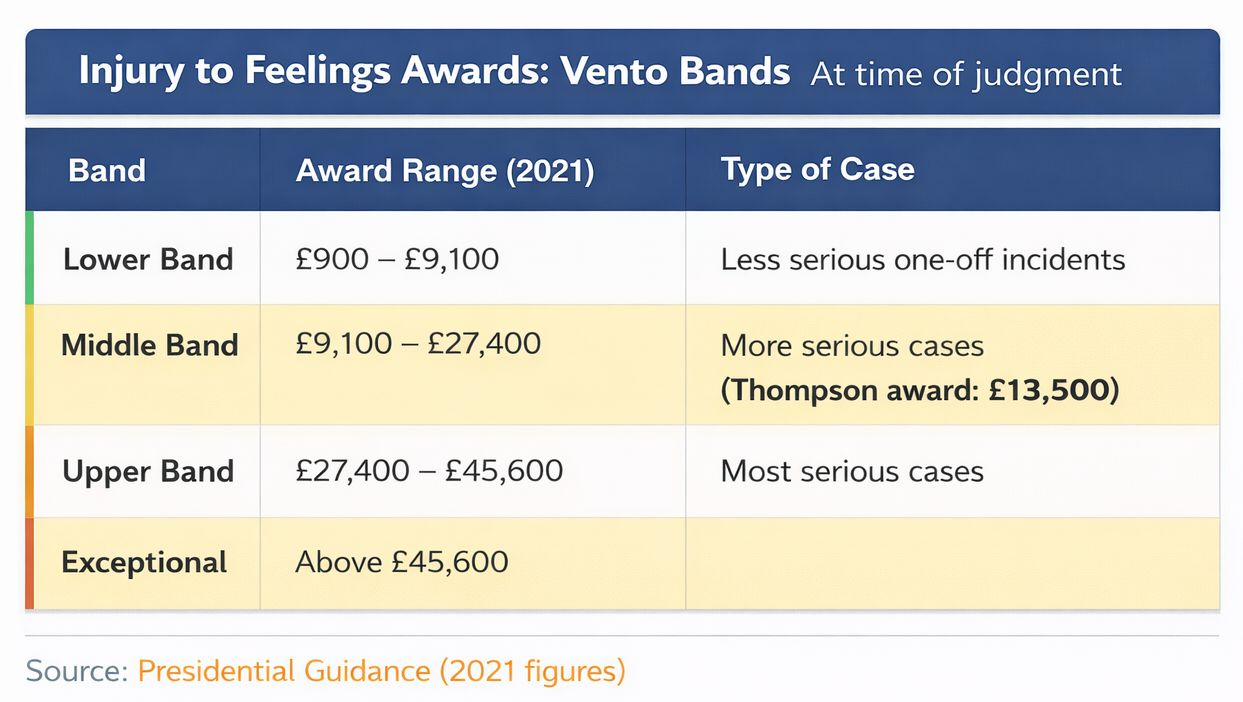
The middle band was appropriate because the injury was more than trivial or one-off, but had subsided after a difficult period. Mrs Thompson had not needed medical help for her distress.
Vento Bands at Time of Judgment (2021)
The tribunal applied the Vento bands in force at the time of the remedy hearing in August 2021. Mrs Thompson’s award of £13,500 fell within the middle band.
| Band | Award Range (2021) | Type of Case |
|---|---|---|
| Lower Band | £900 – £9,100 | Less serious one-off incidents |
| Middle Band | £9,100 – £27,400 | More serious cases (Thompson award: £13,500) |
| Upper Band | £27,400 – £45,600 | Most serious cases |
| Exceptional | Above £45,600 | Only the most exceptional cases |
📊 Current Vento Bands (April 2025)
If you are bringing a claim now, the current bands are significantly higher. These apply to claims presented on or after 6 April 2025:
| Band | Award Range (2025/26) |
|---|---|
| Lower Band | £1,200 – £12,100 |
| Middle Band | £12,100 – £36,400 |
| Upper Band | £36,400 – £60,700 |
| Exceptional | Above £60,700 |
Interest and grossing up
Interest was awarded at 8% per annum on both injury to feelings (from the date of injury) and loss of earnings (from the midpoint of loss).
The total award was then grossed up for income tax. Because Mrs Thompson would receive the award as a lump sum and pay tax on it, the tribunal applied the grossing up methodology approved in PA Finlay Ltd v Finlay to ensure she received the net amount intended after paying tax.
What This Case Means for You
For employees
If your employer refuses a flexible working request linked to childcare responsibilities, this could amount to indirect sex discrimination. You do not need to prove your employer intended to discriminate. The key questions are whether the refusal puts women at a disadvantage (which childcare-related refusals typically will) and whether the employer can justify the refusal as proportionate.
The fact that an employer cites one of the eight statutory business reasons under section 80G of the Employment Rights Act 1996 does not automatically make the refusal lawful. The employer must still be able to prove proportionality.
Compensation for indirect discrimination is uncapped and can include past and future loss of earnings, pension losses, and injury to feelings. For high earners, awards can be substantial.
For employers
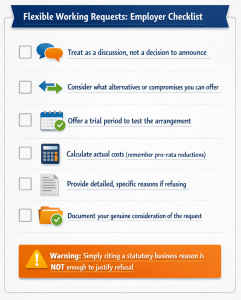
This case is a stark warning about the risks of refusing flexible working requests without proper consideration. Five key lessons emerge.
First, treat flexible working requests as a discussion, not a decision to be announced. If you cannot offer what the employee is asking for, consider what you can offer as a compromise or effective alternative.
Second, consider offering a trial period to see whether the requested flexibility will work in practice. This demonstrates genuine consideration.
Third, remember pro rata reductions to pay and holiday entitlement when calculating costs. The tribunal noted that Mrs Thompson’s request would have been largely cost-neutral.
Fourth, if you are going to refuse, provide detailed reasons in plain English. Simply saying “costs will be high” or “customer demand” without specifics is unlikely to satisfy a tribunal.
Fifth, even small employers must properly consider flexible working. The tribunal specifically noted that a company with only 10 employees was capable of accommodating the request.
“When assessing justification, tribunals will look at whether you genuinely explored alternatives. The employer here could have covered one hour at the end of each day with existing staff, or recruited a junior assistant. Instead, they simply said no. That rigidity cost them nearly £200,000.”
Changes Since This Case
Since the Thompson decision, flexible working rights have been strengthened. The Employment Relations (Flexible Working) Act 2023 came into force in April 2024, giving employees the right to make flexible working requests from day one of employment (previously you needed 26 weeks’ service).
Employees can now make two requests in any 12-month period, and employers must respond within two months (reduced from three). Employers must also consult with the employee before refusing a request.
These changes make it even more important for employers to handle flexible working requests carefully. The substantive legal test for indirect discrimination remains unchanged.
Case Citation
Thompson v Scancrown Ltd (trading as Manors) ET/2205199/2019
London Central Employment Tribunal
Employment Judge Goodman, Ms J. Griffiths, Mr D. Shaw
Liability judgment: May 2021
Remedy judgment: 24 August 2021
Full judgment: Download PDF (GOV.UK)
Frequently Asked Questions
Can refusing a flexible working request be discrimination?
Yes. If the requirement to work fixed hours puts women at a particular disadvantage compared to men (because women disproportionately bear childcare responsibilities), refusing flexible working can amount to indirect sex discrimination under section 19 of the Equality Act 2010. The employer must prove their refusal is a proportionate means of achieving a legitimate aim.
How much compensation was awarded in Thompson v Scancrown?
The tribunal awarded £184,961.32. This included past and future loss of earnings (calculated on what Mrs Thompson would have earned on flexible hours), loss of pension contributions, £13,500 for injury to feelings (middle Vento band), and interest. The total was grossed up for income tax payable by the claimant.
What makes a flexible working refusal lawful?
To lawfully refuse a flexible working request that puts a protected group at disadvantage, the employer must prove the refusal is a proportionate means of achieving a legitimate business aim. This means showing they genuinely considered alternatives and that the business need outweighs the discriminatory impact. Simply citing one of the eight statutory reasons is not enough.
Does the Thompson v Scancrown case apply to small employers?
Yes. Manors had only around 10 employees, yet the tribunal found it could have accommodated the request by reallocating work among the team and possibly recruiting a junior staff member. The case shows that small employers cannot simply claim they lack resources to accommodate flexible working without providing specific evidence.
What is the time limit for bringing a flexible working discrimination claim?
You must start early conciliation with ACAS within three months minus one day of the discriminatory act (the date of the refusal). If there is ongoing discrimination, time runs from the last act in the series. The time limit may be extended in limited circumstances where it was not reasonably practicable to bring the claim in time.
Why did the other claims in Thompson v Scancrown fail?
The pregnancy discrimination and harassment claims failed on the facts. The tribunal found that while some conduct was “less than friendly,” it did not amount to harassment. The unfair dismissal claim failed because Mrs Thompson resigned voluntarily rather than being constructively dismissed. The tribunal found the reason for her resignation was that she could not work the contracted hours, not any breach of contract by the employer.
Is Thompson v Scancrown binding on other tribunals?
No. This is a first instance Employment Tribunal decision, which means it is not legally binding on other tribunals. However, it provides a clear illustration of how tribunals apply the law on indirect discrimination to flexible working refusals and has been widely cited as guidance for employers. The legal principles it applies are well-established.
What should I do if my flexible working request has been refused?
Consider whether the refusal puts you at a disadvantage because of a protected characteristic such as sex. If so, the employer must justify the refusal as proportionate. You could raise a grievance, appeal the decision, or seek legal advice about a potential discrimination claim. Remember the three-month time limit for tribunal claims runs from the date of refusal.
💬 Flexible working request refused?
Our employment solicitors can advise whether you have a discrimination claim
Get Free Initial Advice →Important: This case note provides general information about indirect sex discrimination in the context of flexible working requests. It is not legal advice and should not be relied upon as such. Employment law is complex and the rules may apply differently depending on your circumstances. If you are considering a discrimination claim or have had a flexible working request refused, we strongly recommend seeking professional legal advice.
Sources and Further Reading
Primary Legislation
- Equality Act 2010, s.19 (indirect discrimination)
- Equality Act 2010, s.124 (remedies)
- Employment Rights Act 1996, s.80G (grounds for refusing flexible working)
Key Case Law
- Thompson v Scancrown Ltd ET/2205199/2019 (full remedy judgment)
- Wisbey v Commissioner for City of London Police [2021] EWCA Civ 650 (compensation for indirect discrimination)
- Vento v Chief Constable of West Yorkshire Police [2002] EWCA Civ 1871 (injury to feelings bands)
Official Guidance
Tom Street
Tom Street is the principal solicitor at Tom Street & Co. Solicitors, specialising in employment law and tribunal claims. He regularly represents claimants in unfair dismissal, discrimination, and whistleblowing cases. View full profile