
Legal accuracy verified: 20 January 2026
Reviewed by Tom Street, Solicitor (SRA No. 566718)
20 January 2026 | By Tom Street
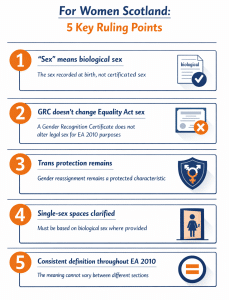
On 16 April 2025, the UK Supreme Court delivered its unanimous judgment in For Women Scotland Ltd v The Scottish Ministers [2025] UKSC 16. The For Women Scotland ruling, clarified that “sex”, “man” and “woman” in the Equality Act 2010 refer to biological sex, not certificated sex through a Gender Recognition Certificate.

Nine months on, employers are still grappling with what this means in practice. The ruling has implications for workplace facilities, diversity initiatives, data collection and much more. Here’s what employment law practitioners and HR professionals need to understand.
Why This Case Matters
This wasn’t an employment case. It arose from a challenge to Scottish Government guidance on gender representation targets for public boards. But its implications reach into every workplace in Great Britain.
The central question was deceptively simple: when Parliament says “woman” in the Equality Act 2010, does it include a trans woman with a Gender Recognition Certificate? The Supreme Court’s answer was unanimous: no, it does not.
Lord Hodge, delivering the judgment alongside Lady Rose and Lady Simler, was careful to frame the ruling narrowly. The Court’s task, he emphasised, was statutory interpretation. It was not, he said, “to adjudicate on the arguments in the public domain on the meaning of gender or sex.” But the practical consequences extend far beyond the technical legal question.
The Legal Background
The Gender Recognition Act 2004 allows adults who meet certain criteria to obtain a Gender Recognition Certificate. Section 9(1) of that Act states that once a GRC is issued, “the person’s gender becomes for all purposes the acquired gender.” On its face, this language could hardly be clearer.
But section 9(3) adds a crucial caveat: this rule is “subject to provision made by this Act or any other enactment.” The question was whether the Equality Act 2010 impliedly disapplied the GRA’s “for all purposes” provision.
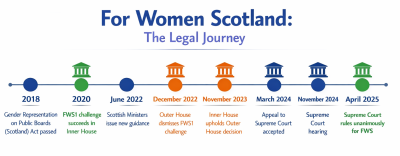
The case had a long journey through the Scottish courts. For Women Scotland first successfully challenged the original Scottish legislation in 2020. When the Scottish Ministers issued new guidance relying on the Equality Act definition, FWS challenged again. They lost in the Outer House in December 2022 and again in the Inner House in November 2023. Lady Haldane, in the Outer House, had stated that the language of section 9 “could scarcely be clearer” in favour of the Ministers’ interpretation.
The Supreme Court disagreed.
What the Supreme Court Decided
The five Justices, led by Lord Hodge with Lords Reed and Lloyd-Jones agreeing, found that interpreting “sex” to include acquired gender through a GRC would render the Equality Act 2010 “incoherent and impracticable to operate.”
The Court examined multiple provisions of the Act and found they only made sense if “sex” meant biological sex. Pregnancy and maternity protections, for instance, can “as a matter of biology” only apply to biological women. Equal pay provisions comparing men’s and women’s work would become confused if those categories could overlap through GRCs.
Crucially, the Court found that a “certificated sex” interpretation would create two classes within the protected characteristic of gender reassignment: those with GRCs would gain additional rights that those without GRCs would lack. This, the Justices concluded, could not have been Parliament’s intention.
The Court also pointed to practical problems with single-sex services. Service providers cannot lawfully demand to see a GRC. If legal sex depended on possessing one, providers would have no way to verify who could access single-sex spaces. The resulting uncertainty, the Court found, indicated the interpretation was wrong.
What the Ruling Does Not Do
Lord Hodge explicitly stated that this judgment “should not be read as a triumph of one or more groups in our society at the expense of another.” The Court emphasised several times that transgender people remain protected under UK law.
Gender reassignment remains a protected characteristic under the Equality Act. Trans people can still bring claims for discrimination and harassment on this ground, regardless of whether they hold a GRC. The ruling changes nothing about this protection.
Trans people can also claim direct sex discrimination in certain circumstances. The Court noted that a trans woman who is treated less favourably because she is perceived to be a woman can bring a sex discrimination claim on that basis. This echoes the reasoning in US Supreme Court jurisprudence.
Employment Law Implications
For employers, the ruling creates both clarity and complexity.
Single-sex facilities: Where employers provide single-sex toilets, changing rooms or showers, these must now be based on biological sex. The EHRC’s interim guidance states that people should not use facilities provided for the opposite biological sex. However, where practical, employers should consider providing additional mixed-sex or gender-neutral facilities.
Diversity data and reporting: Gender pay gap reporting and other diversity monitoring that relies on the category of “sex” must be based on biological sex. Employers should review their data collection practices to ensure alignment.
Positive action initiatives: Programmes designed to increase female representation must be based on biological sex to comply with the Equality Act’s positive action provisions.
Policy language: Equality and diversity policies should be reviewed to ensure language accurately reflects the legal definitions. References to “women” in sex-based contexts should align with the biological definition.
Balancing competing rights: The Employment Tribunal decision in Sandie Peggie v Fife Health Board (case no. 4104864/2024) illustrates the challenges. illustrates the challenges. A nurse claimed harassment for being required to share a changing room with a trans woman colleague. The Tribunal found the employer must balance competing rights and apply a proportionate approach. It upheld her harassment claim regarding the employer’s handling of the situation, while rejecting other claims.
The EHRC Response
The Equality and Human Rights Commission, which intervened in the case, issued interim guidance on 25 April 2025, updated in June. A consultation on a revised Code of Practice for services, public functions and associations ran until 30 June 2025, receiving some 50,000 responses.
The EHRC submitted a draft Code to the UK Government on 4 September 2025. It is currently awaiting ministerial approval before being laid before Parliament. Once approved, Parliament will have 40 days to review under the negative resolution procedure.
Until this Code comes into force, employers face uncertainty. The interim guidance provides some direction but lacks the statutory weight of a full Code of Practice. Employers should monitor developments closely.
⚖️ January 2026 Update
The Government is still reviewing the draft Code, having requested additional cost assessment information on 9 October 2025. The EHRC withdrew its interim guidance in October 2025. The 2011 Code remains technically in force but is now inconsistent with the law. We will update this article when the Code progresses.
What Employers Should Do Now
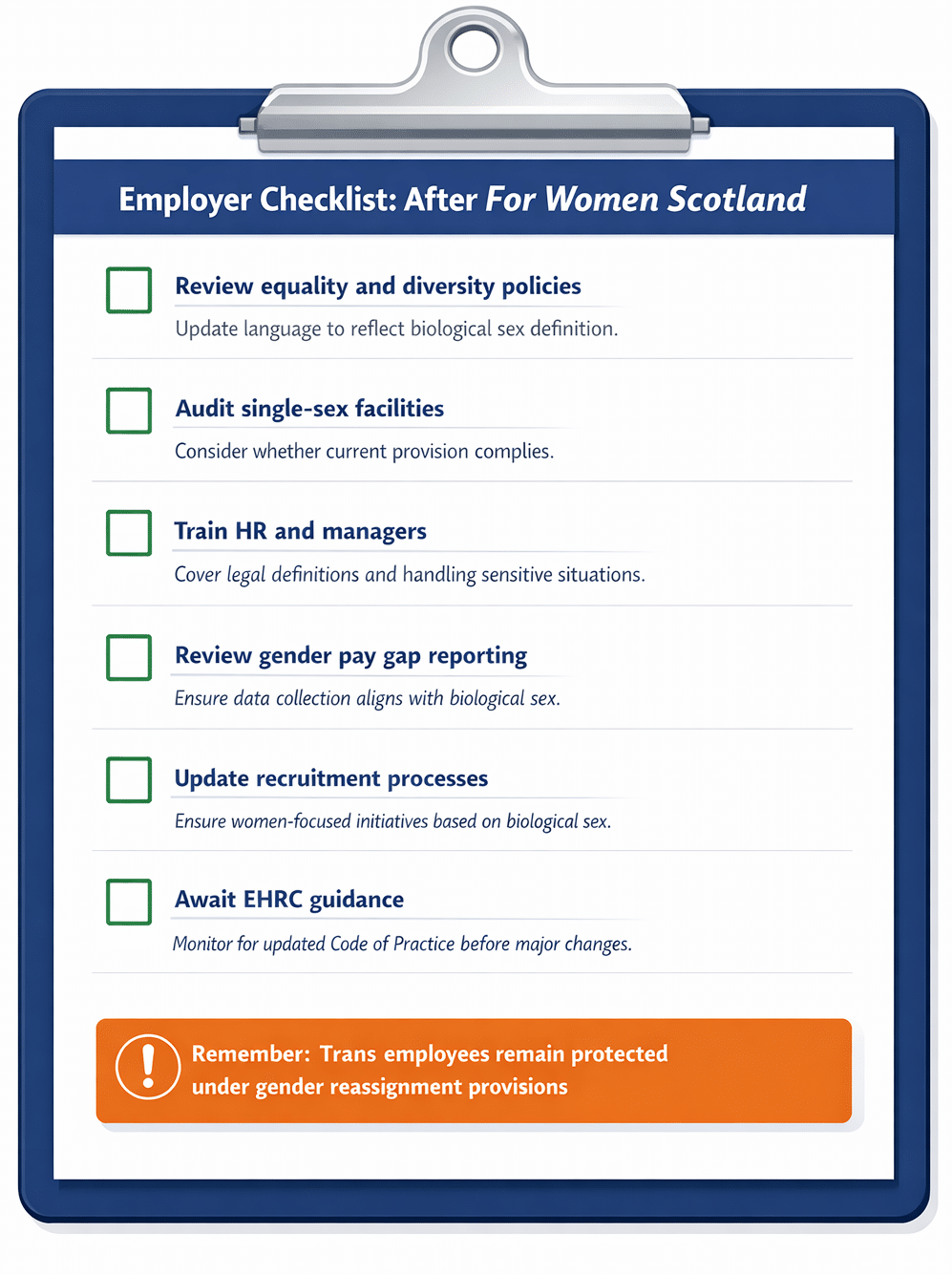
While awaiting final EHRC guidance, employers should take proportionate steps:
First, review existing equality and diversity policies. Ensure language is consistent with the ruling’s interpretation of “sex” as biological sex. Avoid making claims that could mislead employees about their legal rights.
Second, audit single-sex facilities. Consider whether current arrangements comply with the ruling and whether mixed-sex alternatives can be provided. Where changes are needed, consult with affected staff sensitively.
Third, train HR professionals and line managers. They need to understand both the legal position and how to handle sensitive situations with respect for all employees. The ruling does not give licence to treat trans employees poorly.
Fourth, review data collection practices. Ensure sex-based data aligns with biological sex for statutory reporting purposes while being sensitive about how this information is gathered.
Fifth, don’t overreact. The ruling clarifies the law; it doesn’t fundamentally change workplace obligations. Trans employees remain protected. Discrimination and harassment against them remains unlawful. Employers who use this ruling as cover for hostility towards trans staff will face legal consequences.
Looking Ahead
This ruling settles one legal question but opens others. Employment Tribunals will need to apply it to specific workplace disputes. The EHRC Code of Practice, when finalised, will provide crucial guidance.
Trans judge Victoria McCloud has brought a challenge to the European Court of Human Rights, arguing the Supreme Court process was flawed by refusing to hear from trans individuals. For Women Scotland has separately challenged Scottish Government policies on schools and prisons as inconsistent with the ruling.
Neither the UK nor Scottish Government appears to have appetite for legislative change. The Scottish Government confirmed it does not intend to progress its Gender Recognition Reform (Scotland) Bill. The practical implications will therefore be worked out through guidance, case law and individual workplace decisions.
“This ruling provides much-needed clarity for employers who have struggled with conflicting guidance for years. But clarity on definitions doesn’t remove the need for sensitivity. Trans employees are colleagues, not legal problems to be managed. The best employers will find ways to comply with the law while treating everyone with dignity.”

If You’re Facing Discrimination at Work
Whether you’re experiencing discrimination based on sex or gender reassignment, you have legal options. Both remain protected characteristics under the Equality Act 2010. The For Women Scotland ruling clarifies which category applies to which circumstances, but protection under either ground remains robust.
If your employer is using this ruling inappropriately, whether to harass trans employees or to justify existing discrimination, legal advice can help you understand your position and options.
Sources
Tom Street
Principal Solicitor, Tom Street & Co.