
20 January 2026 | By Tom Street
The legal team representing Scottish nurse Sandie Peggie has confirmed they will appeal the employment tribunal ruling in her case against NHS Fife, as well as two subsequent corrected versions of that judgment. This Sandie Peggie appeal is set to challenge the initial decisions made in her case.
Peggie was suspended from her job in the A&E department at Victoria Hospital in Kirkcaldy after she complained about a transgender colleague, Dr Beth Upton, using the female changing room. The incident on Christmas Eve 2023 led to a two-year legal battle that attracted global attention.
The tribunal found in her favour on her harassment claim against NHS Fife, ruling that the health board had unlawfully harassed her. Her other claims of discrimination and victimisation were dismissed. All claims against Dr Upton were also rejected.
A judgment amended twice
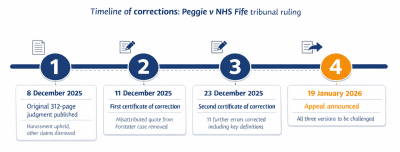
The 312-page ruling, published on 8 December 2025, has since been amended twice following complaints about its accuracy.
The first certificate of correction, issued on 11 December, removed what was described as a “completely made up” quote. The passage purported to be from the landmark Forstater v CGD Europe case but did not appear anywhere in that judgment. Maya Forstater, whose case established that gender-critical beliefs are protected under the Equality Act, said: “I know that judgment inside out, and those words are not there.”
A second certificate of correction followed on 23 December, listing 11 additional errors. These included wrongly defining a “trans man” as someone assigned male at birth (rather than female), misquoting other court cases, and misnaming a campaign group as “Not For Gays” instead of “Not All Gays”.
The Judicial Office has declined to explain how the errors occurred. Some commentators have speculated that artificial intelligence may have been used in drafting the judgment, given that Scottish Courts guidance explicitly warns that AI tools may “hallucinate” fictitious citations.
Understanding the Sandie Peggie Appeal
In a statement, Peggie’s legal team said the appeal covers the original ruling itself, a first correction that rewrote a key passage on how protected characteristics are balanced, and a second round of amendments which altered the wording of several substantive paragraphs.
A second KC has been appointed to support the appeal.
Speaking after the December ruling, Peggie said: “Whilst I am delighted that the tribunal was critical of Fife Health Board and found they harassed me, their judgment I believe falls short in many respects and that is why I certainly won’t be giving up this legal fight any time soon.”
She added: “I am not a campaigner and had never heard of the phrase ‘gender critical’ when I first raised complaints over two years ago about my employer’s decision to allow men into female-only changing rooms. I just knew instinctively that it wasn’t right that women were expected to undress in front of men in private spaces.”
The Darlington connection
The appeal announcement comes just days after eight Darlington nurses won a harassment claim against County Durham and Darlington NHS Foundation Trust in a strikingly similar case.
That tribunal ruled the Trust had created a “hostile, intimidating, humiliating and degrading environment” for nurses who complained about a transgender colleague using female changing facilities. Critically, the panel found that telling the nurses they needed “educating” about trans rights was itself harassing.
The two cases arrived at notably different conclusions on how employers should balance competing rights. The Darlington judgment, applying the Supreme Court’s ruling in For Women Scotland v Scottish Ministers, placed clear responsibility on the employer to provide appropriate facilities for all staff. The Peggie judgment took a more nuanced approach, suggesting that whether a trans woman can use a female changing room depends on factors including their stage of transition and physical appearance.
Critics of the Peggie ruling argue this approach “muddies the waters” and places an impossible burden on employers to make judgments about individual employees’ bodies.
My view
The errors in this judgment are troubling. Whether they stem from AI use, careless drafting, or something else, a 312-page ruling in a case of this significance should not need two rounds of corrections within three weeks of publication.
The more fundamental issue is what the law actually requires. The Supreme Court was clear in April 2025: “sex” in the Equality Act means biological sex. How that clarity became the balancing exercise described in the Peggie judgment is something the appeal will need to address.
The contrast with the Darlington case is stark. There, the tribunal placed responsibility squarely on the employer for failing to provide facilities that respected everyone’s dignity. Here, the judgment seems to suggest women must accept varying levels of discomfort depending on how their transgender colleague looks.
Cases like this show why employers need clear policies that respect everyone’s rights from the start. Telling one group of employees to accept a situation they find uncomfortable, or that they need “educating”, is not a solution. It creates exactly the kind of hostile environment these cases are meant to address.
NHS Fife has acknowledged Peggie’s right to appeal. The outcome may well turn on whether the tribunal’s approach to balancing competing rights can be reconciled with what the Supreme Court actually said.
Peggie is also set to face another tribunal in September 2026 against the Royal College of Nursing, claiming the union failed to support her after her suspension.
Sources
- BBC News: Sandie Peggie legal team to appeal all three versions of tribunal ruling
- Personnel Today: Peggie case: judge issues 11 further corrections to ruling
- Scottish Legal News: Judicial Office refuses to answer questions over fabricated quotes
- UK Supreme Court: For Women Scotland v Scottish Ministers [2025] UKSC 16

Tom Street
Principal Solicitor, Tom Street & Co.