
20 January 2026 | By Tom Street
A Derbyshire police officer has been found guilty of gross misconduct after slapping a female colleague’s bottom, poking another colleague’s buttock, and sending sexually explicit messages to staff.

PC Alexander Kimber resigned before the misconduct hearing took place in December 2025. The panel concluded he would have been dismissed had he still been serving, and his behaviour represented “discriminatory and/or harassing behaviour on the grounds of your colleagues’ sex”.
This case is a stark reminder that this kind of conduct has no place in any workplace, whether you’re in policing or any other profession.
What happened
According to papers made public following the hearing, Kimber’s conduct included:
- Slapping a colleague’s bottom while on duty
- Poking another colleague’s buttock and later messaging her to say it “made my day”
- Telling a colleague not wearing her PPE that it was “nice to see you without your kit on”
- Messaging a colleague that she’d “done a good job” and “it helps that you’re good to look at”
- Telling another colleague that a woman should “show me her boobs for being late”
Kimber accepted gross misconduct and said he was “extremely remorseful”. He claimed his actions were never “malicious nor meant to cause offence” and that he had sought therapy to “better understand boundaries”.
Deputy Chief Constable Simon Blatchly said the behaviour was “totally unacceptable” and the “repeated and targeted actions towards female colleagues was wrong”.
What the law says
Under section 26 of the Equality Act 2010, sexual harassment is defined as unwanted conduct of a sexual nature that has the purpose or effect of violating someone’s dignity, or creating an intimidating, hostile, degrading, humiliating or offensive environment.
Crucially, a single incident can be enough to constitute harassment. There’s no requirement for a pattern of behaviour. What matters is the effect on the recipient, not the intention of the person doing it.
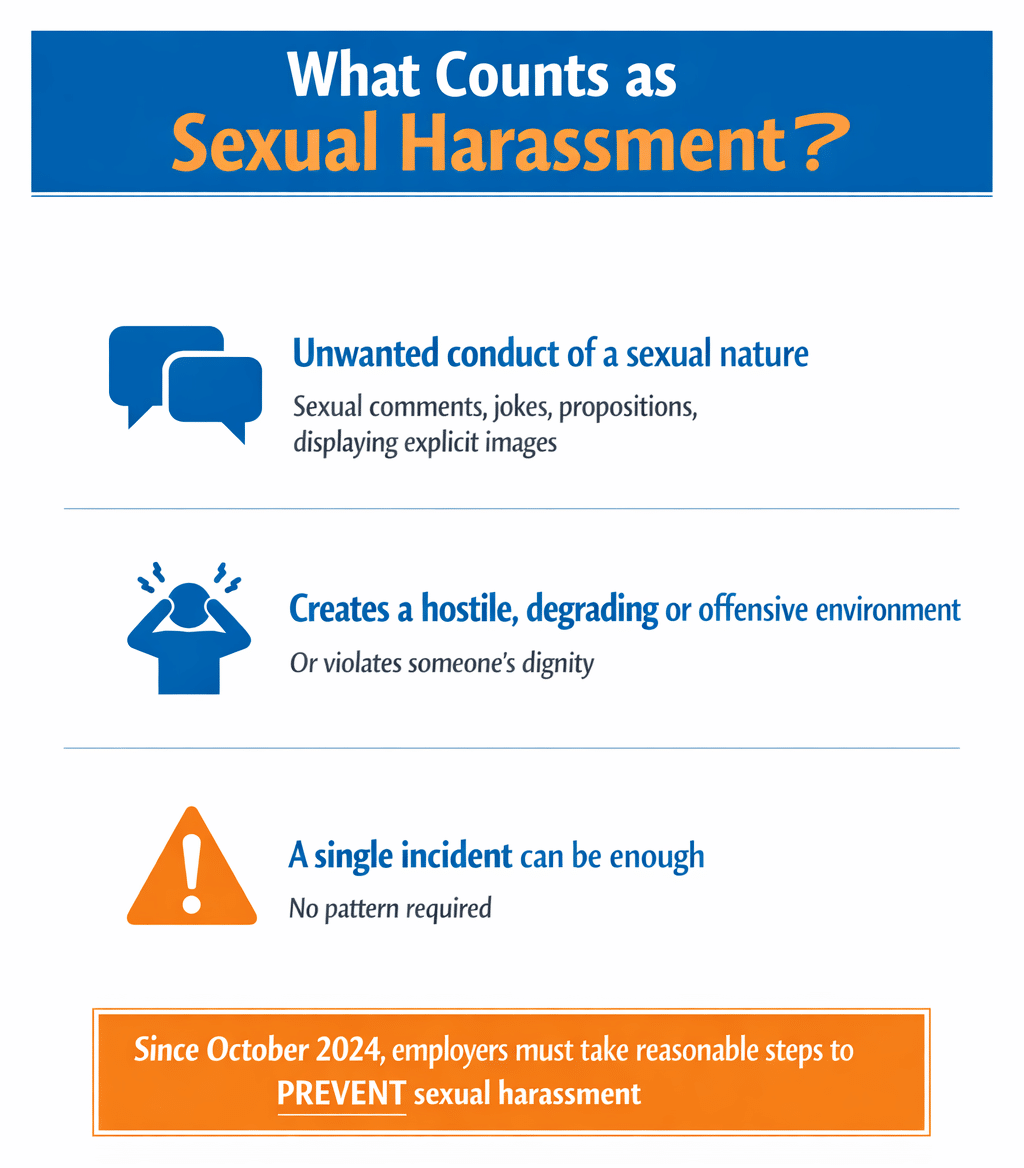
Since October 2024, employers have also had a positive legal duty to take reasonable steps to prevent sexual harassment of their workers. If they fail to do so and harassment occurs, tribunals can increase compensation by up to 25%.
The employment angle
While this case went through police misconduct procedures rather than an employment tribunal, the underlying conduct would absolutely support a sexual harassment claim in any workplace.
If you’re experiencing similar behaviour at work, the comments about how you look, the unwanted physical contact, the sexualised “banter”, you don’t have to put up with it. This isn’t harmless. It’s unlawful.
Many people who experience this kind of behaviour feel unsure whether it’s “serious enough” to complain about. The law is clear: if it’s unwanted and it makes you feel uncomfortable, degraded or humiliated, it can be harassment.
What I think
Every employee deserves to work in an environment free from harassment. The fact that Kimber claimed his actions weren’t “malicious” or “meant to cause offence” is exactly the problem. Too many people still don’t understand that their intentions don’t matter. It’s the impact on the recipient that counts.
If this is happening to you, document everything, raise a formal grievance, and get legal advice. You have rights, and there are specialist employment solicitors who can help you enforce them.
Sources

Tom Street
Principal Solicitor, Tom Street & Co.