
11 February 2026 | Tom Street, Solicitor
What does 40 years of loyal service count for? At PricewaterhouseCoopers in Belfast, apparently not enough to protect you from being asked whether training is really something you’re interested in “at your age.”
A former PwC executive support assistant has settled her age and disability discrimination claim against the company for £150,000, supported by the Equality Commission for Northern Ireland. She gave more than four decades to one of the world’s biggest professional services firms. The reward for that loyalty, she says, was a series of remarks that made her feel her age and her caring responsibilities had become a problem.
What happened
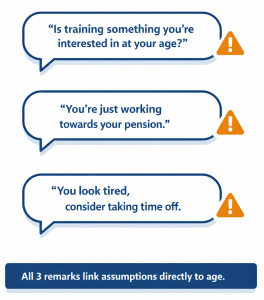
The woman, who has remained anonymous, says a senior colleague unexpectedly raised concerns about her knowledge of new technology. She reports being asked if training was something she was interested in at her age. She was told that, because of her length of service, she was “just working towards her pension.” She was told she looked tired and should consider taking time off for her caring responsibilities.
Think about those remarks for a moment. Every single one of them links a negative assumption directly to her age. That’s not subtle. That’s not a grey area. It’s textbook.
Understandably, the woman raised a formal grievance. What happened next is a pattern I see too often: rather than resolving the problem, the grievance process appeared to make things worse. She claims she was then subjected to unjustified performance criticisms by senior colleagues, despite having received consistently strong performance reviews over many years.
PwC’s internal grievance investigation concluded that she had experienced harassment, but found that it did not amount to unlawful discrimination. Her appeal was unsuccessful. As part of the settlement, she left the company she had worked at for over 40 years.
The grievance problem
I want to pause on something here, because it matters. PwC’s own process found that this woman experienced harassment. That finding alone should have triggered serious action. Instead, the internal process drew a line between “harassment” and “unlawful discrimination” and used that distinction to close the door.
This is a company with enormous resources. It has dedicated HR teams, internal legal departments, and global diversity and inclusion policies. And yet the outcome of this grievance was, essentially: yes, you were harassed, but no, we don’t think it was unlawful. Move on.
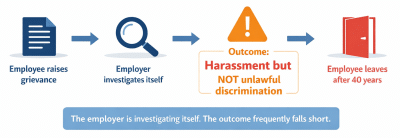
Too many employers treat internal grievance processes as a box-ticking exercise. The employee raises a concern, the employer investigates itself, and the employer finds that it hasn’t done anything too badly wrong. The employee is left feeling that the process was designed to protect the company, not to protect them. That feeling, in many cases, is accurate. If you’re thinking about raising a grievance, our guide on how to write a grievance letter explains how to do it properly.
Has your grievance made things worse? If raising a complaint led to performance management, side-lining, or pressure to leave, you may have a claim. Talk to us about your options — it’s free and confidential.
What the law actually says
In Northern Ireland, age discrimination in employment is covered by the Employment Equality (Age) Regulations (NI) 2006. In England, Scotland and Wales, equivalent protection comes from the Equality Act 2010. The principles are the same: it is unlawful to treat someone less favourably because of their age, and it is unlawful to harass someone in a way related to their age.
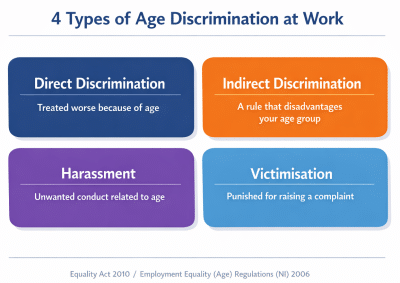
There are four types of discrimination at work that can apply: direct discrimination, indirect discrimination, harassment, and victimisation. The remarks described in this case, if proven, could amount to direct discrimination and harassment. Questioning someone’s interest in training because of their age, or suggesting they’re just running down the clock to retirement, are exactly the kind of age-related assumptions that equality law is designed to prevent.
There’s a persistent myth in workplaces that older employees are less capable with technology, harder to train, and less committed to development. Research submitted to the UK Parliament found that many employers hold these negative views about older workers, including the specific assumption that they have “poor IT skills,” even while claiming not to see age discrimination as a problem in their organisation.
The reality is that the law doesn’t care about assumptions. It cares about evidence. An employee with 40 years of consistently strong performance reviews is not suddenly incapable because she’s older. If an employer has concerns about any employee’s technology skills, the answer is to offer training and support, not to question whether they’re interested in learning “at their age.”
PwC’s track record
This isn’t PwC’s first encounter with age discrimination claims. In the United States, PwC agreed to pay $11.625 million to settle a class action lawsuit alleging that its recruitment practices systematically favoured younger applicants. The plaintiffs argued that PwC’s heavy reliance on campus recruiting effectively shut out older candidates from entry-level positions, a form of age discrimination during recruitment that remains common across many industries. As part of that settlement, PwC committed to advertising jobs to older applicants and removing graduation year requirements from its hiring process.
Different jurisdictions, different legal frameworks, different facts. But when age discrimination allegations surface repeatedly against the same global employer, it raises questions about whether the problem is individual managers behaving badly, or something more systemic in the culture.
What I think
This settlement was reached without any admission of liability. PwC has said it is “very sorry for the experience this employee had” and has committed to working with the Equality Commission to review its equal opportunities policies, procedures and practices. That language is carefully chosen, and I don’t doubt lawyers spent time on it.
But £150,000, the loss of a 40-year career, and a requirement to review your equality policies doesn’t happen when everything was fine. Something went wrong here.
I think cases like this expose a broader problem with how large employers handle discrimination complaints. The internal grievance route, which employees are always encouraged to follow first, is inherently conflicted. The employer is investigating itself. The people conducting the investigation often have professional relationships with the people being complained about. And the outcome, as here, is frequently a finding that falls short of acknowledging any legal liability.
The Equality Commission for Northern Ireland played a vital role in this case, and Geraldine McGahey put it well: older workers bring valuable experience, skills and insight to the workforce. They are not problems to be managed out.
If this sounds familiar
If you’re an older worker experiencing comments about your age, your technology skills, your retirement plans, or your “energy levels,” don’t ignore it. These remarks are not banter. They’re not well-meaning observations. They may be unlawful.
Keep a written record of what was said, when, and by whom. If your employer has a grievance process, use it, but be realistic about what it may achieve. If the grievance doesn’t resolve things, or makes them worse, you have the right to bring a claim to an employment tribunal. You generally have three months minus one day from the act of discrimination to submit a claim, so don’t wait.
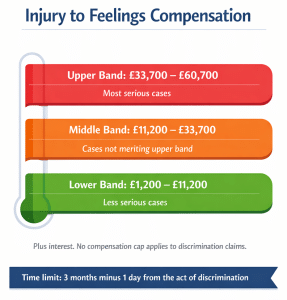
Discrimination claims are not subject to the usual compensation cap that applies in unfair dismissal cases. Injury to feelings awards are assessed using the Vento bands, which are split into three tiers: the lower band (£1,200 to £12,100) for less serious cases, the middle band (£12,100 to £36,400) for serious cases, and the upper band (£36,400 to £60,700) for the most serious cases involving prolonged campaigns of harassment. Interest at 8% per annum can also be claimed on top.
A note for readers in Northern Ireland: this case was brought under the Employment Equality (Age) Regulations (NI) 2006, which provide similar protections to the Equality Act 2010 in Great Britain. Similar time limits apply, but the tribunal system in Northern Ireland operates separately. Our firm represents employees in England and Wales. If you’re based in Northern Ireland, the Equality Commission for Northern Ireland can advise you on your options.
If you’re in England or Wales and think you’ve been discriminated against because of your age, no win no fee employment solicitors can assess your case without any upfront cost. You can also read our guide to how employment tribunals work if you’re unsure about the process.
Frequently asked questions
Can comments about my age at work be discrimination?
Yes. Remarks about your age, your technology skills, your proximity to retirement, or your “energy levels” can amount to harassment related to age, which is a form of unlawful discrimination under the Equality Act 2010. It doesn’t have to be a formal policy or a decision about your job. A single comment can be enough if it violates your dignity or creates a hostile environment. The key question is whether the conduct is related to age and whether it has that effect.
How much compensation can I get for age discrimination?
There is no cap on compensation in discrimination claims. Financial losses (lost earnings, pension, benefits) are calculated based on your actual losses. On top of that, you can claim injury to feelings, assessed using the Vento bands: lower band £1,200 to £12,100, middle band £12,100 to £36,400, and upper band £36,400 to £60,700. Interest at 8% is added to these awards. In this PwC case, the employee settled for £150,000, though every case turns on its own facts.
What if my grievance made things worse?
If you raised a grievance about discrimination and your employer then subjected you to performance management, side-lining, or pressure to resign, that could be victimisation, which is itself a form of unlawful discrimination. The law protects employees who complain about discrimination from being punished for doing so. If your situation has worsened since you raised a complaint, speak to a solicitor about your options sooner rather than later, because time limits still apply.
Do I need two years’ service to bring an age discrimination claim?
No. Unlike unfair dismissal, discrimination claims have no minimum service requirement. You can bring a claim from your first day of employment. You also don’t need to have been dismissed. You can bring a claim while you’re still employed if you’re experiencing ongoing discrimination or harassment.
Sources
- Former PwC worker settles age discrimination case for £150,000 (BBC News)
- Employment Equality (Age) Regulations (Northern Ireland) 2006
- Age discrimination guidance (Acas)
- Parliamentary written evidence on age discrimination in employment
- PwC US age discrimination class action settlement (Outten & Golden)

Tom Street
Tom Street is the principal solicitor at Tom Street & Co. Solicitors, representing employees in age discrimination, unfair dismissal, and whistleblowing cases on a no win no fee basis. If you think you’ve been treated unfairly at work because of your age, get in touch for a free initial assessment. View full profile