
4 February 2026 • By Tom Street
Disclaimer: This article contains Tom Street’s personal opinion and commentary on employment policy. It is not legal advice for your specific circumstances. For advice on your individual situation, please contact us directly. Tom Street is a solicitor regulated by the Solicitors Regulation Authority (SRA No. 566718).
Last week, investment minister Jason Stockwood told the Financial Times that the government is considering a Universal Basic Income to cushion workers from AI driven job losses. “Undoubtedly we’re going to have to think really carefully about how we soft land those industries that go away,” he said.

Here’s what strikes me about this: we’ve just passed the Employment Rights Act 2025, the biggest strengthening of workers’ protections in a generation. Six month qualifying periods for unfair dismissal. Unlimited compensation. Day one sick pay rights. Fire and rehire effectively banned.
And now, barely a month later, we’re talking about giving everyone money because their jobs might not exist anymore.
Something doesn’t add up.
What Universal Basic Income Actually Means
What is Universal Basic Income?
Universal Basic Income (UBI) is a regular payment from the state to every citizen, regardless of whether they work, their income level, or employment status. No means testing. No conditions. Everyone gets it.
Is UBI being tested anywhere in the UK?
Yes. The Welsh government has been trialling a version since 2022, paying 500 care leavers £1,600 a month. The idea is simple: if AI is going to wipe out millions of jobs, people need money to live on.
How much would UBI cost?
This is where the debate gets interesting. Investment minister Jason Stockwood has suggested tech companies could pay a “windfall levy” to fund it. The Institute for Fiscal Studies estimates a UK UBI would cost £200 billion annually, more than the entire NHS budget.
But this headline figure is what economists call the “gross cost”, what you get if you multiply the payment by the population. UBI researcher Karl Widerquist demonstrates that most of this money is recycled through the tax system. High earners would pay back their UBI in taxes, meaning the real “net cost” to fund those who genuinely need it could be far lower.
The question isn’t whether we can afford UBI. It’s whether we’re willing to redistribute productivity gains from AI through progressive taxation.

The Employment Law Problem
Here’s the issue from an employment law perspective. We’ve spent decades building a system of protections for people in work. The Employment Rights Act 2025 strengthens those protections further. Employers now have to consult properly on redundancies, with penalties up to 180 days’ pay if they don’t. They can’t just fire and rehire on worse terms. They can’t dismiss people unfairly without facing unlimited compensation.
These protections matter. They’re hard won rights that give workers bargaining power and dignity at work.
But if we’re simultaneously planning for mass unemployment through UBI, what message does that send? It suggests we’ve already accepted that those protections won’t matter because the jobs themselves won’t exist.
I think about the clients I work with. People facing redundancy. People dismissed unfairly. People fighting for their rights in tribunal. What do I tell them? “Well, in a few years you might get a basic income instead, so don’t worry too much about your employment rights”?
That’s not good enough.
The Harder Questions About Work and AI
The conversation around AI and jobs often assumes job losses are inevitable. Tech ministers talk about “soft landing” industries that “go away”, as if it’s a natural disaster we can only prepare for.
But here’s where I need to acknowledge some serious counterarguments to my position.
The Post Work Argument
Serious left wing thinkers in Britain have a fundamentally different take on this. Aaron Bastani, co-founder of Novara Media and influential in Corbyn era Labour thinking, argues in Fully Automated Luxury Communism that “automation, rather than undermining an economy built on full employment, is instead the path to a world of liberty, luxury and happiness for everyone.” This isn’t about cushioning job losses. It’s about reimagining what work means entirely.
Paul Mason, former BBC and Channel 4 economics editor, has written that Labour must embrace a post work future or “condemn itself to irrelevance.” In his view, capitalism has “changed more profoundly than over the previous 200” years, making traditional employment models obsolete.
Nick Srnicek and Alex Williams, in Inventing the Future, go further. They argue we should actively accelerate automation and use UBI to liberate people from wage labour entirely. Guy Standing, a leading UBI advocate, sees it as essential to post capitalist transition.
Their view: embrace AI’s potential to free us from drudgery, use UBI to ensure everyone benefits from productivity gains, and create space for care work, creativity, and community that capitalism currently undervalues. This isn’t defeat, it’s progress.
I understand this argument. Parts of it are compelling. But here’s the tension: if we’re strengthening employment law while simultaneously planning for a workless future, which vision do we actually believe in? And I remain deeply sceptical that Bastani’s vision of fully automated luxury communism is what Stockwood and tech industry backers actually have in mind when they propose UBI.
The Welfare Replacement Question
UBI isn’t solely a left wing idea. Historically, it’s attracted support from free market thinkers who see it as a way to streamline welfare and reduce state bureaucracy. But here’s the crucial difference: their vision is UBI as a replacement for the welfare state, not an addition to it. Strip away “inefficient” government programmes, give everyone cash, let the market sort it out.
That’s a very different vision from what Bastani and Mason propose. They see UBI as building on the welfare state, complementing worker protections. The free market version would make those protections redundant.
This bipartisan support should make us ask: which version of UBI is Stockwood actually talking about? A foundation that sits alongside the Employment Rights Act’s protections, or a replacement that makes those protections redundant because jobs won’t exist anyway?
The Lump of Labour Fallacy
Economists will point out that technology historically creates more jobs than it destroys. The “lump of labour fallacy” says there isn’t a fixed amount of work to go around. ATMs didn’t eliminate bank tellers. Computers didn’t eliminate office workers. New technologies create new industries and new roles.
So why might this time be different? Because AI isn’t just automating manual tasks or routine calculations. It’s capable of pattern recognition, judgment, and even creativity. The scope of what’s automatable has fundamentally expanded. When Morgan Stanley reports the UK is already losing more jobs to automation than it’s creating, that’s not historical precedent.
What If Jobs Aren’t the Only Thing That Matters?
Finland’s 2017 to 2018 trial is instructive. As a Nordic welfare state often held up as a model for the UK, their experiment carries weight. They gave 2,000 unemployed people €560 per month with no conditions. The official results, published by Finland’s Ministry of Social Affairs and Health, showed minimal employment impact, just six extra days worked on average.
But recipients were significantly happier. They reported less mental strain, less depression, less loneliness, and better cognitive function. Academic analysis found the UBI was “positively associated with individual capacities and confidence in various aspects of life.” They felt more financially secure even though €560 wasn’t enough to live on.
This raises an uncomfortable question for someone in my position: what if wellbeing matters as much as employment? What if having a job but being miserable, stressed, and cognitively impaired isn’t actually the goal? Perhaps that’s the real question Stockwood’s proposal poses: are we optimising for employment numbers, or for human flourishing?
I understand this argument. But I still think it misses the point. The wellbeing improvements came from financial security, not from the absence of work. You know what else would provide financial security? A job that pays enough to live on, with employment protections that prevent arbitrary dismissal.
The Finnish trial shows UBI can improve wellbeing. It doesn’t show that UBI is better than secure, well paid work.
The Global Competition Problem
Here’s a genuine constraint: if the UK heavily regulates AI deployment to protect jobs, but our competitors don’t, what happens to UK businesses? Do we price ourselves out of global markets? This isn’t theoretical. It’s the argument I hear from every employer who wants to dilute worker protections.
But we’ve heard this before. “We can’t afford stronger employment rights, we’ll be uncompetitive.” We heard it before the Employment Rights Act 2025. We heard it before the minimum wage. We heard it before health and safety regulations. And yet, somehow, British businesses survive.
The question isn’t whether we can afford to protect workers. It’s whether we have the political will to do it when tech companies are waving the competitiveness flag.
What If Some Jobs Really Are Unviable?
The strongest argument for UBI is this: what if regulation can’t save jobs that are genuinely economically unviable? If AI can do a task faster, better, and cheaper than humans, indefinitely, can employment law really preserve that role?
Perhaps not. But here’s what we can regulate: the pace of change, the consultation requirements, the retraining obligations, and who benefits from the productivity gains.
The conversation around AI and jobs assumes job losses are inevitable. Tech ministers talk about “soft landing” industries that “go away”. As if it’s a natural disaster we can only prepare for, not something we can actually control.
But we can control it. We control tax policy. We control employment law. We control whether companies can replace workers with AI and pocket the productivity gains, or whether workers share in those gains through shorter hours, better pay, or new roles.
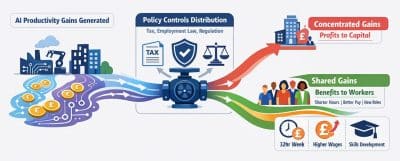
We control the outcome: tax policy and employment law determine whether AI productivity gains enrich a few shareholders or benefit workers through reduced hours, higher wages and reskilling opportunities.
The Employment Rights Act 2025 shows we’re capable of regulating how employers treat workers. Why can’t we regulate how they deploy technology that displaces workers?
France has legislated a “right to disconnect” from work emails outside working hours. Some countries are trialling four day weeks. These are examples of adapting work to technological change without accepting mass unemployment as inevitable.
Now, I need to be honest about something: saying we “can regulate” assumes the regulatory system actually works. The employment tribunal system is currently dealing with over 491,000 open cases. The average wait for a hearing is 18 months to two years. And here’s the kicker: three quarters of workers who win at tribunal never receive the money they’re owed.
The Employment Rights Act 2025 is expected to add another 6,900 cases annually to this already creaking system. So when I say “we could regulate AI deployment,” I’m acutely aware that enforcement is the weak link in employment law.
But that’s an argument for fixing the enforcement system, not for abandoning regulation altogether. If your car’s brakes don’t work, you don’t stop using brakes. You fix them.
The real question isn’t “can we stop all AI displacement?” It’s “have we even tried to ensure workers benefit from AI, or are we jumping straight to UBI as a consolation prize?”
What Should Actually Happen
I’m not against UBI in principle. But I’m deeply suspicious of it being presented as the solution to AI job displacement before we’ve even tried to regulate that displacement.
If Morgan Stanley is right that the UK is losing more jobs to automation than it’s creating, that’s a policy failure, not an unavoidable outcome. We chose to allow that. We could choose differently.
What I’d like to see instead:
First, proper consultation requirements when employers introduce AI that affects jobs. The Employment Rights Act 2025 strengthened collective redundancy consultation. Extend that to technological change. Make employers prove the change is necessary and that they’ve considered alternatives to job losses.
Second, a legal right to training and redeployment when your role is automated. Not a “soft landing” where you’re made redundant with a few weeks’ pay. An actual obligation on employers to retrain you for a different role in the business.
Third, tax AI deployment that replaces human workers, and use that money to fund shorter working weeks or better pay for remaining workers. If productivity is going up, workers should benefit.
Then, if we’ve done all that and jobs still disappear at scale, fine. Let’s talk about UBI. But let’s not reach for UBI as the first response to AI, before we’ve even tried to protect workers’ jobs and livelihoods.
The Timing Tells You Everything
The Employment Rights Act 2025 took years of campaigning and political will. It received Royal Assent in December 2025. Now, barely six weeks later, we’re talking about UBI because jobs might disappear anyway.

And here’s what makes the timing even more striking: most of the Employment Rights Act 2025’s protections don’t even take effect until 2027. The six month qualifying period for unfair dismissal? January 2027. Stronger fire and rehire protections? 2027. We’re discussing UBI as a response to job losses before the worker protections we just passed are even active.
That tells me something. It tells me that strengthening employment rights isn’t seen as the long term solution to workers’ problems. It’s more like tidying up before the demolition crew arrives.
I hope I’m wrong. I hope the government uses the Employment Rights Act 2025 as a foundation to build on, not as a consolation prize before the jobs vanish. I hope they regulate AI deployment with the same energy they’ve regulated zero hours contracts.
But right now, the UBI discussion feels like giving up before the fight has even started. And workers deserve better than that.
Related Reading
- Your Rights: Unfair Dismissal in 2026 – How the Employment Rights Act 2025 changes unfair dismissal protection
- Redundancy Rights Explained – What employers must do when making you redundant
- Collective Redundancy Consultation – New penalties and requirements under ERA 2025
Note: This is commentary on employment policy, not legal advice for your specific circumstances.
Facing Redundancy or Job Changes?
Whether your job is at risk due to AI, restructuring, or other reasons, you have legal rights. We can help you understand your options and fight for the compensation you deserve.
Get Free Initial AdviceSources
- People Management: Universal basic income needed to support workers displaced by AI, minister says
- Fortune: UK minister calls for universal basic income to cushion the blow from AI-related job losses
- Institute for Fiscal Studies: The economics of a Universal Basic Income
- Acas: Employment Rights Act 2025
- House of Commons Library: Potential merits of a universal basic income
- Karl Widerquist: How much does UBI cost? (net vs gross cost methodology)
- Aaron Bastani (2019). Fully Automated Luxury Communism: A Manifesto. Verso Books. (UK: Novara Media co-founder, influential in Corbyn-era Labour)
- Paul Mason: Labour must embrace a post work future (New Statesman, 2021) (UK: Former BBC/Channel 4 economics editor)
- Nick Srnicek and Alex Williams (2015). Inventing the Future: Postcapitalism and a World Without Work. Verso Books.
- Finnish Ministry of Social Affairs and Health: Results of the basic income experiment (2017-2018)
- Kangas et al.: Basic Income and the Status of Women in Finland (PMC, 2023)
- The Bureau of Investigative Journalism: Thousands of rogue bosses have failed to pay tribunal awards
- Law Gazette: Thousands more cases to be piled onto creaking tribunal system

About Tom Street
Tom Street is a solicitor specialising in employment tribunal representation for employees. He advises on unfair dismissal, discrimination, whistleblowing, and redundancy claims across the UK. Tom represents clients on a no win no fee basis, ensuring employees can access justice regardless of financial circumstances.
SRA Number: 566718 | LinkedIn →