
Your employer slides a settlement agreement across the desk. The offer is… underwhelming. Should you push back for more? What if they withdraw the offer completely? What leverage do you actually have in settlement agreement negotiations?
Most employees accept the first offer without realising they’re leaving thousands of pounds on the table. Employers expect negotiation – they’ve often built room into the initial figure. The question isn’t whether to negotiate, but how strong your position is and what strategy to use.
Use our free negotiation strength checker below to assess your leverage, understand what strengthens your hand, and get instant guidance on whether to accept, counter-offer, or push back harder.
Settlement agreement negotiations are expected by employers. Your leverage depends on potential legal claims, procedural failures, timing factors, and employer motivation. Strong positions (discrimination, unfair dismissal with evidence, employer urgency) can yield 20-50% uplifts. Professional negotiation protects you from pressure tactics while maximising both financial and non-financial terms.
⚖️ This guide is for general information only and is not legal advice. Every case is different – if you’re unsure, speak to a solicitor.
Key Points
- ✓ Negotiation is expected: Employers build room into first offers and anticipate counter-proposals from employees
- ✓ Leverage factors: Potential claims, procedural failures, timing pressures, and reputational risks strengthen your position
- ✓ Typical improvements: Professional negotiation achieves 20-50% uplift on initial offers in most cases
- ✓ Employer motivation matters: Understanding why they want settlement reveals negotiation opportunities
- ✓ Non-financial terms count: References, restrictive covenants, and timing can be as valuable as money
- ✓ Professional help pays: Specialist negotiators protect you from pressure tactics and maximise outcomes
⚖️ Legislation Update
Unfair Dismissal Compensation Cap to be Abolished from January 2027
The Employment Rights Act 2025 received Royal Assent on 18 December 2025. From 1 January 2027, the qualifying period for ordinary unfair dismissal reduces from two years to six months. Most significantly, the compensation cap on unfair dismissal awards will be completely removed (commencement date pending secondary legislation, likely also January 2027). This fundamentally changes settlement negotiation dynamics – high earners and senior roles will have substantially stronger negotiating positions once uncapped compensation is in force. Settlement offers made after these changes should reflect significantly higher potential tribunal values.
Free Settlement Agreement Negotiation Strength Checker
Use our confidential checker to assess how strong your position is to negotiate a better settlement agreement. The tool evaluates your potential legal claims, leverage factors, employer motivation, and timing advantages to give you instant, personalised guidance on your negotiation strength.
What the checker assesses:
- Claim strength: Unfair dismissal, discrimination, whistleblowing, constructive dismissal, wrongful dismissal, and breach of contract claims
- Procedural failures: Investigation quality, disciplinary procedure compliance, Acas Code adherence, appeal process, consultation requirements
- Leverage points: Timing pressures, reputational risks, senior role factors, service length, evidence quality, witness availability
- Employer urgency: Restructuring deadlines, financial year pressures, regulatory timing, media sensitivity, precedent concerns
- Your circumstances: Role seniority, salary level, employment duration, performance record, industry sector, contract terms
Your personalised results will show: Overall negotiation strength rating (Strong / Medium / Weak), specific leverage factors identified in your situation regarding settlement agreement negotiations, recommended negotiation strategy tailored to your position, realistic improvement expectations (percentage ranges), suggested next steps and professional advice options.
How the Negotiation Strength Assessment Works
The assessment uses a multi-factor analysis model developed by employment law specialists. It evaluates your responses against established tribunal precedents, statutory compensation ranges (April 2025 rates: unfair dismissal up to £118,223, discrimination unlimited with Vento bands £1,200-£60,700), procedural fairness standards from the Acas Code, and typical settlement negotiation outcomes across thousands of cases. The tool assigns weighted scores to different leverage factors (potential claims 40%, procedural failures 25%, timing/urgency 20%, role/evidence factors 15%) to calculate your overall negotiation strength. Results are provided instantly and remain completely confidential – no information is stored or shared.
Need immediate help with negotiations? Call our specialist settlement agreement hotline on 020 3907 3343 or upload your agreement for expert review.
What Gives You Strong Negotiating Leverage?
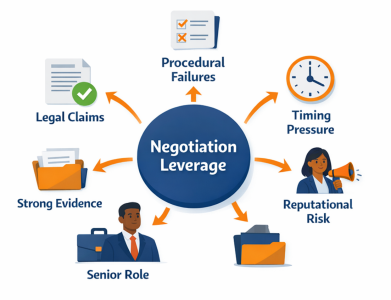
Your ability to negotiate a better settlement agreement depends on how much risk you represent to your employer. The stronger your potential claims and the more they want to avoid tribunal, the more room you have to push back.
Potential Employment Law Claims
If you have viable legal claims against your employer, this is your strongest leverage. Claims that carry unlimited compensation (discrimination, whistleblowing) or significant tribunal awards (unfair dismissal, constructive dismissal) make employers more willing to settle for higher amounts.
High-value leverage claims: Discrimination based on protected characteristics (unlimited compensation plus injury to feelings awards of £1,200 to £60,700 under Vento bands – April 2025 rates), whistleblowing claims (unlimited compensation with no service requirement), constructive dismissal with strong evidence of fundamental breach, unfair dismissal with procedural failures (compensatory award up to £118,223 or one year’s gross salary, whichever is lower – as of April 2025).
Medium-value leverage claims: Wrongful dismissal (notice period pay), breach of contract (unpaid bonuses, commission, benefits), unlawful deduction of wages, failure to provide written reasons for dismissal, failure to consult on redundancy.
Procedural Failures by Your Employer
Even if your employer had legitimate reasons to end employment, failures in process give you leverage. Employers know tribunals scrutinise procedure carefully, and procedural unfairness can make otherwise fair dismissals unlawful.
Strong procedural leverage includes: no proper investigation before disciplinary action, failure to follow Acas Code of Practice on disciplinary procedures, inadequate consultation on redundancy, no appeal process offered or sham appeal, dismissal for performance without any warnings or improvement plan, failure to consider reasonable adjustments for disability.
Timing and Urgency Factors
When employers are under time pressure, your negotiating position strengthens significantly. Their urgency becomes your leverage, especially if delays would cause them problems.
Timing leverage factors: employer restructuring with tight deadlines, senior departure creating reputational management needs, imminent regulatory inspection or audit, end of financial year pressure, upcoming merger or acquisition, need to prevent tribunal claim before specific date, other employees watching the outcome, media interest in the situation.
Reputational and Relationship Factors
Claims that could damage your employer’s reputation or involve sensitive issues give you additional negotiating power beyond the monetary value of potential tribunal awards.
Reputational leverage includes: discrimination involving senior managers, harassment by company directors, whistleblowing about serious wrongdoing, matters involving vulnerable clients or service users, situations likely to attract media attention, industries with strict regulatory oversight, roles where you had access to sensitive information, circumstances that could damage employer brand or recruitment.
Your Role and Service
Senior positions, specialised roles, and long service with clean records all strengthen your hand. Employers consider the disruption your departure causes and the difficulty of defending your dismissal.
Position-based leverage: senior management or director level, highly specialised technical skills, client-facing role with strong relationships, long service (10+ years) with excellent record, key relationships with major customers or suppliers, unique knowledge of systems or processes, industry profile and connections, clean disciplinary record throughout employment.
When Negotiation Is Most Effective
Understanding when you’re in a strong, medium, or weak negotiating position helps you set realistic expectations and choose the right strategy. Not all settlement situations offer equal room for improvement, but even medium positions can yield better terms with skilful negotiation.
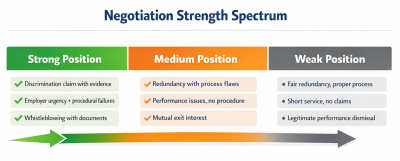
Strong Position Scenarios
You have substantial negotiating power when your potential employment tribunal claims could result in significant awards or your circumstances create serious risk for the employer.
Discrimination or whistleblowing claims: These carry unlimited compensation and significant reputational risk. Employers facing potential discrimination findings often settle for multiples of the initial offer to avoid tribunal. The combination of unlimited awards, injury to feelings compensation, and publicity risk gives you maximum leverage.
Unfair dismissal with clear evidence: When you have emails, documents, or witnesses proving unfair treatment or procedural failures, your claim becomes high-risk for the employer. Strong evidence makes tribunal success more likely and settlement more attractive to them.
Constructive dismissal with fundamental breach: If your employer’s conduct fundamentally breached your contract and you can prove it, you hold significant cards. Cases involving serious bullying, unlawful deductions, or major contractual breaches create substantial employer risk.
Employer urgency situations: When your employer needs quick resolution due to restructuring, senior departures, or reputational management, time pressure shifts power to you. Their deadlines become your leverage for better terms.
Medium Position Scenarios
Medium positions still offer negotiation potential, particularly if you combine multiple factors or your employer wants certainty over litigation risk.
Genuine redundancy with process flaws: Even if the redundancy is real, failures in consultation, selection criteria, or consideration of alternatives give you grounds to push back. Employers often prefer to improve offers rather than defend flawed processes.
Performance issues without proper procedure: If your employer had legitimate performance concerns but failed to follow proper performance improvement procedures, you have negotiating room. The lack of warnings, support, or fair process weakens their defence.
Mutual interest in exit: Relationship breakdowns where both parties want separation can be negotiated constructively. While you may not have strong legal claims, the employer’s interest in smooth exit creates room for improved terms, especially on references and timing.
Restrictive covenants employer wants enforced: If your contract contains restrictive covenants (non-compete, non-solicitation) that the employer wants you to respect, you can negotiate their removal or reduction in exchange for accepting other terms.
Weak Position Scenarios
Some situations offer limited negotiation scope. Recognising weak positions helps you avoid damaging credibility with unrealistic demands while still securing the best available terms.
Genuine fair redundancy: When redundancy is genuine, the selection process was fair, and consultation was proper, your leverage is limited. However, you can still negotiate non-financial terms like references, notice periods, and outplacement support.
Legitimate performance dismissal with proper process: If your employer followed proper procedures, provided support and warnings, and genuinely attempted to help you improve, challenging the dismissal is difficult. Focus negotiation on references and transition support rather than compensation.
Short service with no discrimination claims: With less than two years’ service (the qualifying period for ordinary unfair dismissal), your legal options are limited unless you have discrimination or whistleblowing claims. Your negotiation centres on securing good references and perhaps some financial recognition.
Even in weak positions, professional negotiation often secures improvements. Employers appreciate clean exits and may enhance terms for goodwill, to secure confidentiality, or to obtain your cooperation on handover.
Understanding Your Employer’s Motivation
Effective negotiation requires understanding why your employer offered a settlement agreement in the first place. Their motivation reveals what they’re trying to avoid – and therefore what gives you leverage.
Why Do Employers Offer Settlement Agreements?
Employers use settlement agreements to manage risk, avoid costs, and ensure certainty. Understanding these drivers helps you frame your counter-offer in terms of their concerns rather than just your wants.
Avoiding tribunal costs: Even if the employer would likely win at tribunal, the legal fees (typically £20,000 to £50,000 or more) make settlement attractive. Defending claims consumes management time, legal resources, and creates uncertainty about outcomes. A reasonable settlement often costs less than fighting.
Managing reputational risk: Employment tribunals are public. Details of workplace issues, management conduct, and company practices become part of the public record. Employers in regulated industries, consumer-facing businesses, or sensitive sectors often pay premium settlements to avoid this exposure.
Certainty over litigation risk: Tribunals are unpredictable. Even strong employer cases can fail if witnesses perform poorly, judges take different views on facts, or new evidence emerges. Settlement provides certainty and allows the employer to budget exact costs and close the matter definitively.
Preventing precedent: If your case could encourage other employees to bring similar claims, your employer has extra motivation to settle quietly. Your negotiation strength increases if your situation isn’t unique in the organisation.
What Makes Employers Willing to Negotiate?
Employers expect negotiation on settlement agreements. Understanding what makes them willing to improve offers helps you position your counter-proposal effectively.
Strong legal claims you could bring: The more viable your potential tribunal claims, the more they’ll pay to avoid them. Calculate the potential tribunal award – employers will often settle for 50-70% of that value to avoid the risk and cost of fighting.
Procedural weaknesses in their position: Employers know that tribunals scrutinise process rigorously. If they’ve made procedural mistakes, they’ll negotiate to avoid having those failures examined publicly.
Time pressure and urgency: When employers need quick resolution, they pay more for it. Restructuring deadlines, financial year ends, regulatory pressures, and reputational management create urgency that strengthens your position.
Senior or visible departures: The more senior your role or the more visible your departure, the more the employer needs a controlled exit. Directors, department heads, and public-facing roles create additional employer motivation to settle well.
Financial Leverage Points
Effective negotiation requires understanding every financial element in play – not just the headline settlement figure. Many employees overlook statutory and contractual entitlements, leaving money on the table even in successful negotiations.
Statutory and Contractual Minimums
Before negotiating additional compensation, ensure you’re receiving your minimum legal entitlements. These aren’t negotiable – they’re what you’re owed regardless of settlement.
Notice pay: You’re entitled to your full contractual or statutory notice period pay (whichever is longer). Statutory minimum is one week per year of service up to 12 weeks maximum. Many contracts provide longer notice periods. If you’re paid in lieu of notice (PILON), this is typically taxed as salary.
Accrued holiday pay: You must be paid for all unused holiday up to and including your termination date. This includes both taken and untaken statutory minimum holiday (5.6 weeks in the UK). Calculate carefully – employers sometimes shortchange holiday pay calculations.
Statutory redundancy pay: If genuinely redundant, you’re entitled to statutory redundancy pay if you have two or more years’ service. The calculation is 0.5 week’s pay per year under 22, 1 week’s pay per year between 22-40, 1.5 weeks’ pay per year over 41, with a maximum of 20 years counted and a weekly pay cap of £719 (giving maximum statutory redundancy of £21,570 – April 2025 figures).
Contractual entitlements: Check your contract for bonuses, commission, share options, pension contributions, or other benefits due. These should be calculated accurately and included in addition to any settlement sum.
Potential Tribunal Awards
Understanding what you might win at tribunal gives you a baseline for negotiation. Employers typically settle for 50-70% of potential tribunal awards to reflect the avoided costs and risks of defending claims.
Unfair dismissal compensation: Comprises two elements – basic award and compensatory award.
Basic award: Calculated like statutory redundancy pay based on age, service, and weekly pay. Maximum 30 weeks × £719 weekly pay cap = £21,570 (April 2025).
Compensatory award: Compensates for financial losses caused by dismissal. Capped at the lower of: (a) one year’s gross salary, OR (b) £118,223 (as of April 2025). This means employees earning less than £118,223 annually are effectively capped at their annual salary. For example, someone earning £40,000/year can receive maximum £40,000 compensatory award, while someone earning £150,000/year is capped at £118,223. Awards can be reduced by up to 25% for failure to follow Acas Code.
⚖️ ERA 2025 Impact: Currently, the compensatory award is capped at the lower of one year’s gross salary or £118,223. From 1 January 2027, the £118,223 statutory cap will be abolished entirely, meaning compensation will only be limited by actual financial losses. High earners currently capped at £118,223 (those earning over this amount) will have dramatically stronger negotiating positions once uncapped compensation is in force.
Discrimination compensation: No upper limit on compensation. Awards comprise injury to feelings (Vento bands – April 2025 rates: £1,200-£12,100 for less serious cases, £12,100-£36,400 for middle range, £36,400-£60,700 for most serious cases, with exceptional cases exceeding £60,700), financial losses (lost salary, benefits, pension), aggravated damages in serious cases, potential interest on awards.
Whistleblowing compensation: No upper limit and no qualifying service period required. Can include financial losses, injury to feelings, and exemplary damages in some cases. These claims carry particular reputational risk for employers.
Wrongful dismissal: Compensation equals your notice period pay (the contractual notice you should have received). This is in addition to other claims, not alternative to them. High earners with long notice periods can have substantial wrongful dismissal claims.
Tax Efficiency Opportunities
How your settlement is structured affects how much you actually receive. The first £30,000 of termination payments can be paid tax-free if structured correctly, creating negotiation opportunities.
Tax-free portion: Up to £30,000 (2025/26 tax year) of genuine compensatory payments (not salary, notice pay, or contractual bonuses) can be paid without income tax or National Insurance. This creates planning opportunities – sometimes asking for less money structured tax-efficiently nets you more than higher payments that would be fully taxed.
Taxable elements: Notice pay is always taxable as earnings. Holiday pay is always taxable. Contractual bonuses and benefits in kind are taxable. Only genuine damages/compensation for loss of employment qualify for the £30,000 exemption.
Negotiation opportunity: If you’re still employed, you have more flexibility in structuring payments. You might negotiate to stay on garden leave (receiving taxed salary) while separately negotiating tax-free compensation, optimising your total net receipt.
💡 Calculate Your Settlement Value
Use our free calculators to understand your baseline entitlements and potential tribunal values
Unfair Dismissal Calculator → Tax Calculator →Non-Financial Negotiation Points
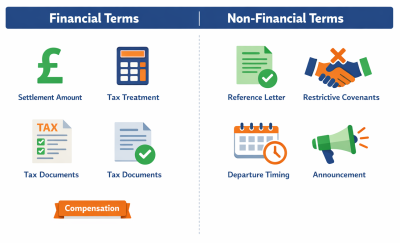
Money isn’t everything in settlement negotiations. Non-financial terms often make the difference between a good and excellent settlement, particularly in terms of your future career prospects and peace of mind.
Agreed References
A strong reference is often worth more than a few thousand pounds extra compensation, particularly if you’re moving to a new employer who will contact your previous employer. Never leave references to chance – negotiate and agree the exact wording.
What to negotiate: Full factual reference confirming role, dates, salary, and responsibilities. Positive statement about performance and conduct. Confirmation of reason for leaving (resignation, redundancy, mutual agreement). Agreement that this wording will be provided to any reference request. Sometimes include quotes like “made valuable contributions to the team” or “left on good terms”.
How to secure it: Draft the reference yourself in the third person as you want it to read. Attach it as a schedule to the settlement agreement. Include a clause obliging the employer to provide this exact wording in response to any reference enquiries. Specify who is authorised to give references (sometimes limiting to HR only prevents rogue managers giving different references).
Restrictive Covenants
Your employment contract may contain restrictive covenants preventing you from working for competitors, soliciting clients, or poaching colleagues. Settlement agreements offer opportunities to negotiate these down or remove them entirely.
Common restrictions: Non-compete clauses preventing work for competitors for 6-12 months. Non-solicitation clauses preventing contact with clients or customers. Non-poaching clauses preventing recruitment of former colleagues. Non-dealing clauses preventing business with former clients. Confidentiality obligations continuing after employment.
Negotiation opportunities: Reduce the geographic scope (UK-wide to your region only). Shorten the time period (12 months to 6 months or 3 months). Narrow the definition of “competitor” or “client”. Remove restrictions entirely in exchange for other terms. Obtain written confirmation that specific roles or employers aren’t covered. Secure employer agreement not to enforce without first raising concerns with you.
Timing and Termination Date
When your employment ends can be as important as how much you receive, particularly if bonuses, share vesting, or other benefits depend on your employment status on specific dates.
Garden leave advantages: Remaining employed on garden leave (full pay, not working) keeps your benefits active, continues pension contributions, preserves certain legal rights, and can bridge you to bonus payment dates or share vesting dates. It also gives you more time to find new employment while still receiving salary.
Immediate exit advantages: Leaving immediately frees you to start new employment without notice period restrictions, may be psychologically preferable after a difficult situation, and allows you to move forward without delay. Sometimes immediate exit with payment in lieu is better than weeks of garden leave uncertainty.
Common Negotiation Mistakes to Avoid
Even strong positions can be undermined by poor negotiation tactics. Understanding what not to do is as important as knowing the right strategies.
Accepting the first offer without assessment: Employers rarely make their best offer first. They expect negotiation and often build room to move into the initial proposal. Accepting immediately suggests either desperation or lack of understanding about your rights, potentially leaving thousands unclaimed.
Asking for unrealistic amounts: While you should aim high, demanding multiples of reasonable value destroys credibility. If your claim is worth £20,000 at tribunal, asking for £100,000 marks you as unreasonable. Employers stop taking you seriously, making further negotiation difficult. Base demands on realistic tribunal values plus employer risk.
Revealing your bottom line too early: Once you’ve told the employer your minimum acceptable figure, you’ve capped the negotiation. Never reveal the lowest amount you’d accept. Instead, explain what you believe you’re entitled to and why, leaving room for structured negotiation downwards.
Negotiating without understanding your claims: You cannot negotiate effectively without knowing what claims you have, their potential values, and the strength of your evidence. Professional legal advice before negotiating is essential. Even one consultation can prevent costly mistakes.
Missing tax optimisation: Accepting a settlement structured inefficiently can cost you thousands in unnecessary tax. The £30,000 tax-free allowance should be maximised. Notice pay, holiday pay, and bonuses should be clearly separated from compensatory payments. Professional tax advice during negotiation pays for itself.
Ignoring non-financial terms: Focusing only on money misses valuable opportunities. References, restrictive covenants, timing, announcements, and post-termination benefits can be as valuable as thousands of pounds extra compensation. These terms often matter more long-term than slightly higher cash payments.
Responding too quickly: Immediate responses suggest desperation or lack of consideration. Take time to review properly, consult advisers, and formulate strategy. Employers respect measured responses more than instant acceptances. Time pressure usually works in their favour, not yours.
Using aggressive tactics: Threats, ultimatums, and hostile communications damage relationships and reduce settlement prospects. Maintain professional tone throughout. Frame demands as legally justified requests, not aggressive demands. Employers settle more readily with professional opponents than hostile ones.
Not getting professional advice: DIY negotiation saves legal fees but typically costs far more in lost improvements. Specialist solicitors know claim values, market rates, leverage tactics, and how to handle employer pressure. The employer’s legal fee contribution makes advice affordable. The 20-50% typical improvement far exceeds the cost.
Forgetting about references: Many employees negotiate hard on money but accept vague reference terms. References can make or break your next job. Never leave them unaddressed. Draft agreed wording and attach it to the settlement agreement. This prevents future disputes and protects your career.
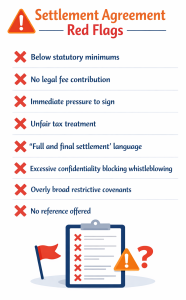
Red Flags in Settlement Offers
Some settlement offers contain terms that should immediately raise concerns. Recognising red flags helps you identify unfair terms and push back effectively.
Financial Red Flags
Offer below statutory minimums: If the settlement doesn’t even cover your notice pay, holiday pay, and statutory redundancy (if applicable), reject immediately. These are legal entitlements, not negotiable items. An offer below minimums suggests either incompetence or bad faith.
No legal fee contribution: Standard practice is for employers to contribute £250-£1,500 plus VAT towards your legal fees. Offering zero contribution is unusual and suggests the employer doesn’t want you taking professional advice. This should raise serious concerns about the fairness of their offer.
Unfair tax treatment: Settlement agreements should maximise your £30,000 tax-free allowance. If the agreement structures everything as taxed earnings, you’re paying unnecessary tax. Insist on proper tax structuring unless there’s good reason (you’re still employed and receiving salary).
Legal Red Flags
Vague “full and final settlement” language: ERA 1996 s.203 requires specific claims to be listed. Vague wording like “all and any claims” isn’t legally valid. The agreement must identify particular claims being settled (unfair dismissal, discrimination, etc.). Insist on proper specific wording.
Waiving non-waivable rights: Some rights can’t be waived even in valid settlement agreements: personal injury claims where injury wasn’t known at signing, pension rights under pension schemes, statutory rights under working time regulations, rights related to participation in protected industrial action. If the agreement tries to waive these, it’s invalid.
Excessive confidentiality preventing whistleblowing: Confidentiality clauses must allow protected disclosures to regulators, law enforcement, and in tribunal proceedings. Confidentiality that prevents you reporting serious wrongdoing is unenforceable and unethical. Ensure your whistleblowing rights are preserved.
Procedural Red Flags
Immediate pressure to sign: Being told “you must sign today” or given unreasonably short deadlines is a major red flag. You’re entitled to reasonable time for legal advice – typically at least 48-72 hours, often a week. Pressure tactics suggest the employer knows the offer is unfair.
Missing required elements: Valid settlement agreements must be in writing, relate to specific proceedings or complaints, include independent legal advice from qualified adviser who has professional indemnity insurance, and list specific statutory rights being waived. If any element is missing, the agreement is invalid.
No reference offered or addressed: Professional employers understand references matter. Refusing to discuss references or provide agreed wording is a warning sign. This suggests potential for bad references later, regardless of settlement agreement terms. Don’t leave references to chance – insist on agreed wording.
How to Make a Counter-Offer
Once you’ve assessed your position and identified negotiation points, you need to present your counter-offer strategically. How you communicate matters as much as what you ask for.
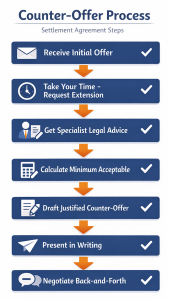
Taking Your Time
Don’t respond immediately to a settlement offer, even if you think it’s acceptable. Taking time demonstrates that you’re considering carefully, consulting professionally, and not desperate to settle. It also prevents pressure-driven mistakes.
Request extension if needed: If the employer gives a tight deadline, politely ask for more time: “I’d like to consult with a specialist employment solicitor before responding. I’ll need until [date] to do that properly. Please confirm you can extend the deadline to then.” Employers almost always agree to reasonable extensions.
Get Specialist Advice First
Before making any counter-offer, consult an employment solicitor who specialises in settlement agreement negotiations. The employer’s legal fee contribution makes this advice essentially free, and it can be worth thousands or tens of thousands of pounds.
Your solicitor should assess the strength of your potential claims, value those claims realistically, identify all leverage points, review the proposed agreement for unfair terms, suggest negotiation strategy tailored to your situation, draft your counter-offer professionally, and handle communications with the employer or their solicitors.
Calculate Your Minimum Privately
Before negotiating, work out privately what you’d actually accept. This is your “walk away” number – the minimum below which you’d rather pursue tribunal or other options. Never reveal this figure to the employer. It’s for your own decision-making only.
Your minimum should be based on realistic tribunal value (accounting for costs, time, stress, and risk of losing), your financial circumstances (can you afford to reject and fight?), strength of your claims and evidence, importance of non-financial terms (especially references), and alternative options available to you.
Start High with Justification
Your counter-offer should be at the high end of what’s justifiable based on your claims and leverage, but not absurdly high. You’re building room for negotiation downwards while anchoring expectations higher.
Justification matters most: Don’t just demand a number. Explain how you reached it: “Based on potential unfair dismissal claim (basic award £X plus compensatory award £Y), discrimination claim (injury to feelings middle Vento band £Z), and procedural failures, I believe fair settlement is £[total].” Show your working. Cite cases, statutory figures, and legal principles.
Structure Your Counter-Offer
Present your counter-offer in professional, structured format addressing both financial and non-financial terms. A well-structured counter-offer demonstrates seriousness and invites constructive negotiation.
Suggested structure: Thank them for the offer and confirm receipt. State you’ve taken legal advice (or are in process of doing so). Present your counter-proposal with specific figures and terms. Provide legal justification for each element. Address non-financial terms (references, restrictive covenants, timing). Suggest timeline for response. Maintain professional, courteous tone throughout.
Make Your Counter-Offer in Writing
Written counter-offers are better than verbal ones. They’re clear, unambiguous, allow careful wording, create paper trail, and are taken more seriously. Email is fine – formal letters aren’t necessary for counter-offers (though final agreement should be formal).
Expect Back-and-Forth
Negotiation rarely resolves in one round. Expect the employer to reject your initial counter-offer and make improved offer somewhere between their opening and your counter. This is normal. Continue negotiating until you reach acceptable terms or conclude no agreement is possible.
What Happens If You Negotiate?
Many employees fear that attempting to negotiate will anger their employer and result in the offer being withdrawn completely. In reality, well-judged negotiation rarely has this effect. Understanding likely outcomes helps you negotiate with confidence.
Best Case Scenario
The employer agrees to your counter-offer, either completely or with minor adjustments. This happens more often than many employees expect, particularly when your requests are reasonable, well-justified, and supported by legal analysis. Some employers make low initial offers specifically to test whether you understand your rights – professional counter-offers get respect.
Likely Case Scenario
The employer makes an improved offer that’s better than their initial proposal but not everything you requested. You negotiate to somewhere in the middle. This is the most common outcome – employers expect this process and often have authority to move up from initial offers within predetermined ranges.
Typical improvements include 20-40% increase on financial terms, enhanced references (from basic factual to positive statements), reduced restrictive covenants (shorter periods, narrower scope), better termination timing (garden leave to desired date), additional non-financial benefits (outplacement support, professional memberships).
Worst Case Scenario
The employer refuses to improve the offer or withdraws it completely. This is rare when negotiation is conducted properly through “without prejudice” discussions or protected conversations under ERA 1996 s.111A, but it can happen if demands are unreasonable, tactics are aggressive, new information seriously weakens your position, or employer concludes you’ll never settle reasonably.
If the offer is withdrawn, you still have options: pursue employment tribunal claim (if you have viable claims), make revised more realistic proposal, wait for employer to return with new offer (they often do), accept that no settlement is possible and focus on new employment.
Professional, well-judged negotiation backed by legal advice rarely results in offer withdrawal. Employers who make settlement offers want settlement. They’ve decided paying you to leave is preferable to keeping you or fighting tribunal. Reasonable negotiation doesn’t change this fundamental calculation.
When to Accept vs. When to Push Back
Knowing when you’ve achieved a good outcome and should accept versus when you should continue pushing is crucial to successful settlement negotiation. Both extremes – accepting too quickly or pushing too hard – cost you money.
Accept the Offer If…
The offer exceeds likely tribunal value: If what’s offered is more than you’d realistically win at tribunal (accounting for the 30-40% chance of losing, legal costs, stress, and time), accept it. A reasonable settlement in hand beats potential tribunal success in the future. You’re avoiding risk and achieving certainty.
You have weak or no legal claims: When your legal position is genuinely weak, receiving any compensatory payment beyond statutory minimums is a positive outcome. Don’t push back when you’re negotiating from weakness – accept reasonable terms and move forward. The employer could have offered nothing extra.
Non-financial terms are excellent: Sometimes a slightly lower cash settlement with strong references, reduced restrictions, and good timing is better than higher cash with poor non-financial terms. Consider the whole package, not just the money. Your career prospects matter more than a few thousand pounds difference.
You need quick resolution: If you need certainty quickly – perhaps you have new job offer, health concerns, or financial pressures – a reasonable settlement now may be better than potentially better outcome later. Only you can judge your own risk tolerance and circumstances.
Push Back If…
Offer significantly below market value: When the offer is clearly inadequate compared to tribunal values, comparable settlements, or standard practice for your situation, push back. Don’t accept derisory offers just because you’re offered something. Stand your ground when you have strong legal position.
Strong legal claims aren’t reflected: If you have clear discrimination claims, whistleblowing claims, or unfair dismissal with strong evidence, and the offer doesn’t reflect this leverage, negotiate firmly. Employers making low offers to employees with strong claims are testing whether you understand your position. Show you do.
Employer has capacity to pay more: Large employers or those with clear urgency can usually offer more. If the employer is a major corporation and you have strong claims, their initial offer is almost never their best offer. Use the negotiation process to reach their actual budget.
Red flags in agreement terms: If the offer contains unfair terms (waiving non-waivable rights, excessive confidentiality, no reference, below minimums), push back regardless of the financial amount. These terms can cause problems for years. Insist on fair terms as well as fair compensation.
How Tribunal Claim Solicitors Can Help
While it’s possible to negotiate settlement agreements yourself, specialist employment solicitors typically achieve significantly better outcomes. Understanding what professional help provides helps you decide whether to use it – and how to use it effectively.
Expert Assessment of Your Position
Solicitors specialising in settlement agreement negotiations can accurately assess the strength of your claims, value them realistically, and identify leverage points you might miss. This assessment forms the foundation of effective negotiation strategy.
We review your employment contract, correspondence, and circumstances to identify all potential claims – not just obvious ones like unfair dismissal, but also discrimination, whistleblowing, breach of contract, wrongful dismissal, and other claims you might not have considered. Many employees have viable claims they don’t realise exist.
Typical Improvement Statistics
Our track record shows that professional negotiation typically achieves 20-50% improvements on initial settlement offers, sometimes substantially more in cases with particularly strong claims or significant employer procedural failures.
The employer’s legal fee contribution (typically £250-£1,500 plus VAT) means professional advice often costs you nothing or very little, making the 20-50% improvement pure additional value. In many cases, even after deducting legal fees, you’re tens of thousands of pounds better off than you would have been negotiating alone.
Specialist Negotiation on Your Behalf
We handle all communications with your employer or their solicitors, removing the emotional burden from you and ensuring negotiations remain professional and strategic throughout. This distance helps achieve better outcomes.
Our solicitors draft your counter-offer in legally precise language that carries weight, respond to employer arguments with legal analysis, manage back-and-forth negotiations professionally, identify when the employer is bluffing versus when they’ve genuinely reached their limit, and know when to push harder and when to accept.
Protection from Pressure Tactics
Employers and their lawyers sometimes use pressure tactics: tight deadlines, “final offer” statements, suggestions that you’re being unreasonable, warnings about offer withdrawal, emphasis on cost of fighting. Professional representation shields you from these tactics and responds appropriately.
We recognise and counter common pressure tactics, maintain professional distance allowing objective assessment, advise when pressure is genuine versus tactical, and keep negotiations on track without emotional reactions.
Tax Optimisation and Agreement Review
Beyond negotiation, we ensure the agreement is structured tax-efficiently and contains no unfair terms. This technical review prevents problems that might not be obvious to non-specialists.
We maximise your £30,000 tax-free allowance, separate taxable and non-taxable elements clearly, identify and remove unfair clauses, ensure all required legal elements are present, draft or improve reference wording, and negotiate restrictive covenant reductions.
Our Fee Structures
We offer flexible fee arrangements depending on your circumstances and the nature of your case.
Fixed fees: For straightforward review and negotiation, we charge fixed fees (typically £1,500-£3,000 plus VAT). You know the cost upfront, and the employer’s contribution often covers most or all of this.
Percentage-based fees: For cases where significant improvement is likely, we work on a percentage basis (typically 20-25% plus VAT of any improvement we achieve). You only pay if we improve the offer – aligning our interests completely with yours.
Hybrid approaches: Sometimes we combine modest fixed fee for initial work with success element for improvements achieved. This balances certainty for you with incentive for us to maximise your outcome.
The employer’s contribution towards your legal fees reduces or eliminates your cost in many cases. Because our fees are often contingent on improvement achieved, our interests align with yours – we only succeed financially when we improve your outcome.
Get immediate help: Call our specialist settlement agreement negotiation team on 020 3907 3343 for a same-day consultation. Or upload your settlement agreement for expert review and negotiation strategy within 24 hours.
“The biggest mistake I see is employees accepting the first offer without understanding their leverage. In over 80% of cases where we negotiate, we secure improvements – typically 20-50% more than the initial offer. Employers expect negotiation; they’ve often built room into the first figure. The key is understanding what strengthens your hand.”

Frequently Asked Questions
Should I negotiate a settlement agreement or just accept it?
You should almost always at least assess whether the offer is fair before accepting. Employers expect negotiation and often build room into initial offers. Professional assessment costs you nothing (the employer pays for your legal advice), and specialist negotiators typically achieve 20-50% improvements. Use our negotiation checker above to assess your leverage, then consult a specialist before responding.
How much can I realistically negotiate on a settlement agreement?
Realistic improvement depends on the strength of your claims and leverage factors. With strong claims (discrimination, unfair dismissal with evidence), improvements of 50-100% or more are achievable. With medium positions, 20-40% improvements are typical. Base your counter-offer on tribunal values – employers typically settle for 50-70% of potential awards.
What if my employer withdraws the offer because I negotiate?
This rarely happens when negotiation is conducted properly through “without prejudice” discussions or protected conversations. Employers who make settlement offers want settlement. Well-judged negotiation doesn’t change this calculation. Professional negotiation minimises risks because demands are justified legally and communications can’t be used against you.
How long do I have to decide on a settlement agreement?
You’re entitled to reasonable time to seek legal advice and consider properly – typically at least 48-72 hours minimum, often 7-14 days for complex agreements. If the employer gives an unreasonably short deadline, request an extension. Most employers agree because pressuring you into signing without advice risks the agreement being challenged.
Can I negotiate if I don’t have strong legal claims?
Yes, though your leverage is more limited. Even without strong claims, you can negotiate non-financial terms: agreed positive references, reduced restrictive covenants, better departure timing, and mutual non-disparagement clauses. Employers value clean exits and may improve terms for goodwill or to secure confidentiality.
Should I negotiate myself or use a solicitor?
Specialist solicitors typically achieve 20-50% better outcomes than individuals negotiating alone. The employer’s contribution towards legal fees (usually £250-£1,500 plus VAT) often covers most cost. Solicitors identify claims you might not know exist, value them accurately, handle pressure tactics, and present demands in legally justified manner that employers respect.
How do I know if my settlement offer is too low?
Compare against statutory minimums, potential tribunal values (unfair dismissal compensatory award up to £118,223 or one year’s gross salary, whichever is lower – as of April 2025; discrimination unlimited with Vento bands £1,200-£60,700 – April 2025 rates), and tax treatment. If the offer is significantly below tribunal value and you have strong claims, it’s likely too low. Professional assessment gives certainty about fair value.
Can I negotiate after signing a settlement agreement?
No. Once validly signed, it’s legally binding and final. Exceptions exist only if the agreement is invalid (doesn’t meet legal requirements), the employer breaches it, or there was fraud or duress. Always get it right first time – you don’t get second chances with settlement agreements.
🧮 Related Calculators & Tools
Calculate Your Entitlements
💰 Settlement Agreement Tax Calculator
Calculate your net receipt after tax on settlement payments. Maximise your £30,000 tax-free allowance
⚖️ Unfair Dismissal Compensation Calculator
Estimate potential tribunal award for unfair dismissal (up to £118,223). Know your negotiating baseline
📊 Statutory Redundancy Calculator
Calculate your statutory redundancy pay entitlement (up to £21,570). Check you’re getting minimum amounts
⏰ Employment Tribunal Time Limits Checker
Check deadlines for bringing tribunal claims. Don’t lose rights by missing time limits
All calculators use current 2025/26 rates and are updated annually
💬 Been offered a settlement agreement?
Get independent legal advice before you sign
Get Free Initial Advice →Important: This guide provides general information about settlement agreement negotiation. It is not legal advice and should not be relied upon as such. Employment law is complex and the rules may apply differently depending on your circumstances. If you have been offered a settlement agreement, we strongly recommend seeking professional legal advice before accepting, rejecting, or negotiating.
Sources and Further Reading
Primary Legislation
- Employment Rights Act 1996 s.203 (Settlement agreement legal requirements – writing, independent advice, specific claims)
- Employment Rights Act 1996 s.111A (Protected conversations – pre-termination negotiations inadmissible in unfair dismissal claims)
- Employment Rights Act 1996 s.123 (Compensatory award for unfair dismissal – current cap and calculation)
- Equality Act 2010 (Discrimination claims, protected characteristics, unlimited compensation)
- Employment Rights Act 2025 (Reduces qualifying period to 6 months and abolishes unfair dismissal compensation cap from January 2027)
Codes of Practice
- Acas Code of Practice on Disciplinary and Grievance Procedures (Failure to follow can increase/reduce awards by up to 25%)
Official Guidance
- Acas – Using settlement agreements (Official guidance on when and how to use settlement agreements)
- Citizens Advice – Making a settlement agreement with your employer (Consumer-focused guidance)
- GOV.UK – Employment tribunals (Official guidance on tribunal process)
Key Case Law
- Bathgate v Technip Singapore [2018] UKEAT/0295/17 (Settlement agreement validity – independent legal advice requirements)
- Polkey v A E Dayton Services Ltd [1987] UKHL 8 (Procedural fairness in dismissals – fundamental principle affecting settlement negotiations)
- Waqas v London Borough of Ealing [2019] UKEAT/0140/18 (Protected conversations and improper behaviour)
- Presidential Guidance on Vento Bands (Current injury to feelings award bands – updated April 2025)
Current Statutory Figures (April 2025 – verified 28 January 2026)
- Unfair dismissal compensatory award cap: £118,223 (or one year’s gross salary if lower)
- Basic award maximum: £21,570 (30 weeks × £719 weekly cap)
- Week’s pay cap: £719
- Tax-free termination payment: £30,000 (2025/26 tax year)
- Vento bands (April 2025): Lower £1,200-£12,100; Middle £12,100-£36,400; Upper £36,400-£60,700; Exceptional above £60,700
Note: Statutory figures are updated annually each April. The figures shown are correct as of April 2025 and were last verified on 28 January 2026. The Employment Rights Act 2025 will introduce significant changes from January 2027 (6-month qualifying period and removal of compensation cap).
Tom Street
Tom Street is the principal solicitor at Tom Street & Co. Solicitors, specialising in employment law and tribunal claims. He regularly represents claimants in unfair dismissal, discrimination, and whistleblowing cases, with particular expertise in settlement agreement negotiations.