
Quick Summary
If you are trans, non-binary or transitioning, the Equality Act 2010 protects you at work from the day you start a job and from the moment you apply for one. You do not need surgery, hormones or a Gender Recognition Certificate to be covered. This page deals with what discrimination actually looks like day to day: misgendering, deadnaming, being outed, dress codes, facilities and time off. Compensation for a successful claim is uncapped, and the deadline for most claims is 3 months minus 1 day from the act you are complaining about.
⚖️ This guide is for general information only and is not legal advice. Every case is different – if you’re unsure, speak to a solicitor.
Key Points
Key Points
- ✓ You are protected the moment you propose to transition. Medical treatment and a Gender Recognition Certificate are irrelevant to your rights at work.
- ✓ Persistent misgendering or deadnaming after you have asked for it to stop is one of the most common successful harassment claims we see.
- ✓ Telling colleagues about your trans status without your consent can breach both the Equality Act 2010 and section 22 of the Gender Recognition Act 2004.
- ✓ Time off for gender reassignment must not be treated worse than sickness absence. That is a separate statutory right under section 16.
- ✓ The 2025 Supreme Court ruling changed what “sex” means in the Equality Act. It did not remove your protection as a trans employee.
- ✓ Two deadlines matter this autumn: claims about acts on or after 1 October 2026 get six months, and employers become liable for harassment by customers and clients from 30 October 2026.
⚖️ Legislation Update
Two changes land in October 2026, on two different dates
The Employment Rights Act 2025 extends the tribunal time limit from 3 months minus 1 day to six months for acts on or after 1 October 2026. Employer liability for harassment by third parties, such as customers, patients and contractors, follows on 30 October 2026 under the government’s revised timetable published on 16 July 2026. Anything that happened before those dates is governed by the old rules, so do not sit on a complaint while you wait for the new law.
Are Transgender Employees Protected in the UK?
Yes. Gender reassignment is one of the nine protected characteristics in the Equality Act 2010. Section 7 protects anyone who is proposing to undergo, is undergoing, or has undergone a process of reassigning their sex.
The word “process” is doing a lot of work in that sentence, and it works in your favour. There is no requirement for surgery, hormones, a doctor’s involvement or a Gender Recognition Certificate. Deciding to live in your acquired gender and telling someone is enough to bring you within section 7.
The protection is wider than most employers realise. You are covered if:
- You are treated badly because your employer thinks you are trans, even if you are not. That is discrimination by perception.
- You are treated badly because of someone else’s transition, for example your partner’s or your child’s. That is discrimination by association.
- You are a job applicant, an agency worker, a contractor or a partner rather than an ordinary employee.
Discrimination protection also applies from day one. There is no two-year qualifying period like there is for ordinary unfair dismissal, so a trans worker dismissed in week three has exactly the same rights as one dismissed in year 10.
Non-binary and gender fluid people are covered too. In Taylor v Jaguar Land Rover Ltd (ET 1304471/2018) the tribunal held that a gender fluid, non-binary engineer fell within section 7, and awarded £180,000 after years of abuse and a failure to deal with her complaints.
💡 Want the full legal framework?
Our companion guide covers the four types of claim, the burden of proof, the Vento bands and worked compensation examples in detail
Read the full guide →What Transgender Discrimination Actually Looks Like at Work
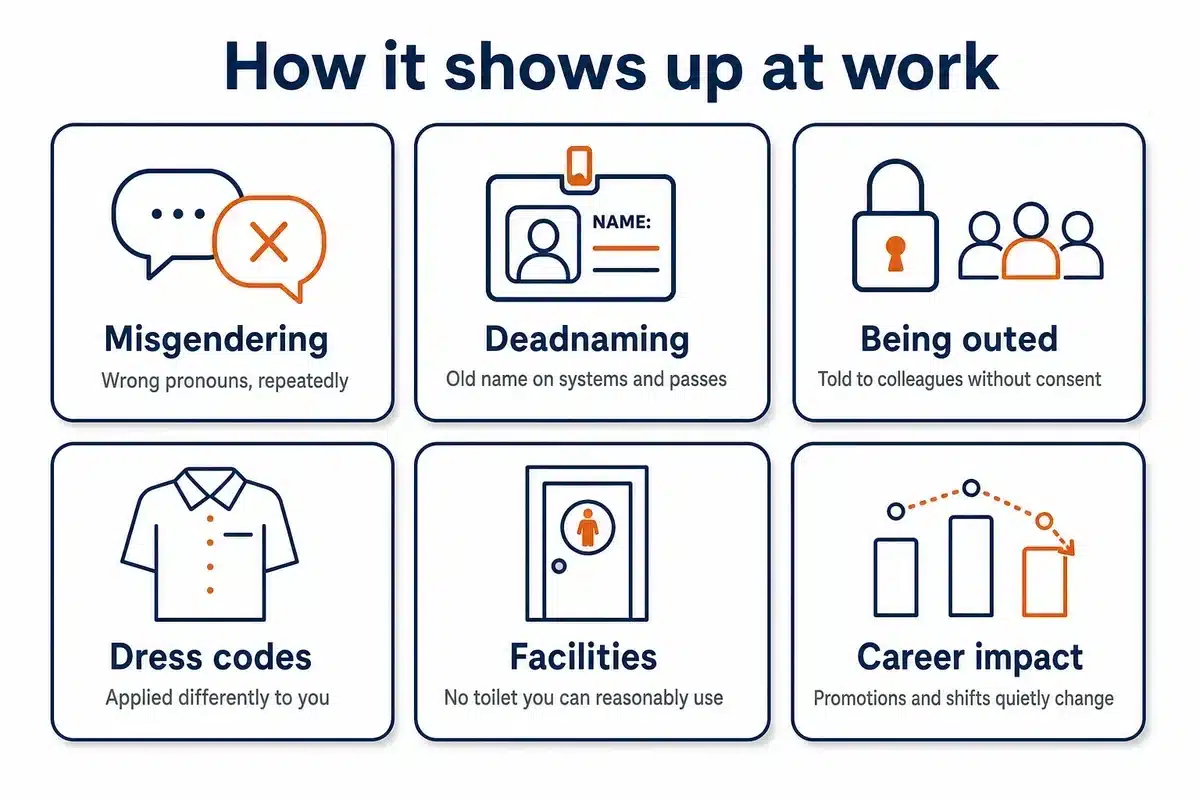
Very few discrimination at work cases involve an employer announcing that it does not want trans staff. The claims that reach tribunals are usually built from smaller incidents that add up: a rota change, a joke that keeps being repeated, a manager who will not use the right name, a promotion that quietly goes elsewhere.
Discrimination can be direct (worse treatment because you are trans), indirect (a rule that applies to everyone but disadvantages trans staff), harassment (unwanted conduct that violates your dignity), or victimisation (being punished for complaining). The sections below deal with the situations that come up most often.
Misgendering and deadnaming
Using the wrong pronouns or your birth name is capable of amounting to harassment under section 26 of the Equality Act 2010. The test is whether the conduct is unwanted and has the purpose or effect of violating your dignity or creating a hostile, degrading, humiliating or offensive environment.
A genuine slip that is corrected and apologised for is unlikely to found a claim. Repetition is what changes the picture. Once you have made your name and pronouns clear, continued use of the old ones starts to look deliberate, and tribunals treat it that way. The same goes for HR systems, email addresses, security passes and rotas that keep producing your old name months after you asked for them to be changed.
Being outed at work
Your trans status is yours to disclose. A manager who tells the team, or mentions it to a client, has almost certainly discriminated against you, and may also have breached data protection law: information about gender reassignment is sensitive personal data.
If you hold a Gender Recognition Certificate there is a further layer. Section 22 of the Gender Recognition Act 2004 makes it a criminal offence for a person who acquires your gender history in an official capacity to disclose it without your consent.
Dress codes and appearance
Employers can have a dress code. What they cannot do is apply it to you in a way they would not apply to other staff, or use it to police your gender presentation. Requiring a trans woman to follow the men’s dress code, or telling a trans employee their appearance makes customers uncomfortable, is direct discrimination in most cases.
Toilets and changing facilities
This is the area that has changed most since 2025, and the area where employers are getting the most anxious advice. Following the Supreme Court’s ruling in For Women Scotland, single-sex facilities at work operate on the basis of biological sex.
That is not the end of the analysis. An employer still has to provide facilities you can actually use. Leaving a trans employee with nowhere to go, or directing them to a toilet on another floor or in another building as an afterthought, is likely to be discriminatory and is a common route into a harassment claim. Self-contained, lockable, gender-neutral facilities available to everybody are the practical answer, and are what most large employers have moved to.
“The single most useful thing a trans client can do is keep a dated note of every incident, however small it feels at the time. Individually these things look trivial and employers argue they were oversights. Set out in a schedule with dates, names and what was said, the same incidents look like a pattern, and a pattern is what wins discrimination cases.”

Transitioning at Work: What Your Employer Should Be Doing
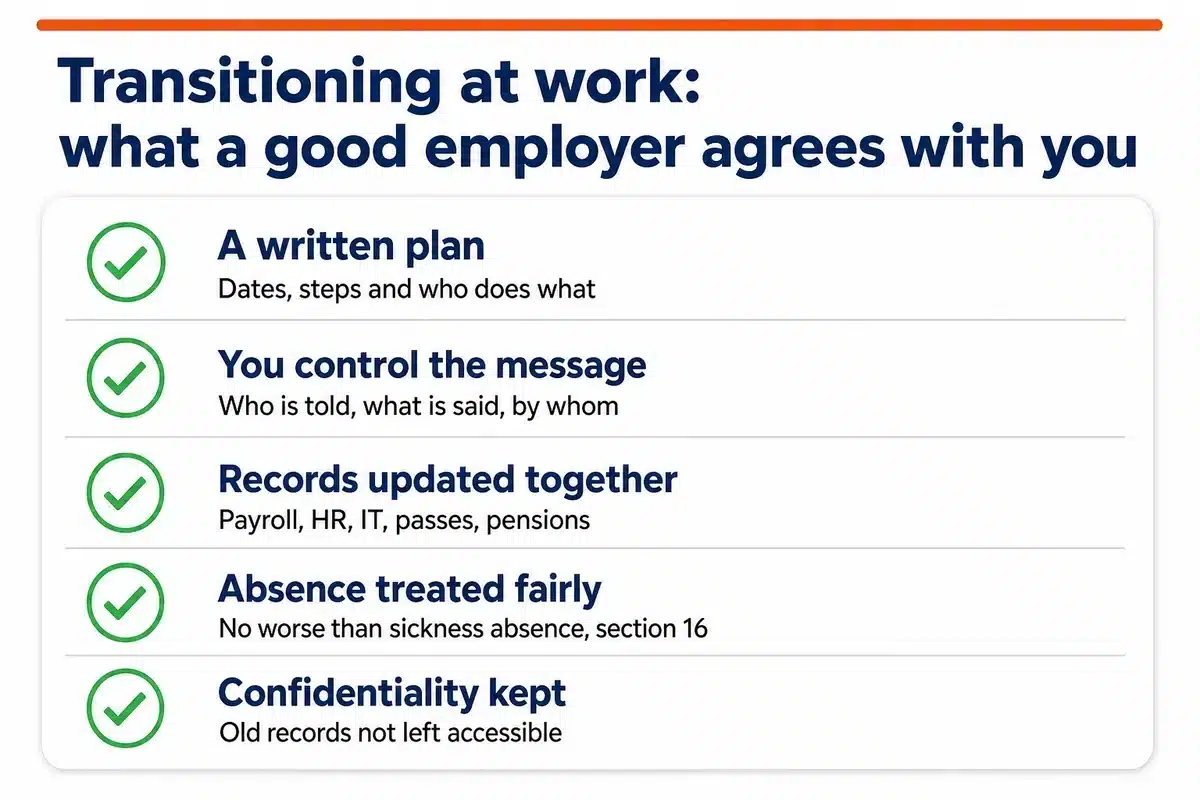
There is no statutory transition procedure, but there is a well established good-practice route, and tribunals notice when an employer has ignored it. A sensible employer agrees a written plan with you covering the date you will start working in your gender, who will be told and by whom, what will be said, and when records and IT will be updated.
You control the communication. It is your decision whether colleagues are told, what they are told, and whether you or your manager tells them.
Time off for treatment: the rule employers forget
Section 16 of the Equality Act 2010 contains a rule that exists nowhere else in discrimination law. If you are absent from work because of gender reassignment, your employer must not treat you worse than it would treat you for sickness absence, or worse than it would treat absence for some other reason if that would be unreasonable.
In practice this means gender reassignment appointments and recovery cannot be counted against you in an absence management policy any more harshly than a knee operation would be. Docking pay, triggering a disciplinary, or refusing leave that would be granted for other medical treatment all breach section 16.
Names, records and references
Your employer should update payroll, HR records, pensions, email, security passes and internal directories, and should not retain your previous records beyond what it genuinely needs. Old documents left accessible on a shared drive are a standard way that people get outed years later. References should be given in your current name.
Where the Law Stands After the 2025 Supreme Court Ruling
In For Women Scotland Ltd v The Scottish Ministers [2025] UKSC 16, decided on 16 April 2025, the Supreme Court held that “sex” in the Equality Act 2010 means biological sex, including for someone holding a Gender Recognition Certificate.
What that ruling did not do is touch section 7. Gender reassignment is a separate protected characteristic and it survives the judgment intact. If you are trans, you can still bring claims for direct discrimination, indirect discrimination, harassment and victimisation exactly as before. What changed is how single-sex spaces and services are analysed, and how a trans claimant frames a claim that depends on sex rather than on gender reassignment.
The Equality and Human Rights Commission’s updated Code of Practice for services came into force on 5 August 2026, having survived a legal challenge in Good Law Project Ltd and ors v EHRC [2026] EWHC 279 (Admin). That code deals with services, not employment. The separate statutory Employment Code has been signalled but not yet updated, so employers making workplace decisions are working from the judgment itself, the existing Employment Code and their own legal advice.
Gender-Critical Beliefs: Both Sides Have Rights
Gender-critical belief is itself a protected philosophical belief, following Forstater v CGD Europe in the Employment Appeal Tribunal in 2021. A colleague cannot be disciplined simply for holding that view.
Holding a belief and acting on it are different things. In Higgs v Farmor’s School [2025] EWCA Civ 109 the Court of Appeal confirmed that an employer can act where the way a belief is manifested is objectionable, provided the response is proportionate. Applied to the workplace, a colleague is entitled to their opinion. Directing it at you through deliberate misgendering, comments about your body, or a campaign of “just asking questions” is manifestation, and it can be harassment.
Time Limits: The Deadline That Ends Most Claims
A discrimination claim must reach the employment tribunal within 3 months minus 1 day of the act you are complaining about. For acts on or after 1 October 2026, that becomes six months.
You must notify Acas (the Advisory, Conciliation and Arbitration Service) for early conciliation before you can issue a claim, which pauses the clock. Where discrimination is a continuing course of conduct rather than a one-off, time runs from the end of that course of conduct under section 123(3). Tribunals can extend time where it is just and equitable, but you should never plan on that: it is a discretion, not a right.
What a Transgender Discrimination Claim Is Worth
Discrimination compensation is uncapped, unlike ordinary unfair dismissal. An award has three main parts: injury to feelings, financial loss, and interest at 8%.
Injury to feelings is assessed using the Vento bands, which from 6 April 2026 run from £1,300 to £12,600 for a one-off incident, £12,600 to £37,700 for a serious case, and £37,700 to £62,900 for a sustained campaign, with more than that in exceptional cases. Awards in reported trans cases have ranged from a few thousand pounds to the £180,000 in Taylor v Jaguar Land Rover. In de Souza E Souza v Primark Stores Ltd, a trans shop worker outed by colleagues on her first shifts recovered just over £47,000. Our gender reassignment discrimination guide sets out the full band table and how each element is calculated.
What to Do If You’re Facing Transgender Discrimination
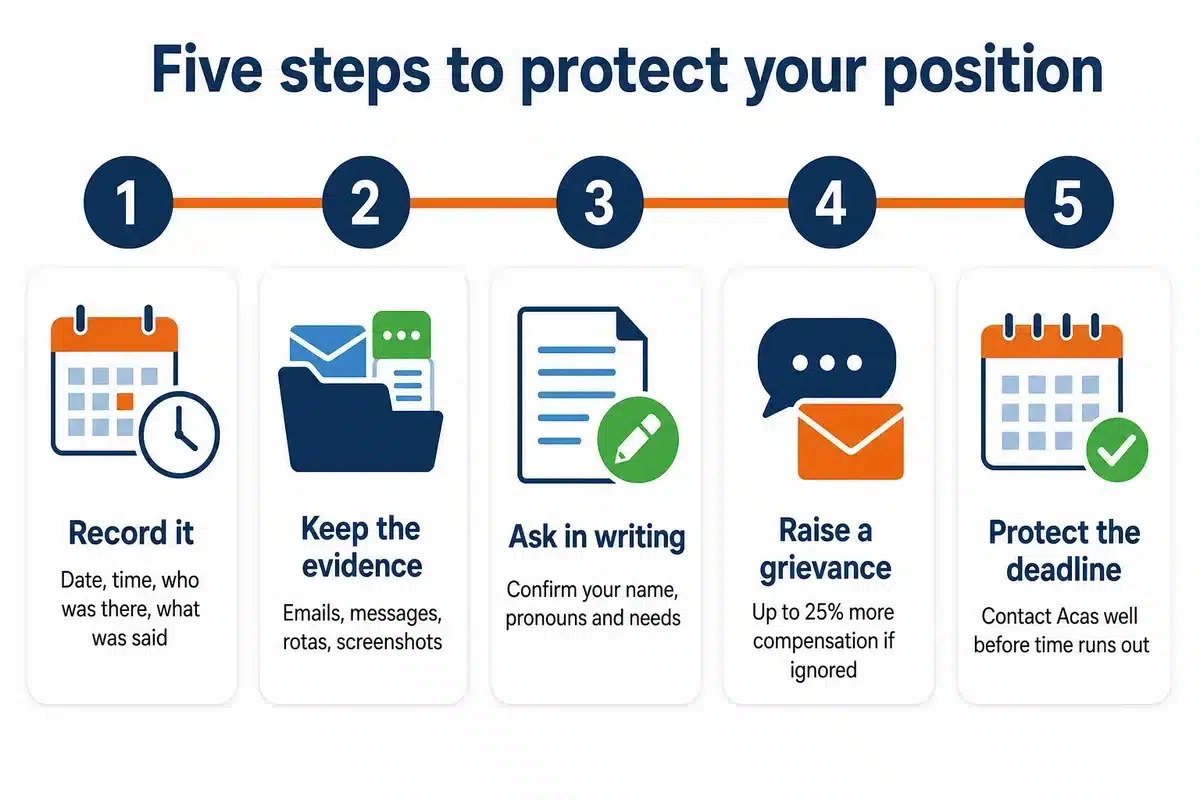
Write it down as it happens. Date, time, who was present, exactly what was said. Contemporaneous notes carry far more weight than a recollection assembled a year later.
Keep the evidence. Emails, Teams and WhatsApp messages, rotas, screenshots of systems still showing your old name. Send anything held only on a work account to yourself sensibly, and be aware of your employer’s IT policy.
Ask once, clearly, in writing. A short email confirming your name and pronouns, or asking for a facility you can use, converts a vague grievance into a documented request that the employer either met or ignored.
Raise a grievance. It gives the employer a chance to fix things, and if they do not, the failure itself becomes evidence. It can also increase compensation by up to 25% where the Acas Code is ignored.
Protect the deadline. Grievances and internal appeals do not stop the clock. Contact Acas and take advice well before the limit expires.
How We Can Help
We act for trans and non-binary employees in tribunal claims and in negotiated exits, and we have handled these cases both before and after the 2025 ruling. That matters at the moment, because a lot of general employment advice on this subject is out of date by more than a year.
The first conversation is free and there is no obligation. We will tell you honestly whether we think you have a claim, what it is likely to be worth, and what your deadline is.
Frequently Asked Questions
Do I need a Gender Recognition Certificate to be protected at work?
No. Section 7 of the Equality Act 2010 protects you if you are proposing to undergo, are undergoing or have undergone a process of reassigning your sex, with or without medical treatment. A Gender Recognition Certificate affects your legal sex for other purposes, but it is not needed to bring a discrimination claim.
Is misgendering me at work illegal?
It can be harassment under section 26 of the Equality Act 2010. An isolated mistake that is corrected will rarely succeed on its own. Repeated use of the wrong pronouns or your birth name after you have asked for it to stop very often does, particularly where a manager knew and did nothing.
Can my employer tell my colleagues that I am transgender?
Not without your consent. Disclosure is your decision. Outing you is likely to be discrimination and harassment, is a breach of data protection rules covering sensitive personal data, and where you hold a Gender Recognition Certificate can be a criminal offence under section 22 of the Gender Recognition Act 2004.
Which toilets can I use at work after the Supreme Court ruling?
Single-sex facilities at work now operate on the basis of biological sex. Your employer must still provide something you can reasonably use, and gender-neutral self-contained facilities are the usual solution. Being left with no usable facility, or singled out and sent elsewhere, is likely to be discriminatory.
Can I be disciplined for time off for gender reassignment treatment?
Not more harshly than for sickness absence. Section 16 of the Equality Act 2010 makes it discrimination to treat absence for gender reassignment less favourably than absence for illness or injury, including under absence management and pay policies.
How long do I have to bring a transgender discrimination claim?
Currently 3 months minus 1 day from the act complained of, extending to six months for acts on or after 1 October 2026. You must start Acas early conciliation first, which pauses the clock. Where the treatment is ongoing, time usually runs from the last incident.
What if the abuse comes from customers rather than colleagues?
From 30 October 2026 employers become liable for harassment of their staff by third parties such as customers, clients and contractors where they have not taken all reasonable steps to prevent it. Before that date, a claim usually has to be framed around how your employer responded once it knew.
💬 Being treated differently at work because you’re trans?
Speak to our employment team in confidence about what has happened and what your options are
Get Free Initial Advice →Important: This guide provides general information about transgender discrimination at work. It is not legal advice and should not be relied upon as such. This area of law moved significantly in 2025 and 2026 and continues to develop. If you are experiencing discrimination or considering a tribunal claim, we strongly recommend seeking professional legal advice before your time limit expires.
Sources and Further Reading
Primary Legislation
- Equality Act 2010, section 7 (gender reassignment as a protected characteristic)
- Equality Act 2010, section 16 (absence from work for gender reassignment)
- Equality Act 2010, section 26 (harassment)
- Equality Act 2010, section 123 (time limits)
- Gender Recognition Act 2004, section 22 (disclosure of protected information)
- Employment Rights Act 2025 (October 2026 changes)
Official Guidance
- EHRC Code of Practice for Services (in force 5 August 2026; services, not employment)
- Acas guidance on gender reassignment discrimination
- Acas: Employment Rights Act 2025 implementation timetable
Key Case Law
- For Women Scotland Ltd v The Scottish Ministers [2025] UKSC 16 (meaning of “sex” in the Equality Act 2010)
- Higgs v Farmor’s School [2025] EWCA Civ 109 (belief and its manifestation)
- Taylor v Jaguar Land Rover Ltd (ET 1304471/2018) (non-binary and gender fluid identities within section 7)
Templates and Resources
- Tribunal time limits guide (work out your deadline)
- Gender reassignment discrimination guide (compensation and claim types in full)
Tom Street
Tom Street is the principal solicitor at Tom Street & Co. Solicitors, specialising in employment law and tribunal claims. He regularly represents claimants in unfair dismissal, discrimination, and whistleblowing cases. View full profile