
5 March 2026 • By Tom Street, Solicitor
Disclaimer: This article contains Tom Street’s personal opinion and commentary on employment policy. It is not legal advice for your specific circumstances. For advice on your individual situation, please contact us directly. Tom Street is a solicitor regulated by the Solicitors Regulation Authority (SRA No. 566718).
Key Facts
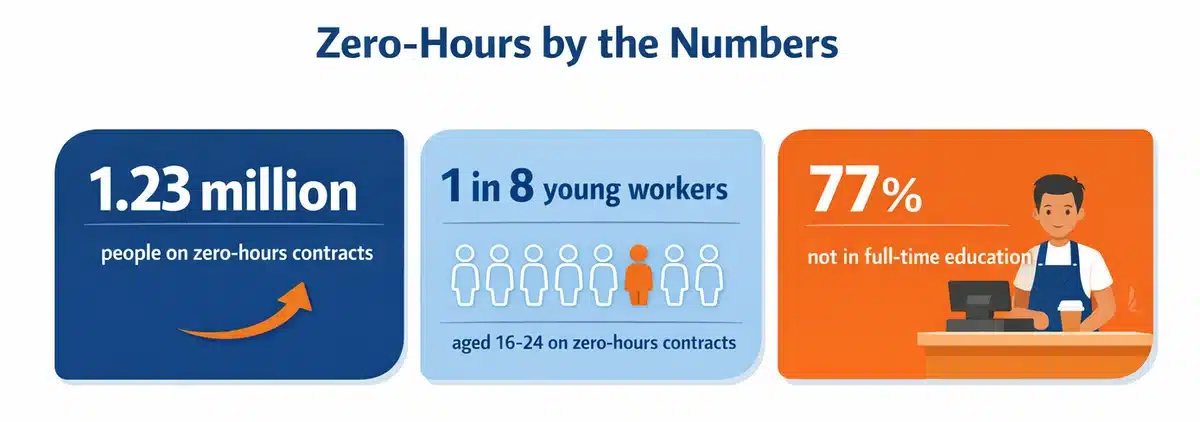
- A record 1.23 million people are now on zero-hours contracts as their main job, per Work Foundation analysis of ONS data
- The number has risen by 91,000 in the past year and by 181,000 since Labour came to power in July 2024
- Young workers aged 16-24 are 5.1 times more likely to be on these contracts than older workers
- 943,000 (77%) of zero-hours workers are not in full-time education, undermining the “student flexibility” argument
- The Employment Rights Act 2025 will ban exploitative zero-hours contracts, but reforms won’t take effect until 2027 at the earliest
One million people is an abstract number. It’s hard to feel the weight of it. So try this instead: think about Anna Jameson, 22, working retail in Maltby. She doesn’t know what she’ll earn at the end of the month. She can’t get a rented flat because landlords want proof of consistent income. She can’t plan a week ahead, let alone a year. That’s not flexibility. That’s not freedom. That’s a power imbalance dressed up in neutral language and sold as a workplace benefit.
New analysis from the Work Foundation at Lancaster University, based on data from the Office for National Statistics (ONS), reveals that the number of people on zero-hours contracts has hit 1.23 million, the highest figure ever recorded. The government that promised to end exploitative work arrangements has, since taking office, presided over an increase of 181,000 people on these contracts. The law to fix this exists. The question is when it will actually arrive.
The “Flexibility” Argument Has Run Out of Road
For years, the defence of zero-hours contracts rested on a simple story: these arrangements suit students who want to fit work around lectures, and parents who need to juggle childcare. The flexibility, we were told, cuts both ways.
The data has now demolished that argument. Of the 1.23 million people on zero-hours contracts, 943,000 are not in full-time education. That’s 77%. And a third of them are working full-time hours on these arrangements, actively seeking more. These aren’t students topping up their income. These are people trying to build a life on a foundation that shifts under them every week.
Tom Street’s View
Zero-hours contracts are exploitative in the vast majority of cases. The flexibility argument has always been a cover story.
I’ve never bought the idea that zero-hours contracts are genuinely worker-friendly. The “flexibility” they offer is almost always weighted in the employer’s favour. The employer decides when work is offered. The employer cancels shifts with no notice and no penalty. The worker bears all the risk. That’s not a flexible arrangement. That’s a contract designed to keep workers insecure and employers comfortable.
Young People Are Carrying the Most Risk

The generational dimension here is particularly troubling. Workers aged 16 to 24 are 5.1 times more likely to be on a zero-hours contract than workers over 25. One in eight young workers in the UK is on one right now. These are the years when people are meant to be building credit histories, securing tenancies, establishing financial independence. None of that is straightforward when you don’t know what you’re earning next month.
Young women are disproportionately affected. The Young Women’s Trust has described many of them as feeling “forced” into these roles because they’re the only jobs available. That’s not a lifestyle choice. That’s a labour market that has decided young women’s time and security are negotiable.
Labour Won an Election Partly on This Promise
The Employment Rights Act 2025, which received Royal Assent in December 2025, represents a genuine step forward. Once in force, it will require employers to offer guaranteed hours to workers based on their actual working patterns over a 12-week reference period. Workers will be entitled to reasonable advance notice of shifts. If a shift is cancelled at short notice, they’ll be compensated.
The Work Foundation estimates that nine in ten zero-hours workers would have qualified for guaranteed hours under the original 12-week reference period proposal. That would be transformative for over a million people.
But the reforms won’t take effect until 2027. Consultation on the detail is still ongoing. And while that consultation continues, the numbers keep climbing.
Tom Street’s View
The law exists. The delay is a political choice, not a legal inevitability.
I understand that legislative implementation takes time. Secondary legislation, consultation, parliamentary process; none of it happens overnight. But 181,000 more people have been added to these contracts since this government took office on a platform of worker protection. Every month of delay is a month in which more people join a workforce that can’t say no when the employer changes the rules. The urgency here isn’t political point-scoring. It’s 1.23 million people waiting for a security that Parliament has already said they deserve.
What Zero-Hours Workers Can Do Right Now
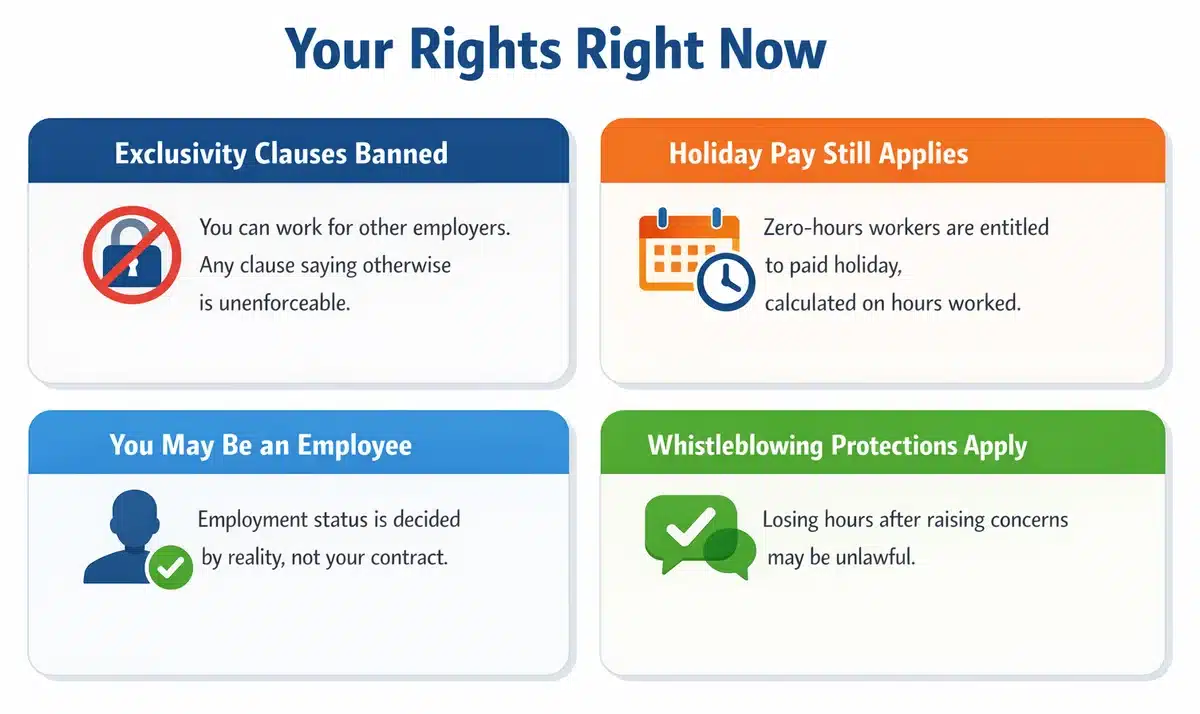
The reforms aren’t law yet, but zero-hours workers already have rights that many don’t know about. If you’re on one of these contracts, your situation isn’t without legal protection.
Your Rights on a Zero-Hours Contract
You cannot be prevented from working elsewhere. Exclusivity clauses in zero-hours contracts are unenforceable under the Small Business, Enterprise and Employment Act 2015. If your employer has told you that you can’t work for anyone else, that clause has no legal effect. You can ignore it.
You still have worker status protections. Zero-hours workers are legally “workers” for most purposes. That means you’re entitled to the National Minimum Wage, paid holiday (calculated on the hours you work), and rest breaks. If you’re being denied these, that’s unlawful.
Your employment status may be higher than your contract suggests. If you work regular, consistent hours and your employer controls how and when you work, you may have employee status regardless of what the contract says. Employment status is determined by reality, not by what the paperwork calls you.
Whistleblowing protection applies to you. If you raise concerns about health and safety, minimum wage breaches, or unlawful treatment, and you lose work as a result, that is potentially a detriment for whistleblowing. Get advice before assuming you have no recourse.
On a Zero-Hours Contract and Something Feels Wrong?
Many zero-hours workers have more rights than their employers acknowledge. If you’ve lost work after raising concerns, been denied holiday pay, or think your employment status may be misclassified, we can tell you where you stand. Initial advice is free.
Related Reading
Sources
- Work Foundation at Lancaster University: Zero-hour contracts reach new record high (2026)
- Employment Rights Act 2025, legislation.gov.uk
- Small Business, Enterprise and Employment Act 2015, section 153 (exclusivity clauses), legislation.gov.uk
- ONS: People in employment on zero-hours contracts (EMP17)

Tom Street
Principal Solicitor, Tom Street & Co.