
Quick Summary
Gender reassignment is one of the nine protected characteristics under the Equality Act 2010, and the 2025 Supreme Court ruling on the meaning of “sex” did not remove that protection. You are covered from the moment you propose to transition, with no need for surgery, hormones or a Gender Recognition Certificate. Compensation is uncapped, with injury to feelings awards currently running from £1,300 to £62,900 and beyond in the worst cases. Claims must reach the tribunal within 3 months minus 1 day, though that deadline doubles to six months for anything happening on or after 1 October 2026.
⚖️ This guide is for general information only and is not legal advice. Every case is different – if you’re unsure, speak to a solicitor.
Key Points
Key Points
- ✓ Protection starts when you propose to transition, not when treatment begins. No medical procedure and no Gender Recognition Certificate is required.
- ✓ For Women Scotland v The Scottish Ministers changed the meaning of “sex” in the Equality Act. It did not change the protected characteristic of gender reassignment.
- ✓ You can claim for direct discrimination, indirect discrimination, harassment or victimisation, and for discrimination by perception or by association.
- ✓ Section 16 gives a separate right: absence from work for gender reassignment must not be treated worse than sickness absence.
- ✓ Compensation is uncapped and includes injury to feelings, lost earnings, interest at 8% and an uplift of up to 25% if your employer ignored the Acas Code.
- ✓ You do not need two years’ service. Discrimination protection applies from day one, and to job applicants, workers and contractors.
⚖️ Legislation Update
Two major changes take effect in October 2026, on two different dates
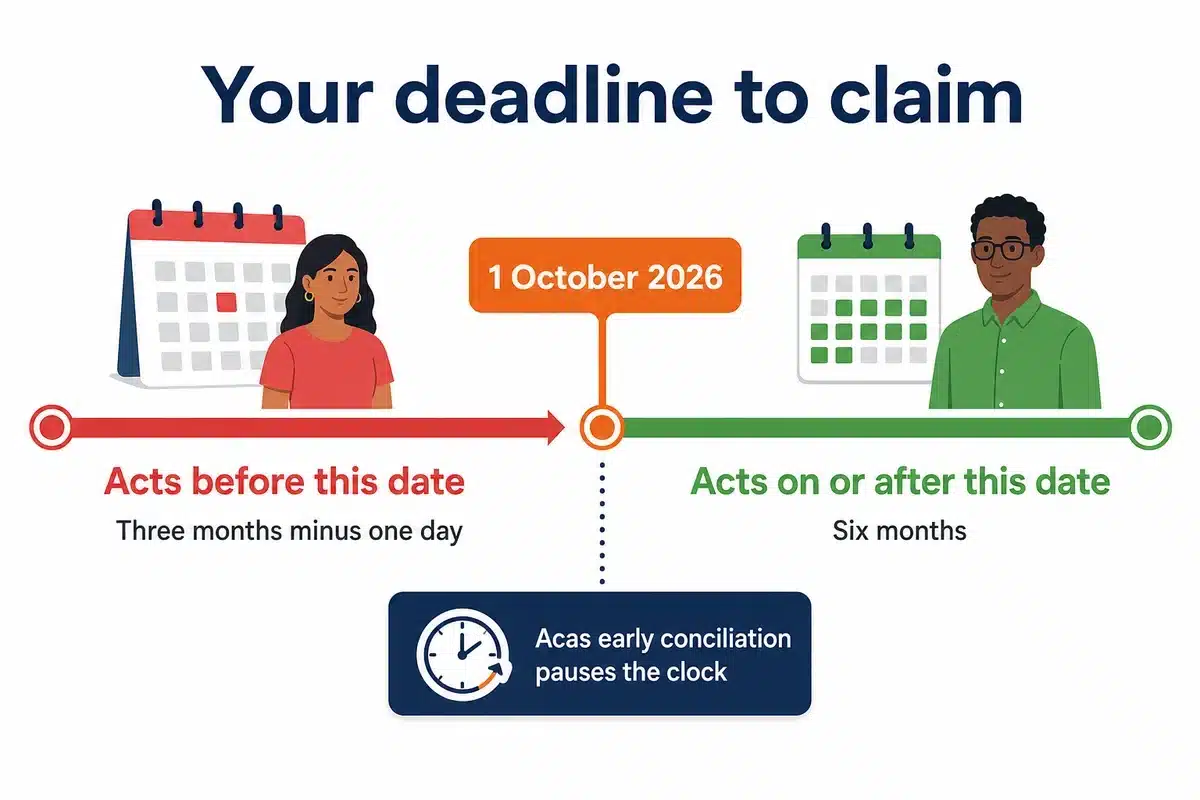
The Employment Rights Act 2025 doubles the tribunal time limit from 3 months minus 1 day to six months, for acts on or after 1 October 2026, and reintroduces employer liability for harassment by third parties such as customers, clients and contractors from 30 October 2026 under the government’s revised timetable published on 16 July 2026. If your treatment happened before those dates, the old rules still govern your claim, so do not wait.
💡 Not sure how long you have left to claim?
Our free time limits calculator works out your tribunal deadline, including the Acas early conciliation extension
Check my deadline →What Counts as Gender Reassignment Discrimination?
Gender reassignment discrimination happens when you are treated badly at work because you are transitioning, have transitioned, or are thought to be. It is unlawful under the Equality Act 2010, which makes gender reassignment one of nine protected characteristics.
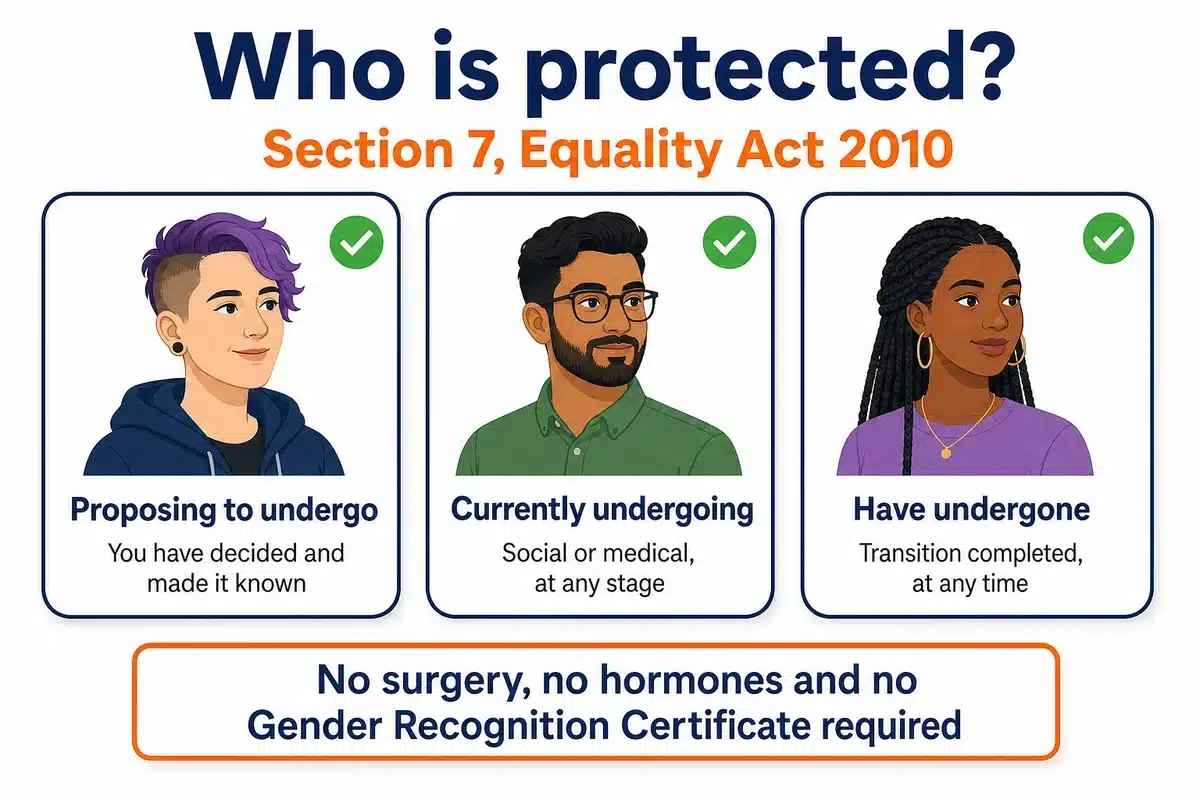
Section 7 of the Act sets the definition. You have the protected characteristic if you are proposing to undergo, are undergoing, or have undergone a process (or part of a process) for the purpose of reassigning your sex by changing physiological or other attributes of sex.
Three things follow from that wording, and employers get all three wrong regularly.
You do not need medical treatment. The words “or other attributes” cover social transition: changing your name, your pronouns, your dress, how you present at work. Surgery and hormones are not the trigger.
You do not need a Gender Recognition Certificate. A GRC changes your legal sex under the Gender Recognition Act 2004. It has nothing to do with whether you are protected from discrimination at work. Most trans people do not hold one, and they are protected either way.
Protection starts early. “Proposing to undergo” means you are covered from the point you form the intention and make it known, even if you never start any process. If you tell your line manager you intend to transition and are sidelined the following week, that is when the protection bites.
Does it cover non-binary and gender fluid people?
Yes, on the current authority. In Taylor v Jaguar Land Rover Ltd (Employment Tribunal, 2020) the employer argued that a gender fluid, non-binary engineer fell outside section 7. The tribunal disagreed, holding that gender is a spectrum and that the claimant plainly came within the definition. She was awarded £180,000.
That decision is first instance, so it does not bind other tribunals. It is widely followed and remains the leading authority on the point.
Does the 2025 Supreme Court Ruling Change Your Protection?
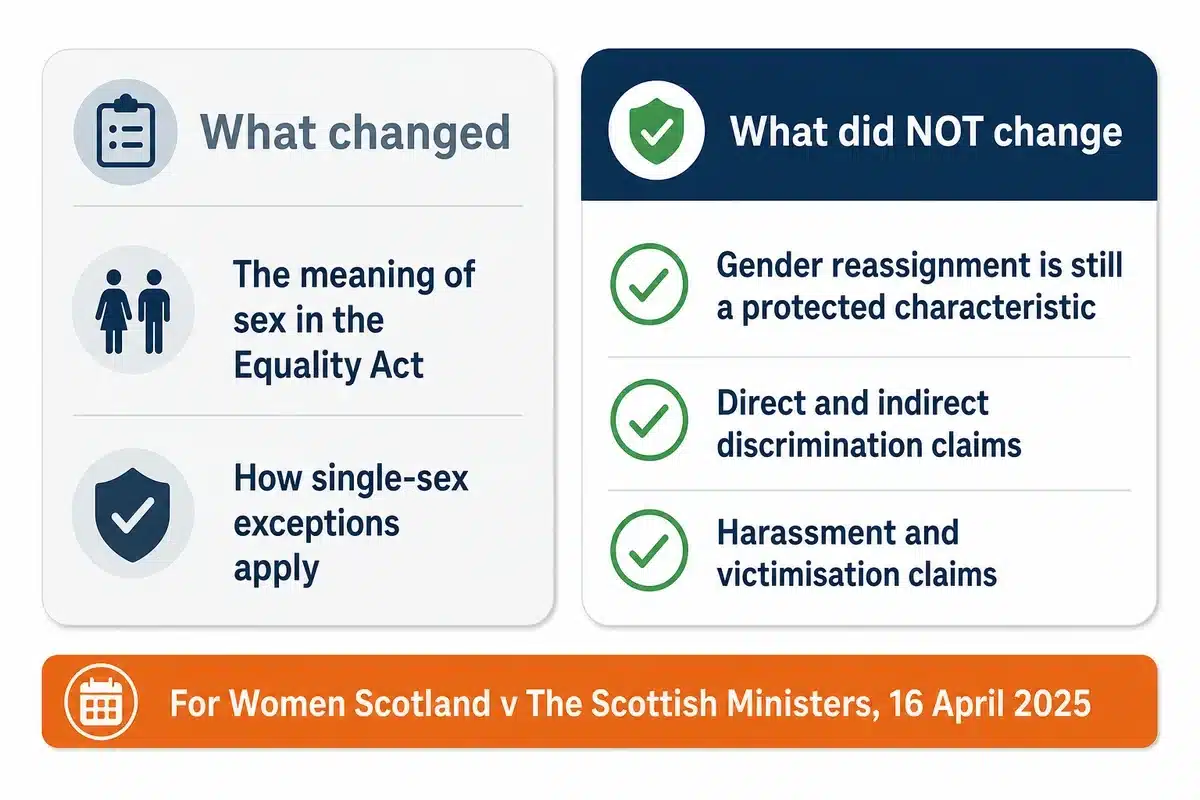
This is the question we are asked most often, and the short answer is no.
In For Women Scotland Ltd v The Scottish Ministers [2025] UKSC 16, handed down on 16 April 2025, the Supreme Court held unanimously that the words “sex”, “man” and “woman” in the Equality Act 2010 refer to biological sex, and that a Gender Recognition Certificate does not change that for the purposes of the Act.
The Court was explicit that its ruling does not strip trans people of legal protection. Gender reassignment remains a separate protected characteristic in its own right. Claims for direct discrimination, indirect discrimination, harassment and victimisation on that ground are unaffected, as are claims based on perception and association.
What the ruling did change is how the single-sex exceptions in the Act operate, and how a claim framed as sex discrimination rather than gender reassignment discrimination is analysed. If you are a trans woman who was passed over for promotion, your claim runs on gender reassignment grounds, and that route is intact.
“Since the Supreme Court ruling I’ve had trans clients arrive convinced they have no case left. That is simply wrong. The characteristic that protects you at work is gender reassignment, and the Court did not touch it. What changed is the law on single-sex spaces, not your right to be free from harassment and unfair treatment because of who you are.”

Where the guidance stands now
The Equality and Human Rights Commission published an interim update after the judgment. It was challenged by judicial review and upheld. In Good Law Project Ltd and others v Commission for Equality and Human Rights [2026] EWHC 279 (Admin), decided on 13 February 2026, Mr Justice Swift dismissed every ground of challenge and held that the EHRC had acted lawfully and given legally correct advice.
The EHRC’s updated statutory Code of Practice for Services, Public Functions and Associations came into force on 5 August 2026. One point matters enormously for anyone reading this page: that Code does not apply to employers. It governs service providers. The separate Employment Statutory Code of Practice has not yet been updated, and the EHRC is still considering how to issue revised workplace guidance.
So employers are in an awkward position. They have detailed statutory guidance aimed at services, and nothing equivalent for the workplace. Some are applying the services Code to staff facilities as if it were binding on them. It is not, although a tribunal may still find parts of its reasoning on proportionality persuasive. For more on the employment consequences of the ruling, see our analysis of the For Women Scotland decision and what it means for employers.
The Four Types of Gender Reassignment Discrimination Claim
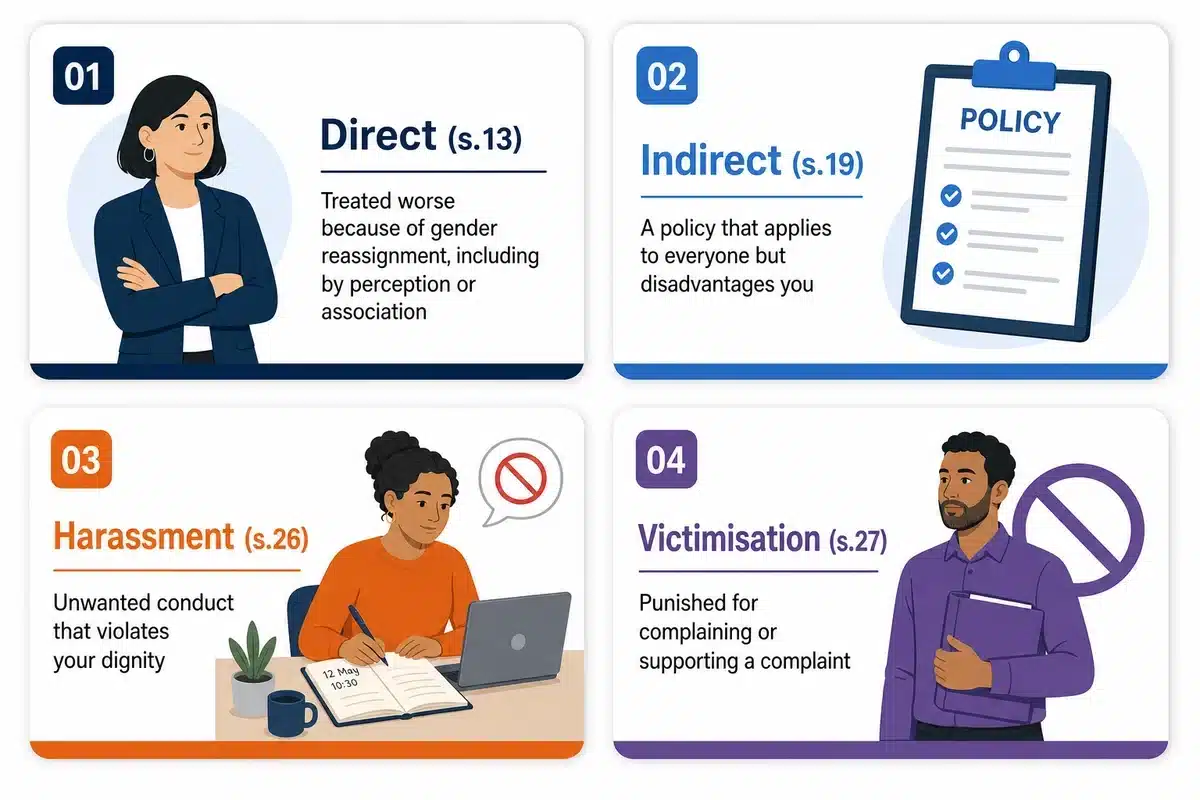
Most cases involve more than one of these, and it is normal to plead several in the alternative.
Direct discrimination (section 13)
Treating you less favourably than someone else because of gender reassignment. Refusing a promotion, excluding you from meetings, dismissing you, cutting your hours, or moving you to a back-office role once you transition.
Two extensions catch employers out. Discrimination by perception applies where you are treated badly because your employer thinks you are trans, whether or not you are. Discrimination by association applies where you are treated badly because someone close to you is trans, such as a parent whose child has transitioned.
There is no justification defence for direct discrimination. If the reason for the treatment was gender reassignment, it is unlawful.
Indirect discrimination (section 19)
A rule, policy or practice that applies to everyone but puts trans people at a particular disadvantage. A requirement to produce a birth certificate for an ID check, or a rigid uniform policy tied to sex assigned at birth, are classic examples.
Indirect discrimination can be defended if the employer shows the policy is a proportionate means of achieving a legitimate aim. Proportionate is the hard part: the employer must show there was no less discriminatory way of achieving the same aim.
Harassment (section 26)
Unwanted conduct related to gender reassignment that violates your dignity or creates an intimidating, hostile, degrading, humiliating or offensive environment. In practice this is the most common claim we see, and it covers:
- Persistent misgendering or deliberate use of the wrong pronouns
- Deadnaming, including HR systems and email addresses left in your former name
- Outing you to colleagues or clients without your consent
- Intrusive questions about your body, surgery or sex life
- Nicknames, jokes and “banter” at your expense
- Comments made in your absence that get back to you
The conduct does not have to be aimed at you, and the perpetrator does not need to have intended offence. What matters is the effect, judged against what is reasonable in the circumstances. A single serious incident can be enough. See our guide to harassment at work for the full test.
Victimisation (section 27)
Being subjected to a detriment because you did a protected act: raising a grievance about discrimination, bringing a tribunal claim, giving evidence for a colleague, or simply alleging that the Act has been breached. Being sidelined after complaining is often a stronger and cleaner claim than the original complaint. Our page on victimisation explains the test in detail.
Absence From Work for Gender Reassignment
Section 16 of the Equality Act creates a distinct right that many employers have never heard of.
If you are absent from work because of gender reassignment, your employer discriminates against you if it treats that absence less favourably than it would treat absence due to sickness or injury, or less favourably than any other absence it would reasonably expect to allow.
In plain terms: appointments, procedures and recovery connected with transition must be handled at least as generously as ordinary sick leave. Docking pay for gender clinic appointments while paying for physiotherapy appointments, or applying an attendance trigger to transition-related absence that would not be applied to other medical absence, breaches section 16.
This is a standalone claim. You do not have to prove a comparator suffered better treatment in fact, only that they would have been treated better.
Facilities, Dress Codes and Records: Where Employers Get It Wrong
Toilets and changing facilities
This is the area most affected by the 2025 ruling, and it is genuinely difficult. Following For Women Scotland and the litigation that followed, the position is that workplace single-sex toilets and changing facilities operate on the basis of biological sex. That flows from the Supreme Court’s construction of the Act together with the employer’s obligations under the Workplace (Health, Safety and Welfare) Regulations 1992.
That is not the end of the analysis, and employers who stop there create liability for themselves. Leaving a trans employee with no facility they can reasonably use is likely to be discriminatory. The workable answer for most employers is to provide self-contained, lockable, single-user facilities available to anyone, alongside single-sex provision. A blanket instruction to a trans employee to use a facility a long walk away, or to wait until the building is empty, is the sort of treatment that founds a harassment claim.
Dress codes and appearance
Dress codes may set standards, but they must not require you to dress in a way inconsistent with your gender identity, and they must not apply harsher standards to you than to colleagues. Policing a trans woman’s skirt length while ignoring other staff is direct discrimination dressed up as a uniform rule.
Names, records and confidentiality
Failing to update your name across HR systems, payroll, email, ID badges and rotas is one of the most common triggers for a claim, and tribunals treat it seriously because it is both avoidable and repetitive. In AB v Royal Borough of Kingston upon Thames the claimant gave her employer eight months’ notice that she intended to transition, then spent two years chasing corrections to her pension records, her door pass and the staff directory. The tribunal found the deadnaming was direct discrimination and awarded £25,400, of which £21,000 was for injury to feelings. The council’s failure to apologise properly was taken into account in setting that figure.
Confidentiality carries a separate risk. Under section 22 of the Gender Recognition Act 2004 it is a criminal offence for a person who acquires information about someone’s application for, or holding of, a GRC in an official capacity to disclose it without consent. Beyond that narrow offence, disclosing someone’s trans status to colleagues without consent is a straightforward harassment claim and usually a data protection breach as well.
Gender-Critical Beliefs and Competing Rights
Workplaces now regularly contain people whose sincerely held beliefs conflict. The law protects both sides, and understanding that helps you judge your own position.
Gender-critical belief, the belief that sex is binary and immutable, is a protected philosophical belief under section 10 of the Equality Act, following Forstater v CGD Europe (Employment Appeal Tribunal, 2021). In Higgs v Farmor’s School [2025] EWCA Civ 109, decided on 12 February 2025, the Court of Appeal held that a school employee’s dismissal for gender-critical social media posts was discriminatory, because the dismissal was not a proportionate response to the way she had expressed her belief.
The principle running through both cases is the distinction between holding a belief and manifesting it. Holding a gender-critical belief cannot lawfully be the reason for dismissal or detriment. Manifesting it in a way that harasses a colleague, such as deliberately and persistently misgendering someone at work, is a different matter and can still be unlawful harassment.
The practical consequence for a trans employee is that “my colleague is entitled to their beliefs” is not a complete answer from your employer. The employer must still deal with conduct that crosses into harassment. Equally, a colleague expressing a gender-critical view respectfully and outside work is unlikely to give you a claim. Our page on religious and belief discrimination covers the other side of this.
What Changes in October 2026
The Employment Rights Act 2025 brings in two changes that matter directly to gender reassignment claims. They commence four weeks apart, and the second date moved: the government’s revised implementation timetable of 16 July 2026 pushed the harassment provisions from 1 October to 30 October 2026.
Six-month time limit, from 1 October 2026
The standard tribunal time limit rises from 3 months minus 1 day to six months. The extension applies where the act, detriment or termination happens on or after 1 October 2026. Anything that happened before that date keeps the current, shorter deadline, so the old rule will govern most live complaints for some time yet.
Liability for harassment by third parties, from 30 October 2026
Employer liability for third-party harassment returns, and it expressly covers harassment related to gender reassignment. If a customer, client, contractor or member of the public harasses you, your employer will be liable unless it took all reasonable steps to prevent it.
Two features make this significantly tougher than the old provision repealed in 2013. There is no requirement that you were harassed on two previous occasions, and no requirement that the employer knew about earlier incidents. The standard also moves from “reasonable steps” to “all reasonable steps”, and tribunals can increase compensation by up to 25% where an employer has failed to meet it.
For customer-facing roles, this is the most significant change in years. An employer that has ignored repeated abuse from members of the public will have a much harder defence from 30 October 2026.
Time Limits: The Deadline That Ends Most Claims
A gender reassignment discrimination claim must reach the employment tribunal within 3 months minus 1 day of the act you are complaining about, under section 123 of the Equality Act 2010. Miss it and the tribunal usually has no jurisdiction, however strong your case.
Three refinements matter.
Acas early conciliation pauses the clock. You must notify Acas before you can issue a claim. The time spent in early conciliation is added back, and you get at least one month from the certificate date. Notify Acas early rather than at the end of the period.
Conduct extending over a period. Section 123(3) treats continuing discrimination as done at the end of the period. A campaign of harassment over 18 months is not 30 separate out-of-time incidents if it can properly be characterised as a continuing state of affairs. This argument saves a great many claims, and it needs to be pleaded properly from the start.
Just and equitable extension. Tribunals have a broad discretion in discrimination cases to extend time where it is just and equitable to do so. It is a real discretion, not a formality, and the burden is on you to justify it. Do not plan around it.
What Compensation Can You Claim?
Discrimination compensation is uncapped. There is no equivalent of the compensatory award cap that limits ordinary unfair dismissal claims, which is why discrimination claims often settle for considerably more.
An award is usually built from several components.
Injury to feelings
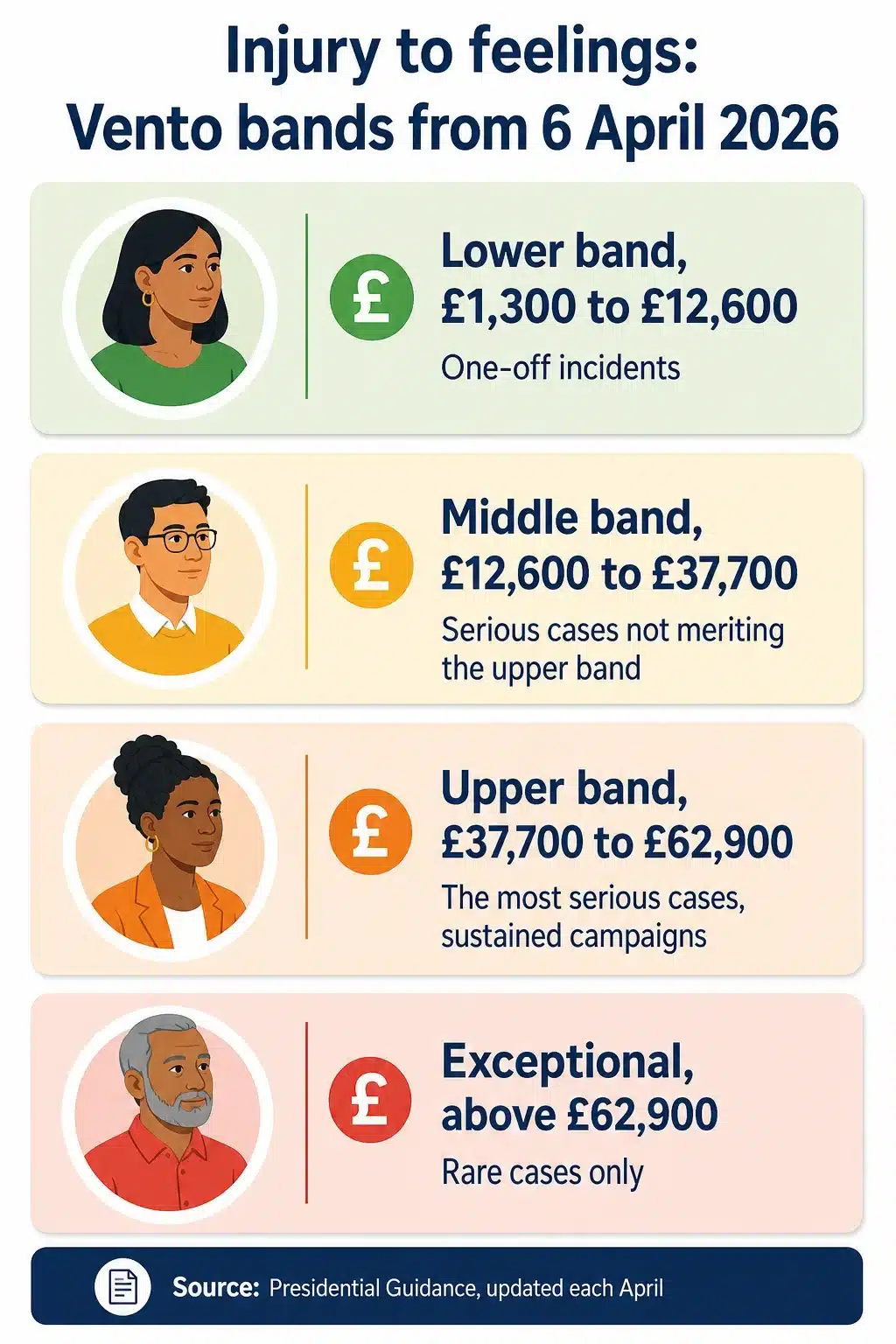
Every successful discrimination claim attracts an award for injury to feelings, whether or not you lost any money. The amount is set by reference to the Vento bands, updated each April by Presidential Guidance.
Vento Bands for Injury to Feelings (from 6 April 2026)
| Band | Range | Typical gender reassignment cases |
|---|---|---|
| Lower | £1,300 to £12,600 | A one-off incident, such as a single offensive comment or a short delay in updating your name |
| Middle | £12,600 to £37,700 | Repeated misgendering or deadnaming over months, a mishandled grievance, or loss of a promotion |
| Upper | £37,700 to £62,900 | A sustained campaign of harassment, outing, or dismissal following transition |
| Exceptional | above £62,900 | Rare cases of extreme and prolonged mistreatment causing serious psychiatric harm |
Source: Presidential Guidance on Vento bands, updated April 2026
The other components
Financial loss. Past and future lost earnings, pension, bonuses and benefits if you were dismissed, resigned or lost out on promotion. In serious cases this dwarfs the injury to feelings element.
Personal injury. A separate award where the discrimination caused a recognised psychiatric injury, supported by medical evidence.
Aggravated damages. Awarded where the employer’s conduct made things worse, such as a sham investigation or an aggressive defence of an obviously good claim.
Interest. 8% simple interest, running from the date of the act for injury to feelings and from the mid-point for financial loss.
Acas Code uplift. Up to 25% more where the employer unreasonably failed to follow the Acas Code on grievances.
What tribunals have actually awarded
- Taylor v Jaguar Land Rover Ltd (2020): £180,000 to a gender fluid engineer subjected to abuse, poor treatment and a failure to address her complaints.
- de Souza E Souza v Primark Stores Ltd (2018): £47,433 to a trans woman who was deadnamed, mocked and, in the tribunal’s words, bullied out of a job. That comprised £25,000 for injury to feelings and close to £20,000 for lost pay and pension, with a 25% Acas uplift applied.
- AB v Royal Borough of Kingston upon Thames: £25,400, including £21,000 for injury to feelings, where the employer took two years to correct her name across its systems.
- Cole v Royal Mail Group Ltd (2025): £12,500 for direct discrimination and harassment related to gender reassignment.
These are the figures awarded at the time, in those specific cases. Yours will turn on your own facts, your losses and the severity of what happened.
How to Prove Gender Reassignment Discrimination
Almost no employer records a discriminatory reason in writing, so these claims are usually built on inference. The law helps you here.
Section 136 of the Equality Act shifts the burden of proof. If you can show facts from which a tribunal could decide, in the absence of any other explanation, that discrimination occurred, the burden moves to the employer to prove that the treatment had nothing whatsoever to do with gender reassignment. A bare denial will not do.
What builds that initial case:
- A timeline. Dates, what happened, who was present, what was said. Write it up contemporaneously. Treatment that changes sharply after you come out is powerful evidence.
- Documents. Emails, messages, rotas, appraisals, HR records. Keep copies somewhere you will still have access to if you leave, but do not take confidential material you are not entitled to.
- Comparators. How were colleagues in a similar position treated?
- A written grievance. It forces the employer to give an explanation in writing, which is often the moment their account starts to shift.
- A subject access request. Under UK GDPR your employer must give you the personal data it holds about you, usually within one month. Internal emails discussing you are frequently the strongest evidence in the case.
What to Do If You’re Being Discriminated Against
Practical Steps
Start writing everything down today. A dated note made at the time carries far more weight than a recollection reconstructed a year later.
Raise it in writing. An informal word rarely creates a record. A written grievance does, and it puts your employer on notice, which matters for both liability and the Acas uplift.
Protect the deadline. Work out your three-month date now and notify Acas well before it. Grievances and appeals do not extend the time limit, and waiting for an internal process to finish is the single most common way good claims are lost.
Do not resign in the heat of the moment. Constructive dismissal is a hard claim to run. Take advice before you hand in notice, because your options usually narrow once you have.
Get advice early. The first conversation costs you nothing and often changes what you do next, particularly if a settlement agreement is put in front of you.
How We Can Help
We act for employees, not employers. Tom Street & Co. Solicitors is a specialist employment practice, and we handle discrimination claims from the first grievance letter through to a full tribunal hearing.
A first conversation covers whether what happened to you is unlawful, what your deadline is, what your claim is realistically worth, and what your options are, including negotiating a settlement without ever issuing a claim. It is free, and there is no obligation to instruct us afterwards.
If you are already in a process, we can help with the grievance, the appeal, an Acas early conciliation negotiation, or a settlement agreement that has been put in front of you. If your claim is already issued, we can take it over.
Frequently Asked Questions
Am I still protected from gender reassignment discrimination after the Supreme Court ruling?
Yes. For Women Scotland v The Scottish Ministers [2025] UKSC 16 decided what “sex” means in the Equality Act 2010. Gender reassignment is a separate protected characteristic under section 7 and was not affected. You can still claim direct discrimination, indirect discrimination, harassment and victimisation.
Do I need a Gender Recognition Certificate to bring a claim?
No. A GRC is irrelevant to protection at work. Section 7 protects anyone proposing to undergo, undergoing or having undergone a process of reassigning their sex, with or without any medical treatment or legal recognition.
Is misgendering or deadnaming me unlawful?
It can be harassment under section 26 if it is unwanted and has the purpose or effect of violating your dignity or creating a hostile or degrading environment. Isolated genuine mistakes that are corrected are unlikely to found a claim. Persistent use of the wrong name or pronouns after you have asked for it to stop very often does, and tribunals have made substantial awards for exactly that.
Which toilets can I use at work?
Following the 2025 ruling, workplace single-sex facilities operate on the basis of biological sex. That does not mean your employer can leave you with nowhere to go. Failing to provide a facility you can reasonably use is likely to be discriminatory, and most employers should be providing lockable single-user facilities open to everyone alongside their single-sex provision.
How long do I have to bring a claim?
3 months minus 1 day from the act you are complaining about, extended by the Acas early conciliation period. For anything happening on or after 1 October 2026 the limit becomes six months. Where the discrimination is continuing, time usually runs from the last incident, but do not rely on that without advice.
How much compensation could I get for gender reassignment discrimination?
There is no cap. Injury to feelings alone currently ranges from £1,300 to £12,600 for less serious cases up to £37,700 to £62,900 for the most serious, with more in exceptional cases. On top of that you can claim lost earnings, pension loss, personal injury, interest at 8% and an uplift of up to 25% where your employer ignored the Acas Code.
Do I need two years’ service to claim?
No. Unlike ordinary unfair dismissal, discrimination protection applies from your first day, and it also covers job applicants, agency workers, contractors and partners. If you were rejected at interview because you are trans, you can bring a claim without ever having been employed.
What if the harassment comes from customers rather than colleagues?
Your employer’s duty to protect you is being strengthened. From 30 October 2026, employers become liable for harassment of their staff by third parties such as customers and clients unless they took all reasonable steps to prevent it. Before that date, a claim usually depends on showing that the employer’s own failure to act was itself harassment or discrimination.
💬 Experienced discrimination at work?
We can help you understand your rights and potential compensation, in confidence and with no obligation
Get Free Initial Advice →Important: This guide provides general information about gender reassignment discrimination. It is not legal advice and should not be relied upon as such. Employment law is complex, this is a fast-moving area following the 2025 Supreme Court ruling, and the rules may apply differently depending on your circumstances. If you are considering a tribunal claim or have been offered a settlement, we strongly recommend seeking professional legal advice.
Sources and Further Reading
Primary Legislation
- Equality Act 2010, section 7 (definition of gender reassignment)
- Equality Act 2010, section 16 (absence from work for gender reassignment)
- Equality Act 2010, section 123 (time limits, continuing acts, just and equitable extension)
- Equality Act 2010, section 136 (burden of proof)
- Gender Recognition Act 2004, section 22 (disclosure of protected information)
- Employment Rights Act 2025 (six-month time limit from 1 October 2026, third-party harassment from 30 October 2026)
- Workplace (Health, Safety and Welfare) Regulations 1992 (sanitary and changing facilities)
Official Guidance
- EHRC summary of the High Court judgment in Good Law Project v EHRC
- EHRC Code of Practice for Services, Public Functions and Associations (in force 5 August 2026, applies to service providers rather than employers)
- Acas guidance on gender reassignment discrimination
- Presidential Guidance on Vento bands (updated each April)
Key Case Law
- For Women Scotland Ltd v The Scottish Ministers [2025] UKSC 16 (meaning of sex in the Equality Act 2010)
- Good Law Project Ltd and ors v Commission for Equality and Human Rights [2026] EWHC 279 (Admin) (EHRC interim update held lawful)
- Higgs v Farmor’s School [2025] EWCA Civ 109 (holding a belief versus manifesting it)
- Taylor v Jaguar Land Rover Ltd (ET 1304471/2018) (non-binary and gender fluid identities within section 7)
Templates and Resources
- Employment tribunal time limits calculator (work out your deadline)
- Free initial case assessment (speak to a specialist employment solicitor)
Tom Street
Tom Street is the principal solicitor at Tom Street & Co. Solicitors, specialising in employment law and tribunal claims. He regularly represents claimants in unfair dismissal, discrimination, and whistleblowing cases. View full profile