
Quick Summary
You currently need two years’ continuous employment to claim ordinary unfair dismissal, but this drops to six months from 1 January 2027. Some claims, including discrimination, whistleblowing, and automatically unfair dismissal, have no qualifying period at all. This guide explains how continuous employment is calculated, what breaks it, and what to do if you’re close to the threshold.
⚖️ This guide is for general information only and is not legal advice. Every case is different, so if you’re unsure about your rights, speak to a solicitor.
Key Points
- ✓ You need two years’ continuous employment to claim ordinary unfair dismissal (reducing to six months from 1 January 2027)
- ✓ Continuous employment is calculated from your start date to your effective date of termination, week by week
- ✓ A gap of one clear week (Sunday to Saturday) with no contract breaks continuity
- ✓ TUPE transfers, temporary cessation of work, and agreed absences can preserve continuity despite a break
- ✓ Discrimination, whistleblowing, and automatically unfair dismissal claims have no qualifying period
- ✓ If your employer dismisses you to prevent you gaining unfair dismissal rights, that dismissal is itself automatically unfair
⚖️ Legislation Update
Qualifying Period Reducing to Six Months from January 2027
The Employment Rights Act 2025 reduces the unfair dismissal qualifying period from two years to six months. From 1 January 2027, anyone with six months’ continuous employment will be able to claim ordinary unfair dismissal. The compensation cap is also expected to be removed from January 2027. From October 2026, the time limit for most tribunal claims extends from three months to six months. See our ERA 2025 guide for full details.
What Is the Qualifying Period for Unfair Dismissal?
To bring an ordinary unfair dismissal claim in the employment tribunal, you must have been continuously employed by the same employer for a minimum period. Under section 108(1) of the Employment Rights Act 1996 (ERA 1996), that period is currently two years.
Your continuous employment is measured from the day you started work to your effective date of termination (EDT), which is usually your last day of employment. If you haven’t completed two years by the time your employment ends, you generally can’t bring an ordinary unfair dismissal claim.
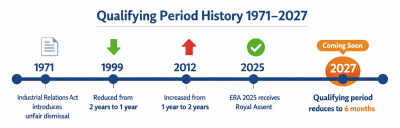
The qualifying period has changed several times since the right to claim unfair dismissal was first introduced by the Industrial Relations Act 1971. It was reduced from two years to one year in 1999, then increased back to two years in April 2012. From 1 January 2027, it will reduce again to six months under the Employment Rights Act 2025.
The qualifying period only applies to ordinary unfair dismissal. Several types of claim have no qualifying period at all, which we cover below.
How Is Continuous Employment Calculated?
The rules for calculating continuous employment are set out in sections 210 to 219 of the ERA 1996. Your period of continuous employment starts on the day your contract of employment begins and is calculated on a week-by-week basis, with each week running from Sunday to Saturday.
There’s a statutory presumption of continuity: under section 210(5) of the ERA 1996, your employment is presumed to have been continuous unless your employer proves otherwise. This is an important protection, because the burden falls on your employer to show a break, not on you to prove there wasn’t one.
Your qualifying period runs until the effective date of termination (EDT). If you were dismissed with notice, this is the date your notice period expires. If you were dismissed without notice (summary dismissal), the EDT is the date the dismissal takes effect. If you resigned, it’s the last day of your notice period.
Here’s a practical example. Say you started work on 15 March 2024 and were dismissed with your last working day being 14 March 2026. That’s exactly two years, so you meet the qualifying period. But if your last day was 14 March 2026 and you started on 16 March 2024, you’d fall one day short.
What Counts Towards Continuous Employment
Any week during which your contract of employment exists, even for part of the week, counts towards your continuous employment. There’s no minimum number of hours you need to work. If you’re employed under a contract, you’re building continuous service, whether you work one hour a week or 50.
The following all count towards your continuous employment:
- Periods of sick leave (whether paid or unpaid, provided your contract remains in place)
- Maternity, paternity, adoption, shared parental, and parental leave
- Annual holiday
- Suspension from work (including on full pay or during investigation)
- Career breaks where your employment contract remains in place
- Garden leave (you’re still employed, even if you’re not attending work)
What Breaks Continuous Employment
Continuity of employment is broken by a gap of one clear week (Sunday to Saturday) during which no contract of employment exists. If you resign on a Tuesday and start a new contract with the same employer the following Monday, your continuity is preserved because there’s no complete Sunday-to-Saturday gap without a contract. If you resign on a Friday and don’t return for over a week, continuity is likely broken.
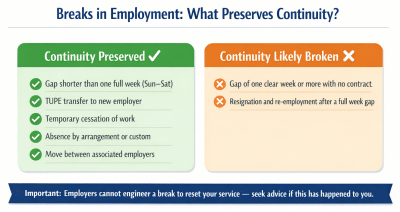
Common situations that break continuity include resigning and later being re-employed (unless the gap is covered by one of the statutory exceptions), and the end of a fixed-term contract where there’s a gap before a new one starts.
However, an employer can’t get around continuity rules by asking you to resign and re-join specifically to reset the clock. The courts have made clear that parties cannot agree between themselves to break continuity in order to sign away statutory rights (Secretary of State for Employment v Globe Elastic Thread Co Ltd [1980] AC 506). Similarly, where an employer dismisses an employee and then reinstates them, this doesn’t necessarily break continuity (Ingram v Foxon [1985] IRLR 5). If your employer has engineered a break in your employment to prevent you from building up qualifying service, take legal advice, as it may not be effective.
Strike action does not break continuity of employment, though the days spent on strike don’t count towards the total period of continuous employment. They effectively pause the clock rather than resetting it.
From 18 February 2026, the ERA 2025 also strengthens protections for employees who take part in protected industrial action. Dismissal for participating in protected industrial action is now automatically unfair with no time limit, replacing the previous 12-week protected period. This means there’s no qualifying period for this type of claim either.
When Continuity Is Preserved Despite a Break
The ERA 1996 sets out several situations where continuity is preserved even though you weren’t actually working:
TUPE transfers. If your employer’s business (or part of it) is transferred to a new employer, your continuous employment transfers with you under section 218(2) of the ERA 1996 and the TUPE Regulations. Your new employer inherits your full period of continuous service.
Temporary cessation of work. Under section 212(3)(b), if you’re absent from work because work has temporarily stopped (for example, your workplace is closed for refurbishment or there’s a seasonal shutdown), the break doesn’t count against your continuity.
Absence by arrangement or custom. Under section 212(3)(c), if you’re absent from work in circumstances where, by arrangement or custom, you’re regarded as continuing in employment, continuity is preserved. This can cover sabbaticals, career breaks, or gaps between fixed-term contracts where there’s an understanding that employment will resume.
Re-employment after redundancy. If you’re made redundant but accept a suitable alternative role with the same employer within four weeks of your previous contract ending, your continuity is preserved.
Associated employers. If you move between employers that are part of the same group of associated companies, continuity can be preserved under section 218 of the ERA 1996.
“The rules on what breaks or preserves continuity catch a lot of people out. If you’ve had any kind of gap in your employment, or you transferred from another employer, it’s worth checking whether your continuous service is longer than you think. TUPE transfers in particular can add years to your qualifying period.”

Claims You Can Bring Without the Qualifying Period
The two-year qualifying period only applies to ordinary unfair dismissal. Several important employment tribunal claims have no qualifying period, meaning you can bring them from day one of your employment.
Discrimination claims. If you’ve been dismissed (or treated unfairly) because of a protected characteristic such as age, disability, race, sex, pregnancy, religion, sexual orientation, or gender reassignment, you can bring a claim under the Equality Act 2010 regardless of your length of service. Read our discrimination guide for more detail.
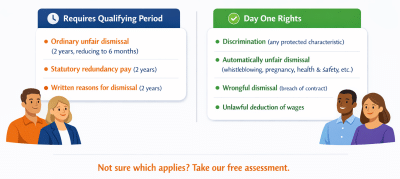
Automatically unfair dismissal. Certain reasons for dismissal are classed as “automatically unfair” under the ERA 1996 and other legislation, and no qualifying period applies. There are approximately 60 grounds for automatically unfair dismissal. Some of the most common include dismissal for reasons connected to pregnancy or maternity leave, whistleblowing (making a protected disclosure), raising health and safety concerns, trade union membership or activities, asserting a statutory right, requesting flexible working, taking time off for dependants, jury service, and TUPE-related dismissals. From January 2027, dismissal for refusing to agree to a variation of contract (“fire and rehire”) also becomes automatically unfair under the ERA 2025. For the full list, see our guide to automatic unfair dismissal.
Wrongful dismissal. A wrongful dismissal claim is a breach of contract claim, typically brought when your employer hasn’t paid your notice or hasn’t followed the correct contractual procedure. There’s no qualifying period for breach of contract claims. See our wrongful dismissal guide.
Unlawful deduction of wages. If your employer has failed to pay you wages you’re owed, you can bring a claim for unlawful deduction of wages regardless of how long you’ve worked there.
💡 Not sure if you qualify? Take our free assessment
Answer a few quick questions and we’ll tell you whether you might have a claim, even if you have less than two years’ service
Start Free Assessment →The Qualifying Period Is Changing: What You Need to Know
The Employment Rights Act 2025, which received Royal Assent on 18 December 2025, reduces the unfair dismissal qualifying period from two years to six months. This change takes effect from 1 January 2027.
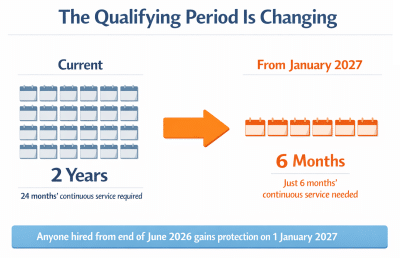
The change applies to anyone who has six months’ continuous employment on 1 January 2027. This is important: it’s not limited to people who start new jobs after that date. If you were hired in June 2026 and are still employed on 1 January 2027, you’ll have six months’ service and will gain unfair dismissal protection immediately.
Alongside the reduced qualifying period, the statutory cap on the compensatory award for unfair dismissal (currently £118,223 or 52 weeks’ gross pay, whichever is lower – figures correct from 6 April 2025. Updated rates expected April 2026) is expected to be removed entirely from January 2027, though this has not yet been formally commenced by commencement order. This would bring ordinary unfair dismissal compensation into line with discrimination and whistleblowing claims, which are already uncapped.
Another significant change: from October 2026 (expected, subject to commencement regulations), the time limit for bringing most employment tribunal claims extends from three months to six months. This gives employees more time to seek legal advice and file their claim after dismissal. See our time limits guide for full details.
The basic award calculation remains unchanged: it’s still based on your age, length of service, and weekly pay (capped at £719 for 2025/26 – figures correct from 6 April 2025. Updated rates expected April 2026), with a maximum of £21,570 (figures correct from 6 April 2025. Updated rates expected April 2026).
For a comprehensive breakdown of all the ERA 2025 changes and their implementation timeline, see our Employment Rights Act 2025 guide.
“The reduction to six months from January 2027 is a significant change. If you’re starting a new job in 2026, you’ll gain unfair dismissal protection much sooner than you would under the current rules. And with the compensation cap being removed at the same time, employers will need to take fair procedures seriously from much earlier in the relationship.”
Other Rights Affected by Length of Service
Unfair dismissal isn’t the only employment right that depends on your length of service. Here are the key qualifying periods you should know about:
Qualifying Periods for Key Employment Rights
| Right | Current Qualifying Period | Changing? |
|---|---|---|
| Ordinary unfair dismissal | 2 years | Reducing to 6 months (January 2027) |
| Statutory redundancy pay | 2 years | No change |
| Written reasons for dismissal | 2 years (day one if pregnant/on maternity leave) | Likely to reduce to 6 months (s.92 has historically been aligned with s.108 by secondary legislation, but no specific amendment confirmed yet) |
| Statutory notice periods | 1 week per year of service (after 1 month), up to 12 weeks | No change |
| Statutory maternity/paternity pay | 26 weeks | No change to pay; paternity leave becomes day one (April 2026) |
| Flexible working requests | Day one (since April 2024) | Already changed |
| Discrimination claims | None (day one right) | No change |
| Wrongful dismissal | None (day one right) | No change |
Source: Employment Rights Act 1996, Employment Rights Act 2025
Your length of service also affects how much statutory notice you’re entitled to. After one month’s employment, you’re entitled to at least one week’s notice. After two years, this increases by one week for each additional year of service, up to a maximum of 12 weeks after 12 years.
For statutory redundancy pay, you need two years’ continuous employment. The amount you receive depends on your age, length of service, and weekly pay (capped at £719). You can use our redundancy calculator to estimate your entitlement.
Practical Steps: Checking Your Qualifying Period
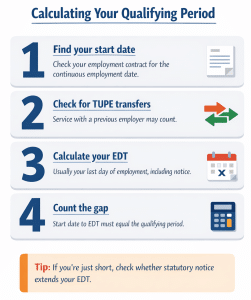
If you’re thinking about bringing an employment tribunal claim, one of the first things to check is whether you meet the qualifying period. Here’s how to work it out.
How to Work Out Your Start Date
Your continuous employment starts on the day you began work under your current contract. This date should appear in your written statement of employment particulars (your employment contract). Look for both your “start date” and your “continuous employment date”, as these can be different.
If you transferred to your current employer from a previous employer through a TUPE transfer, your continuous employment includes your time with the previous employer. The continuity date in your contract should reflect this, but it doesn’t always. If you think a TUPE transfer may apply, check the details carefully.
If you were re-employed after a break, check whether the break preserved or reset your continuity. A break of less than one clear week, or a break covered by one of the statutory exceptions (temporary cessation, arrangement or custom), means your earlier service should count.
How to Work Out Your Effective Date of Termination
The EDT is the end point for calculating your qualifying period. It depends on how your employment ended:
- Dismissed with notice: the EDT is the date your notice period expires, whether you work it or not
- Dismissed without notice (summary dismissal): the EDT is the date the dismissal takes effect, but if your employer should have given statutory notice, the EDT may be extended by the statutory notice period for the purpose of calculating the qualifying period
- Resignation: the EDT is the last day of your notice period
- Fixed-term contract ending: the EDT is the date the contract expires
The distinction matters. If your employer dismisses you without notice at 23 months’ service, the statutory minimum notice period of one week could push your EDT past the two-year mark, potentially giving you the qualifying period you need.
What If You’re Close to the Qualifying Period?
Some employers dismiss employees just before they reach two years’ service, believing this avoids any risk of an unfair dismissal claim. This is a common tactic, but it can backfire.
Under section 104 of the ERA 1996, if the reason (or principal reason) for your dismissal is that you raised or tried to exercise a statutory employment right, the dismissal is automatically unfair. There’s no qualifying period for this claim. Where employers deliberately time a dismissal to prevent an employee gaining unfair dismissal rights, there may be grounds for a section 104 claim, particularly if the employee had raised the issue. However, the legal position depends on the specific circumstances, so it’s important to take advice.
Even without two years’ service, consider whether any of the following apply to your situation:
- Were you dismissed because of a protected characteristic (age, disability, race, sex, pregnancy)? That’s discrimination, with no qualifying period.
- Did you raise concerns about wrongdoing at work? That could be whistleblowing, with no qualifying period.
- Were you dismissed for taking part in protected industrial action? That’s automatically unfair with no time limit from February 2026.
- Were you dismissed for refusing to agree to changes to your contract (fire and rehire)? From January 2027, this is automatically unfair.
- Were you dismissed for raising health and safety concerns, requesting flexible working, taking time off for dependants, or another automatically unfair reason? See our automatic unfair dismissal guide.
- Were you denied notice pay or other contractual entitlements? That’s wrongful dismissal, with no qualifying period.
Been Offered a Settlement Agreement?
If your employer has offered you a settlement agreement, the qualifying period is less important — a settlement agreement is a contract between you and your employer to end the employment relationship on agreed terms, regardless of your length of service. Before you sign, it’s essential to get independent legal advice on whether the terms are fair. Read our settlement agreement guide →
💬 Not sure whether you have enough service to claim?
Our employment solicitors can assess your situation and advise on your options, even if you have less than two years’ service
Get Free Initial Advice →Frequently Asked Questions
How long do you need to work to claim unfair dismissal?
You currently need two years’ continuous employment with the same employer to bring an ordinary unfair dismissal claim. From 1 January 2027, this reduces to six months under the Employment Rights Act 2025. Some dismissals are automatically unfair regardless of length of service.
Can I claim unfair dismissal with less than two years’ service?
Yes, if the reason for your dismissal falls into one of the “automatically unfair” categories. There are approximately 60 grounds, including pregnancy, whistleblowing, health and safety, trade union activities, asserting a statutory right, taking time off for dependants, and jury service. Discrimination claims under the Equality Act 2010 also have no qualifying period. See our automatic unfair dismissal guide for the full list.
Does a break in employment reset my continuous service?
A gap of one clear week (Sunday to Saturday) with no contract in place will normally break continuity. Shorter gaps, or gaps covered by statutory exceptions such as TUPE transfers, temporary cessation of work, or absence by arrangement, won’t break continuity.
Does sick leave count towards my continuous employment?
Yes. Any period of sick leave (paid or unpaid) counts towards your continuous employment, provided your contract of employment remains in place. The same applies to maternity leave, paternity leave, adoption leave, and annual holiday.
What if I transferred from another employer under TUPE?
If your employment transferred under the TUPE Regulations, your continuous employment includes your time with the previous employer. Your total qualifying period is the combined service with both employers. Check your contract for the continuity date, which should reflect this.
My employer dismissed me just before I reached two years. Can I still claim?
Possibly. If you raised or tried to exercise a statutory employment right and were dismissed for doing so, that may be automatically unfair under section 104 of the ERA 1996. Where the timing of a dismissal suggests it was engineered to prevent you gaining rights, there may also be grounds for a claim. You should also consider whether discrimination, whistleblowing, or any other day-one claim applies. Speak to an employment solicitor to discuss your options.
When does the qualifying period change to six months?
The change takes effect on 1 January 2027. It applies to anyone with six months’ continuous employment on that date, not just employees hired after the change. This means anyone hired from the end of June 2026 who is still employed on 1 January 2027 will gain unfair dismissal protection.
Do I need two years’ service for a redundancy payment?
Yes. You need two years’ continuous employment to qualify for statutory redundancy pay, and this hasn’t been changed by the Employment Rights Act 2025. Use our redundancy calculator to estimate what you’re owed.
What happens to my continuous service if I retire and then come back to the same employer?
If there’s a gap of more than one clear week between your retirement and re-employment, your continuous service will normally reset to zero, even if you had decades of service. However, the outcome depends on the circumstances. If there was an arrangement or understanding that you would return after a short break, continuity may be preserved under section 212(3)(c) of the ERA 1996. Courts also look sceptically at arrangements designed to reset the clock and reduce statutory liabilities (Secretary of State for Employment v Globe Elastic Thread Co Ltd [1980] AC 506). If you’ve retired and been re-employed after a gap, it’s worth taking legal advice to check whether your earlier service still counts.
Important: This guide provides general information about qualifying periods and continuous employment for employment tribunal claims. It is not legal advice and should not be relied upon as such. Employment law is complex and the rules may apply differently depending on your circumstances. If you are considering bringing a claim or have been dismissed, we strongly recommend seeking professional legal advice.
Sources and Further Reading
Primary Legislation
- ERA 1996, section 108 (qualifying period for unfair dismissal)
- ERA 1996, sections 210-219 (continuous employment rules)
- ERA 1996, section 104 (asserting a statutory right)
- Equality Act 2010 (discrimination claims, no qualifying period)
- Employment Rights Act 2025 (six-month qualifying period from January 2027)
Secondary Legislation
- Employment Rights (Increase of Limits) Order 2025 (current compensation caps and weekly pay limit)
Official Guidance
- GOV.UK: Dismissal (government guidance on dismissal rights)
- Acas: Unfair dismissal (Acas guidance on qualifying periods and unfair dismissal)
Further Reading
- House of Commons Library: Unfair dismissal qualifying service rule (history of qualifying period changes)
Key Case Law
- Secretary of State for Employment v Globe Elastic Thread Co Ltd [1980] AC 506 (parties cannot agree to break continuity to sign away statutory rights)
- Ingram v Foxon [1985] IRLR 5 (dismissal and reinstatement does not necessarily break continuity)
Tom Street
Tom Street is the principal solicitor at Tom Street & Co. Solicitors, specialising in employment law and tribunal claims. He regularly represents claimants in unfair dismissal, discrimination, and whistleblowing cases. View full profile