
Quick Summary
Some dismissals are automatically unfair because the reason behind them is one the law protects. If you can show the principal reason for your dismissal was a protected reason, such as pregnancy, whistleblowing, raising a health and safety concern or asserting a statutory right, you can usually claim from day one, with no qualifying period. The employer cannot save the dismissal by arguing it acted reasonably. Whistleblowing and health and safety dismissals carry uncapped compensation, and several categories carry a guaranteed minimum basic award of £9,157.
⚖️ This guide is for general information only and is not legal advice. Every case is different, so if you’re unsure, speak to a solicitor.
Key Points
Key Points
- ✓ Automatic unfair dismissal means the reason for your dismissal is one the law treats as unlawful in itself.
- ✓ Most of these claims need no qualifying period, so you can bring them from your first day at work.
- ✓ Once you prove the protected reason, the employer cannot defend the claim by saying it acted reasonably.
- ✓ Whistleblowing and health and safety dismissals carry uncapped compensation.
- ✓ Several categories carry a minimum basic award of £9,157, whatever your length of service.
- ✓ You normally have only 3 months minus 1 day from your dismissal to start a claim.
⚖️ Legislation Update
The Employment Rights Act 2025 is adding new protected categories
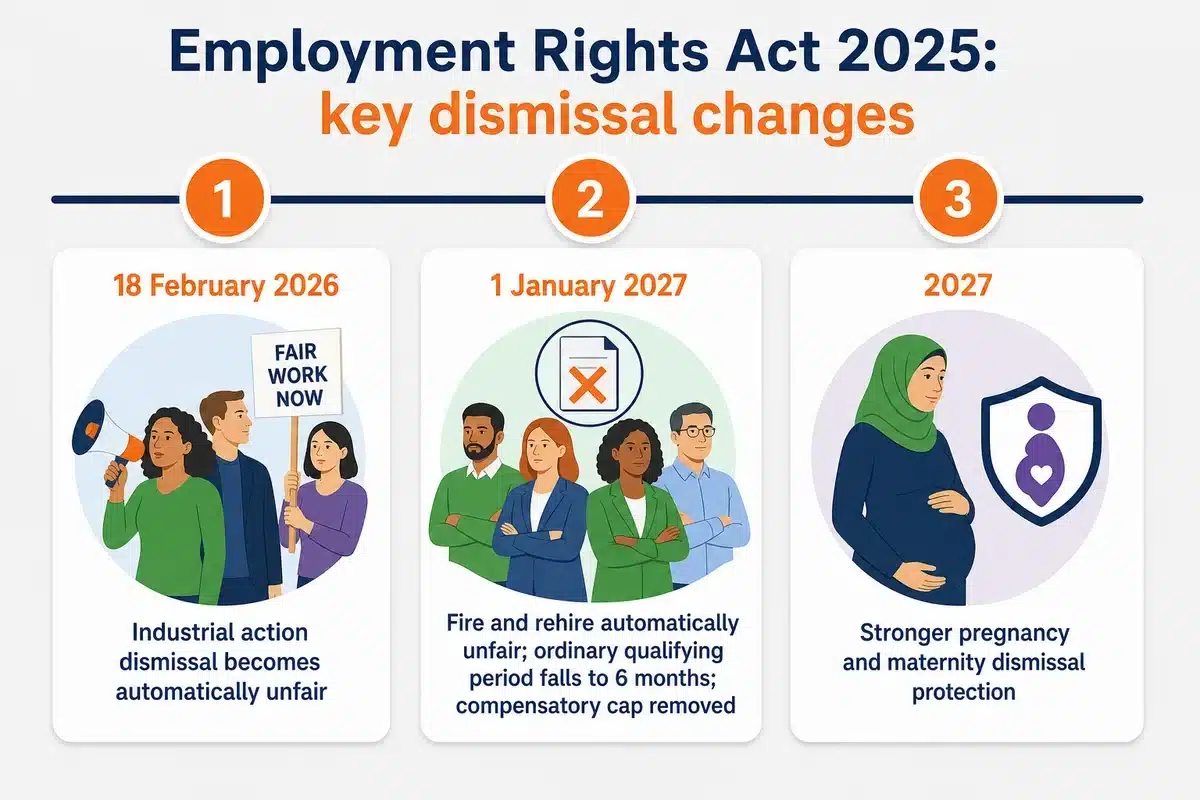
Dismissal for taking part in industrial action became automatically unfair on 18 February 2026. From 1 January 2027, dismissing staff and re-engaging them on worse terms, known as fire and rehire, becomes automatically unfair in most cases, and pregnancy and maternity dismissal protection is being strengthened. The same date reduces the qualifying period for ordinary unfair dismissal from 2 years to 6 months and removes the cap on the compensatory award.
What is automatic unfair dismissal?
Automatic unfair dismissal happens when the real reason for your dismissal is one the law specifically protects. The list of protected reasons is set out mainly in the Employment Rights Act 1996 (ERA 1996), with others in the Trade Union and Labour Relations (Consolidation) Act 1992 (TULRCA 1992) and the TUPE Regulations.
The word “automatic” is the important part. If the protected reason was the principal reason you were dismissed, the tribunal treats the dismissal as unfair without asking whether your employer behaved reasonably. There is no need to weigh up the fairness of the process or whether dismissal fell within a band of reasonable responses. The reason alone decides it.
This makes automatic unfair dismissal very different from “ordinary” unfair dismissal, where the tribunal looks closely at whether the employer had a fair reason and followed a fair procedure. Here, proving the protected reason is the whole battle.
How automatic unfair dismissal differs from ordinary unfair dismissal
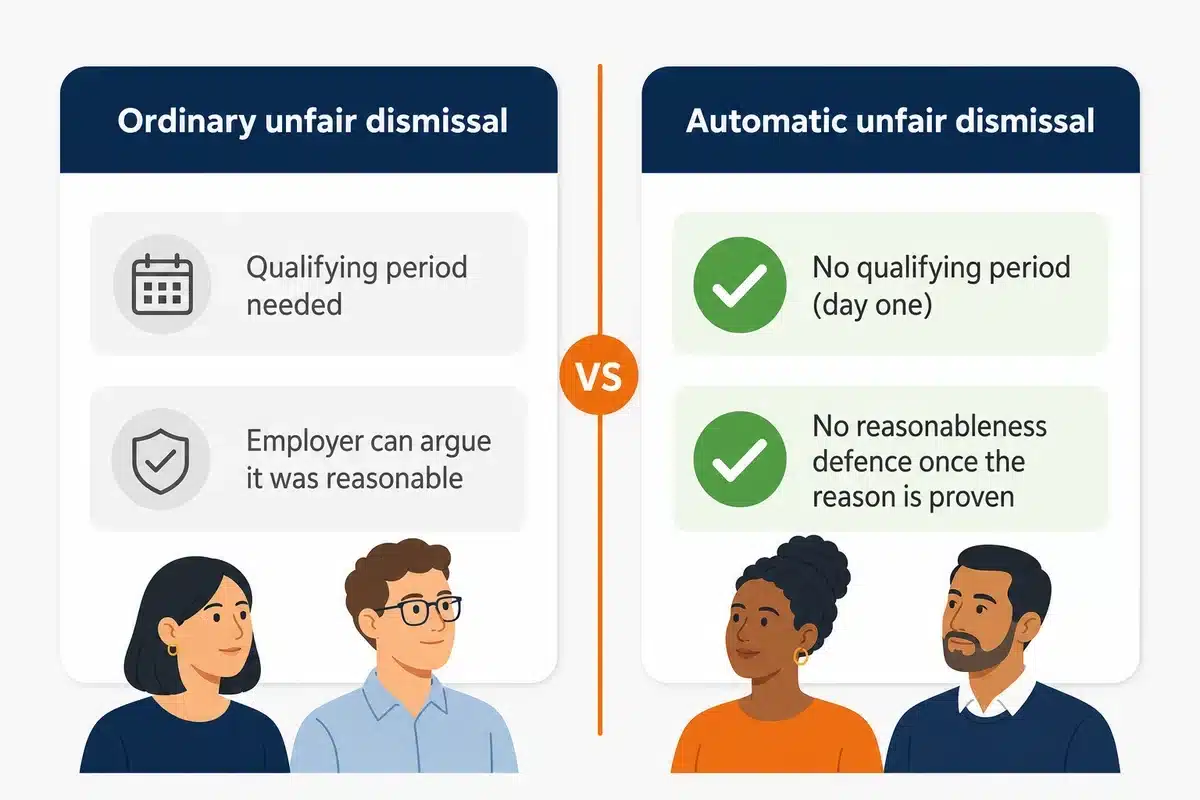
Two differences matter most. First, most automatic unfair dismissal claims need no qualifying period, so you are protected from your first day of employment. Second, the employer cannot rely on the usual reasonableness defence once you establish the protected reason.
Automatic versus ordinary unfair dismissal
| Feature | Automatic unfair dismissal | Ordinary unfair dismissal |
|---|---|---|
| Qualifying period | None for most categories (day one) | 2 years now, falling to 6 months from 1 January 2027 |
| What you must show | The protected reason was the principal reason | The dismissal was unfair on the facts and process |
| Reasonableness defence | Not available once the reason is proven | Central to the case |
| Compensation | Capped, but uncapped for whistleblowing and health and safety; minimum basic award for some categories | Basic award plus compensatory award up to £123,543 |
See our main guide on unfair dismissal for how ordinary claims work.
One point often gets confused. The government dropped its plan for full day-one ordinary unfair dismissal rights. Instead, from 1 January 2027 the qualifying period for ordinary claims falls to 6 months. None of this affects automatic unfair dismissal, which already protects you from day one and continues to do so.
The reasons that count as automatically unfair
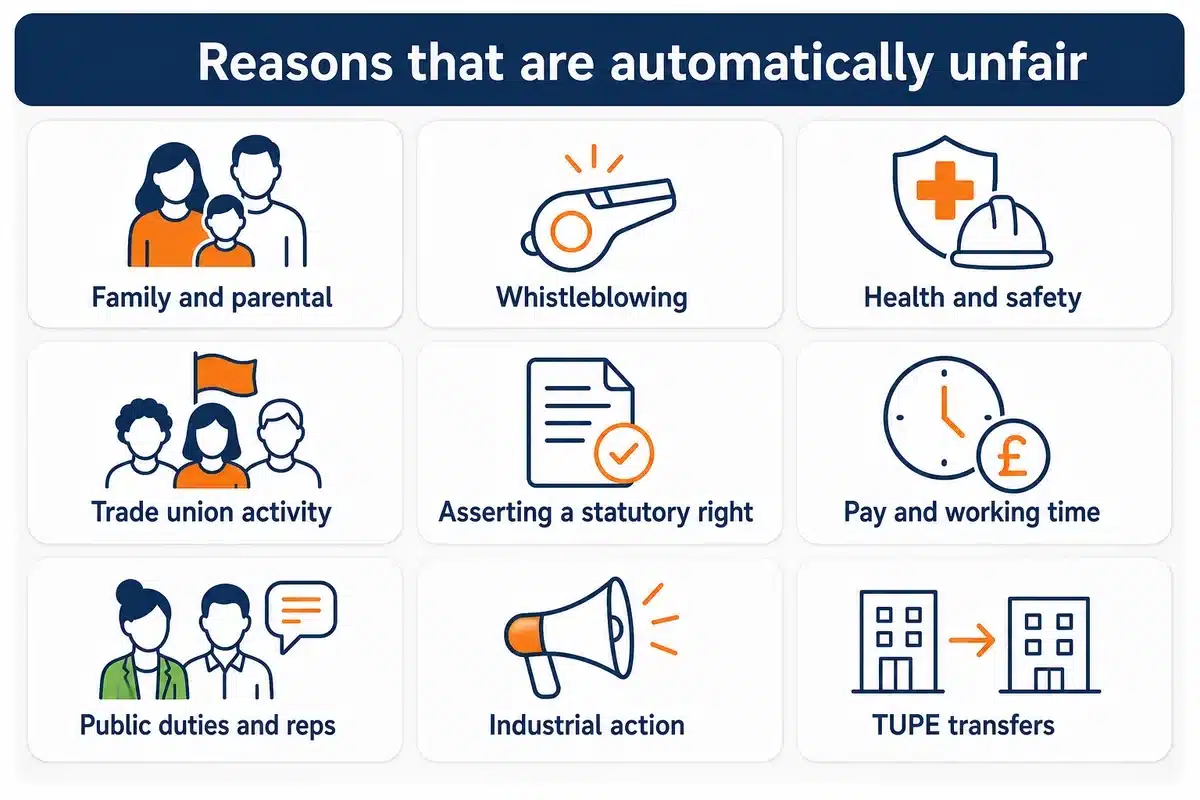
The protected reasons fall into a number of themes. Each carries its own statutory basis, and several carry enhanced remedies.
Family and parental reasons
Dismissal connected with pregnancy, childbirth, maternity, adoption, paternity or shared parental leave is automatically unfair under section 99 of ERA 1996 and the associated maternity and parental leave regulations. The same protection covers taking, or seeking to take, time off for dependants in an emergency. From 2027 the Act strengthens protection for pregnant employees and new mothers further, extending enhanced dismissal protection beyond redundancy situations.
Whistleblowing (making a protected disclosure)
If you are dismissed because you made a protected disclosure, the dismissal is automatically unfair under section 103A of ERA 1996. This is one of the strongest protections in employment law: compensation is uncapped, and a guaranteed minimum basic award of £9,157 applies. You may also be able to apply for interim relief to keep your pay flowing pending the hearing. See our whistleblowing guide for detail.
Health and safety
Section 100 of ERA 1996 protects you if you are dismissed for raising a genuine health and safety concern, for leaving or refusing to return to a workplace you reasonably believed was seriously and imminently dangerous, or for carrying out health and safety duties. Compensation is uncapped and the minimum basic award of £9,157 applies.
Trade union membership and activities
Dismissal for being a member of a trade union, for taking part in its activities, or for refusing to join one, is automatically unfair under sections 152 and 153 of TULRCA 1992. These dismissals also carry the minimum basic award of £9,157, and interim relief may be available.
Asserting a statutory right
Section 104 of ERA 1996 protects you if you are dismissed for asserting a statutory employment right, or for trying to. It does not matter whether you turned out to be right about the right, as long as your claim was made in good faith. Examples include asking for a written statement of terms, challenging an unlawful deduction from wages, or insisting on your rest breaks.
Pay, working time and the minimum wage
Dismissal for asserting rights under the Working Time Regulations 1998, such as paid annual leave or limits on working hours, is automatically unfair under section 101A. Dismissal connected with the National Minimum Wage is automatically unfair under section 104A. You cannot lawfully be sacked for insisting on the pay and hours the law guarantees.
Public duties and workplace representation
Several categories protect people carrying out public or workplace roles. These include jury service (section 98B), acting as an employee representative or a candidate to be one (section 103), acting as an occupational pension scheme trustee (section 102), and refusing to work on Sundays for shop and betting workers (sections 101 and 105). Dismissal for performing these roles is automatically unfair.
Taking part in industrial action
Dismissal for taking part in lawfully organised industrial action became automatically unfair on 18 February 2026, when the previous 12-week protected-period limit was removed. Employees taking protected industrial action now have far stronger protection against being dismissed for it.
TUPE transfers
Under regulation 7 of the TUPE Regulations 2006, dismissal is automatically unfair where the sole or principal reason is the transfer of a business itself. A narrow exception applies where there is an economic, technical or organisational reason entailing changes in the workforce.
“The mistake I see again and again is people assuming they have no rights because they have only been in the job a few months. With automatic unfair dismissal that assumption is wrong. If you were sacked for raising a safety concern or blowing the whistle, your length of service is irrelevant. What matters is the reason, and the timing usually tells the real story.”

Discrimination dismissals sit alongside these categories. A dismissal because of a protected characteristic such as sex, race, disability, age, religion or sexual orientation is unlawful under the Equality Act 2010 and also needs no qualifying period. Forced retirement is age discrimination unless the employer can objectively justify it. If your dismissal involved discrimination, see our discrimination at work guide, as the remedies can be greater again.
How to prove the reason for your dismissal
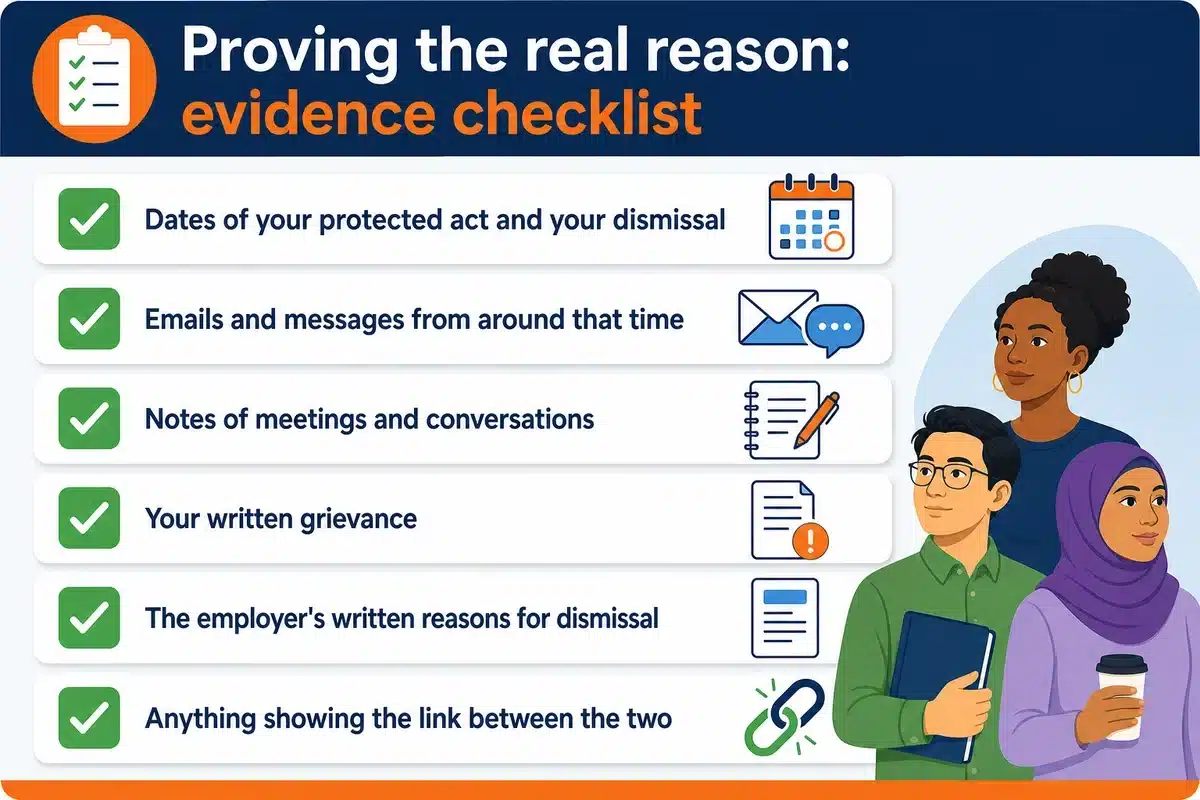
The reason is everything in these cases, so evidence of why you were dismissed is what wins them. Employers rarely admit an unlawful reason, so tribunals look at the surrounding facts, and timing is often the strongest clue.
There is a practical point on the burden of proof. If you have less than the ordinary qualifying period of service, you need to produce some evidence that the reason was a protected one. Once you raise it credibly, the tribunal examines what really drove the decision. If you have longer service, the employer has to show the reason for dismissal in the usual way.
Useful evidence includes the dates of your protected act and your dismissal, any emails or messages around that time, notes of meetings, your written grievance, and the reasons the employer gave in writing. The closer in time the protected act and the dismissal, the harder it is for an employer to explain the link away.
Compensation for automatic unfair dismissal
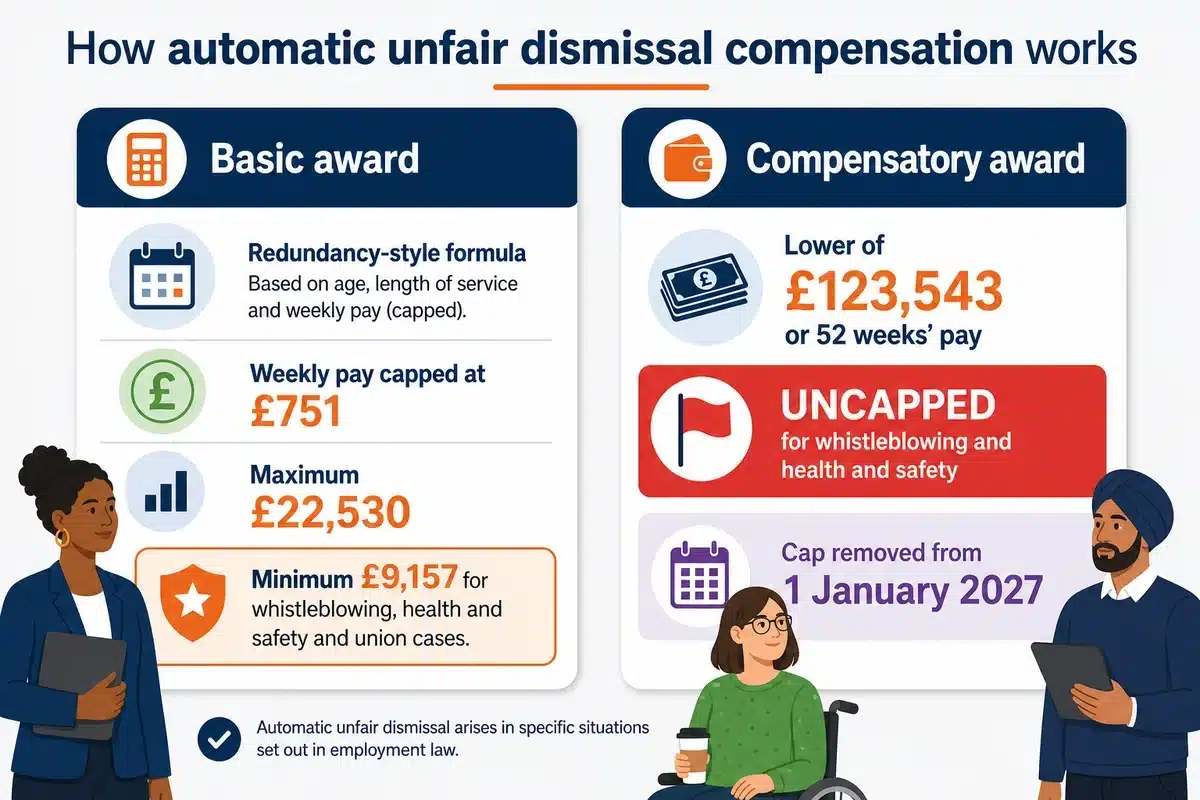
Compensation has two main parts: a basic award and a compensatory award.
The basic award uses the same formula as statutory redundancy pay: half a week’s pay for each year worked under age 22, one week’s pay for each year aged 22 to 40, and one and a half weeks’ pay for each year aged 41 and over, up to 20 years. A week’s pay is capped at £751, giving a maximum basic award of £22,530. For whistleblowing, health and safety, union and several other categories, a minimum basic award of £9,157 applies regardless of your age or length of service.
The compensatory award reflects your actual financial losses, mainly lost earnings and benefits. It is normally capped at the lower of £123,543 or 52 weeks’ gross pay. There are two important exceptions: dismissals for whistleblowing under section 103A and for health and safety under section 100 are uncapped. From 1 January 2027, under the Employment Rights Act 2025, the compensatory cap is removed for all unfair dismissal claims.
In whistleblowing and trade union cases you may also apply for interim relief, which can require the employer to keep paying you until the full hearing. The deadline is short, just seven days from dismissal, so act quickly if this might apply.
💡 Want to estimate your potential claim?
Use our free calculator with current 2026/27 figures to see what an unfair dismissal award might look like.
Try the calculator →Time limits for making a claim
You normally have only 3 months minus 1 day from the date your employment ended to start a claim. Before you can lodge it, you must notify Acas (the Advisory, Conciliation and Arbitration Service) and go through early conciliation, which can extend the deadline a little. The Employment Rights Act 2025 is expected to extend the general time limit to six months, no earlier than October 2026, but until then you should treat the three-month deadline as strict.
If you want to apply for interim relief in a whistleblowing or union case, the deadline is much shorter at seven days from dismissal. Missing a deadline usually ends a claim before it starts, so get advice early.
Frequently Asked Questions
What is the difference between unfair dismissal and automatic unfair dismissal?
Ordinary unfair dismissal looks at whether the employer had a fair reason and followed a fair process, and normally needs a qualifying period of service. Automatic unfair dismissal applies when the reason itself is one the law protects. If you prove that reason, the dismissal is unfair regardless of how reasonably the employer behaved, and most categories need no qualifying period.
Can I claim automatic unfair dismissal from day one?
Yes, for most categories. Protected reasons such as pregnancy, whistleblowing, health and safety, asserting a statutory right and trade union activity carry no qualifying period, so you are protected from your first day of employment.
How much compensation can I get for automatic unfair dismissal?
You can claim a basic award (up to £22,530) and a compensatory award for your financial losses, normally capped at the lower of £123,543 or 52 weeks’ pay. Whistleblowing and health and safety dismissals are uncapped, and several categories carry a minimum basic award of £9,157. The cap is removed entirely from 1 January 2027.
Is being sacked for whistleblowing automatically unfair?
Yes. Dismissal because you made a protected disclosure is automatically unfair under section 103A of the Employment Rights Act 1996. It needs no qualifying period, compensation is uncapped, and a minimum basic award of £9,157 applies. You may also be able to apply for interim relief within seven days.
Is fire and rehire automatically unfair?
From 1 January 2027, dismissing employees and re-engaging them on worse terms, known as fire and rehire, becomes automatically unfair in most cases under the Employment Rights Act 2025. A limited exception is expected where a business faces genuine financial difficulty, with the detail set out in an updated code of practice.
How do I prove my dismissal was automatically unfair?
You need evidence that the protected reason was the real reason for dismissal. Timing is usually the strongest clue, so keep a record of when you raised the issue and when you were dismissed, along with emails, meeting notes, your grievance and the employer’s written reasons.
How long do I have to make a claim?
Normally 3 months minus 1 day from the date employment ended, after first notifying Acas for early conciliation. The deadline for interim relief is only seven days. The time limit is expected to extend to six months, no earlier than October 2026.
💬 Been dismissed for a protected reason?
Our solicitors can assess whether your dismissal was automatically unfair and advise on your options, including urgent interim relief.
Get Free Initial Advice →Important: This guide provides general information about automatic unfair dismissal. It is not legal advice and should not be relied upon as such. Employment law is complex and the rules may apply differently depending on your circumstances. If you believe you have been automatically unfairly dismissed, we strongly recommend seeking professional legal advice quickly, as strict time limits apply.
Sources and Further Reading
Primary Legislation
- Employment Rights Act 1996, Part X (unfair dismissal, including the automatically unfair categories in sections 98B to 105)
- ERA 1996, section 103A (protected disclosure dismissal)
- TULRCA 1992, section 152 (trade union dismissal)
- TUPE Regulations 2006, regulation 7 (transfer-related dismissal)
- Employment Rights Act 2025 (reforms to dismissal protection)
Official Guidance
- Acas: Employment Rights Act 2025 (implementation dates)
- Acas: Dismissals
- GOV.UK: Dismissal
Tom Street
Tom Street is the principal solicitor at Tom Street & Co. Solicitors, specialising in employment law and tribunal claims. He regularly represents employees in automatic unfair dismissal cases, including whistleblowing, health and safety and trade union claims, and advises on urgent interim relief applications. View full profile