
Quick Summary
Sexual orientation is a protected characteristic under section 12 of the Equality Act 2010, and it protects lesbian, gay, bisexual and heterosexual people alike. You are covered from your first day at work and from the moment you apply for a job, with no qualifying period. Compensation is uncapped, and on top of any financial loss a tribunal can award between £1,300 and £62,900 for injury to feelings. The deadline is currently 3 months minus 1 day from the act you are complaining about, rising to six months for acts occurring on or after 1 October 2026.
⚖️ This guide is for general information only and is not legal advice. Every case is different – if you’re unsure, speak to a solicitor.
Key Points
Key Points
- ✓ Protection is a day one right. There is no qualifying period, and job applicants are covered too.
- ✓ You do not have to be gay to bring a claim. Being wrongly assumed to be, or being targeted because of a partner or friend, is enough.
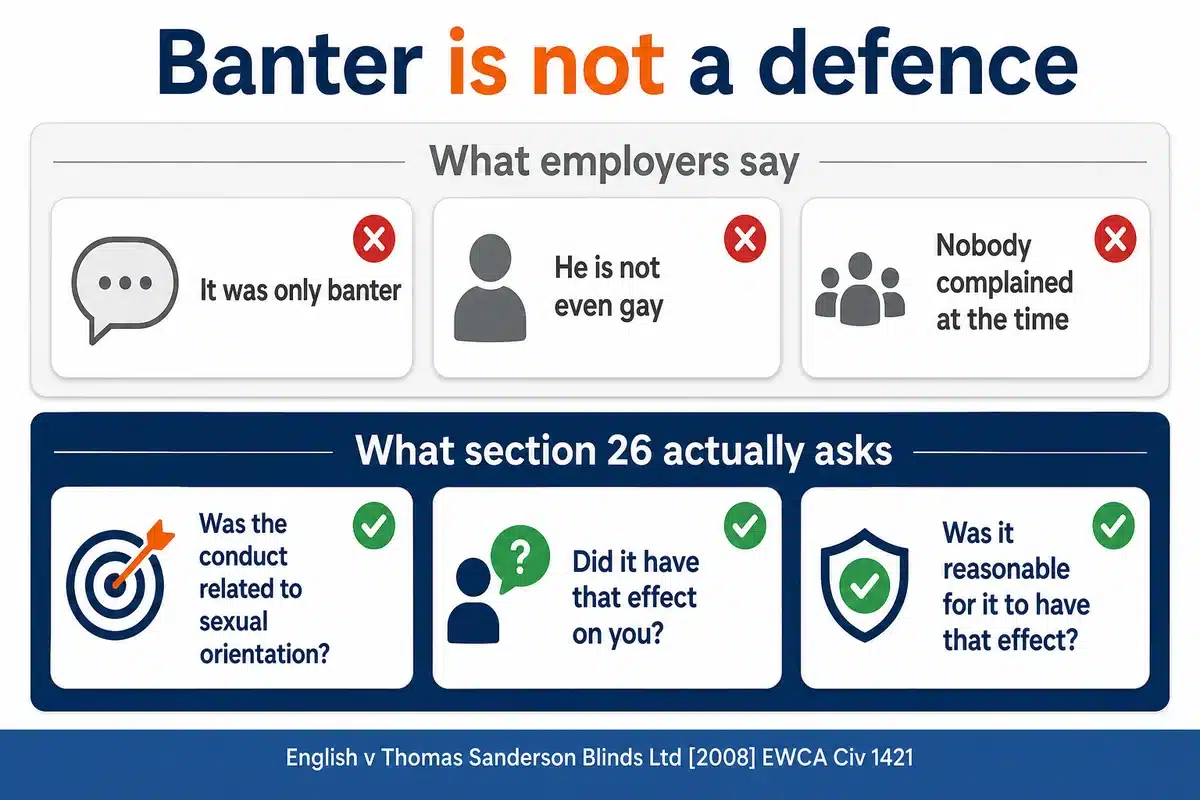
- ✓ “Banter” is not a defence. The Court of Appeal has confirmed that homophobic taunting is harassment even where everyone knows the target is straight.
- ✓ Compensation is uncapped, unlike ordinary unfair dismissal, and includes an award for injury to feelings.
- ✓ From 30 October 2026 your employer becomes liable for harassment by customers, clients and other third parties.
- ✓ The time limit is strict. Miss it and the tribunal usually has no power to hear your claim, whatever its merits.
⚖️ Legislation Update
Two changes land this October
The Employment Rights Act 2025 extends the tribunal time limit from three months to six months from 1 October 2026, where the act you are complaining about happens on or after that date. From 30 October 2026 employers also become liable for harassment by third parties such as customers and clients, unless they took all reasonable steps to prevent it. If your complaint concerns something that happened before those dates, the current rules still apply to you.
What Counts as Sexual Orientation Discrimination at Work?
Sexual orientation is one of the nine protected characteristics under the Equality Act 2010. Section 12 defines it as a person’s sexual orientation towards persons of the same sex, persons of the opposite sex, or persons of either sex.
That wording matters. The protection is symmetrical: it covers lesbian, gay and bisexual people, and it covers heterosexual people on exactly the same terms. In practice the overwhelming majority of claims are brought by LGB employees, but the statutory right belongs to everyone.
Protection is not limited to your orientation as an abstract fact about you. Acas guidance confirms it extends to discrimination connected with manifestations of that orientation. A same-sex marriage or civil partnership, bringing your partner to a work event, a photograph on your desk, or simply answering “we” when a colleague asks about your weekend all fall inside the protection. An employer who is relaxed about your orientation in principle but penalises you the moment it becomes visible is still discriminating.
What section 12 does not cover
Three distinctions catch people out, and getting them right at the start saves a great deal of difficulty later.
Gender reassignment is a different characteristic. Section 7 protects trans people, and it is separate from section 12. Sexual orientation is about who you are attracted to; gender reassignment is about transitioning. A trans person may of course be gay, straight or bisexual, and may have claims under both sections, but they are legally distinct routes. We cover them in our guides to transgender discrimination and gender reassignment discrimination.
Marriage and civil partnership is also its own characteristic. Section 8 protects people who are married or in a civil partnership from being treated worse for that reason. If you were passed over after entering a same-sex marriage, you may have claims under both section 8 and section 12, pleaded in the alternative. See our guide to marriage and civil partnership discrimination.
Not every relationship preference is a sexual orientation. In Tudose v Armour Home Electronics Ltd an employment tribunal struck out a claim brought by a claimant who argued that polyamory was a manifestation of his heterosexuality, holding there was no reasonable prospect of establishing that polyamory is a sexual orientation within section 12. The statutory definition is confined to the sex of the people you are oriented towards.
Who is protected
Protection under the Equality Act 2010 is a day one right. There is no qualifying period of service, which sets it apart from ordinary unfair dismissal, where a qualifying period still applies until it drops to six months on 1 January 2027. Sexual orientation protection also covers:
- Job applicants, including at the advertising, shortlisting and interview stages
- Employees and workers, including agency workers and those on zero hours contracts
- Self-employed contractors who perform work personally
- Partners, office holders and, in some circumstances, former employees, for example where a reference is refused
Recruitment is a real problem area rather than a theoretical one. Stonewall research found that almost one in five LGBT people looking for work said they were discriminated against because of their identity while trying to get a job.
The Five Forms of Sexual Orientation Discrimination
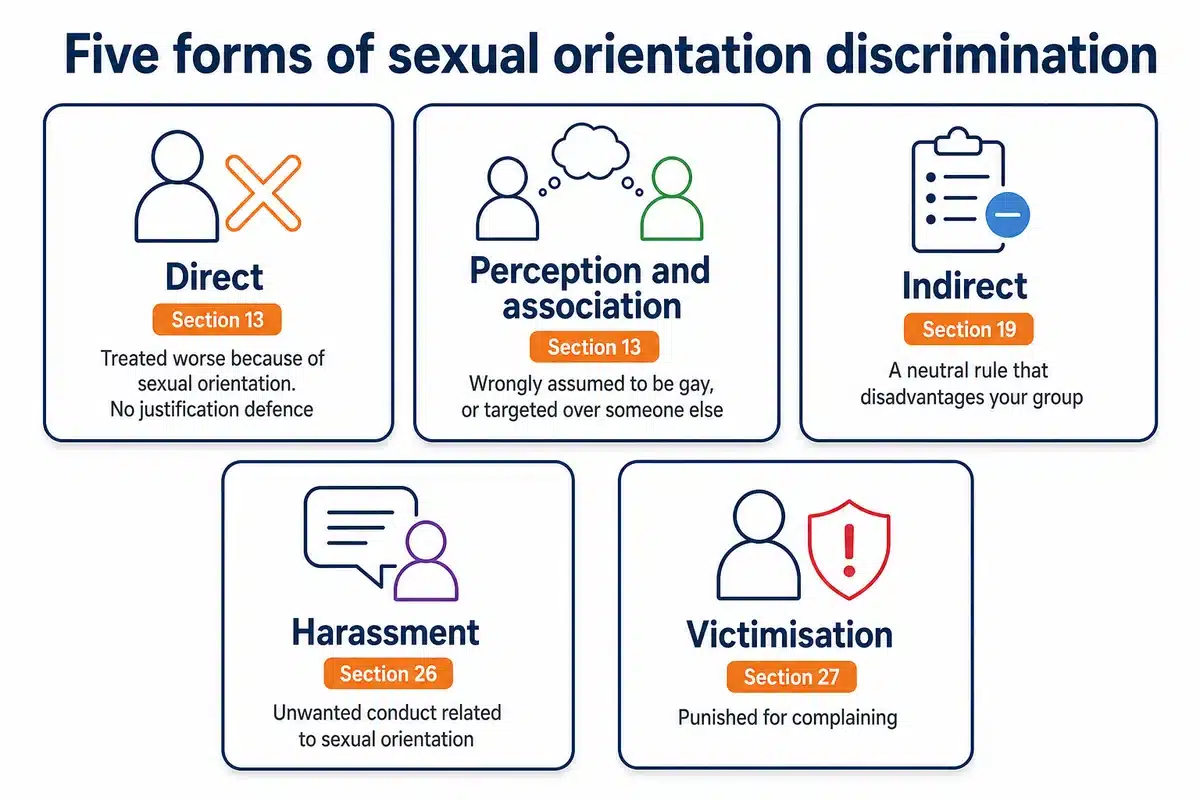
Claims come in five distinct forms. They are not interchangeable, and identifying the right one matters because each has a different legal test and a different defence available to the employer. Many claims plead more than one in the alternative.
Direct discrimination (section 13)
Direct discrimination is treating someone less favourably because of sexual orientation. There is no defence of justification for direct discrimination, so if you prove it, the employer cannot argue it had a good business reason.
Example. A senior manager is told he is being moved off a major client account because the client is “traditional” and would be more comfortable with someone else, following a work dinner at which he mentioned his husband. That is direct discrimination. The employer’s own attitude is beside the point, and the prejudices of customers are never a lawful reason for less favourable treatment.
The comparison is with how the employer treated, or would have treated, someone in materially the same circumstances but of a different sexual orientation. You do not need to point to a real person. A hypothetical comparator is enough, and tribunals often work with one.
Discrimination by perception and by association
Section 13 is drafted as less favourable treatment “because of” the characteristic, not because of your characteristic. That opens two further routes.
Perception. You are treated badly because someone assumes you are gay. Whether the assumption is correct is legally irrelevant. A straight employee refused promotion because a director wrongly believed he was gay has a direct discrimination claim, and so does a gay employee in the same position.
Association. You are treated badly because of someone else’s orientation. A manager sidelined after her employer discovered her son is gay, or an employee frozen out after speaking warmly about a same-sex couple in his family, is protected.
Both routes exist because the statutory wrong is the employer acting on sexual orientation, not the claimant holding a particular one.
Indirect discrimination (section 19)
Indirect discrimination works differently. Here everybody is treated the same, but a provision, criterion or practice puts people of a particular sexual orientation at a particular disadvantage, and puts you at that disadvantage too.
Example. A pub chain advertises for a “husband and wife team” to manage a site, with accommodation provided. Applied literally, that requirement excludes same-sex couples and disadvantages gay and lesbian applicants. Depending on how it was drafted and applied, the same advert can support a direct claim as well: if the intention was to keep same-sex couples out, it is direct discrimination and no justification is available.
Unlike direct discrimination, indirect discrimination can be defended if the employer shows the requirement was a proportionate means of achieving a legitimate aim. The employer has to show both that the aim is legitimate and that it could not reasonably have achieved it in a less discriminatory way. In the pub example, recruiting any two people willing to live on site and work as a pair achieves the entire commercial purpose, so the requirement fails.
Since 1 January 2024, section 19A allows an indirect claim even where you do not share the protected characteristic yourself, provided you suffer substantively the same disadvantage as the group that does. We cover the mechanics in our section 19A guide.
Harassment (section 26)
Harassment is unwanted conduct related to sexual orientation which has the purpose or effect of violating your dignity, or of creating an intimidating, hostile, degrading, humiliating or offensive environment.
Two features make it a powerful claim. First, the conduct only has to be related to sexual orientation, so it does not have to be directed at you personally. Homophobic jokes told across an office, or a slur about a colleague who is not in the room, can found a claim. Second, you do not need to share the characteristic yourself.
Section 26(4) is where most harassment cases are actually decided. Where the employer says the effect was unintended, the tribunal must take into account your perception, the other circumstances of the case, and whether it was reasonable for the conduct to have that effect. Intention is not required. An employer who says “no offence was meant” has not answered the claim.
Our harassment at work guide goes through the section 26 test in more detail.
Victimisation (section 27)
Victimisation is being subjected to a detriment because you did a protected act, or because your employer believes you have done or may do one. Protected acts include bringing a claim, giving evidence in someone else’s claim, raising a grievance about discrimination, or making any allegation that the Equality Act has been breached.
You do not need to have been right about the underlying discrimination. Provided the allegation was made in good faith, you are protected even if the complaint fails. This is why the way a grievance is written matters so much: a letter that says plainly you believe the treatment relates to your sexual orientation creates a protected act, and any retaliation that follows becomes a separate claim in its own right. See our guide to victimisation.
Who is legally responsible
Under section 109, an employer is liable for discrimination and harassment committed by its employees in the course of employment. That covers conduct at work, and it reaches beyond the office to work nights out, conferences and work-related group chats.
The employer has a defence if it can show it took all reasonable steps to prevent the conduct. In practice this is a high bar. A dusty equal opportunities policy nobody has read does not meet it. Tribunals look for current, meaningful training, proper investigation of complaints, and evidence that the employer acted on what it found.
Section 110 also makes the individual harasser personally liable. Naming them as a respondent alongside the employer is sometimes appropriate, and it changes the dynamics of a case considerably.
“Banter” Is Not a Defence
The most common response to a homophobic harassment complaint is that it was only banter, that everyone joined in, and that the claimant is not even gay. None of those points is a defence.
The leading authority is English v Thomas Sanderson Blinds Ltd [2008] EWCA Civ 1421. Mr English was a heterosexual married man with three children. His colleagues subjected him to years of homophobic taunting, which began after one of them discovered he had been to boarding school in Brighton. Everybody involved knew he was not gay, and nobody believed he was.
The Court of Appeal held, by a majority, that he had been harassed. The critical fact was that he was repeatedly taunted as gay. It did not matter whether he was gay, and it did not matter that his tormentors knew he was not. Where the conduct has sexual orientation as its focus, it is related to sexual orientation, and that is what the statute requires.
A more recent illustration is Fleming v McGill Facilities Management Ltd, in which a manager was told by a supervisor that “you dykes sit at the top” during a discussion about office seating. She did not hold the protected characteristic. The tribunal found unlawful harassment and constructive dismissal, awarding £15,460 in total, including £2,000 for injury to feelings.
Two practical points follow. Joining in to deflect attention does not defeat a claim, and tribunals understand perfectly well why someone would. And the fact that nobody complained for months is not the answer the employer thinks it is, particularly where the alternative was outing yourself to a hostile room.
Being outed at work without your consent sits in the same territory. Disclosing a colleague’s sexual orientation to others, whether as gossip or as a supposedly well meant introduction, is unwanted conduct related to sexual orientation, and where it creates a humiliating or hostile environment it can found a harassment claim.
Harassment by Customers and Clients Changes on 30 October 2026
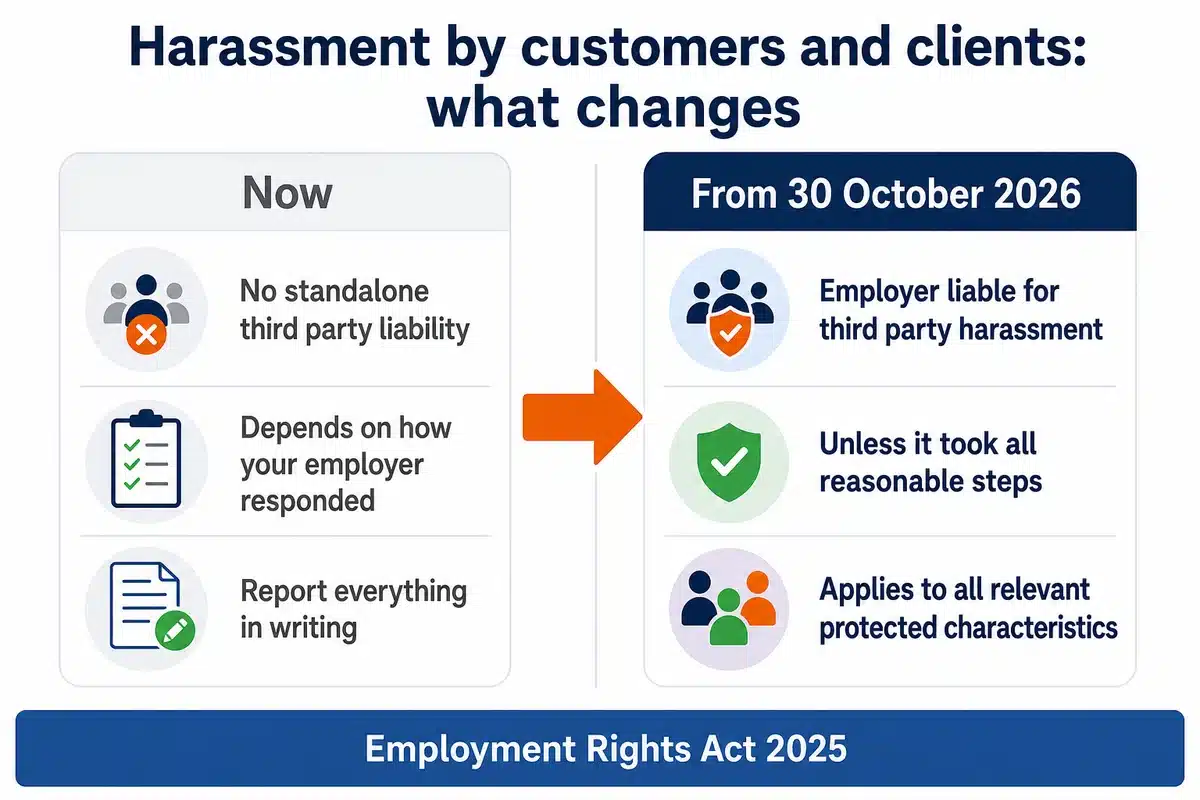
Employees who deal with the public have historically had weak protection when the abuse comes from outside the organisation. That changes shortly.
From 30 October 2026, the Employment Rights Act 2025 makes an employer liable where it permits a third party to harass an employee in the course of employment, unless it took all reasonable steps to prevent it. The provision applies to harassment related to all relevant protected characteristics, not just sexual harassment.
The change is significant for LGB workers in customer-facing roles. Stonewall research found that more than one in four LGBTQ+ people experienced verbally abusive conduct from customers or clients because of their identity.
Until the new provisions take effect, protection depends on how the employer itself responded. An employer that shrugs off repeated homophobic abuse from a regular customer, or that tells you to put up with it because the client is important, is exposing itself to a claim that its own conduct created the hostile environment. Report every incident in writing, and keep what the employer says back. Those responses are the evidence that matters both now and after October.
When Religion or Belief Collides with Sexual Orientation
Sexual orientation and religion or belief are both protected, and cases where they pull against each other reach the higher courts regularly. The law here is more settled than the headlines suggest.
In Higgs v Farmor’s School [2025] EWCA Civ 109, a school employee was dismissed after a parent complained about Facebook posts criticising the teaching of same-sex relationships and gender in schools. The Court of Appeal held on 12 February 2025 that dismissing an employee merely for expressing a protected belief, where the employer or a third party objects to it, is direct discrimination because of religion or belief. The Supreme Court refused the school permission to appeal on 6 June 2025, so that judgment stands.
Higgs is a religion or belief case, and it is worth being clear about what it does and does not do. It protects the expression of a belief. It does not license harassment of colleagues, and it leaves section 26 entirely intact. Where the manifestation of a belief is objectionable in its manner, its extent or its effect on others, an employer may still act, provided its response is a proportionate one. Conduct directed at an LGB colleague in the workplace is a different question from a personal social media post, and tribunals treat it differently.
The organised religion exception (Schedule 9, paragraph 2)
There is a narrow statutory exception allowing a requirement relating to sexual orientation, or a requirement not to be married to someone of the same sex, where employment is for the purposes of an organised religion. The employer must show the requirement engages either the compliance principle or the non-conflict principle, and that the individual does not meet it.
The exception was applied in Pemberton v Inwood [2018] EWCA Civ 564, where a Church of England priest who entered a same-sex marriage was refused the licence he needed to take up a hospital chaplaincy post. The Court of Appeal accepted that the employment was for the purposes of an organised religion, because the role required a licensed minister to conduct religious services.
The boundaries are tight. The exception is confined to employment for the purposes of an organised religion, which means roles such as ministers of religion, not the whole of a religious organisation’s activities. A faith school’s administrative staff, a church-run care home’s cleaners, or a religious charity’s finance team are not covered. If a religious employer has relied on this exception against you, it is worth testing whether the role genuinely falls inside it.
Proving Sexual Orientation Discrimination: The Burden of Proof
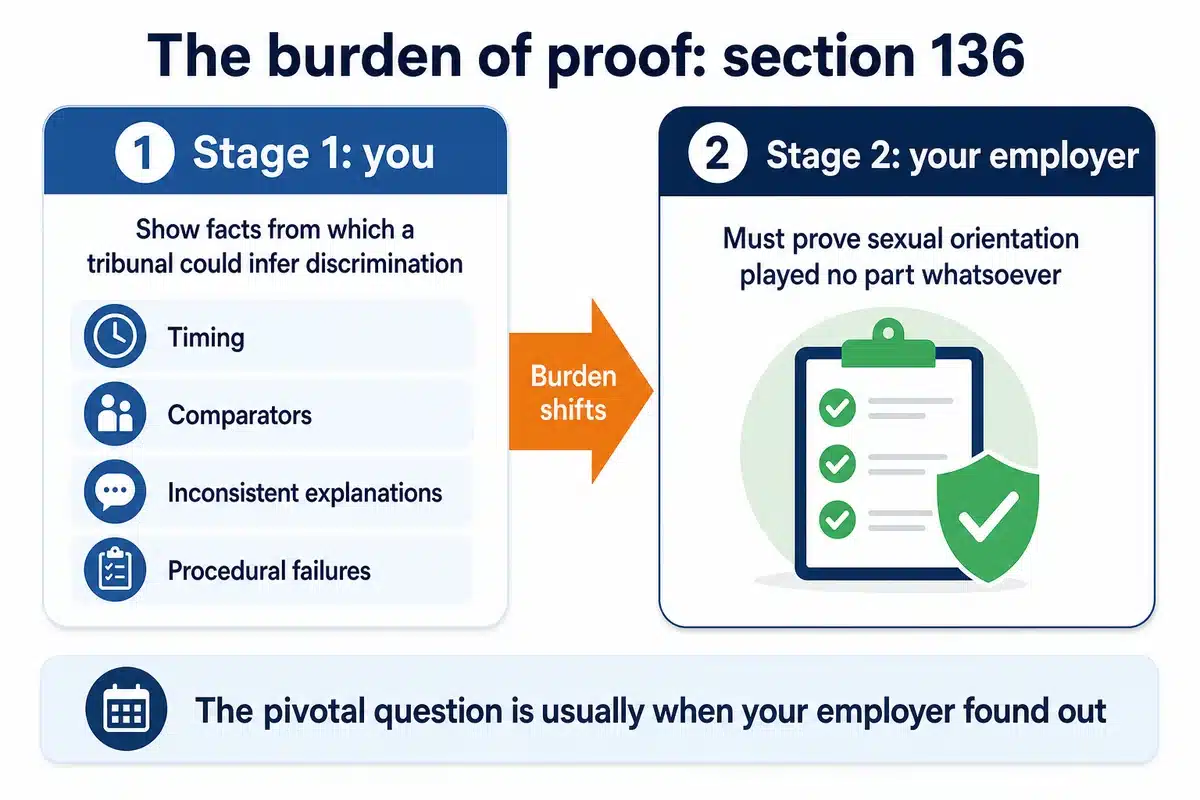
Almost nobody has a written admission. The law recognises this, and section 136 of the Equality Act 2010 sets up a two-stage burden of proof designed to deal with it.
At stage one, you must show facts from which a tribunal could decide, in the absence of any other explanation, that discrimination occurred. If you get there, the burden shifts. At stage two the employer must prove that sexual orientation played no part whatsoever in its treatment of you. Not that it played a small part, or a justifiable one: no part at all.
The Supreme Court in Royal Mail Group Ltd v Efobi [2021] UKSC 33 confirmed that tribunals consider all the evidence at stage one, from whichever party it comes, and may draw inferences from an employer’s failure to call an obvious witness or produce an obvious document.
What builds a stage one case
Sexual orientation is not visible, which creates an evidential problem that does not arise in the same way in race or sex claims. The pivotal question is usually when the employer found out, and what changed afterwards.
- Timing. Appraisal scores that fell away after you came out, or after a partner appeared at a work event, are powerful. Pin the date down precisely.
- Comparators. Someone in materially similar circumstances who was treated better. Differences of treatment on a disciplinary charge or in a redundancy scoring exercise are the usual ground.
- Inconsistent explanations. An employer that gives one reason in a meeting, another in a grievance outcome and a third in its response to the claim is doing your work for you.
- Procedural failures. Skipped steps, no investigation, no appeal, or a grievance that quietly goes nowhere all support an inference.
- Culture evidence. Group chats, jokes at team meetings, comments about “not the right fit”. Individually trivial, collectively revealing.
- Written questions. The old statutory questionnaire was abolished, but you can still ask your employer written questions before issuing, and an evasive or unanswered reply is something a tribunal can take into account.
Time Limits: The Deadline That Ends Most Claims
More strong claims are lost to the deadline than to the evidence. Under section 123 of the Equality Act 2010, the current limit is 3 months minus 1 day from the act you are complaining about.
Where the act complained of occurs on or after 1 October 2026, the limit rises to six months under the Employment Rights Act 2025. Until then, and for anything that happened before that date, the shorter deadline applies.
Three points regularly decide whether a claim gets through the door.
Acas early conciliation is compulsory and it stops the clock. You must notify Acas before issuing. The clock pauses from the day you notify until you receive the certificate. Our guide to registering with Acas early conciliation takes you through it.
A continuing act runs from the end, not the beginning. Where discrimination is a course of conduct rather than a single event, section 123(3) treats it as done at the end of that period. A sustained campaign of homophobic harassment is usually a continuing act, which means an incident from a year ago may still be in time if the conduct continued. Whether a series of events is one continuing act or several separate ones is frequently the first thing argued at a preliminary hearing.
An internal grievance does not pause anything. Waiting for a grievance or appeal to conclude is the single most common reason people miss the deadline. Run the two in parallel.
A tribunal can extend time where it is just and equitable to do so, and that discretion is broader in discrimination claims than the test that applies to unfair dismissal. It is still a discretion, not a right, and it is not something to build a case on. See our tribunal time limits guide to work out your date.
What a Sexual Orientation Discrimination Claim Is Worth
There is no statutory cap on discrimination compensation. This is the main financial difference between a discrimination claim and an ordinary unfair dismissal claim, where the compensatory award is capped.
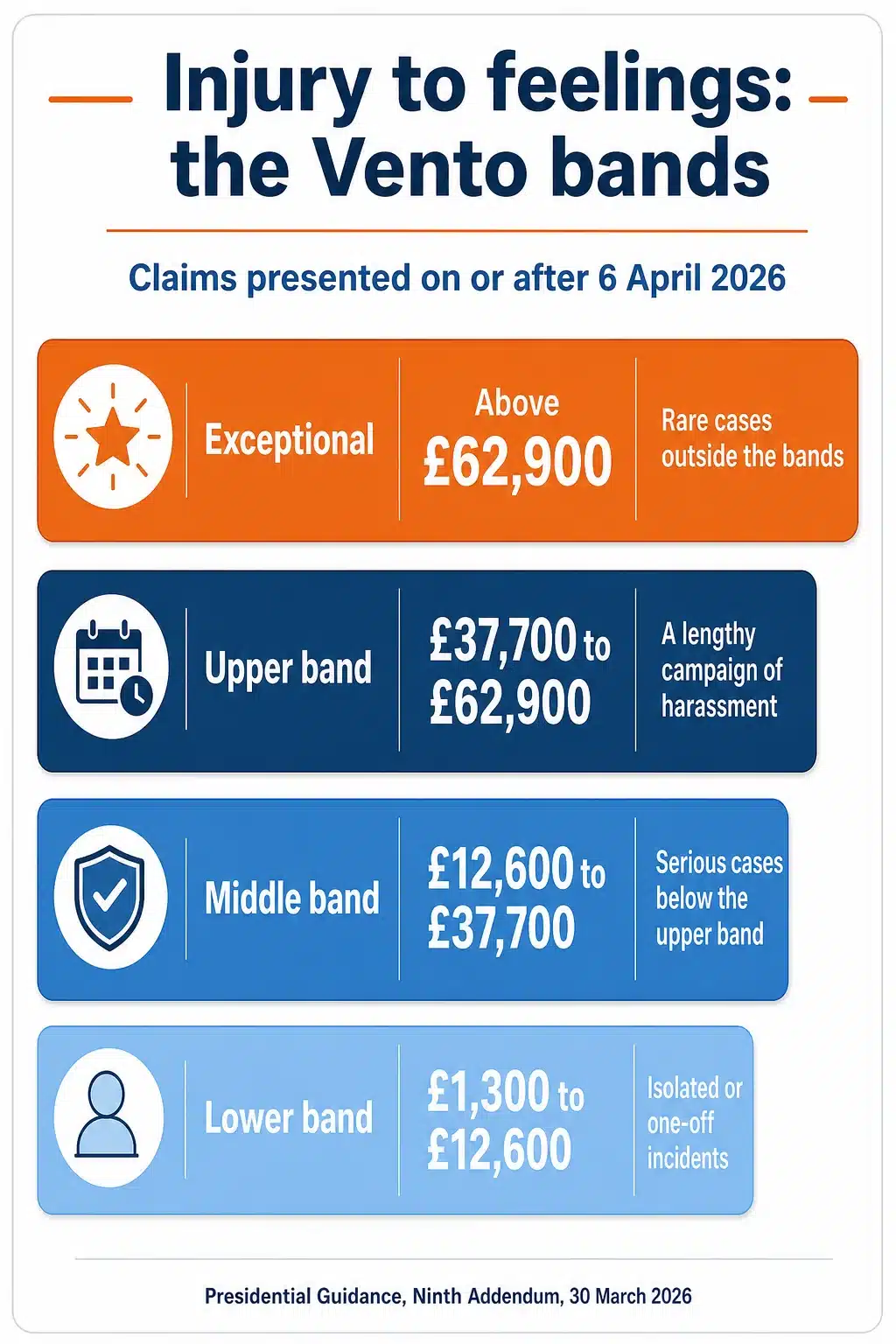
An award has two main parts. Financial loss covers lost earnings, pension and benefits, past and future, and in a career-ending case that element does the heavy lifting. Injury to feelings compensates the distress itself, and is assessed by reference to the Vento bands.
Vento bands for injury to feelings (claims presented on or after 6 April 2026)
| Band | Range | When it applies |
|---|---|---|
| Lower band | £1,300 to £12,600 | Less serious cases, such as an isolated or one-off incident |
| Middle band | £12,600 to £37,700 | Serious cases that do not merit an award in the upper band |
| Upper band | £37,700 to £62,900 | The most serious cases, such as a lengthy campaign of harassment |
| Exceptional cases | Above £62,900 | Rare cases falling outside the upper band altogether |
On top of those, a tribunal can award aggravated damages where the employer behaved in a high handed or malicious way, or defended the claim oppressively, and personal injury damages where the discrimination caused a diagnosable psychiatric injury. Interest runs on injury to feelings from the date of the act, and awards can be increased by up to 25% where an employer unreasonably failed to follow the Acas Code of Practice on disciplinary and grievance procedures.
A realistic view of outcomes
The most recent published tribunal award statistics, covering 2023/24, show a median sexual orientation discrimination award of £26,693 and an average of £27,070, with the highest award that year reaching £47,297. Award data for 2024/25 has not yet been published while HMCTS quality assures figures from its new case management system.
That median is the highest of any discrimination type published for the year, and it is worth understanding why rather than reading too much into it. Race discrimination had a median of £10,253 that year and sex discrimination £16,161, yet both had maximum awards running into the hundreds of thousands. Sexual orientation awards cluster in a narrower band: fewer very small awards, and no outliers at the top. The number of awards is also small, so a single unusual year moves the figures more than it would for race or disability.
The honest reading is that successful sexual orientation claims tend to involve sustained conduct rather than one-off remarks, which pushes injury to feelings into the middle band and above. It is not a reason to expect a particular figure in your own case.
Most claims never reach a judgment. The great majority settle or are withdrawn, so published award figures describe only the minority of cases decided at a final hearing. Any source quoting a simple “success rate” for discrimination claims should be treated with caution, because withdrawn and settled claims are not failures.
What to Do If You’re Facing Sexual Orientation Discrimination at Work
Practical Steps
Write it down as it happens. A contemporaneous note with the date, who was present and the words used carries far more weight than a recollection assembled months later. Keep it somewhere outside your employer’s systems.
Fix the date your employer found out. In a sexual orientation claim this is usually the hinge of the whole case. Note when you came out, who to, and what changed afterwards.
Secure your evidence early. Emails, rotas, appraisal scores and messages have a habit of becoming inaccessible the moment you are suspended or dismissed. Keep your own copies, but only of documents you are entitled to see.
Raise a grievance in writing. Say plainly that you believe the treatment relates to your sexual orientation. That does two jobs: it triggers the employer’s obligations, and it is a protected act, so any retaliation becomes a victimisation claim in its own right.
Report third party abuse in writing too. If the abuse comes from a customer or client, put it in an email and keep the reply. What your employer did about it is the evidence, both now and once the October 2026 rules apply.
Diarise the deadline now. Work back from the act you are complaining about and start Acas early conciliation in good time. Do not wait for the grievance or appeal to conclude, because an internal process does not stop the clock.
Take advice before you resign. Resigning can convert a strong discrimination claim into a difficult constructive dismissal argument. If you are close to walking out, get advice first.
How We Can Help
We act for employees bringing sexual orientation discrimination claims, from the first grievance letter through to a final hearing. In practice that means assessing honestly whether the evidence supports an inference of discrimination, framing the grievance so it does the work it needs to do, protecting your time limit, and negotiating where settlement serves you better than a hearing.
We understand that these cases carry a dimension that others do not. Bringing a claim can mean disclosing your orientation to people you had not chosen to tell, and that is a real cost to weigh rather than something to brush past. We will talk it through with you properly, including what can be kept private and what cannot.
We offer a free initial assessment, and we work on a no win no fee basis in suitable cases. If your claim is not strong, we will tell you at the outset rather than after you have spent a year on it.
Frequently Asked Questions
Do I need two years’ service to claim sexual orientation discrimination?
No. Discrimination claims under the Equality Act 2010 have no qualifying period, so you are protected from your first day and even as a job applicant. The two year requirement people have in mind applies to ordinary unfair dismissal, which is a different claim altogether, and which itself drops to six months on 1 January 2027.
I’m not gay, but I was taunted as if I were. Can I still claim?
Yes. In English v Thomas Sanderson Blinds Ltd [2008] EWCA Civ 1421 the Court of Appeal held that a heterosexual man subjected to years of homophobic taunting had been harassed, even though his colleagues knew perfectly well he was not gay. Section 26 asks whether the conduct was related to sexual orientation, not whether you hold the characteristic.
Can my employer discipline me for talking about my same-sex partner at work?
Not if colleagues can talk about their opposite-sex partners freely. Protection extends to manifestations of your sexual orientation, so a rule applied only to you, or applied strictly to same-sex relationships and loosely to everyone else, is direct discrimination. A genuinely neutral rule about personal conversations applied evenly to everybody is a different matter.
My employer outed me to colleagues. Is that discrimination?
It can be harassment. Disclosing your sexual orientation without consent is unwanted conduct related to sexual orientation, and where it violates your dignity or creates a humiliating or hostile environment it meets the section 26 test. Intention is not required, so “I didn’t think you’d mind” is not an answer. Depending on how the information was held, there may also be a data protection complaint.
Is my employer responsible if a customer abuses me because I’m gay?
From 30 October 2026, yes, where the employer failed to take all reasonable steps to prevent it. The Employment Rights Act 2025 introduces third party harassment liability across all relevant protected characteristics. Before that date the position is weaker and depends on how your employer itself responded, so report every incident in writing and keep the replies.
Can a religious employer refuse to employ me because I’m gay?
Only in narrow circumstances. Schedule 9, paragraph 2 of the Equality Act 2010 permits a requirement relating to sexual orientation where the employment is for the purposes of an organised religion and the compliance or non-conflict principle is engaged. It was applied in Pemberton v Inwood [2018] EWCA Civ 564. It does not cover a religious organisation’s general workforce, such as administrative, care or teaching support staff.
How long do I have to bring a sexual orientation discrimination claim?
Currently 3 months minus 1 day from the act you are complaining about, rising to six months where the act occurs on or after 1 October 2026. You must notify Acas for early conciliation first, which pauses the clock. Where the discrimination is a continuing course of conduct, time runs from the last act rather than the first.
How much compensation could I get for sexual orientation discrimination?
There is no cap. Awards combine financial loss with injury to feelings, which currently ranges from £1,300 to £62,900 depending on severity, plus interest. The median sexual orientation award in 2023/24 was £26,693, the highest median of any discrimination type that year, but the figures come from a small number of awards and your own case turns on its facts.
💬 Experienced discrimination at work?
We can help you understand your rights and potential compensation
Get Free Initial Advice →Important: This guide provides general information about sexual orientation discrimination at work. It is not legal advice and should not be relied upon as such. Employment law is complex and the rules may apply differently depending on your circumstances. If you are considering a sexual orientation discrimination claim, or a deadline is approaching, we strongly recommend seeking professional legal advice.
Sources and Further Reading
Primary Legislation
- Equality Act 2010, section 12 (definition of sexual orientation)
- Equality Act 2010, section 13 (direct discrimination)
- Equality Act 2010, section 19 (indirect discrimination)
- Equality Act 2010, section 19A (indirect discrimination by association, in force 1 January 2024)
- Equality Act 2010, section 26 (harassment)
- Equality Act 2010, section 27 (victimisation)
- Equality Act 2010, section 109 (employer liability and the reasonable steps defence)
- Equality Act 2010, section 110 (personal liability of employees and agents)
- Equality Act 2010, section 123 (time limits and continuing acts)
- Equality Act 2010, section 136 (burden of proof)
- Equality Act 2010, Schedule 9, paragraph 2 (organised religion occupational requirement)
- Employment Rights Act 2025 (protection from harassment and discrimination)
Compensation and Awards
- Presidential Guidance on injury to feelings awards, Ninth Addendum (Vento bands from 6 April 2026)
- HMCTS tribunal statistics (award data, most recent published year 2023/24)
Official Guidance
- Acas: sexual orientation discrimination
- Acas: Employment Rights Act 2025 implementation timetable
- EHRC: sexual harassment and harassment at work technical guidance
- Stonewall: LGBTQ+ facts and figures (workplace data)
Key Case Law
- English v Thomas Sanderson Blinds Ltd [2008] EWCA Civ 1421 (harassment where the claimant is not gay and is not thought to be)
- Higgs v Farmor’s School [2025] EWCA Civ 109 (dismissal for expressing a protected belief)
- Pemberton v Inwood [2018] EWCA Civ 564 (organised religion occupational requirement)
- Royal Mail Group Ltd v Efobi [2021] UKSC 33 (burden of proof and drawing inferences)
Templates and Resources
- Tribunal time limits guide (work out your deadline)
- Registering with Acas early conciliation (step by step)
- How to raise a grievance (framing a discrimination complaint)

Tom Street
Tom Street is the principal solicitor at Tom Street & Co. Solicitors, specialising in employment law and tribunal claims. He regularly acts for employees in sexual orientation and other discrimination claims, including harassment cases where the conduct was dismissed as banter, and advises on how much of a claimant’s private life a claim will and will not expose. View full profile