
8 May 2026 • By Tom Street, Solicitor

Get free initial advice from a local firm
We’re based in Frome, just down the A361 from Trowbridge. We act for employees only and we’ll tell you straight whether you’ve got a claim worth pursuing. No fee for the first conversation.
Or call us on 01373 486574
If you’re one of the 71 people who lost their job at Airsprung last week, the next few weeks matter more than you might think. Some of what you’re owed won’t come from the company at all. It’ll come from the government. And one of the biggest potential claims has a tight three-month deadline that the administrators are unlikely to flag for you.
We’re a local firm, based in Frome, about seven miles from the Canal Road site. We’ve put this together because the rules around insolvency redundancies are different from a standard redundancy, and a lot of workers walk away with less than they’re entitled to.
Key Facts
- 71 of 202 Airsprung employees were made redundant on 1 May 2026 when PwC’s Edward Williams and Ross Connock were appointed joint administrators.
- Because the company is insolvent, statutory payments come from the Redundancy Payments Service (RPS), part of the Insolvency Service, not the employer.
- Statutory redundancy pay is capped at £751 a week from 6 April 2026, with a maximum payout of £22,530.
- A separate protective award of up to 90 days’ actual gross pay may be available if proper collective consultation didn’t take place.
- The deadline to bring a protective award claim is three months less one day from the date of dismissal.
Why this is different from a normal redundancy
When a solvent employer makes you redundant, they pay you directly. When the employer is in administration, the company usually doesn’t have the cash. The Redundancy Payments Service steps in and pays the statutory parts of what you’re owed out of the National Insurance Fund.
You don’t claim from PwC. You claim from the government. The administrators will normally hand you, or email you, an RP1 form with a reference number, and you complete it online. A second form, RP2, deals with notice pay and is sent to you a few weeks later when you’re eligible. Don’t put either off. The forms are straightforward and the payments are processed separately, so you may receive several different letters and payments over the following weeks.
What the Insolvency Service will pay
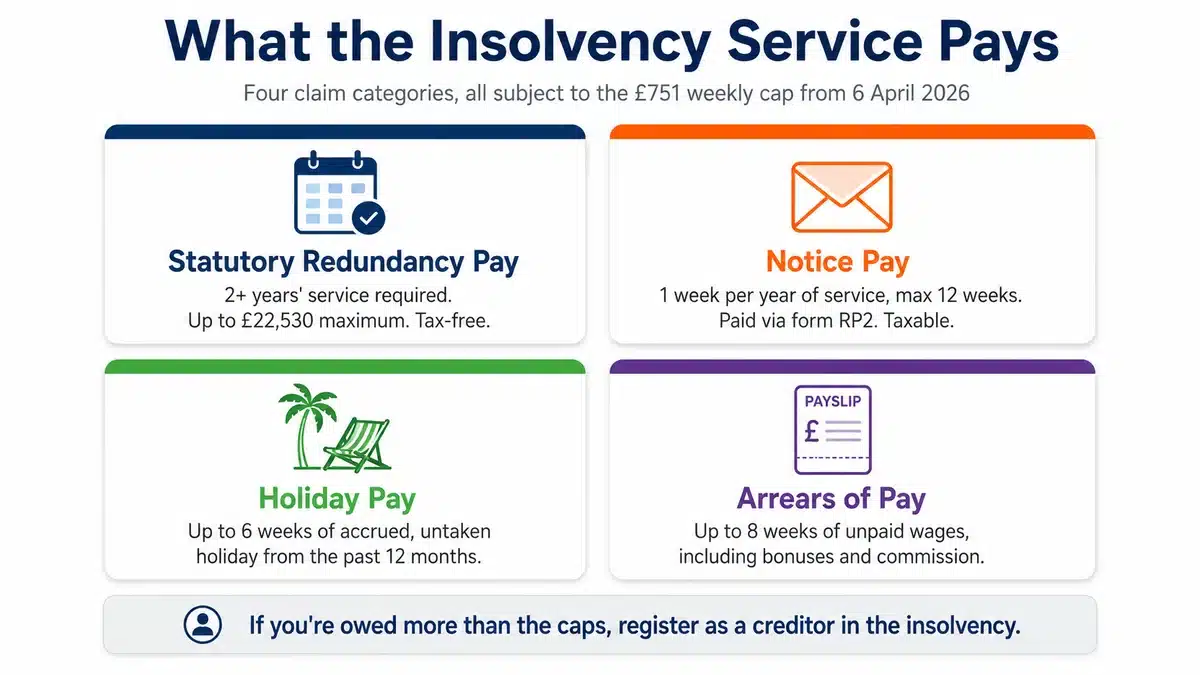
The RPS can pay four main things, each subject to its own cap. All of them use the £751 weekly pay limit that came in on 6 April 2026.
Statutory redundancy pay. If you’ve got two or more years of continuous service, you’re entitled to a redundancy payment. The formula is age-based: half a week’s pay for each full year worked under 22, one week’s pay for each year between 22 and 40, and one and a half weeks’ pay for each year from 41 onwards. Service is capped at 20 years. The maximum payment is £22,530. Statutory redundancy pay is tax-free.
Notice pay. The statutory minimum is one week’s notice for each full year of service, up to a maximum of 12 weeks. If you weren’t given notice, the RPS pays this through form RP2. Notice pay is taxable.
Holiday pay. Up to six weeks of accrued but untaken holiday from the past 12 months.
Arrears of pay. Up to eight weeks of unpaid wages, including unpaid bonuses and commission.
If you’re owed more than the RPS caps, you can register as a creditor in the insolvency for the balance. You may not get all of it back, but it’s worth doing.
The claim most Airsprung workers don’t know they have
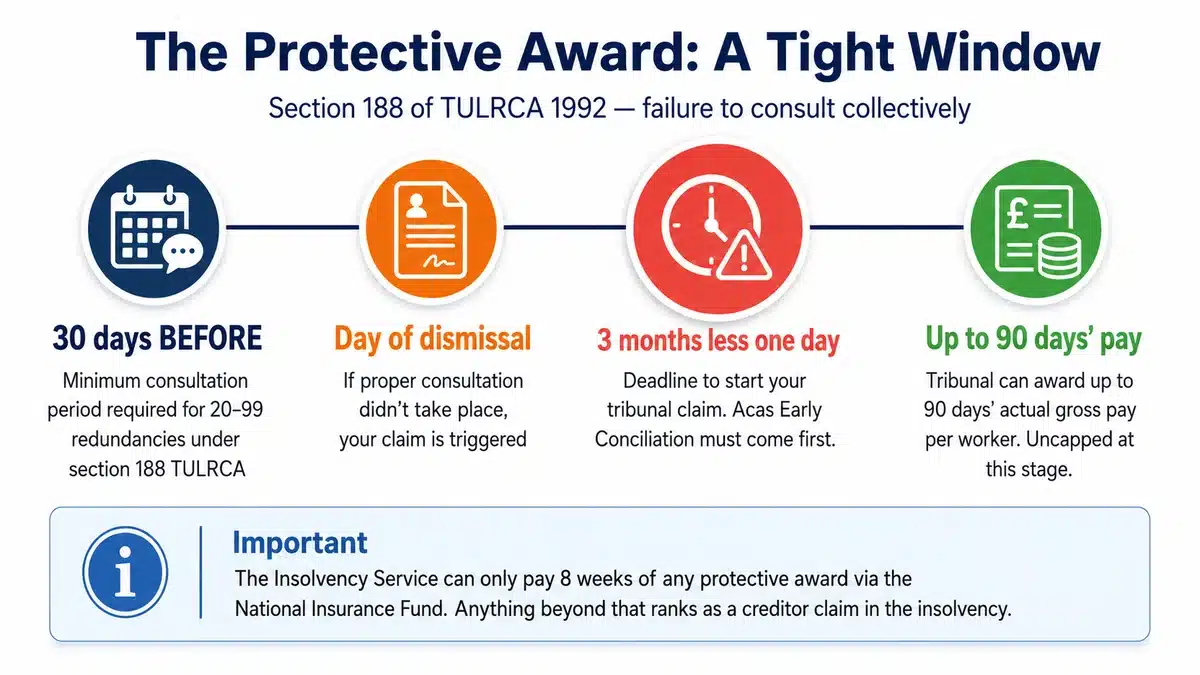
This is the bit that often gets missed. When an employer proposes to dismiss 20 or more people at one establishment within a 90-day period, section 188 of the Trade Union and Labour Relations (Consolidation) Act 1992 kicks in. The employer has to consult collectively with elected employee representatives or a recognised trade union, in good time, before any dismissal takes effect.
For 20 to 99 redundancies, the minimum consultation period is 30 days before the first dismissal. Airsprung’s 71 redundancies sit squarely in that bracket.
If the proper consultation didn’t happen, an employment tribunal can make a protective award of up to 90 days’ actual gross pay per employee. That’s uncapped, so it’s based on what you actually earned, not the £751 weekly limit. For someone earning, say, £600 a week, that’s potentially £7,800 on top of redundancy pay.
Going into administration doesn’t excuse this. Case law is clear that insolvency on its own isn’t a “special circumstances” defence under section 188(7). The duty to consult survives the appointment of administrators, although the administrators themselves don’t normally face personal criminal liability for missing the deadline.
The practical reality: if you were told on 1 May that you were redundant the same day, with no prior 30-day consultation period, no elected representatives, and no proper information pack about the proposed redundancies, there’s a real prospect of a protective award claim.
The catch: you need to bring the claim within three months less one day from the date of dismissal, and you have to go through Acas Early Conciliation first. So if your last day was 1 May 2026, you’ve got until the end of July to start that process. Miss it and the claim is gone.
One thing to flag. The RPS will pay protective awards, but only as if they were arrears of pay, capped at eight weeks at £751 a week. Anything beyond that you claim from the insolvent estate as a creditor. So the tribunal award stands, but you may not see all of it. Even with that caveat, it’s usually well worth pursuing.
Dedicated to Airsprung workers
Find out what you’re owed in three minutes
A short eligibility check tailored to the administration. We’ll tell you what you can claim from the Insolvency Service, whether a protective award applies, and what the deadlines are. No fee for the first conversation.
Or call us on 01373 486574
If you’re one of the 131 still in work
The administrators have said they’re trading on while they look for a buyer. That’s good news in the short term. But a few things to keep an eye on.
If a buyer emerges and takes the business as a going concern, TUPE (the Transfer of Undertakings (Protection of Employment) Regulations 2006) is likely to apply. Your employment, your length of service, and most of your terms transfer across automatically. A new owner can’t lawfully cut your pay or change your contract just because of the transfer.
If the rescue plan involves variations to terms, redundancies, or a relocation, take advice before signing anything. Don’t accept a “new contract” on the assumption that you have to. You probably don’t.
Tom Street’s View
In insolvency redundancies, the protective award is the claim people miss.
Statutory redundancy pay is the bit everyone knows about. The collective consultation duty is the bit that quietly gets dropped when administrators are working at speed. That doesn’t make it lawful, and it doesn’t extinguish the claim. The 90-day pay award is often the most valuable thing on the table, and the time limit is short. If you were told on day one that you were redundant, the chances are something has gone wrong with the process and it’s worth getting a proper look.
What to do this week
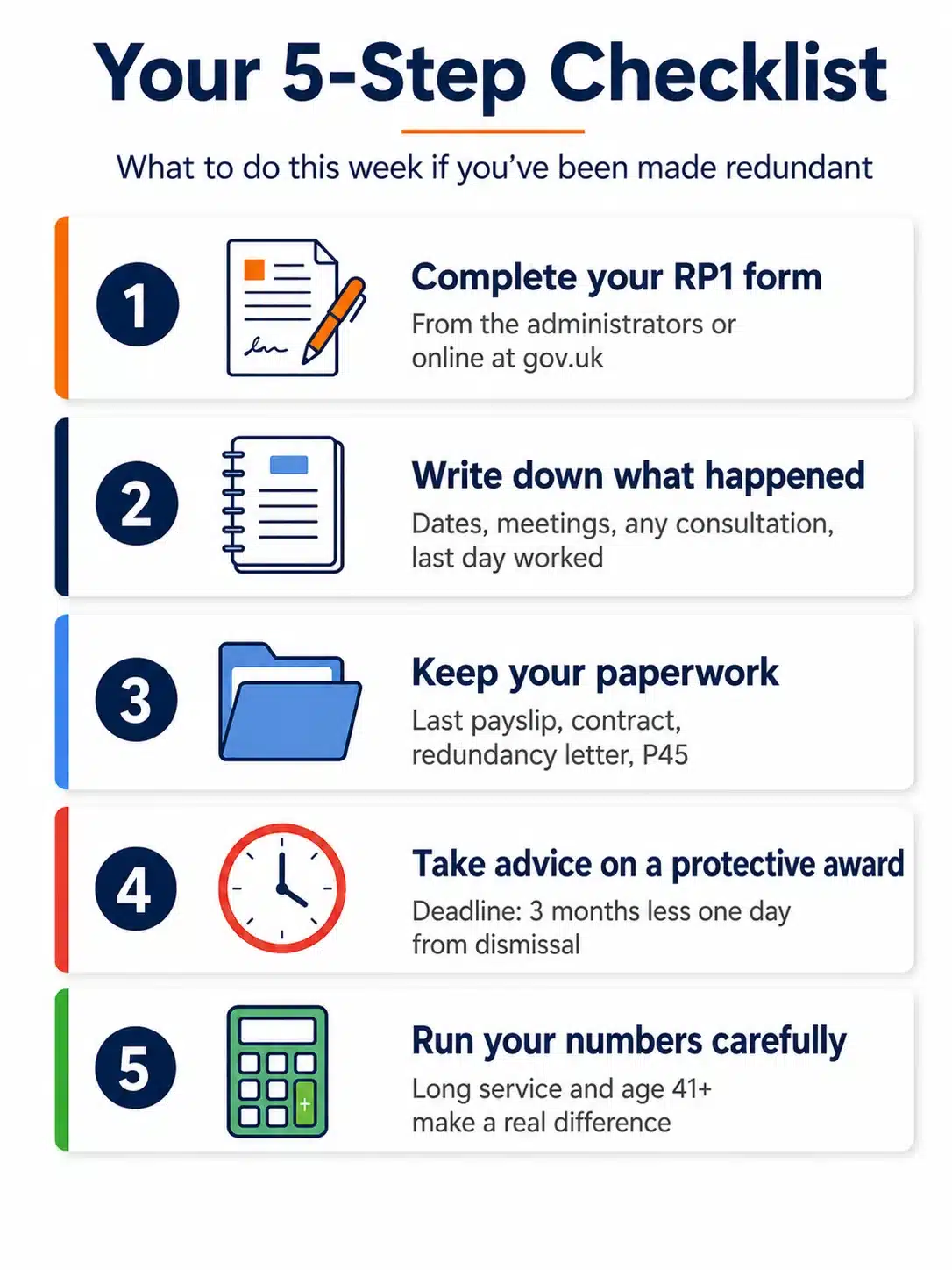
Practical steps for affected Airsprung workers
Complete your RP1 form promptly. The administrators at PwC will provide it with a case reference number. You can also start it online at gov.uk. Don’t wait for them to chase you.
Write down what happened. When were you first told about possible redundancies? Was there any election of employee representatives? Were any meetings held? When was your last day? These facts will determine whether a protective award claim has legs.
Keep your paperwork. Last payslip, contract, redundancy letter, any emails about consultation, P45 when it arrives. Don’t bin anything.
Take advice on the protective award before the end of July. The deadline is three months less one day from your dismissal date, with Acas Early Conciliation required first. After that, the claim is gone.
If you’re 41 or older with long service, run the numbers carefully. The 1.5 weeks per year band makes a real difference. A worker aged 50 with 20 years’ service hits the £22,530 cap. Many Airsprung employees have been there for decades.
Dedicated to Airsprung workers
Find out what you’re owed in three minutes
A short eligibility check tailored to the administration. We’ll tell you what you can claim from the Insolvency Service, whether a protective award applies, and what the deadlines are. No fee for the first conversation.
Or call us on 01373 486574
Sources
- BBC News: Bed company enters administration after 150 years (6 May 2026)
- PwC press release: Airsprung Group PLC and Airsprung Furniture Limited in administration (1 May 2026)
- GOV.UK: Redundancy: your rights – statutory redundancy pay
- GOV.UK: Explaining your redundancy payments (Insolvency Service)
- Trade Union and Labour Relations (Consolidation) Act 1992, section 188
- TULRCA 1992, section 189 – complaint and protective award
- GOV.UK: Redundancy payments – further information and guidance
Related Reading

Tom Street
Principal Solicitor, Tom Street & Co.