2 May 2026 • By Tom Street, Solicitor
Disclaimer: This article contains Tom Street’s personal opinion and commentary on employment policy. It is not legal advice for your specific circumstances. For advice on your individual situation, please contact us directly. Tom Street is a solicitor regulated by the Solicitors Regulation Authority (SRA No. 566718).
Key Facts
- From 6 April 2026, statutory sick pay (SSP) is payable from the first qualifying day of sickness absence. The three-day waiting period is gone.
- The lower earnings limit has been removed, bringing an estimated 1.3 million low-paid workers into the SSP system for the first time.
- SSP is now paid at the lower of £123.25 per week or 80% of average weekly earnings over the previous eight weeks.
- The reforms are part of the Employment Rights Act 2025 and were brought into force by the Employment Rights Act 2025 (Commencement No. 3 and Transitional Provisions) Regulations 2026.
- The new Fair Work Agency launched the day after, on 7 April 2026, and is expected to take on enforcement of SSP, although the timing of active SSP enforcement is still being clarified.
The first major test of the Employment Rights Act 2025 quietly arrived on 6 April. From that date, statutory sick pay (SSP) became payable from the first day of sickness absence. The three-day waiting period that’s been a feature of British employment law since the early 1980s is gone.
The lower earnings limit, which excluded around 1.3 million low-paid workers from SSP altogether, has gone too. And SSP is now calculated as the lower of £123.25 a week or 80% of the worker’s average weekly earnings, which broadens the system to people who used to fall below the threshold entirely.
It’s the most significant reform to sick pay in 40 years. And for a lot of the workers most affected by it, it changes the maths of being ill.
Tom Street’s View
For four decades, getting sick at work meant losing money before you got any help. That’s finally over.
The waiting days were always indefensible. They penalised the people least able to absorb a financial hit, and they pushed sick people into work, which is bad for them, bad for their colleagues, and bad for productivity. This change should have happened a decade ago. The fact that it took the Employment Rights Act 2025 to get it across the line tells you something about how slowly the system moves on issues that affect ordinary workers.
What’s actually changed

Three things, taken together.
The waiting days have gone. SSP is now payable from the first qualifying day of sickness absence. Before 6 April, the first three days were unpaid. For someone on a zero-hours contract or a tight budget, that often meant the difference between staying home with a chest infection and dragging themselves into work and infecting everybody else.
The earnings threshold has gone. Workers no longer need to earn above the previous lower earnings limit (£125 a week in 2025/26) to qualify for SSP. According to the government’s own figures, around 1.3 million extra workers are now covered. Most of them are part-timers, zero-hours staff, and people on irregular contracts, the workers who needed sick pay protection the most.
There’s a new payment formula. SSP is now paid at whichever is lower of two figures: the flat weekly rate of £123.25, or 80% of the worker’s average weekly earnings over the previous eight weeks. For someone earning £400 a week, the maths is simple. They get £123.25, because 80% of £400 is £320, well above the cap. For someone earning £120 a week, they get £96, because 80% of their pay is below the flat rate.
That second figure is the bit that needs attention.
Try the SSP Calculator
Plug in your usual pay and see what your employer should be paying you under the rules in force from 6 April 2026.
Calculate my SSP →The 80% rule deserves more scrutiny
The reform has been sold as expanding sick pay coverage, and it does. But the way the new rate works for the lowest earners means a lot of newly eligible workers will receive less than the headline £123.25 a week.
Take a part-time cleaner earning £140 a week. Under the old system, she got nothing for the first three days off sick, then £118.75 a week. Under the new system, she gets £112 a week (80% of £140) from day one. Better than nothing for the first three days. Worse than the headline figure she’s likely been told about.
If she’s not aware of the 80% rule, she might assume she’s being underpaid. She isn’t. But the law is doing something subtler than the press releases suggest, and there’s a real risk of confusion in the early months. Acas has produced guidance which explains the calculation, but most workers don’t read Acas guidance. Most workers just look at the headline rate, expect to receive it, and don’t. If you want to check what your own figures should look like, our SSP calculator applies the dual-rate rule for you.
Tom Street’s View
Day-one SSP is a real win, but £123.25 a week isn’t survival money, and 80% of poverty wages is still poverty wages.
Let’s not oversell what’s happened. SSP works out to roughly £3.25 an hour for a full-time worker. The National Living Wage from the same date is £12.71 an hour. So even with day-one entitlement, statutory sick pay is about a quarter of what a low-paid worker would normally earn. That isn’t enough to cover bills, food, or rent for any meaningful length of time.
The bit the headlines miss
The 80% rule and the day-one entitlement don’t change the deeper problem, which is that SSP is set at a level that doesn’t cover most people’s outgoings. £123.25 a week is around £535 a month. For most workers, that doesn’t pay the rent, let alone everything else.
That’s why a lot of workers who get seriously ill end up with two bad options. They go back to work too early, which is bad for their health and frequently makes the underlying problem worse. Or they stay off and run up debt, which is bad for everything else in their life. The reform doesn’t fix that. It just removes one of the more obviously cruel features of the old system.
For comparison, statutory sick pay in Germany runs at 100% of normal pay for the first six weeks. In the Netherlands it’s 70% for up to two years. In Sweden it’s 80% for the first 14 days then a state-funded benefit kicks in. We are, as ever, an outlier downwards.
What employers are getting wrong
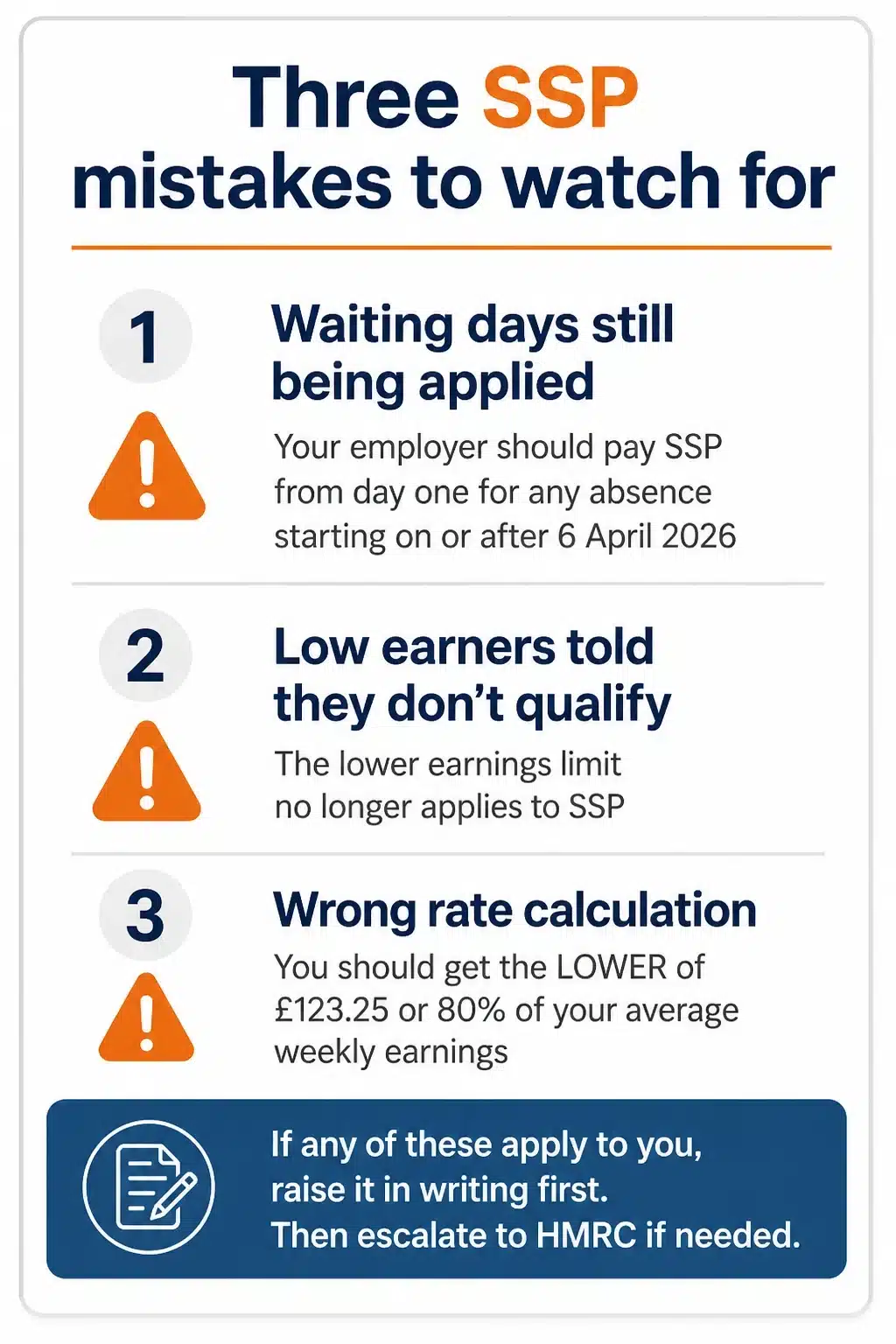
A month in, it’s not uncommon to find employers who haven’t updated their payroll or their policies. The most common issues fall into three buckets.
Waiting days still being applied. If you were off sick after 6 April and your employer didn’t pay you for the first three qualifying days, that’s wrong. They owe you SSP from day one, assuming you meet the other conditions (you’ve started work, you’ve notified them in line with their policy, and you’re sick on a qualifying day).
Low earners being told they don’t qualify. If your employer says you don’t earn enough for SSP, they’re working off the old rules. The lower earnings limit no longer applies to SSP, although it does still apply to other statutory payments like maternity and paternity pay.
Wrong rate calculations. Some payroll systems are still defaulting to the flat rate of £123.25 for everyone, including those who should be getting the 80% figure. Others are doing the opposite, paying 80% to people who should be getting the flat rate. Both are wrong, and both can usually be fixed once you point it out.
There’s a fourth issue worth flagging, although it’s less about SSP and more about what comes next. If you’re off sick for any length of time, expect your employer to start managing you. Sometimes that’s appropriate. Sometimes it’s a backdoor route to dismissal. The day-one SSP rules don’t change the underlying law on capability dismissals or disability discrimination, and they don’t stop employers from using sickness absence as a pretext to push people out.
What to Do If Your SSP Looks Wrong
Check the calculation yourself. Work out 80% of your average weekly earnings over the eight weeks before you went off sick. Compare that to £123.25. The lower figure is what you should be getting per week, divided across your normal qualifying working days. Our SSP calculator will do the maths for you.
Raise it in writing first. Email your line manager or HR. Refer to the SSP changes from 6 April 2026 and ask them to recalculate. Most genuine errors get fixed at this stage, and a written request creates a paper trail if it doesn’t.
Escalate to HMRC if needed. If your employer refuses to put it right, contact HMRC’s statutory payment dispute team. They can issue a binding decision and recover what you’re owed.
Report to the Fair Work Agency or HMRC. The Fair Work Agency launched on 7 April 2026 with a remit that will eventually include SSP enforcement, although the exact start date for active SSP enforcement is still being clarified. HMRC retains responsibility for now. Reporting to both ensures whichever body is currently leading on SSP enforcement can pick up the case.
Get advice if you’re being managed out. SSP disputes don’t usually exist in isolation. If a period of sickness is being used against you, the SSP is rarely the most important issue. Speak to a solicitor early.
Where this leaves us
Day-one SSP is the right thing to do. Removing the lower earnings limit is overdue. The idea that 1.3 million workers had no right to sick pay because they earned slightly too little was always wrong. On both counts, the Employment Rights Act 2025 has done something useful.
But there’s a bigger argument we should be having now, which is whether SSP should be set at a meaningful percentage of normal pay, the way it is across most of Europe. £123.25 a week is, in 2026, a token gesture toward the cost of being ill. Until the rate moves, all the day-one entitlement does is bring forward the point at which workers run out of money.
This isn’t a fringe position. In its recent Ending the Pay Crisis report, the TUC called for SSP to be paid from day one (now done) and for the rate to be raised to the level of the real Living Wage (still pending). The Resolution Foundation’s Low Pay Britain 2024 analysis found that a UK worker on average pay who’s off sick for four weeks gets back roughly 11% of their previous earnings, compared to about 68% across the OECD. Its Low Pay Britain 2025 report goes further: of the OECD countries that operate a statutory sick pay system, the UK provides the lowest level of legal income protection. Only the United States and South Korea, neither of which has a statutory system at all, sit outside that ranking.
And the gap between the legal floor and what it actually costs to live is getting harder to ignore. The Living Wage Foundation calculates that a full-time worker on the new £12.71 National Living Wage will earn £1,443 a year less than they would on the real Living Wage of £13.45 (£4,076 less in London). SSP, of course, sits well below even the lower of those two figures. The day-one entitlement is welcome. The rate is still where the argument needs to go next.
That argument isn’t going to win this year. So in the meantime, the practical advice is the boring kind. Check your contract: if your employer offers contractual sick pay above the statutory minimum, use it. If they don’t, consider income protection insurance if you can afford it. And if you think your SSP has been calculated wrongly, run your figures through our SSP calculator and push back. The law is on your side, and getting your numbers right is the first step toward not being walked over.
One last point. SSP disputes don’t usually exist in isolation. If an employer is mishandling sick pay, there’s often something else going on too: pressure to come back early, capability procedures used as a backdoor to dismissal, failure to make reasonable adjustments for disabled workers, or in the worst cases, dismissal for the sickness itself. If you’re being treated badly because of a period of sickness absence, get advice early. The window to do something about it can close quickly, and the value of a successful claim can be substantial: the unfair dismissal compensatory award cap rose to £123,543 from 6 April 2026, and disability discrimination claims aren’t capped at all.
Sick pay problem turning into something bigger?
If your employer is mishandling SSP, putting you on a capability process, or pushing you out because of sickness absence, get advice before things escalate. Tom Street offers free initial advice on dismissal, discrimination, and disability claims.
Related Reading
- SSP Calculator – Work out your statutory sick pay rate under the rules in force from 6 April 2026.
- Disability Discrimination at Work – Your rights when sickness, injury or a long-term condition affects your job.
- Capability Dismissal: When Is It Unfair? – What your employer must do before dismissing you for ill health, and what makes a capability dismissal unfair.
- Unfair Dismissal Claims – When dismissal for sickness absence crosses the line, and what to do about it.
- The Employment Tribunal Process – A plain-English guide to bringing a claim against your employer.
Sources
- GOV.UK: Statutory Sick Pay (SSP), What you’ll get
- GOV.UK: Work out your employee’s Statutory Sick Pay manually
- Acas: Statutory sick pay
- Low Incomes Tax Reform Group: Statutory sick pay
- TUC: Ending the Pay Crisis (report calling for day-one SSP and rate set at real Living Wage)
- TUC press release: Millions of low-paid women set to benefit (8 March 2026)
- Resolution Foundation: Low Pay Britain 2025
- Resolution Foundation: Low Pay Britain 2024 press release (11% vs 68% OECD figure)
- Living Wage Foundation: National Living Wage rise welcomed (April 2026)
- Brabners: Statutory Sick Pay Reforms, What’s Changing
- Howes Percival: Government confirms SSP changes for 6 April 2026

About Tom Street
Tom Street is the Principal Solicitor at Tom Street & Co. Solicitors. He represents employees nationally in disputes involving sickness absence, disability discrimination, and capability dismissals, including cases where statutory sick pay or contractual sick pay has been mishandled. Based in Frome, Somerset.
SRA Number: 566718 | LinkedIn →