
5 June 2026 • By Tom Street, Solicitor
Disclaimer: This article contains Tom Street’s personal opinion and commentary on a reported employment tribunal decision. It is not legal advice for your specific circumstances. For advice on your individual situation, please contact us directly. Tom Street is a solicitor regulated by the Solicitors Regulation Authority (SRA No. 566718).
Key Facts
- Beth Littlewood, a former canoe polo champion and personal trainer at Nuffield Health’s Bridgend gym, won around £149,000 at the Cardiff Employment Tribunal
- In June 2022 she raised a health and safety concern, that a colleague had passed an MoD recruit on a fitness test despite a dangerously high blood pressure reading. The tribunal found this was a protected disclosure
- What followed was treated as whistleblowing detriment: payments stopped, rota changed without notice, her medal photo removed from reception, wages withheld, and a nine-hour investigation without breaks
- The “last straw” was being ordered, while competing in Germany, to attend an in-person meeting. She drove 800 miles overnight, only to find the manager who summoned her hadn’t turned up
- The tribunal found her constructive dismissal was automatically unfair because the protected disclosure was the principal reason. The award included roughly £37,000 for injury to feelings
The headline is irresistible. An international athlete, mid-competition in Germany, told to be at a meeting in South Wales within days. She drives through the night, 800 miles, terrified of breaching a final written warning. She arrives, exhausted, only to be told the manager who summoned her isn’t there. He’s away on training.
The judge called that “contemptuous”. She was right to. But the 800-mile drive isn’t really what this case is about. It’s about what happens to people who speak up.
Because Beth Littlewood v Nuffield Health (Case No. 1600573/2023) is, at its heart, a whistleblowing case. And the legal mechanism that got her to nearly £149,000, automatically unfair dismissal, is one of the most powerful protections an employee has. Most people have never heard of it.
What Actually Happened
Beth Littlewood started at Nuffield Health in 2015. In June 2022, she spotted something that worried her: a fitness manager had passed a recruit on a Ministry of Defence physical fitness test despite a blood pressure reading high enough that, in her view, the person should not have been allowed to take it.
On 21 June 2022 she emailed the manager responsible for the MoD testing to raise the concern. The tribunal found she “had a reasonable belief that the health and safety of that individual had been endangered by permitting the person to do a fitness test”. That made it a qualifying protected disclosure, what most people would call whistleblowing.
That should have been the end of it. Instead, it was the beginning of the problem.
What Whistleblowing Retaliation Looks Like
The tribunal found Littlewood was subjected to a series of detriments after raising her concern. Reported examples include additional payments for extra fitness classes being stopped, her rota being changed without notice, her medal photo being removed from the reception display, wages being withheld, and an unannounced disciplinary investigation lasting around nine hours without proper breaks.
Alongside this came disciplinary allegations and a final written warning. The judge was unimpressed with how the company handled the underlying issues, finding the incidents “were in the main caused by poor communication and of a trivial nature”, and that “a reasonable employer would have dealt with [them] as management issues. They should never have been escalated to the degree they were. Common sense was wholly departed from.”
This is what retaliation usually looks like in real life. Rarely a single dramatic act. More often a slow accumulation of small punishments that, added together, make someone’s position impossible.
The Meeting That Said Everything
The “last straw” came in September 2023. Littlewood was in Brandenburg for the European Canoe Polo Championships. She’d submitted an annual leave request back on 7 June and had been open with managers about her plans. She chased the unapproved leave on 8 August. The reply came on 7 September, while she was already in Germany: no approved leave, no valid sick note, and an instruction to attend a meeting in person on 12 September.
Conscious she was on a final written warning, she drove back through the night to make it. When she arrived in Bridgend after 800 miles, her manager wasn’t there.
Judge Samantha Moore did not hold back: “If there was one act by the respondent that demonstrated the contemptuous manner of the treatment of the claimant, this was it. To refuse leave requested months earlier, knowing what competing meant to the claimant, and require her to attend a meeting, then not bother to turn up was contemptuous and wholly unreasonable.”
Tom Street’s View
Punishing someone for raising a safety concern is exactly the behaviour the law is built to stop.
She flagged a genuine health and safety risk. The response, on the tribunal’s findings, was to make her working life worse until she had no choice but to leave. That’s the precise harm whistleblowing law exists to prevent. The “contemptuous” no-show meeting grabs the headlines, but the part that should worry every employer is simpler: if you retaliate against someone for speaking up, you can end up writing a very large cheque.
Why “Automatically Unfair” Is the Bit That Matters
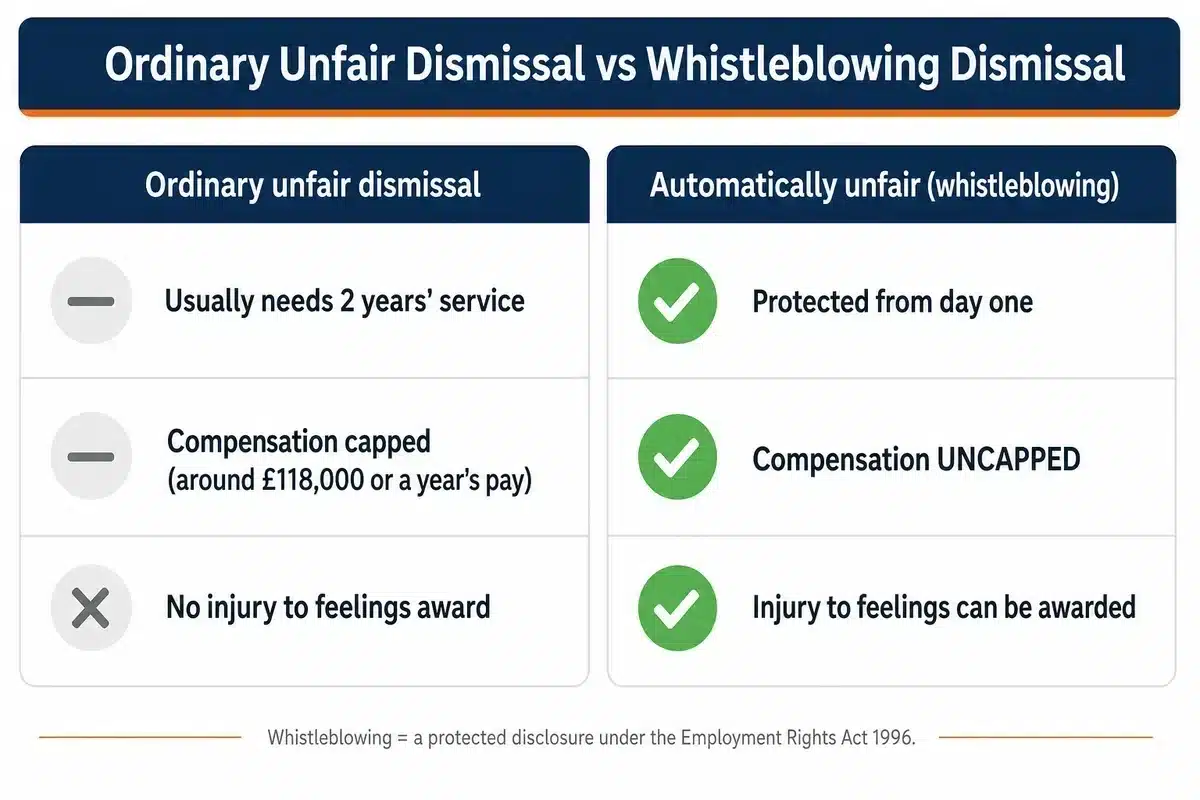
Most people think they need two years’ service to claim unfair dismissal, and that compensation is capped. Usually, that’s true. The current cap on the compensatory award is £123,543, or a year’s gross pay if lower.
Whistleblowing is different. If the reason, or principal reason, for a dismissal is that the worker made a protected disclosure, the dismissal is automatically unfair under the Employment Rights Act 1996. Two things change as a result. First, there’s no qualifying period: you’re protected from day one. Second, and this is the big one, compensation is uncapped.
Littlewood’s award reflected that. Reported components include around £62,000 for loss of earnings and roughly £37,000 for injury to feelings, a head of compensation you don’t get in an ordinary unfair dismissal claim but can get in whistleblowing detriment cases. The award also included unpaid holiday and sick pay, and an element to account for the tax she’ll pay, so the sum lands at the level the tribunal intended.
For its part, Nuffield Health said it was “committed to providing a fair and supportive working environment for all colleagues” and that, while it respects the tribunal process, it is “disappointed with the decision” and considers the matter subject to appeal. The findings described here are those of the tribunal at this stage.
And While You’re Here: Check Your Holiday Pay
One smaller part of the award is worth flagging on its own, because it’s so common. The tribunal found Littlewood’s holiday pay “was not calculated on a true average of gross pay or in accordance with government guidelines”. In plain English, she’d been underpaid for her holidays.
Personal trainers rarely earn a flat salary. A chunk of income comes from sessions, classes and commission. The law says holiday pay must reflect your “normal remuneration”, not just basic pay, and the leading case on commission, British Gas Trading Ltd v Lock, settled that years ago. For variable pay, the employer should use a 52-week average, looking back over the weeks you were actually paid. The government’s guidance on calculating holiday pay for workers without fixed hours or pay and Acas both spell this out.
Underpaid holiday pay is usually an unlawful deduction from wages, claimable within three months minus one day of the last underpayment. If you earn commission or variable pay, it’s worth a look.
Tom Street’s View
She had no lawyer. Just meticulous records. That’s the whole game.
Littlewood represented herself against a large employer with a full legal team, and said she had “no legal training. I just had my meticulous records that I’d been keeping.” Tribunals run on evidence. The person who kept the dated emails, the leave requests and the payslips is usually the person who wins. If you ever think something at work isn’t right, start writing it down now, not later.
If You Need to Raise a Concern at Work
Put it in writing. A dated email setting out your concern, and why you think it matters, is both the responsible thing to do and your best evidence if you’re later treated badly for it.
Frame it as a genuine concern, not a personal grievance. Whistleblowing protection applies to disclosures you reasonably believe are in the public interest, such as a health and safety risk or a legal breach.
Keep your own records. Save emails, payslips, rotas and notes somewhere you’ll still have access to them if you leave.
Watch for retaliation, and act early. If your treatment changes after you speak up, get advice quickly. Tribunal time limits are short, usually three months minus one day.
Treated badly after speaking up at work?
We act for employees, never employers. If you’ve raised a concern and your employer has made your life difficult since, we can tell you quickly whether you have a whistleblowing claim worth pursuing.
Related Reading
- Whistleblowing claims – what counts as a protected disclosure and how the law protects you
- Unfair dismissal claims – including automatically unfair dismissal and the day-one rights
- Unlawful deduction of wages – how to claim back underpaid holiday pay and wages
- The employment tribunal process – what to expect, including if you represent yourself
Sources
- BBC Wales: Athlete forced to travel 800 miles for meeting that boss didn’t show up for wins £149,000
- Employment Tribunal: Littlewood v Nuffield Health (1600573/2023) written reasons
- People Management: Nuffield Health trainer awarded £150k after raising safety concerns
- GOV.UK: Calculating holiday pay for workers without fixed hours or pay
- Employment Rights Act 1996

About Tom Street
Tom Street is a solicitor who acts exclusively for employees in disputes with their employers. He has particular experience in whistleblowing and automatically unfair dismissal claims, the day-one, uncapped protections at the heart of the Littlewood case, as well as unlawful deductions and holiday pay disputes. He believes too many workers are punished for doing the right thing and never realise the law is on their side.
SRA Number: 566718 | LinkedIn →