
8 March 2026 • By Tom Street, Solicitor
Key Facts
- The biggest single batch of Employment Rights Act 2025 changes takes effect on 6 April 2026
- Statutory sick pay becomes a day-one right with no earnings threshold and no waiting days
- Paternity leave and unpaid parental leave become day-one rights
- The protective award for failing to consult on collective redundancies doubles from 90 to 180 days’ pay
- Sexual harassment reporting becomes a qualifying whistleblowing disclosure
- The Fair Work Agency launches on 7 April 2026 as the new enforcement body for employment rights
- National Living Wage rises to £12.71 per hour from 1 April 2026
6 April 2026 is now less than a month away, and with it comes the biggest set of employment law changes in a generation. The Employment Rights Act 2025 (ERA 2025) received Royal Assent on 18 December 2025, and the government is now rolling out its reforms in phases across 2026 and 2027.
If you’re an employee, some of these changes will affect you immediately. Others won’t kick in until later in the year or early 2027. But all of them are worth knowing about now, because they change the balance of power between employers and workers in ways that haven’t been seen since the last Labour government’s employment reforms in the late 1990s.
Here’s what’s actually changing, and when.
Statutory Sick Pay: No More Waiting Days, No More Earnings Threshold
From 6 April 2026, statutory sick pay (SSP) will be payable from the first day of sickness absence. Currently, you have to wait until day four before you qualify. That three-day gap has always hit the lowest-paid workers hardest, and it’s finally being scrapped.
At the same time, the lower earnings limit is being removed. Right now, you need to earn at least £125 a week to qualify for SSP. From April, that threshold disappears entirely. If you earn below the current limit, you’ll receive SSP at a rate of 80% of your normal weekly earnings, or the flat SSP rate of £123.25 per week, whichever is lower.
The flat rate itself rises from £118.75 to £123.25 per week.
Day-One Rights for Paternity Leave and Unpaid Parental Leave

Two types of family leave become day-one entitlements from 6 April 2026. You’ll no longer need 26 weeks’ continuous employment to qualify for paternity leave, and you won’t need a year’s service for unpaid parental leave.
One important distinction: while the right to take paternity leave becomes a day-one right, the qualifying period for Statutory Paternity Pay (SPP) remains unchanged at 26 weeks’ continuous employment. So if you start a new job and your partner is expecting, you can take the time off from day one, but you won’t be entitled to statutory pay for it unless you’ve been in the job for at least 26 weeks by the qualifying week. Check whether your employer offers enhanced paternity pay that might cover the gap.
Newly eligible employees have been able to give notice of their intention to take leave since 18 February 2026, with the notice period for paternity leave temporarily reduced from 15 weeks to 28 days.
A new right to bereaved partner’s paternity leave is also being introduced. If the mother or primary adopter dies within one year of the birth or placement, eligible fathers and partners can take up to 52 weeks of unpaid paternity leave.
Statutory Pay Rate Increases
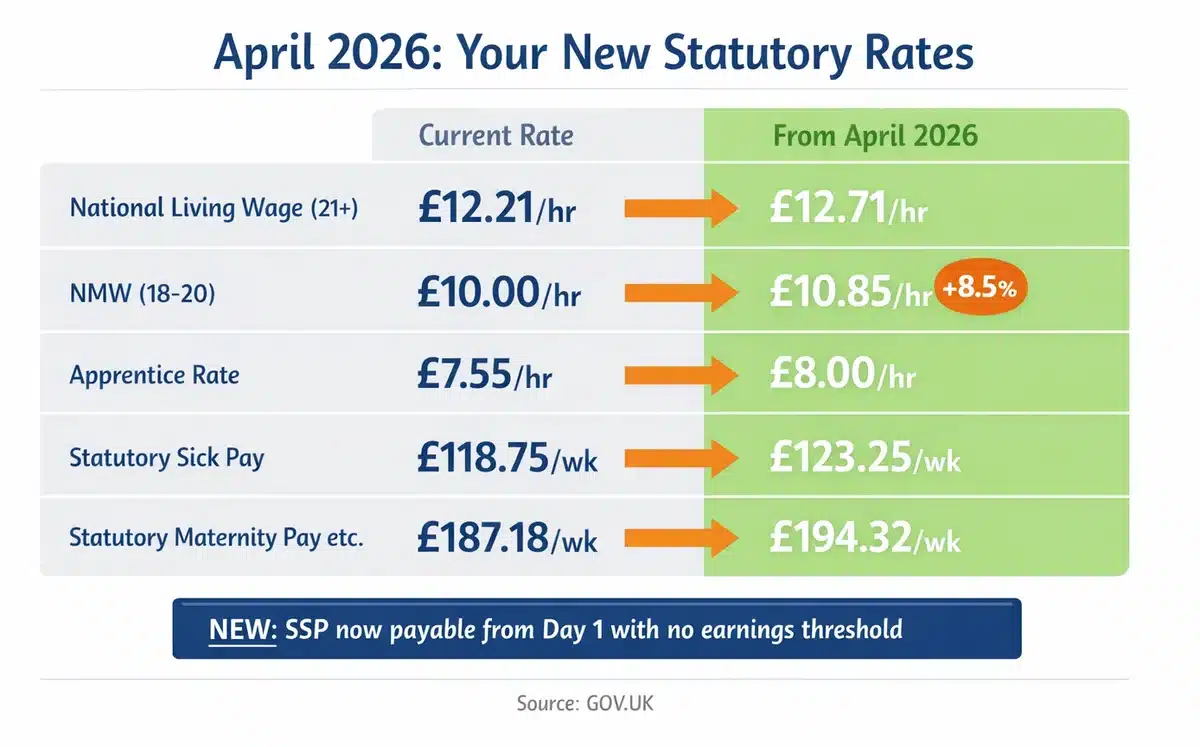
Alongside the structural changes, the usual annual rate increases take effect from April:
Statutory maternity pay, paternity pay, adoption pay, shared parental pay, parental bereavement pay, and neonatal care leave pay all rise from £187.18 to £194.32 per week.
The National Living Wage (for workers aged 21 and over) increases from £12.21 to £12.71 per hour, a 4.1% rise. The rate for 18 to 20 year olds jumps 8.5% to £10.85, and the apprentice rate rises to £8.00.
The statutory cap on a week’s pay (used for calculating basic awards and statutory redundancy pay) and the Vento bands for injury to feelings awards are both expected to be updated in March 2026, with new figures taking effect on 6 April.
Sexual Harassment Becomes a Whistleblowing Disclosure
From 6 April 2026, disclosing sexual harassment at work will be explicitly listed as a qualifying disclosure under whistleblowing law. That means employees who report sexual harassment will have protection from detriment and unfair dismissal as whistleblowers, provided they reasonably believe the disclosure is in the public interest.
Sexual harassment complaints could already qualify for whistleblowing protection in some circumstances, but the change removes any ambiguity. It’s a significant shift, particularly for employees who’ve been worried about retaliation after reporting harassment.
Collective Redundancy: The Protective Award Doubles
The maximum penalty for employers who fail to properly consult on collective redundancies doubles from 90 days’ gross pay to 180 days’ gross pay per affected employee. For an employer making 50 people redundant without following the rules, that’s a massive potential liability.
The collective redundancy consultation threshold itself (currently 20 or more redundancies at one establishment within 90 days) stays the same for now. But a new, additional threshold is coming in 2027, which will be based on total redundancies across an entire organisation rather than at individual sites. That change will pull far more redundancy exercises into the collective consultation net.
Trade Union Recognition Gets Simpler
The trade union recognition process is being simplified from 6 April 2026. Most of the Trade Union Act 2016 was already repealed on 18 February 2026, and the April changes continue that process. An updated Code of Practice on trade union recognition is expected in October 2026.
Dismissal for taking part in industrial action has already been confirmed as automatically unfair since 18 February 2026, with no time limit on protection (previously, there was a 12-week limit). The April changes to trade union recognition build on that earlier reform.
The Fair Work Agency Launches
On 7 April 2026, the government’s new Fair Work Agency (FWA) starts operating. The FWA brings together existing enforcement functions into a single body. It will enforce National Minimum Wage compliance, holiday pay, and statutory sick pay. It will also have the power to take enforcement action on behalf of individual employees and bring employment tribunal claims for them.
If you’ve been underpaid or had your holiday pay miscalculated, the FWA is intended to be a single place you can go to for help, rather than navigating multiple enforcement bodies.
Gender Equality and Menopause Action Plans (Voluntary)
Large employers can begin publishing action plans on gender equality and supporting employees through the menopause from 6 April 2026 on a voluntary basis. These become mandatory from some point in 2027. Government guidance was published on 4 March 2026.
What’s Coming Later in 2026

April is just the first wave. More significant changes are scheduled for October 2026 and beyond:
October 2026 brings the extended duty on employers to take “all reasonable steps” to prevent sexual harassment (up from “reasonable steps”), third-party harassment liability, tribunal time limits doubling from three months to six months, a new duty for employers to inform workers of their right to join a trade union, tipping consultation requirements, and updated trade union access rules.
January 2027 is when the headline change arrives: the unfair dismissal qualifying period drops from two years to six months, and the compensatory award cap is removed entirely. Fire and rehire protections also take effect in January 2027, along with zero-hours contract reforms and guaranteed hours rights.
The Consultations You Should Know About
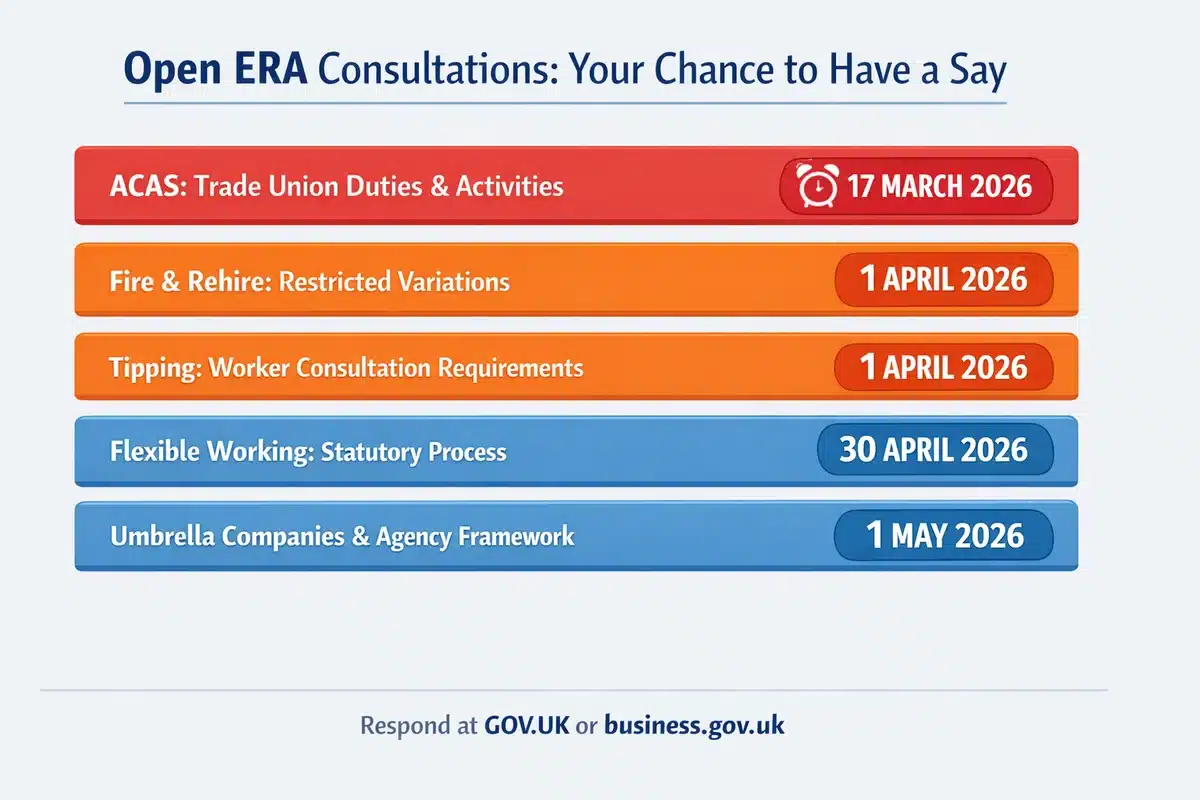
The government is running several consultations right now that will shape how these changes work in practice. If you’re affected, or if you’re a trade union representative, your response matters.
The ACAS consultation on trade union duties and activities closes on 17 March 2026. That’s just nine days away. The flexible working consultation (on the new statutory process employers must follow before refusing a request) closes on 30 April 2026. Fire and rehire and tipping consultations close on 1 April 2026. The umbrella companies and agency framework consultation closes on 1 May 2026.
What You Should Do Right Now
Check your sick pay arrangements. If your employer currently applies waiting days or excludes you from SSP because of your earnings, that changes on 6 April. Make sure your employer knows about the new rules.
Know your new family leave rights. If you’ve been in your job for less than 26 weeks and your partner is expecting, you’ll be eligible for paternity leave from day one. But the qualifying period for Statutory Paternity Pay stays at 26 weeks, so you may need to take unpaid leave unless your employer offers enhanced pay.
Understand the October changes. The tribunal time limit doubling from three to six months is a big deal. If something goes wrong at work later this year, you’ll have longer to decide whether to bring a claim. But don’t rely on that until the change actually takes effect.
Start preparing for January 2027. The six-month unfair dismissal qualifying period and removal of the compensation cap are transformational. If you’re in a new job and worried about being pushed out during a probationary period, these changes will give you significantly more protection from the start of next year.
The Employment Rights Act 2025 is the most significant piece of employment legislation since the Employment Relations Act 1999. Not every change will affect every worker, and some of the detail is still being worked out through consultations. But the direction is clear: stronger rights for employees, tougher consequences for employers who don’t follow the rules, and a new enforcement body with real teeth.
If you’re facing a workplace issue right now, don’t assume you need to wait for the new laws. Many of the protections you need already exist. The key is knowing what they are and acting before time runs out.
Worried About Your Employment Rights?
Whether it’s unfair dismissal, discrimination, redundancy, or whistleblowing, we can help you understand your rights and your options. Free initial advice, no obligation.
Related Reading
Unfair Dismissal: Your Complete Guide
Whistleblowing at Work: What You Need to Know
Sources
- GOV.UK: Plan to Make Work Pay and Employment Rights Act: Timeline Update
- ACAS: Employment Rights Act 2025
- Lewis Silkin: What’s in the Employment Rights Act?
- Pinsent Masons: Employment Rights Act Implementation for UK Employers
- Littler: Revised Implementation Timeline and New Consultations
- GOV.UK: New Employment Rights Guidance for Businesses and Workers

Tom Street
Principal Solicitor, Tom Street & Co.