
Quick Summary
Capability dismissal is one of five potentially fair reasons an employer can use to end your employment, covering both poor performance and ill health. For a capability dismissal to be fair, your employer must not only have a genuine capability concern, they must also follow a fair procedure, including warnings, support, targets, and a proper opportunity for you to improve or recover. Many capability dismissals are found to be unfair because the procedure was inadequate, not because the underlying concern was unjustified. If you have been dismissed for capability, you have three months less one day from your dismissal date to start the process of making a tribunal claim.
⚖️ This guide is for general information only and is not legal advice. Every case is different – if you’re unsure, speak to a solicitor.
Key Points
- ✓ Capability dismissal covers poor performance, ill health, and lack of qualifications, but it is a distinct fair reason from conduct, redundancy, or SOSR
- ✓ Your employer must follow a fair procedure: warnings, support, targets, and a genuine opportunity to improve or recover
- ✓ Dismissing without proper procedure can make the dismissal unfair even if the performance concern was genuine
- ✓ If your ill health amounts to a disability, your employer must also make reasonable adjustments before dismissing you
- ✓ Compensation for unfair dismissal is capped at £123,543 (from 6 April 2026), but disability discrimination awards are uncapped
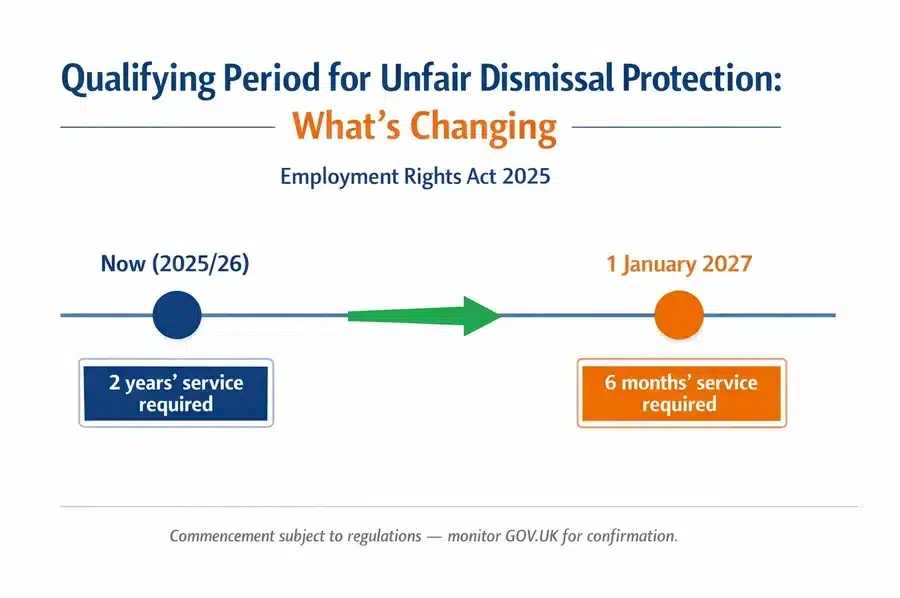
- ✓ You currently need two years’ continuous service to claim unfair dismissal, but this reduces to six months from 1 January 2027
⚖️ Legislation Update
Qualifying Period Reduces to Six Months from January 2027
The Employment Rights Act 2025 will reduce the qualifying period for unfair dismissal from two years to six months. This change takes effect from 1 January 2027, meaning significantly more employees will gain protection against unfair capability dismissals. If you were dismissed recently and have been employed for less than two years, this change does not apply retrospectively, but it may affect your options if you are dismissed after the commencement date.
Dismissed for Capability: When Is It Unfair?
Capability dismissal is one of the most misunderstood areas of unfair dismissal law. Many employees assume that if their employer has evidence of poor performance or repeated absences, the dismissal must be fair. That is not how employment law works.
Having a legitimate capability concern gives your employer a potentially fair reason to dismiss you. But potential fairness is only the first hurdle. Tribunals then look at whether your employer acted reasonably, followed the right procedure, and gave you a genuine opportunity to improve or recover. Many capability dismissals fail that second test entirely.
This guide sets out exactly what capability dismissal means, what your employer must do to make it fair, and what your options are if they got it wrong.
What Is Capability Dismissal?

Under section 98(2)(a) of the Employment Rights Act 1996 (ERA 1996), a dismissal is potentially fair if the reason relates to the capability or qualifications of the employee for performing work of the kind they were employed to do.
Section 98(3)(a) defines capability broadly: it means the employee’s capability “assessed by reference to skill, aptitude, health or any other physical or mental quality.” In practice, capability dismissals fall into two main categories, each with its own procedural requirements.
Performance and incompetence
This is where your employer says you are not performing your job to the required standard. Examples include: repeatedly missing targets or deadlines, an inability to adapt to new systems or technology, persistent errors, or an inability to work effectively with colleagues or clients.
The critical distinction here is between capability and conduct. If you cannot do the job, it is a capability issue. If you will not do the job, it is misconduct. The Court of Appeal drew this line clearly in Abernethy v Mott Hay & Anderson [1974] ICR 323. Getting this distinction wrong, and disciplining someone for capability issues under a conduct procedure, is itself a procedural error that can undermine the fairness of a dismissal.
Ill health and sickness absence
This applies where illness or injury prevents you from doing your job. It covers two distinct situations:
Long-term absence: A single extended period of sickness. Your employer must obtain proper medical evidence, consult with you, and consider whether adjustments would allow you to return, before reaching any decision to dismiss.
Intermittent or recurring absence: A pattern of short but frequent sickness absences. In International Sports Co Ltd v Thomson [1980] IRLR 340, the EAT confirmed that an employer does not need to show that an employee will never recover where the cumulative effect of absences makes it unreasonable to continue the employment. However, the employer still needs to consult with the employee and consider the position properly.
Qualifications
A dismissal can also fall under capability where an employee loses or fails to obtain a professional qualification that is essential to their role. This is relatively rare and often overlaps with the statutory illegality ground under section 98(2)(d) ERA 1996 (where continuing to employ the person would breach a legal requirement). An example would be a driver losing their licence or a solicitor losing their practising certificate.
💡 Want to estimate what a claim might be worth?
Use our free unfair dismissal compensation calculator with current 2025/26 figures
Calculate Your Claim →The Legal Test: What Must Your Employer Show?
Section 98 ERA 1996 sets out a structured two-stage test that every tribunal applies when a dismissal is challenged.
Stage one: establishing a potentially fair reason. The employer must show that the real reason for dismissal was capability. If the employer cannot demonstrate this, or if the tribunal concludes the stated reason was a pretext for something else (such as discrimination or a desire to remove a troublesome employee), the dismissal will be unfair at this first stage.
Stage two: the reasonableness test. Even where the employer establishes a genuine capability reason, section 98(4) requires the tribunal to consider whether the employer acted reasonably in treating it as sufficient reason to dismiss, having regard to all the circumstances, including the size and administrative resources of the employer.
This is assessed by reference to the “band of reasonable responses” established in British Leyland (UK) Ltd v Swift [1981] IRLR 91. The question is not whether the tribunal would have dismissed in the same circumstances, but whether the dismissal fell within the range of reasonable responses open to a reasonable employer. That said, this test has limits: a dismissal that bypasses all procedural safeguards will fall outside any reasonable band.
Tribunals must also take into account the Acas Code of Practice on Disciplinary and Grievance Procedures when deciding whether an employer acted reasonably. Unreasonable failure by the employer to follow the Code can result in a compensation uplift of up to 25%.
The Procedure Your Employer Must Follow
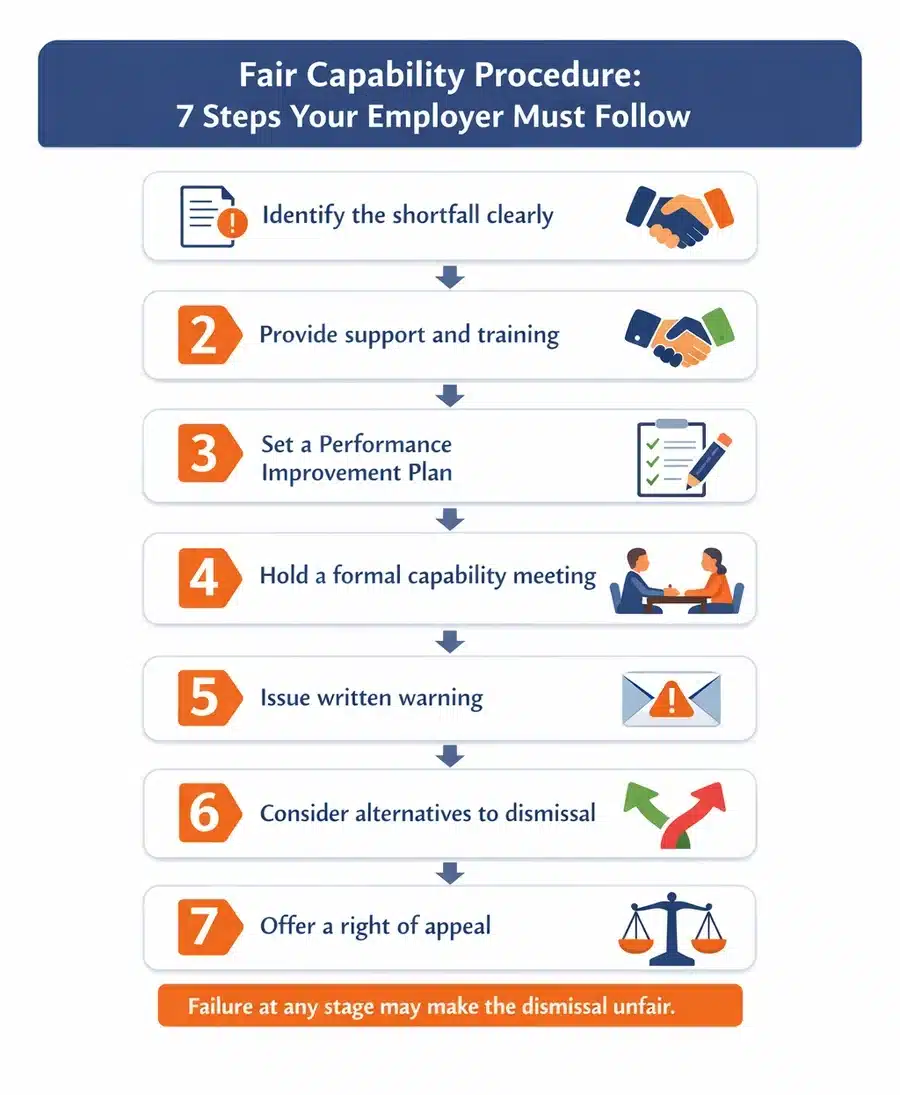
Capability and conduct share the same Acas Code framework, but capability cases require different practical steps depending on whether the issue is performance or ill health.
For performance capability
Dismissal for poor performance must be a last resort. Your employer is expected to follow these steps before reaching a decision to dismiss:
Identify the shortfall clearly. Your employer must set out, in writing, what the required standard is and how your performance falls short. Vague or shifting goalposts will undermine any subsequent dismissal.
Provide adequate support. The Acas guidance is explicit: an employer must provide “adequate resources” for you to do your job. That means appropriate training, mentoring, coaching, or adjustment to your workload or tools. A failure to offer any support is a significant procedural gap.
Set a Performance Improvement Plan (PIP). Targets must be specific, measurable, and achievable within a reasonable timeframe. The improvement period must be genuinely reasonable given the nature of the role and the shortfall involved. A three-week improvement plan for a complex senior role is unlikely to withstand scrutiny.
Hold formal capability meetings. If performance does not improve, a formal meeting should be held. You have the right to be accompanied by a trade union representative or fellow worker at any formal capability meeting under section 10 of the Employment Relations Act 1999.
Issue written warnings. A written warning, then a final written warning if performance does not improve. Each warning must set out what improvement is required, in what timeframe, and the potential consequences of continued underperformance.
Consider alternatives before dismissing. Before proceeding to dismissal, your employer must genuinely consider whether there is a suitable alternative role, a demotion, or some other arrangement that would address the problem without ending your employment.
Offer a right of appeal. After any dismissal, you must be given the right to appeal the decision. Failing to do so is a breach of the Acas Code and can result in a compensation uplift.
For ill health capability
Ill health cases require a different approach, and tribunals scrutinise them closely. The key principles established in East Lindsey DC v Daubney [1977] ICR 566 remain good law today: before dismissing for ill health, an employer must consult properly with the employee and obtain medical evidence.
Keep in regular contact. An employer who simply waits out a long-term absence and then dismisses without any contact is unlikely to survive scrutiny. Regular, sensitive communication during absence is expected.
Obtain medical evidence. This usually means an occupational health referral or, with your consent, a report from your GP or treating specialist. In Post Office v Mughal [1977] ICR 763, the EAT held that dismissing for ill health without obtaining a medical opinion is likely to make the dismissal unfair. Your employer cannot simply rely on their own assessment of your condition.
Consult the employee. You must be given the medical evidence and the opportunity to respond. The consultation must be genuine, not a formality. If you disagree with the medical assessment, you should be given the opportunity to obtain a second opinion.
Consider the prognosis. The key questions, drawn from Spencer v Paragon Wallpapers Ltd [1977] ICR 301, are: how long has the absence lasted; how long is it likely to continue; can the employer reasonably be expected to wait longer; is the position capable of being kept open; and is there a suitable alternative role?
Allow a reasonable period. There is no fixed rule on how long an employer must wait. It depends on the nature of the role, the size of the employer, and the prognosis. A small employer with a critical role to fill is in a different position from a large employer with a temporary replacement in place.
Consider reasonable adjustments. If the illness may amount to a disability under the Equality Act 2010, the obligation to make reasonable adjustments applies. See below for more on this.
“Capability cases fail more often than people expect, and usually it comes down to procedure. The employer had a genuine concern about performance or absence, but they rushed to dismissal without proper warnings, without a real improvement plan, or without considering whether adjustments would have made a difference. Tribunals do not expect perfection, but they do expect employers to have taken the process seriously. When they clearly haven’t, unfair dismissal findings follow.”

When Is a Capability Dismissal Unfair?
A capability dismissal can be unfair on procedural grounds, substantive grounds, or both.
Procedural unfairness is the most common finding. It occurs where the employer had a genuine capability concern but failed to follow the correct process. Common examples include: dismissing without any prior warnings; setting an unreasonably short or unachievable improvement plan; failing to provide training or support before dismissing; not allowing the employee to be accompanied at formal meetings; failing to consider alternatives to dismissal; or not offering a right of appeal.
Where a procedural failure is identified, the tribunal will apply the principle from Polkey v AE Dayton Services Ltd [1987] UKHL 8, considering whether the employee would still have been dismissed had a fair procedure been followed. If dismissal was inevitable regardless of process, compensation may be reduced to reflect this. However, if a fair process might have led to a different outcome, the full loss can be awarded.
Substantive unfairness arises where the employer’s decision to dismiss, even after proper procedure, falls outside the band of reasonable responses. Examples include: dismissing after a single capability meeting when the employee’s performance had only recently dipped; dismissing for ill health after only a short absence with a good prognosis; setting performance targets that were unreasonable or unachievable; or using performance management as a vehicle to remove an employee for other unstated reasons.
Disguised dismissals are common and worth highlighting. If your employer was genuinely trying to make you redundant, or if the capability process was triggered shortly after you raised a grievance, requested flexible working, or took protected family leave, that timing may indicate that capability was not the real reason. A tribunal will look beyond the stated reason if there is evidence of an ulterior motive.
Capability Dismissal and Disability
This is where capability dismissal and discrimination law overlap, and it is an area many employees do not fully understand.
If your illness or health condition amounts to a disability under the Equality Act 2010, which covers any physical or mental impairment that has a substantial and long-term adverse effect on your ability to carry out normal day-to-day activities, your employer has additional obligations before dismissing you.
Under section 20 of the Equality Act 2010, employers must make reasonable adjustments where a provision, criterion or practice puts a disabled person at a substantial disadvantage compared to non-disabled employees. In a capability context, this might mean adjusting absence trigger points, modifying duties, providing specialist equipment, allowing phased returns, or offering flexible working arrangements.
A dismissal that would otherwise be a fair capability dismissal can still constitute disability discrimination if the employer failed to make reasonable adjustments, or if the dismissal was for a reason arising in consequence of the disability and the employer cannot justify it.
The practical significance is real: an unfair dismissal claim is capped at £123,543 (from 6 April 2026). A disability discrimination claim is uncapped. If your health condition amounts to a disability and your employer failed to make reasonable adjustments, you may have two separate claims of very different values. Getting advice early, before the three-month time limit expires, is essential.
What Compensation Can You Get?
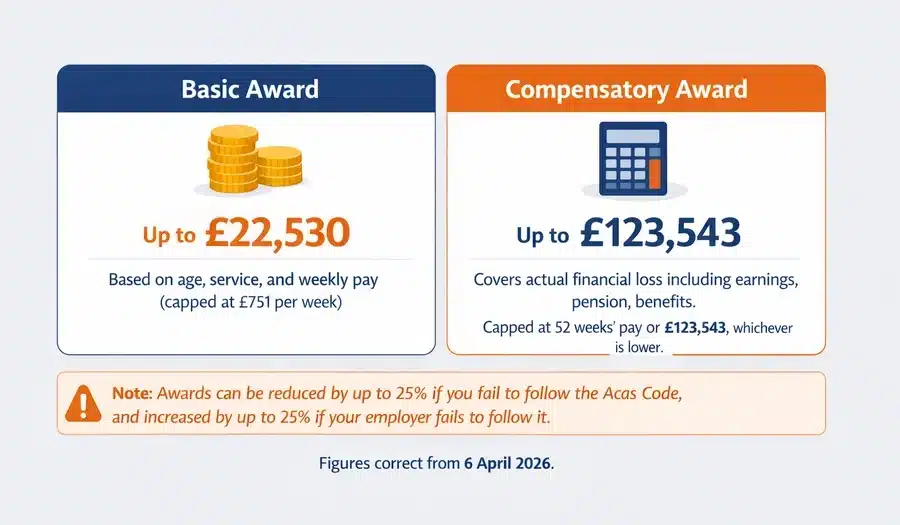
If your capability dismissal is found to be unfair, you can be awarded two types of compensation.
The basic award is calculated using the same formula as a statutory redundancy payment: your weekly pay (capped at £751 from 6 April 2026) multiplied by the number of years’ service, with a multiplier based on your age. The maximum basic award is £22,530.
The compensatory award covers your actual financial loss: lost earnings, pension contributions, and the value of any benefits. It is capped at the lower of one year’s gross pay or £123,543 (from 6 April 2026). The tribunal will also consider whether you acted to mitigate your loss by looking for alternative work. This cap is expected to be abolished from 1 January 2027 under the Employment Rights Act 2025, alongside the qualifying period reduction, meaning future claimants will be able to recover their full financial loss with no ceiling.
Both awards can be adjusted. If your employer unreasonably failed to follow the Acas Code, the tribunal can increase your compensation by up to 25%. If you unreasonably failed to follow the Code yourself, your compensation can be reduced by up to 25%. The tribunal will also apply any Polkey reduction if it finds that a fair procedure might still have led to dismissal.
Where a disability discrimination claim succeeds alongside an unfair dismissal claim, the discrimination award can include injury to feelings, which is not available in ordinary unfair dismissal claims, as well as uncapped compensation for financial loss.
How Long Do You Have to Make a Claim?
You must start the Acas Early Conciliation (EC) process before submitting any employment tribunal claim. EC is free, confidential, and handled by Acas (the Advisory, Conciliation and Arbitration Service). It allows the parties to try to resolve the dispute without going to tribunal. Early Conciliation can last up to 12 weeks.
The time limit for unfair dismissal claims is three months less one day from your effective date of termination (the date your employment ended). The EC process pauses this clock, but the original deadline still applies once EC concludes. Most people have significantly less than three months between dismissal and the end of EC, so time pressure is real.
Under the Employment Rights Act 2025, these time limits will extend to six months, no earlier than October 2026, once the relevant commencement regulations are made. Until then, the three-month limit applies.
There is no qualifying period requirement for disability discrimination claims. But for ordinary unfair dismissal, you currently need two years’ continuous employment. That threshold reduces to six months from 1 January 2027.
What Should You Do If You’ve Been Dismissed for Capability?
Steps to Take Now
Note the date of your dismissal. Your three-month time limit starts running from the day your employment ended, not the day you received your letter or the date of your dismissal meeting. Get this date right from the start.
Gather your documents. Collect everything: your contract, any performance reviews, PIP documents, meeting notes, correspondence about your capability, your dismissal letter, and any medical evidence relating to your health. Written records are the foundation of any claim.
Appeal your dismissal if you haven’t already. Failing to appeal can reduce your compensation by up to 25%. Even if you plan to bring a tribunal claim, appeal first. It also creates a formal record of your position.
Consider whether disability applies. If your capability dismissal relates to your health, consider whether your condition meets the Equality Act 2010 definition of disability. If it does, the legal picture changes significantly and specialist advice is important.
Take legal advice promptly. Three months passes very quickly, and the procedural requirements for bringing a claim are strict. We offer a no win, no fee service for employment tribunal claims. Call us or complete our online assessment to find out where you stand.
“The question I get asked most often is: ‘but my employer did put me on a PIP, so doesn’t that mean the process was fair?’ Not necessarily. A PIP that was designed to fail, an improvement period that was unreasonably short, or targets that were moved without warning, can all indicate that the employer had already decided to dismiss before the process had properly run its course. We look very carefully at the substance of the procedure, not just whether it formally took place.”
Think your capability dismissal may have been unfair?
We act exclusively for employees and operate on a no win, no fee basis. Get free initial advice from a specialist employment solicitor today.
Frequently Asked Questions
Can I be dismissed for capability without any warnings?
In most circumstances, no. The Acas Code of Practice requires employers to give employees the opportunity to improve before dismissing for capability, which means warnings and a genuine improvement period must come first. Dismissing for poor performance without prior warnings is a significant procedural failing and is likely to make the dismissal unfair. The only exception might be where performance is so seriously deficient from the outset that it amounts to gross negligence, which is rare.
What is the difference between capability dismissal and misconduct dismissal?
Capability applies where an employee cannot do the job: the problem lies in their ability. Misconduct applies where the employee will not do the job: the problem lies in their behaviour or attitude. The Court of Appeal confirmed this distinction in Abernethy v Mott Hay & Anderson [1974] ICR 323. Employers sometimes misuse capability procedures where the issue is really conduct, which is itself a procedural error. If you believe you were dismissed via the wrong procedure, that can be relevant to fairness.
Can I be dismissed for capability if I’m off sick?
Yes, but only after following a proper procedure. Your employer must obtain medical evidence, consult with you, and consider all alternatives including reasonable adjustments, phased return, and modified duties before reaching a decision to dismiss. The dismissal must also be reasonable in all the circumstances, including how long you have been absent, the prognosis, and whether the employer can realistically continue to wait. If your condition amounts to a disability, failure to make reasonable adjustments may also give rise to a discrimination claim.
How long does my employer have to wait if I’m on long-term sick leave?
There is no fixed time period set by law. Tribunals consider the nature of the role, the size of the employer, the availability of cover, and the medical prognosis. The questions from Spencer v Paragon Wallpapers Ltd [1977] ICR 301 remain the guide: how long has the absence lasted, how long is it likely to continue, can the employer reasonably be expected to wait longer, and can the position be held open? A larger employer with a clear temporary replacement will generally be expected to wait longer than a small business without cover.
What happens if my employer doesn’t follow the Acas Code?
If the tribunal finds that your employer unreasonably failed to follow the Acas Code of Practice on Disciplinary and Grievance Procedures, it can increase your compensation by up to 25%. This applies to the total compensation award, so it can be a significant additional sum. The Code sets out minimum expectations for any capability or disciplinary process, including written notification of concerns, the right to a hearing, the right to be accompanied, and the right of appeal.
Do I need two years’ service to bring a claim?
For ordinary unfair dismissal, yes, you currently need two years’ continuous employment with the same employer. However, this requirement does not apply to certain automatically unfair dismissals or to discrimination claims under the Equality Act 2010. There is no qualifying period for disability discrimination. The Employment Rights Act 2025 will reduce the qualifying period for unfair dismissal to six months from 1 January 2027, which will bring significantly more employees within the protection of unfair dismissal law.
How do I know if my condition counts as a disability?
The Equality Act 2010 defines disability as a physical or mental impairment that has a substantial and long-term adverse effect on your ability to carry out normal day-to-day activities. “Long-term” means the condition has lasted, or is expected to last, at least 12 months. Conditions including depression, anxiety, cancer, diabetes, and musculoskeletal conditions can all meet the definition depending on their effect. You do not need a formal diagnosis, and your employer does not need to have known about your disability at the time of dismissal for discrimination protection to apply in some circumstances. Specialist advice is recommended if you think disability may be relevant to your case.
Related Guides
Unfair Dismissal: Complete Guide
Everything you need to know about making an unfair dismissal claim, including qualifying period, compensation, and time limits.
Disciplinary Procedures
Your rights during a disciplinary process, including the right to be accompanied, investigations, and appealing outcomes.
Disability Discrimination
When capability dismissal related to a health condition may also be disability discrimination, and what that means for your claim.
Gross Misconduct Dismissal
The distinction between capability and conduct dismissal, and what fair procedure looks like when gross misconduct is alleged.
Legal Disclaimer
This guide is for general information only and does not constitute legal advice. Employment law is complex, fact-specific, and subject to change. Nothing in this guide should be relied upon as legal advice for your individual circumstances. If you have been dismissed or are facing capability proceedings, you should seek specialist legal advice as soon as possible. Tom Street & Co. Solicitors is regulated by the Solicitors Regulation Authority (SRA No. 566718). All content has been written and reviewed by a qualified solicitor but is not a substitute for advice tailored to your situation. The information on this page was accurate as of the date of publication but legislation and case law may have changed.
Sources and Further Reading
Primary Legislation
- Employment Rights Act 1996, section 98 – fair reasons for dismissal and the reasonableness test
- Employment Rights Act 1996, section 108 – qualifying period for unfair dismissal
- Equality Act 2010, section 20 – duty to make reasonable adjustments
- Employment Rights Act 2025 – qualifying period reduction and time limit changes
Acas Guidance
- Acas Code of Practice on Disciplinary and Grievance Procedures
- Acas: Dismissals for capability or conduct
- Acas: Capability and performance for disabled employees
Key Case Law
- Abernethy v Mott Hay & Anderson [1974] ICR 323 (CA) – capability vs misconduct distinction
- East Lindsey DC v Daubney [1977] ICR 566 (EAT) – ill health procedure requirements
- Spencer v Paragon Wallpapers Ltd [1977] ICR 301 (EAT) – how long to wait in ill health cases
- International Sports Co Ltd v Thomson [1980] IRLR 340 (EAT) – intermittent sickness absence
- British Leyland (UK) Ltd v Swift [1981] IRLR 91 (CA) – band of reasonable responses
- Polkey v AE Dayton Services Ltd [1987] UKHL 8 – procedural unfairness and compensation reductions
Tom Street
Principal Solicitor, Tom Street & Co. Solicitors (SRA No. 566718)
Tom Street is an employment solicitor with extensive experience representing employees in unfair dismissal, discrimination, and whistleblowing claims. He acts exclusively for employees and operates on a no win, no fee basis for employment tribunal cases.