
Quick Summary
Constructive dismissal occurs when your employer’s conduct is so serious that you have no choice but to resign. Despite you resigning, the law treats this as a dismissal. To claim, you need two years’ service (reducing to six months from January 2027) and must prove your employer committed a fundamental breach of contract. Compensation can reach £139,793, combining a basic award (up to £21,570) and compensatory award (up to £118,223). Time limits are strict: you must start ACAS early conciliation within three months minus one day of your resignation.
⚖️ This guide is for general information only and is not legal advice. Every case is different. If you’re considering resigning or have already resigned, speak to an employment solicitor before taking action.
⚠️ Important: Constructive dismissal claims are notoriously difficult to win. We assess every case carefully, but we can only offer no win no fee funding for claims with strong prospects of success. Complete our free online assessment to get a free consultation with a solicitor. Read more about funding options below.
Key Points
- ✓ Constructive dismissal is when your employer’s conduct forces you to resign, and the law treats your resignation as a dismissal
- ✓ You must prove your employer committed a fundamental breach of contract (express or implied terms)
- ✓ You currently need two years’ continuous employment (reducing to six months from January 2027)
- ✓ Maximum compensation is £139,793 for 2025/26 (basic award £21,570 + compensatory award £118,223)
- ✓ You must act promptly: start ACAS early conciliation within three months minus one day of resignation
- ✓ These claims are notoriously difficult to win. Do not resign without taking legal advice first
⚖️ Legislation Update
Major Changes Coming in 2027: Easier Access to Constructive Dismissal Claims
The Employment Rights Act 2025 introduces significant changes. From January 2027, the qualifying period for unfair dismissal claims (including constructive dismissal) reduces from two years to six months, and the compensation cap will be removed entirely. This means more employees will be able to claim, and those who do could receive substantially higher awards.
What is Constructive Dismissal?
Constructive dismissal, properly called “constructive unfair dismissal,” occurs when your employer’s conduct is so serious that you feel you have no reasonable option but to resign. Although you technically resign, the law treats your resignation as a dismissal by your employer.

The legal definition comes from section 95(1)(c) of the Employment Rights Act 1996, which states that an employee is dismissed when “the employee terminates the contract under which he is employed (with or without notice) in circumstances in which he is entitled to terminate it without notice by reason of the employer’s conduct.”
In plain English, this means you can resign and claim constructive dismissal if your employer has behaved so badly that they have effectively ended the employment relationship, even though it was technically you who handed in your notice.
Constructive dismissal claims are a type of unfair dismissal claim. If you succeed in proving you were constructively dismissed, you can then argue that the dismissal was unfair, entitling you to compensation.
Free Download: Constructive Dismissal Action Pack
Templates, checklists and step-by-step guidance to protect your claim – including grievance and resignation letter templates, evidence log, compensation calculator, and key deadlines.
Download Your Free Action Pack (PDF)“Constructive dismissal claims are among the most difficult employment tribunal claims to win. The legal threshold is high, and tribunals expect clear evidence that your employer’s conduct made it impossible for you to continue working. That’s why getting expert advice before you resign is absolutely crucial.”

How to Prove Constructive Dismissal
To succeed in a constructive dismissal claim, you must prove four things. This legal test was established by Lord Denning in the landmark case of Western Excavating (ECC) Ltd v Sharp [1978] ICR 221 and has been applied in every constructive dismissal case since.
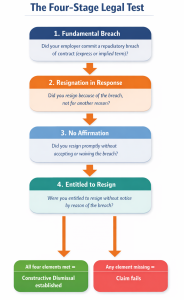
1. Your Employer Committed a Fundamental Breach of Contract
Your employer must have committed a “repudiatory breach” of your employment contract. This is a breach so serious that it “goes to the root of the contract” or shows that your employer no longer intends to be bound by essential terms of your employment.
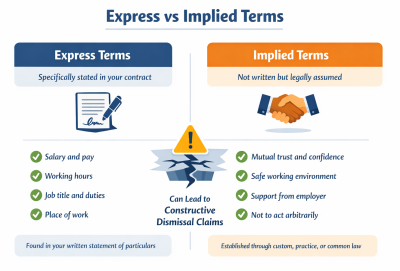
The breach can be of either an express term (something specifically written in your contract) or an implied term. The most important implied term is the duty of mutual trust and confidence, established in Malik v BCCI [1997] UKHL 23. This requires your employer not to conduct themselves, without reasonable and proper cause, in a manner calculated or likely to destroy or seriously damage the relationship of trust and confidence between you.
Importantly, merely unreasonable conduct by your employer is not enough. As Lord Denning made clear, you must show an actual breach of contract, not just that your employer has behaved unfairly. The test is objective: would a reasonable person consider the conduct to be a fundamental breach?
2. You Resigned in Response to the Breach
Your resignation must be a direct response to your employer’s breach of contract. If you resigned for some other reason, such as having found a new job or for personal reasons, your claim will fail even if there was also a breach.
This does not mean the breach has to be the only reason for your resignation, but it must be a significant cause. If the breach played a part in your decision to resign, that is generally sufficient.
3. You Did Not “Affirm” or Accept the Breach
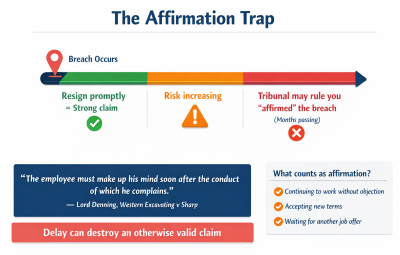
If you continue working for too long after the breach occurs, you may be treated as having “affirmed” the contract. This means you have accepted the breach and lost your right to treat yourself as constructively dismissed.
There is no fixed time limit for how long is “too long.” It depends on the circumstances of each case. Working for several months after a breach without protest will almost certainly be fatal to your claim. Working for a few weeks while considering your position is more likely to be acceptable, especially if you make clear that you are working “under protest.”
4. You Were Entitled to Resign Without Notice
The breach must be serious enough that you were entitled to resign immediately, without working your notice period. While you can choose to work your notice, you must have had the right not to.
This requirement emphasises the seriousness of the breach needed. Minor breaches, even if they are technically breaches of contract, will not entitle you to resign without notice.
Examples of Repudiatory Breaches
Breaches that may justify a constructive dismissal claim fall into two categories: breaches of express terms and breaches of the implied term of trust and confidence.

Breaches of Express Terms
These involve your employer breaking specific terms in your employment contract, such as:
Unilateral reduction in pay: Your salary is an express term of your contract. If your employer cuts your pay without your agreement, this is likely a fundamental breach.
Demotion without justification: If your employer demotes you, removes significant responsibilities, or changes your job title without good reason or consent, this may breach your contract.
Changing your place of work: Unless your contract gives your employer the right to relocate you, forcing you to work at a different location could be a breach.
Changing your hours: Unilaterally altering your working hours, for example from day shifts to night shifts, without contractual authority to do so.
Breaches of the Implied Term of Trust and Confidence
The implied term of trust and confidence covers a wide range of employer conduct that, while not breaking a specific written term, destroys the employment relationship. Examples include:
Bullying or harassment: Persistent bullying at work, whether by managers or colleagues (if your employer fails to address it), can breach the duty of trust and confidence.
Discrimination: Treating you less favourably because of a protected characteristic such as age, sex, race, disability, or religion is both unlawful discrimination and a breach of the implied term.
Failing to address grievances: If you raise legitimate concerns through your employer’s grievance procedure and they ignore or dismiss them without proper investigation, this may breach trust and confidence.
Unfair disciplinary action: Subjecting you to disciplinary proceedings that are manifestly unfair, based on false allegations, or conducted without proper process.
Excessive workload: Continuously overloading you with work to the point where your health suffers, without providing support or relief.
Public humiliation: Criticising, reprimanding, or belittling you in front of colleagues or customers.
The “Last Straw” Doctrine
You do not always need to point to a single dramatic incident that justifies your resignation. Under the “last straw” doctrine, you can resign in response to a series of acts by your employer which, taken together, amount to a fundamental breach of the implied term of trust and confidence.
The principles were set out in London Borough of Waltham Forest v Omilaju [2004] EWCA Civ 1493 and refined in Kaur v Leeds Teaching Hospitals NHS Trust [2018] EWCA Civ 978. The Court of Appeal in Kaur confirmed that for the “last straw” doctrine to apply:
The final act need not be serious in itself. It does not have to be a breach of contract on its own. It must add something to the overall breach: it cannot be entirely innocuous or utterly trivial. Viewed with the earlier acts, the cumulative conduct must amount to a repudiatory breach. The final act need not be of the same character as earlier acts.
The key point is that even if individual incidents seem minor on their own, together they may demonstrate a pattern of conduct that destroys trust and confidence. A “last straw” event can revive earlier breaches that you might otherwise have been treated as affirming.

“The biggest mistake employees make is waiting too long to resign after their employer’s conduct becomes intolerable. I understand why people do it: they’re worried about money, they’re hoping things will improve, they want to find another job first. But the longer you stay, the harder it becomes to argue that your employer’s behaviour was serious enough to justify resignation.”
Who Can Claim Constructive Dismissal?
To bring a claim for ordinary constructive unfair dismissal, you currently need:
Employee status: You must be an “employee” under employment law, not a worker or self-employed contractor. If you have a contract of employment, receive a regular salary through PAYE, and work set hours, you are almost certainly an employee.
Two years’ continuous employment: You must have worked for your employer for at least two years at the date of your resignation. This qualifying period reduces to six months from 1 January 2027 under the Employment Rights Act 2025.
There are exceptions where no qualifying period applies. You can claim constructive dismissal regardless of your length of service if the reason for your employer’s conduct (and therefore your resignation) relates to discrimination based on a protected characteristic (age, disability, gender reassignment, marriage and civil partnership, pregnancy and maternity, race, religion or belief, sex, or sexual orientation), whistleblowing (making a protected disclosure about wrongdoing), asserting a statutory employment right, or trade union membership or activities.
In these cases, your claim would be for “automatically unfair” constructive dismissal, and compensation is uncapped.
Constructive Dismissal Compensation
If you succeed in a constructive dismissal claim, you are entitled to the same compensation as for ordinary unfair dismissal. This comprises two parts: a basic award and a compensatory award.

Basic Award
The basic award is calculated in the same way as statutory redundancy pay. It depends on your age, length of service, and weekly pay (capped at £719 for dismissals from 6 April 2025):
Half a week’s pay for each complete year of service when you were under 22. One week’s pay for each complete year when you were 22 to 40. One and a half weeks’ pay for each complete year when you were 41 or over. A maximum of 20 years’ service can be counted.
The maximum basic award for 2025/26 is £21,570 (£719 × 1.5 × 20).
Compensatory Award
The compensatory award compensates you for the financial losses you suffer as a result of being constructively dismissed. This includes immediate past loss of earnings (wages lost between resignation and tribunal or new job), future loss of earnings (estimated future losses if you cannot immediately find equivalent employment), loss of benefits (pension contributions, private healthcare, company car), loss of statutory rights (compensation for needing to build up employment rights again in a new job, typically £350-£500), and expenses (job search costs, for example).
The compensatory award is capped at the lower of 52 weeks’ gross pay or £118,223 (for dismissals from 6 April 2025).
The Employment Rights Act 2025 removes this cap entirely from January 2027. After that date, compensatory awards will be unlimited, as they already are for discrimination and whistleblowing claims.
ACAS Uplift
If your employer failed to follow the ACAS Code of Practice on Disciplinary and Grievance Procedures, the tribunal can increase your compensatory award by up to 25%. Conversely, if you failed to follow the Code (for example, by not raising a grievance), your award can be reduced by up to 25%.
Maximum Total Compensation
For 2025/26, the maximum total compensation for an ordinary constructive dismissal claim (without discrimination or whistleblowing) is £139,793:
Maximum Constructive Dismissal Compensation 2025/26
| Award Component | Maximum Amount | Notes |
|---|---|---|
| Basic Award | £21,570 | Based on age, service (max 20 years), weekly pay (capped £719) |
| Compensatory Award | £118,223 | Or 52 weeks’ gross pay, whichever is lower |
| Total Maximum | £139,793 | Plus potential 25% ACAS uplift on compensatory award |
Time Limits and the Claims Process
Strict time limits apply to constructive dismissal claims. Missing these deadlines will almost certainly mean losing your right to claim, regardless of how strong your case might be.
Current Time Limit
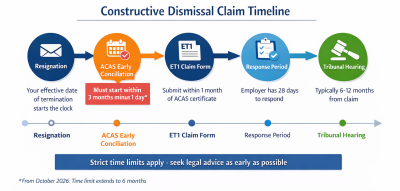
You must start ACAS early conciliation within three months minus one day of the “effective date of termination.” This is normally the date your employment ended, which for constructive dismissal is typically the date your resignation takes effect.
For example, if you resign with immediate effect on 15 March, your effective date of termination is 15 March. You must contact ACAS by 14 June (three months minus one day).
If you work your notice period, your effective date of termination is the last day of your notice period, not the date you handed in your resignation.
ACAS Early Conciliation
Before you can submit a claim to the employment tribunal, you must go through ACAS early conciliation. This is a free service where ACAS tries to help you and your employer resolve the dispute without going to tribunal.
Starting early conciliation “stops the clock” on your time limit. Once you receive an early conciliation certificate from ACAS (whether or not settlement is reached), you have at least one calendar month to submit your tribunal claim.
Future Changes
The Employment Rights Act 2025 extends the time limit for employment tribunal claims from three months to six months. This change is expected to take effect from October 2026. Until then, the current three-month limit applies.
The Reality of Constructive Dismissal Claims: Why Expert Assessment Matters
We believe in being upfront with clients from the start: constructive dismissal claims are among the most challenging employment tribunal claims to win. Research suggests that a relatively small percentage of these claims succeed at tribunal. Understanding why this is the case helps explain our approach to taking on these cases.
Why Are These Claims So Difficult?
Several factors make constructive dismissal claims harder to win than ordinary unfair dismissal claims. First, the legal test is demanding. You must prove a fundamental breach of contract, not merely that your employer behaved badly or unfairly. Many employees understandably feel they have been treated terribly, but their employer’s conduct does not meet the high legal threshold required.
Second, timing is critical and often fatal to claims. Employees frequently wait too long before resigning, either hoping things will improve or wanting to secure another job first. By the time they resign, a tribunal may find they have “affirmed” the breach and lost their right to claim.
Third, evidence can be difficult to gather. Proving what was said in meetings, demonstrating a pattern of behaviour, or showing how conduct affected you requires contemporaneous documentation that many employees do not have.
Why This Makes Expert Assessment Essential
Because these claims are genuinely difficult, getting an honest, expert assessment of your case before you resign is not just helpful: it is essential. A solicitor experienced in constructive dismissal claims can tell you whether your situation is likely to meet the legal test, advise on timing and how to avoid affirming any breach, help you gather and preserve the right evidence, identify whether discrimination, whistleblowing, or other factors strengthen your position, and give you a realistic view of your prospects.
This assessment can save you from resigning prematurely for a claim that will not succeed, or conversely, from staying too long and losing a valid claim.
How We Assess and Fund Cases
We offer a free consultation to assess every potential constructive dismissal case when you complete our online assessment tool. During this consultation, we will review your situation, explain the legal test, and give you an honest assessment of your prospects.
Because of the inherent difficulty of these claims, we can only offer no win no fee arrangements for cases where we assess the prospects of success as strong. This is not about being selective for its own sake: it protects you from pursuing a claim that is unlikely to succeed while incurring legal costs.
For cases where the prospects are less certain but still reasonable, we can discuss alternative funding options. These may include fixed fee arrangements where you pay an agreed amount for defined work, hourly rate funding where you pay as the case progresses, legal expenses insurance if you have cover through home insurance or a trade union, or a combination of approaches.
We will always be transparent about costs and funding from the outset. Our goal is to help you understand your options and make an informed decision about how to proceed.
The Value of Early Advice
Whether or not we can take your case on a no win no fee basis, the initial consultation provides real value. You will leave with a clear understanding of whether you have a potential claim, what steps you should take (or avoid), the strength of your evidence, realistic compensation estimates if you were to succeed, and your options for next steps.
Many clients find that even a single consultation gives them the clarity they need to make the right decision for their situation, whether that is proceeding with a claim, negotiating a settlement, or taking a different approach entirely.
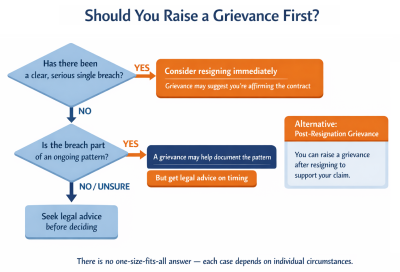
Should You Raise a Grievance Before Resigning?
This is one of the most common questions, and there is no simple answer. There are competing considerations.
Arguments for Raising a Grievance
Failing to raise a grievance before resigning can result in a 25% reduction in your compensation under the ACAS Code of Practice. The tribunal may also view your failure to give your employer an opportunity to address the issues as unreasonable. A grievance creates a paper trail and forces your employer to respond on the record.
Arguments Against Raising a Grievance
If your employer’s conduct is truly a fundamental breach, it should by definition be incapable of being “cured” by a grievance process. Raising a grievance delays your resignation, which risks you being treated as having affirmed the breach. Some employers use the grievance process to delay matters and wear down employees.
A Possible Compromise: Post-Resignation Grievance
One approach is to raise a grievance after you have resigned. This allows you to demonstrate that you followed the ACAS Code without risking affirmation of the breach. In your resignation letter, you can state that you will be raising a formal grievance about the matters that led to your resignation.
See our guide on how to write a grievance letter for more information.
How to Resign for Constructive Dismissal
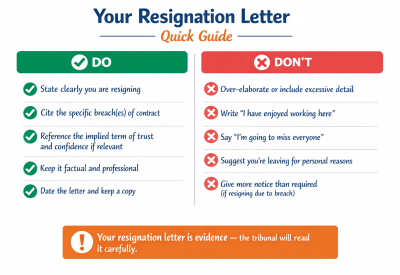
If you decide to resign, how you do so matters. Your resignation letter is an important piece of evidence in any subsequent claim.
Key Points for Your Resignation Letter
State clearly that you are resigning because of your employer’s conduct. Identify the specific breaches of contract you are relying on. Make clear that you consider yourself to have been constructively dismissed. Avoid sentiments like “thank you for the opportunity” or “I’ve enjoyed working here” that could undermine your position. Keep it professional and factual. Do not exaggerate or make accusations you cannot support.
Notice Period
You do not have to work your notice period if you are claiming constructive dismissal. By definition, if your employer has committed a fundamental breach, you are entitled to treat the contract as terminated immediately.
Working your notice period will not automatically defeat your claim, but it may make it harder to argue that the breach was so serious you could not continue working. If you do work notice, make clear in writing that you are doing so “under protest” and reserving your rights.
If you do work your notice, your employer may place you on gardening leave, where you remain employed but are not required to attend work. See our gardening leave guide for more information on how this works and your rights during this period.
Constructive Dismissal vs Unfair Dismissal
People often confuse constructive dismissal with ordinary unfair dismissal. The key difference is who ends the employment.
In ordinary unfair dismissal, your employer dismisses you (sacks you, makes you redundant, or does not renew a fixed-term contract). You then claim the dismissal was unfair.
In constructive dismissal, you resign, but because of your employer’s conduct, your resignation is treated as a dismissal by them. You then claim that this constructive dismissal was unfair.
In both cases, if successful, you receive the same types of compensation. The difference is in what you need to prove. Constructive dismissal requires you to first establish that you were dismissed at all (by proving the employer’s fundamental breach), before going on to argue the dismissal was unfair.
What to Do If You Think You Have a Constructive Dismissal Claim
If you believe your employer’s conduct may justify a constructive dismissal claim, take these steps.
Document everything: Keep a detailed record of incidents, including dates, times, what was said or done, and any witnesses. Save copies of relevant emails, messages, and documents. Keep this information at home, not just on work systems.
Get legal advice before resigning: This is the most important step. Once you resign, you cannot undo it. An employment solicitor can assess whether your situation is likely to meet the legal test for constructive dismissal and advise on the best strategy.
Consider your options: Resignation is not the only option. You may be able to resolve matters through a grievance, negotiate a settlement agreement, or take other steps. A solicitor can help you evaluate the alternatives.
Act promptly: Remember that delaying too long after a breach risks affirming the contract. If you are going to resign, do so within a reasonable time of the conduct you are complaining about.
Be aware of time limits: If you do resign, you have three months minus one day to start ACAS early conciliation. Do not leave this to the last minute.
Our experienced constructive dismissal solicitors have helped many employees successfully claim compensation at employment tribunals across the UK. Complete our online assessment tool to get a free consultation where we can assess your situation and discuss the best funding options for your case.
To get started, complete our free online assessment and we will be in touch to arrange your free consultation.

Free Download: Constructive Dismissal Action Pack
Templates, checklists and step-by-step guidance to protect your claim – including grievance and resignation letter templates, evidence log, compensation calculator, and key deadlines.
Download Your Free Action Pack (PDF)Frequently Asked Questions
What is constructive dismissal?
Constructive dismissal occurs when your employer’s conduct is so serious that you have no choice but to resign. Despite you resigning, the law treats this as a dismissal by your employer. To claim, you must show your employer committed a fundamental breach of your employment contract.
How much compensation can I get for constructive dismissal?
Compensation comprises a basic award (up to £21,570) plus a compensatory award (up to £118,223 or 52 weeks’ pay, whichever is lower). The maximum total is £139,793 for 2025/26. If your claim includes discrimination or whistleblowing, compensation is uncapped. From January 2027, the cap is being removed entirely.
How long do I have to make a constructive dismissal claim?
You must start ACAS early conciliation within three months minus one day of your resignation date. This deadline is strict, though ACAS conciliation extends the time limit. From October 2026, the time limit is expected to increase to six months under the Employment Rights Act 2025.
Do I need two years’ service to claim constructive dismissal?
For ordinary constructive unfair dismissal, yes, you currently need two years’ continuous employment. No qualifying period applies if your resignation relates to discrimination, whistleblowing, or another automatically unfair reason. From January 2027, the qualifying period reduces to six months.
Should I raise a grievance before resigning?
While not legally required, failing to raise a grievance could reduce your compensation by up to 25% under the ACAS Code. Raising a grievance delays your resignation, which risks affirming the breach. A post-resignation grievance is sometimes a sensible compromise. Get legal advice on the best approach for your situation.
What is the “last straw” in constructive dismissal?
The “last straw” doctrine allows you to resign based on a series of incidents that collectively breach the implied term of trust and confidence. The final incident does not need to be serious itself, but it must contribute to the overall breach and cannot be entirely innocuous.
Can I still claim if I work my notice period?
Yes, working your notice will not automatically defeat your claim. But it may be harder to argue the breach was so serious you could not continue working. If you work notice, state in writing that you are doing so “under protest” and reserving your rights. Many employees resign with immediate effect to strengthen their position.
How hard is it to win a constructive dismissal claim?
Constructive dismissal claims are among the most difficult to win. Research suggests that a relatively small percentage succeed at tribunal. This is because the legal threshold is high, many employees wait too long to resign, and proving a fundamental breach can be challenging. Complete our online assessment to get a free consultation where we can give you an honest view of your prospects. Read more about how we assess and fund cases.
Can I get a no win no fee solicitor for constructive dismissal?
Because constructive dismissal claims are difficult to win, most solicitors (including us) can only offer no win no fee funding for cases with strong prospects of success. Complete our online assessment tool to get a free consultation where we can assess your case honestly. If the prospects are good, we may offer no win no fee. Otherwise, we can discuss alternative funding options such as fixed fees or hourly rates. We are always transparent about costs from the outset.
💬 Thinking of Resigning? Get Expert Advice First
Complete our online assessment to get a free consultation with one of our constructive dismissal solicitors
Start Free Assessment →Important: This guide provides general information about constructive dismissal in England and Wales. It is not legal advice and should not be relied upon as such. Employment law is complex and the rules may apply differently depending on your circumstances. If you are considering resigning or have already resigned, we strongly recommend seeking professional legal advice before taking further action.
Sources and Further Reading
Primary Legislation
- Employment Rights Act 1996, section 95 (definition of dismissal)
- Employment Rights Act 1996, section 98 (fairness of dismissal)
- Employment Rights Act 1996, section 123 (compensatory award)
- Employment Rights Act 2025 (upcoming changes)
Official Guidance
- Acas: Constructive dismissal
- Acas Code of Practice on Disciplinary and Grievance Procedures
- GOV.UK: Employment tribunal compensation limits
- Official 2025 compensation limits
Key Case Law
- Western Excavating (ECC) Ltd v Sharp [1978] ICR 221 (the contractual test for constructive dismissal)
- Malik and Mahmud v BCCI [1997] UKHL 23 (implied term of mutual trust and confidence)
- London Borough of Waltham Forest v Omilaju [2004] EWCA Civ 1493 (the “last straw” doctrine)
- Kaur v Leeds Teaching Hospitals NHS Trust [2018] EWCA Civ 978 (five-stage test)
Tom Street
Tom Street is the principal solicitor at Tom Street & Co. Solicitors, specialising in employment law and tribunal claims. He regularly represents claimants in unfair dismissal, discrimination, and whistleblowing cases. View full profile