
20 August 2026 • By Tom Street, Solicitor
Disclaimer: This article contains Tom Street’s personal opinion and commentary on employment policy. It is not legal advice for your specific circumstances. For advice on your individual situation, please contact us directly. Tom Street is a solicitor regulated by the Solicitors Regulation Authority (SRA No. 566718).
Key Facts
- From 1 October 2026, the time limit for most employment tribunal claims rises from three months minus one day to six months minus one day.
- The longer limit applies only where the act you’re complaining about happens on or after 1 October 2026. Anything earlier stays on three months.
- It covers the everyday claims: unfair dismissal, discrimination, whistleblowing detriment, and unlawful deduction from wages.
- Breach of contract claims in Scotland follow on 9 November 2026.
- Acas early conciliation still pauses the clock, and the conciliation window itself now runs up to 12 weeks.
- Interim relief still has a seven-day deadline. That has not changed and it will not change.
Every week someone contacts us who has just worked out that their claim is out of time. Usually they did everything they thought was sensible. They raised a grievance. They waited for the appeal. They tried to sort it out internally, like a reasonable person. Then they discovered the tribunal clock had been running the whole time and had already stopped.
So a change that gives people longer to bring a claim is genuinely good news, and I’d rather have it than not. From 1 October 2026 the standard tribunal deadline doubles.
What worries me is what people will hear. They’ll hear “six months”. They’ll relax. And a good number of them will be relying on a deadline that doesn’t apply to their case at all.
What actually changes on 1 October
The change comes from the Employment Rights Act 2025, backed up by The Employment Tribunal (Extension of Time Limits) (Miscellaneous Amendments and Transitional Provisions) Regulations 2026, which Parliament has now approved.
The standard time limit for presenting a claim to an employment tribunal (ET) goes from three months minus one day to six months minus one day. It applies to the bulk of what tribunals actually deal with: unfair dismissal, every form of discrimination under the Equality Act 2010, whistleblowing detriment, and unlawful deduction from wages.
The regulations also sweep in a set of claims that the Act didn’t originally cover, including breach of contract claims in England and Wales. In Scotland, breach of contract claims move to six months on 9 November 2026 rather than 1 October.
Some claims were already on six months and are unaffected: statutory redundancy pay, equal pay, and unfair dismissal connected to industrial action. If you’ve ever wondered why the tribunal system had two different deadlines running side by side for the same court, so have I. That inconsistency is finally going.
The date that matters isn’t the date you claim
Here’s the part that will catch people out, and it deserves to be said plainly.
The six-month limit applies where the act you are complaining about happens on or after 1 October 2026. It is not about when you submit your claim. It is not about when you found out. It is not about when you finally admitted to yourself that what happened wasn’t right.
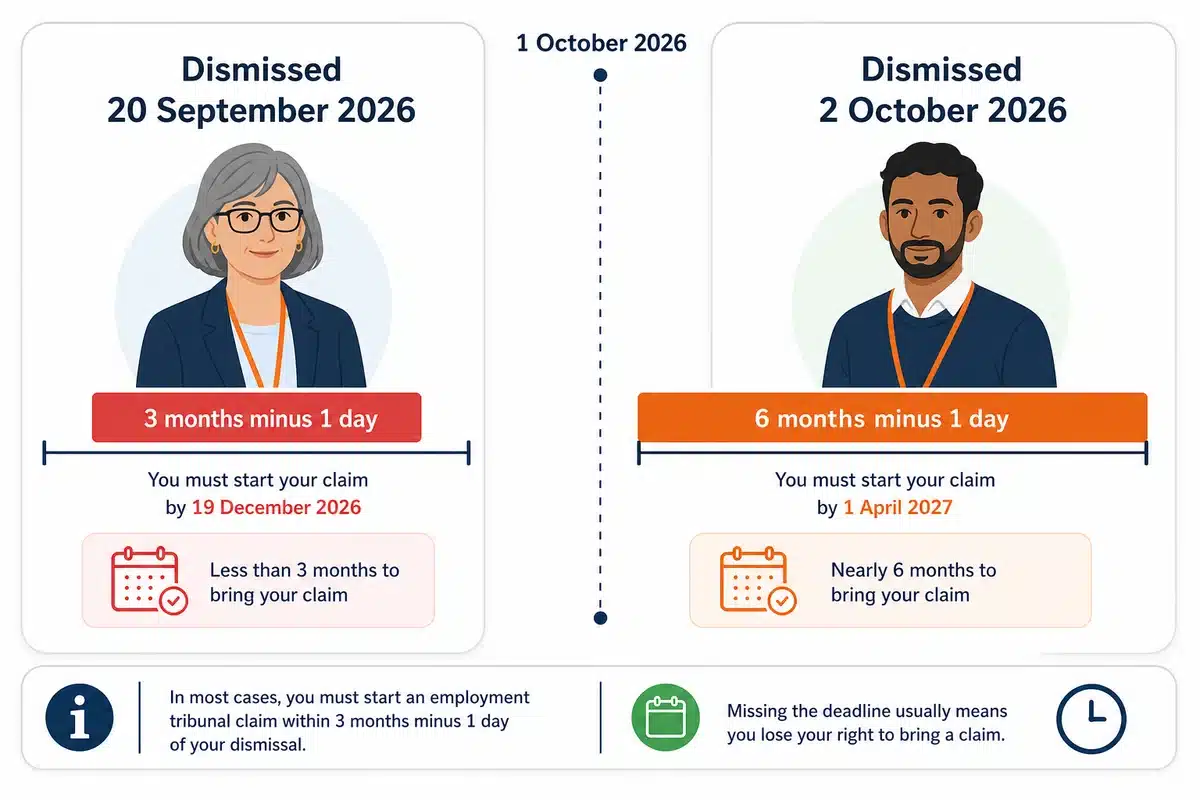
If you were dismissed on 20 September 2026, your deadline is three months minus one day, even if you’re filling in the ET1 form in November when the new rules are all over the news. If you were dismissed on 2 October 2026, you get six months.
Two people, dismissed a fortnight apart, with completely different deadlines. That’s how transitional provisions work, and it’s why the coverage that just says “workers now get six months” is doing real damage.
Tom Street’s View
The cliff edge between September and October is going to cost people claims.
I understand why transitional rules exist. Employers need certainty about their exposure, and you can’t retrospectively revive claims that have already expired. But the practical effect is that for the next few months there are two deadlines in circulation, the headlines are only reporting one of them, and the people most likely to get it wrong are the ones without a solicitor. If you’re anywhere near a deadline this autumn, work out your date from the act, not from the news.
Continuing acts make the date harder than it looks
Working out “the act you’re complaining about” sounds simple. It often isn’t.
In a dismissal case it’s usually clean: the effective date of termination. In a discrimination case it can be genuinely difficult. Where you’re describing a pattern of behaviour rather than one incident, the question becomes whether those incidents form a continuing act, in which case time runs from the last one, or whether they’re separate events, each with its own deadline.
Get that wrong and part of your claim can fall away even though the rest is in time. This autumn adds a second layer to it, because a pattern that starts in August and continues into November may straddle the changeover.
If your situation looks anything like that, take advice on the date before you do anything else.
Early conciliation still stops the clock, and it’s longer now too
Nothing about the process for starting a claim has changed. You still have to notify Acas (the Advisory, Conciliation and Arbitration Service) and go through early conciliation before you can present a tribunal claim, and that still pauses the clock while conciliation runs.
The conciliation window itself doubled from six weeks to 12 weeks in December 2025. Stack the two changes together and someone dismissed after 1 October could, in some circumstances, be more than nine months out from the dismissal before their claim absolutely must be in.
That is a lot of runway compared to where we were two years ago. It’s also a lot of rope, and I’ll come back to that.
The deadlines that haven’t moved
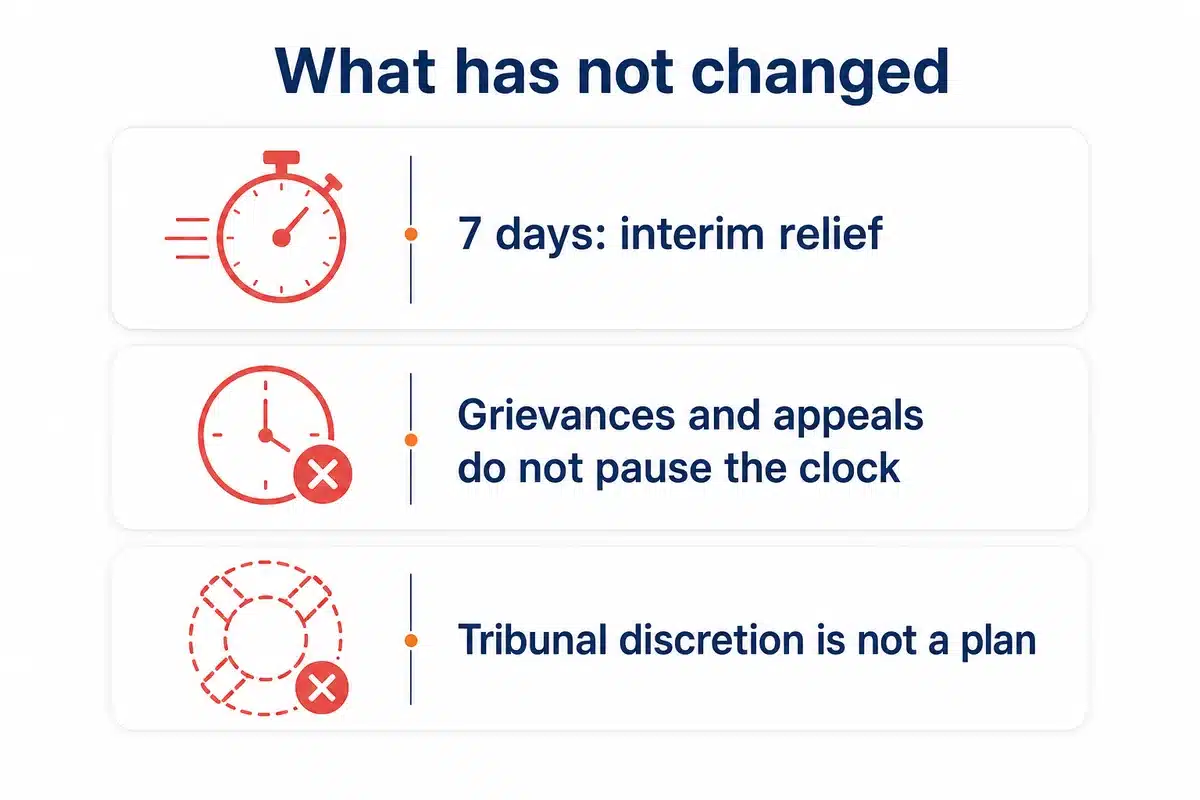
Three things stay exactly as they are, and each of them ends claims.
Interim relief is still seven days. If you’re dismissed for whistleblowing or trade union reasons and you want an order keeping your pay running until the hearing, the application has to be in within seven days of the effective date of termination. Seven. Not six months. This remedy is already badly underused, and a public conversation about “six months to claim” is not going to help.
Internal processes do not pause anything. Your grievance doesn’t stop the clock. Your appeal doesn’t stop the clock. Settlement discussions with HR don’t stop the clock. The tribunal deadline runs in parallel with whatever your employer’s procedure is doing, and it does not care that you were told to wait for the outcome.
Judicial discretion is not a plan. Tribunals can still extend time, on the “not reasonably practicable” test for unfair dismissal and the broader “just and equitable” test in discrimination cases. Those are safety nets for genuine exceptional cases, not an alternative route for people who ran late. I would never advise anyone to rely on one.
Tom Street’s View
A longer deadline is not permission to wait, and I’d hate to see it treated as one.
Evidence decays. Witnesses leave the business and stop returning messages. WhatsApp threads get cleared, and company laptops get wiped and reissued. The version of your case you can prove in month two is almost always stronger than the version you can prove in month five, and tribunals are increasingly asking why a claimant sat on something. Take the extra time as breathing room to get advice and gather documents properly, not as an invitation to put it off.
Why this is still the right change
None of that means the reform is wrong. It’s overdue.
Three months minus one day was a brutal deadline for anyone dealing with a dismissal on top of everything a dismissal brings. People lose their income, their routine and often their confidence, all in the same week. They’re expected to research their rights, work out whether they have a claim, contact Acas, and get a claim in, while applying for jobs and sometimes while unwell. A meaningful number of good claims died in that window, not because they lacked merit, but because the person bringing them was overwhelmed at exactly the moment the law asked them to be organised.
Six months is a fairer reflection of how people actually recover. It also brings the mainstream claims into line with equal pay and redundancy pay, which have managed on six months for years without the system collapsing.
My concern isn’t the reform. It’s the gap between what the reform does and what people will think it does.
What To Do If You Think You Have a Claim
Write down the date of the act, not the date you noticed. Dismissal, demotion, the incident, the unpaid wages. That date decides which deadline applies to you. If it falls before 1 October 2026, work on three months minus one day.
Treat the deadline as separate from your grievance. Run your internal process if you want to, but never let it govern your tribunal timing. The two are not connected.
Notify Acas early rather than at the last moment. Conciliation pauses the clock, but only from the point you notify. Leaving it until the final week gives you no margin if something goes wrong with the form.
Ask about interim relief immediately in whistleblowing and union cases. Seven days from termination. If that might be you, get advice this week, not this month.
Gather your evidence now, whichever deadline applies. Contract, payslips, emails, messages, notes of meetings. Download anything held on a work account before your access is cut off.
Not sure which deadline applies to you?
Working out your time limit takes a short conversation, and getting it wrong ends a claim before anyone looks at whether it was any good. We’ll tell you your date and whether you have something worth pursuing.
Related Reading
- Employment tribunal time limits: the full breakdown of deadlines by claim type
- Early conciliation and the time limit: how notifying Acas pauses the clock
- Unfair dismissal claims: whether you have a claim and what it might be worth
- The Employment Rights Act 2025: everything changing between now and 2027
Sources

About Tom Street
Tom is the principal solicitor at Tom Street & Co. and acts for employees only, never employers. Time limits are the first thing he checks on every enquiry, because a missed deadline ends a claim regardless of how strong it is. He writes regularly on the Employment Rights Act 2025 and what each stage of it means in practice for people bringing tribunal claims.
SRA Number: 566718 | LinkedIn →