
Quick Summary
An unfair dismissal occurs when your employer sacks you without a fair reason or without following a fair procedure. You currently need 2 years’ service to claim (reducing to 6 months from January 2027). Compensation is capped at £123,543 (or 52 weeks’ pay if lower), though this cap is being abolished. You have just 3 months minus 1 day from your dismissal to start a claim.
⚖️ This guide is for general information only and is not legal advice. Every case is different. If you’re unsure whether you have a claim, speak to a solicitor.
Key Points
- ✓ A dismissal is unfair if your employer lacks a fair reason OR fails to follow a fair procedure
- ✓ The 5 fair reasons for dismissal are: conduct, capability, redundancy, illegality, and SOSR
- ✓ You currently need 2 years’ service to claim, but this reduces to 6 months from January 2027
- ✓ Maximum compensation is £123,543 (or 52 weeks’ pay), but this cap is being abolished
- ✓ You must act within 3 months minus 1 day of your dismissal date
- ✓ Some dismissals are automatically unfair regardless of your length of service
⚖️ Major Law Change
Unfair Dismissal Rules Changing from January 2027
The Employment Rights Act 2025 introduces major changes. The qualifying period for unfair dismissal claims will reduce from 2 years to 6 months from 1 January 2027 (confirmed). The compensation cap will be abolished (confirmed, exact commencement date awaiting regulations). Time limits for claims are expected to extend from 3 to 6 months, subject to secondary legislation. This guide covers both current law and upcoming changes.
💡 Want to calculate your potential compensation?
Use our free calculator with current 2026/27 figures
Calculate your claim →If you’ve been dismissed from your job and believe it was unfair, you may be entitled to bring a claim at the Employment Tribunal and receive compensation. But what exactly makes a dismissal “unfair” in legal terms? And how do you prove it?
This comprehensive guide explains everything you need to know about unfair dismissal claims in the UK, including the legal tests tribunals apply, how compensation is calculated, and the significant changes coming into force in 2027.

What is unfair dismissal?
Unfair dismissal is a statutory right that protects employees from being sacked without good reason or without a fair procedure. It is governed by section 98 of the Employment Rights Act 1996.
For a dismissal to be fair, two conditions must be met. First, your employer must have a potentially fair reason for dismissing you. Second, they must act reasonably in treating that reason as sufficient grounds for dismissal, which includes following a fair procedure.
The tribunal does not simply ask whether your dismissal was harsh or whether they would have made the same decision. Instead, it asks whether the decision to dismiss fell within the “range of reasonable responses” open to a reasonable employer in the circumstances.
“Many employees assume their dismissal was unfair simply because they disagree with the decision. But the legal test is different. We have to show that no reasonable employer, following a fair process, would have dismissed in those circumstances. That’s why the procedure your employer followed is often just as important as their reason for dismissing you.”

What are the 5 fair reasons for dismissal?
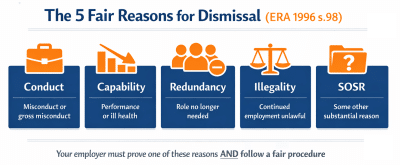
Under section 98 of the Employment Rights Act 1996, there are five potentially fair reasons for dismissal. Your employer must be able to identify one of these reasons; otherwise, the dismissal will automatically be unfair.
1. Conduct
Your employer can dismiss you for misconduct, which includes breaking workplace rules, insubordination, or inappropriate behaviour. Misconduct falls into two categories: ordinary misconduct (which usually requires warnings before dismissal) and gross misconduct (which can justify instant dismissal without notice).
Examples of gross misconduct include theft, fraud, violence, serious insubordination, being intoxicated at work, and serious breaches of health and safety rules. However, what constitutes gross misconduct depends on the nature of your role and your employer’s policies.
2. Capability
Your employer can dismiss you if you are unable to do your job to the required standard. Capability dismissals cover two main situations: poor performance (where you are failing to meet targets or standards) and ill health (where medical issues prevent you from working).
For performance dismissals, your employer should usually give you clear targets, support to improve, and a reasonable timeframe before dismissing you. For ill health dismissals, they should obtain medical evidence (usually through occupational health) and consider whether adjustments can be made.
3. Redundancy
Your employer can dismiss you if your role is genuinely redundant. Under section 139 of the ERA 1996, redundancy occurs when the employer’s need for employees to do work of a particular kind has ceased or diminished.
However, even genuine redundancies can be unfair if your employer fails to follow a fair process. This includes giving proper warning, consulting with you individually, applying fair selection criteria, and considering alternative employment. See our guide to redundancy rights for more detail.
4. Illegality
Your employer can dismiss you if continuing to employ you would break the law. This might apply, for example, if you are a driver who loses their licence, or if you lose the immigration status required to work in the UK.
Even in these situations, your employer should still follow a fair procedure before dismissing you, including exploring whether alternative work is available.
5. Some Other Substantial Reason (SOSR)
This is a catch-all category covering situations that do not fit the other four reasons but are still substantial enough to justify dismissal. SOSR dismissals might include an irretrievable breakdown in the working relationship, refusal to agree to contractual changes that are genuinely necessary for the business, or pressure from a third party (such as a client who refuses to work with you).
Because SOSR is so broad, tribunals look carefully at whether the reason genuinely justified dismissal and whether a fair process was followed.
What makes a dismissal procedurally unfair?
Even if your employer has a fair reason to dismiss you, the dismissal can still be unfair if they fail to follow a fair procedure. The ACAS Code of Practice on Disciplinary and Grievance Procedures sets out the minimum standards employers should follow.

A fair procedure typically includes:
Investigation: Your employer should investigate the matter thoroughly before taking action. In misconduct cases, this means gathering evidence, interviewing witnesses, and establishing the facts before any disciplinary hearing.
Notification: You should be told in writing what you are accused of, with enough detail to understand the case against you. You should receive copies of any evidence your employer intends to rely on.
Hearing: You should be invited to a disciplinary or other meeting where you can respond to the allegations, put forward your case, and ask questions. You have a statutory right to be accompanied by a colleague or trade union representative.
Consideration: The decision-maker should genuinely consider your response before reaching a decision. The decision should be communicated to you in writing with clear reasons.
Appeal: You should be offered the right to appeal against the decision, and the appeal should be heard by someone who was not involved in the original decision where possible.

If your employer fails to follow the ACAS Code unreasonably, the tribunal can increase your compensation by up to 25%. Conversely, if you unreasonably fail to follow it (for example, by not appealing), your compensation can be reduced by up to 25%.
The Burchell test for misconduct dismissals
When assessing whether a misconduct dismissal was fair, tribunals apply a three-stage test established in the case of British Home Stores Ltd v Burchell [1978] IRLR 379.
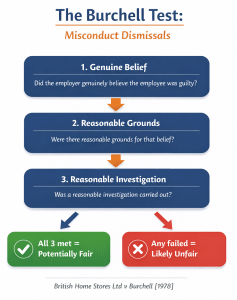
To satisfy the Burchell test, the employer must show:
1. Genuine belief: The employer genuinely believed that the employee was guilty of the alleged misconduct at the time of dismissal.
2. Reasonable grounds: The employer had reasonable grounds for that belief. This does not mean proving guilt to a criminal standard; a reasonable belief on the balance of probabilities is sufficient.
3. Reasonable investigation: The employer carried out as much investigation as was reasonable in the circumstances before forming that belief.
Importantly, the tribunal does not decide whether you were actually guilty of misconduct. It assesses whether your employer’s belief in your guilt was reasonable based on the investigation conducted. This means employers can sometimes dismiss fairly even when the employee maintains their innocence, provided the employer followed a reasonable process.
Common errors that can make a misconduct dismissal unfair include: conducting a superficial or one-sided investigation, ignoring evidence that points to innocence, not allowing the employee to properly respond to allegations, having the same person investigate and decide the outcome, and dismissing for a first offence that does not amount to gross misconduct.
The range of reasonable responses test
Alongside the Burchell test, tribunals apply the “range of reasonable responses” test from Iceland Frozen Foods v Jones [1982] IRLR 439. This means the tribunal must not substitute its own view for that of the employer.
The question is not whether the tribunal would have dismissed, but whether dismissal fell within the range of responses open to a reasonable employer. Different employers might reasonably take different views on the same set of facts. As long as the employer’s decision falls within the band of reasonable responses, the dismissal will be fair, even if another employer might have given a warning instead.
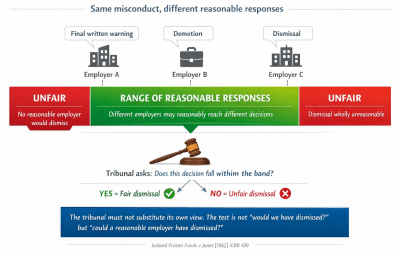
This test also applies to the investigation. The tribunal asks whether the investigation was within the range of reasonable investigations, not whether it was perfect.
How long do you need to be employed to claim unfair dismissal?
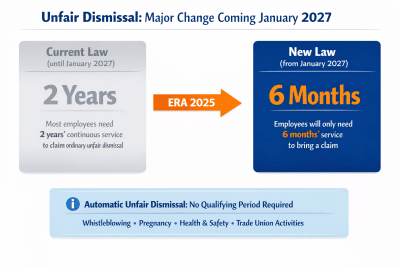
Currently, you need 2 years’ continuous service with your employer to bring an ordinary unfair dismissal claim. This is measured from your start date (usually your first day at work) to your “effective date of termination” (EDT), which is typically your last day of employment.
From January 2027, this qualifying period is being reduced to 6 months under the Employment Rights Act 2025. The government has confirmed that this change will apply to anyone who has six months’ service on 1 January 2027, not just those employed after that date.
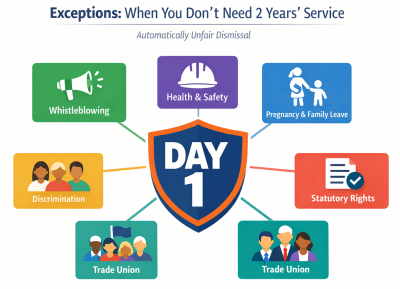
Exceptions: when you don’t need 2 years’ service
Some dismissals are automatically unfair regardless of your length of service. These include dismissal because:
- Whistleblowing: You made a protected disclosure about wrongdoing at work (whistleblowing).
- Health and safety: You raised health and safety concerns, refused to work in dangerous conditions, or took action to protect yourself or others from danger.
- Pregnancy and family leave: You are pregnant, took maternity leave, or exercised rights relating to paternity, adoption, or shared parental leave.
- Asserting statutory rights: You tried to enforce a statutory employment right, such as the right to minimum wage, working time limits, or paid holiday.
- Trade union membership: You joined a trade union, took part in union activities, or participated in official industrial action.
- Discrimination: Your dismissal was connected to a protected characteristic (age, disability, race, sex, etc.). In this case, you would bring a discrimination claim rather than unfair dismissal, but compensation for loss of earnings would be included.
Time limits for unfair dismissal claims
You must act quickly. The time limit for bringing an unfair dismissal claim is 3 months minus 1 day from your effective date of termination.
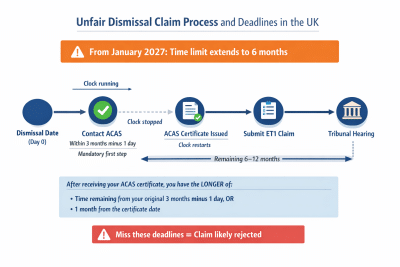
Before you can submit a claim to the Employment Tribunal, you must first contact ACAS to start Early Conciliation. This is mandatory. The time spent in Early Conciliation (up to 6 weeks) pauses the clock on your time limit, giving you additional time to submit your claim after ACAS issues a certificate.
Use our time limits calculator to work out your deadline.
Tribunals can only extend time limits in exceptional circumstances where it was “not reasonably practicable” for you to claim in time. This is a high bar; not knowing your rights or waiting to see if things improve will rarely be sufficient.
From 2027, the time limit for unfair dismissal claims will extend to 6 months under the Employment Rights Act 2025.
How is unfair dismissal compensation calculated?
If you win your unfair dismissal claim, the tribunal awards compensation in two parts: a basic award and a compensatory award.
The headline limits that apply to your claim depend on the effective date of termination. The summary below shows what’s in force now and what changes under the Employment Rights Act 2025.
| Limit | Pre-6 April 2026 | From 6 April 2026 (current) | From 1 January 2027* |
|---|---|---|---|
| Week’s pay cap | £719 | £751 | Continues to apply, with annual RPI adjustment each April |
| Maximum basic award | £21,570 | £22,530 | Basic award formula unchanged (30 × week’s pay cap) |
| Maximum compensatory award | £118,223 | £123,543 (or 52 weeks’ pay if lower) | Cap abolished — compensation uncapped |
Basic award
The basic award is calculated using the same formula as statutory redundancy pay:
- 0.5 weeks’ pay for each complete year of service when you were under 22
- 1 week’s pay for each complete year of service when you were aged 22 to 40
- 1.5 weeks’ pay for each complete year of service when you were 41 or over
A week’s pay is capped at £751 (from April 2026), even if you earned more. The maximum basic award is therefore £22,530 (30 weeks at £751).
Compensatory award
The compensatory award aims to compensate you for financial losses caused by the dismissal. Under section 123 of the ERA 1996, the tribunal awards what it considers “just and equitable” having regard to your loss.
This typically includes:
- Past loss of earnings: The income you have lost between dismissal and the tribunal hearing
- Future loss of earnings: Ongoing losses if you have not found equivalent employment
- Loss of statutory rights: Usually £350-£500 to reflect the fact you must rebuild qualifying service in a new job
- Loss of pension contributions: Employer pension contributions you have lost
- Other expenses: Such as job search costs
The compensatory award is currently capped at the lower of 52 weeks’ pay or £123,543 (from April 2026). However, this cap does not apply to whistleblowing or health and safety dismissals, where compensation is uncapped.
From January 2027, the compensation cap is being abolished entirely under the Employment Rights Act 2025, bringing ordinary unfair dismissal in line with discrimination and whistleblowing claims.
What is the average unfair dismissal payout?
According to the most recent tribunal statistics (2023/24), the median award for unfair dismissal is £6,746 and the average (mean) award is £13,749. The highest award during that period was £179,124, which would have been an uncapped case.
These figures only cover tribunal awards. Many cases settle before a hearing, often for different amounts. The average settlement is harder to track but is typically higher than the median tribunal award.
Reductions to compensation
Your compensation can be reduced in several circumstances.
Polkey deductions
A Polkey deduction (from Polkey v AE Dayton Services Ltd [1987] UKHL 8) reduces your compensatory award to reflect the chance that you would have been dismissed anyway, even if your employer had followed a fair procedure.
For example, if your dismissal was procedurally unfair but the tribunal believes there was a 70% chance you would have been fairly dismissed if proper procedures had been followed, it might reduce your compensatory award by 70%.
In some cases, a 100% Polkey reduction is made, meaning you receive no compensatory award (though you may still receive the basic award).

Contributory fault
If your own conduct contributed to your dismissal, the tribunal can reduce both your basic and compensatory awards by a percentage it considers just and equitable. Contributory fault can range from 0% to 100%.
Failure to mitigate
You have a duty to take reasonable steps to find alternative employment and reduce your losses. If you fail to apply for suitable jobs, turn down reasonable offers, or otherwise fail to mitigate your loss, the tribunal can reduce your compensatory award.
ACAS Code adjustments
As mentioned above, compensation can be adjusted by up to 25% for unreasonable failure to follow the ACAS Code, either by you or your employer.
Do you pay tax on unfair dismissal compensation?
The first £30,000 of compensation for unfair dismissal is normally tax-free, as it is treated as compensation for loss of employment.
However, any element that represents notice pay (whether contractual or statutory) is taxable as earnings. If you received payment in lieu of notice, this will usually be taxed.
Any amount of compensation over £30,000 is subject to income tax (but not National Insurance).
Settlement agreements
Many unfair dismissal disputes are resolved through settlement agreements rather than going to tribunal. A settlement agreement is a legally binding contract where you agree to give up your claims in exchange for a payment and sometimes other benefits.
For a settlement agreement to be valid, you must receive independent legal advice. Your employer will usually pay a contribution towards your legal fees for this advice.
Settlement agreements can be negotiated before you leave your job or after you have been dismissed. If you have a strong unfair dismissal claim, you may be able to negotiate a settlement without having to go through the stress and uncertainty of tribunal proceedings.
“The Employment Rights Act 2025 represents the most significant change to unfair dismissal law in decades. Reducing the qualifying period to six months and removing the compensation cap will fundamentally change the dynamics of employment relationships. Employers will need to treat every dismissal, from day one, as carrying significant legal risk.”
What is the difference between unfair and constructive dismissal?
Unfair dismissal occurs when your employer terminates your employment. Constructive dismissal occurs when you resign in response to your employer’s serious breach of contract.
In a constructive dismissal claim, you must prove that your employer committed a fundamental breach of contract (such as bullying, failure to pay wages, or unilaterally changing your terms), that you resigned in response to that breach, and that you did not wait too long before resigning (which might suggest you accepted the breach).
Constructive dismissal claims are generally harder to win because the burden of proof falls on you to establish the employer’s breach.

What is the difference between unfair and wrongful dismissal?
Wrongful dismissal is a common law claim for breach of contract. It usually arises when your employer dismisses you without giving the notice required by your contract.
The main difference is that wrongful dismissal compensates you for the notice period you should have received, while unfair dismissal compensates you for ongoing losses caused by the dismissal. You can claim both if applicable.
Wrongful dismissal claims do not require any minimum length of service.

How we can help
Our employment law solicitors have extensive experience representing employees in unfair dismissal claims. We can help you understand whether you have a claim, what it might be worth, and the best strategy for your situation.
We offer:
• Free initial assessment: Tell us about your situation and we’ll let you know if you have a viable claim
– No win no fee representation: For qualifying cases, you only pay if we win (see our no win no fee policy)
– Settlement negotiation: We can negotiate with your employer to achieve a fair settlement without tribunal proceedings
– Tribunal representation: If your case goes to tribunal, we provide expert representation throughout
Call us on 020 3835 3940 or use our online case assessment tool to get started.
💬 Been unfairly dismissed?
Our solicitors can assess your claim and advise on your options
Get Free Initial Advice →Frequently Asked Questions
How long do I have to claim unfair dismissal?
You must start ACAS Early Conciliation within 3 months minus 1 day from your dismissal date. The time limit extends to 6 months from January 2027 under the Employment Rights Act 2025. Missing this deadline usually means losing your right to claim.
What is the average payout for unfair dismissal in the UK?
According to Ministry of Justice tribunal statistics for 2023/24, the median award is £6,746 and the mean (average) is approximately £13,749. The maximum award was £179,124, which would have been an uncapped case such as whistleblowing. Settlements before tribunal often differ from these figures.
Can I claim unfair dismissal with less than 2 years’ service?
Currently, you need 2 years’ continuous service for ordinary unfair dismissal claims. However, automatically unfair dismissals (whistleblowing, pregnancy, health and safety, discrimination, asserting statutory rights) have no minimum service requirement. From January 2027, the qualifying period reduces to 6 months.
What qualifies as unfair dismissal?
A dismissal is unfair if your employer did not have a fair reason (conduct, capability, redundancy, illegality, or SOSR) or did not follow a fair procedure. The tribunal assesses whether dismissal fell within the range of reasonable responses available to a reasonable employer.
What is the Burchell test?
The Burchell test applies to misconduct dismissals. The employer must show: (1) genuine belief in the employee’s guilt, (2) reasonable grounds for that belief, and (3) a reasonable investigation. The employer does not need to prove guilt to a criminal standard.
What is a Polkey reduction?
A Polkey reduction (named after Polkey v AE Dayton Services Ltd [1987]) reduces your compensation if the tribunal believes you would have been dismissed anyway, even if your employer had followed a fair procedure. Reductions can range from 0% to 100%.
Do I pay tax on unfair dismissal compensation?
The first £30,000 of compensation is usually tax-free. However, any payment representing notice pay (contractual or statutory) is taxable as earnings. Amounts over £30,000 are subject to income tax.
How long does an unfair dismissal case take?
From starting ACAS Early Conciliation to a tribunal hearing typically takes 9-12 months, sometimes longer due to tribunal backlogs. Many cases settle before the hearing. Settlement negotiations can conclude in weeks if both parties are willing.
Important: This guide provides general information about unfair dismissal in the UK. It is not legal advice and should not be relied upon as such. Employment law is complex and the rules may apply differently depending on your circumstances. If you have been dismissed or are facing dismissal, we strongly recommend seeking professional legal advice.
Sources and Further Reading
Primary Legislation
- Employment Rights Act 1996, s.98 (fair and unfair dismissal)
- Employment Rights Act 1996, s.123 (compensatory award)
- Employment Rights Act 1996, s.111 (time limits)
- Employment Rights (Increase of Limits) Order 2025 (current statutory caps)
- Employment Rights Act 2025 (6-month qualifying period, uncapped compensation)
Official Guidance
- ACAS Code of Practice on Disciplinary and Grievance Procedures
- ACAS Guide to Dismissals
- GOV.UK: Employment Tribunals
Key Case Law
- British Home Stores Ltd v Burchell [1978] IRLR 379 (three-stage misconduct test)
- Polkey v AE Dayton Services Ltd [1987] UKHL 8 (procedural fairness)
- Iceland Frozen Foods v Jones [1982] IRLR 439 (range of reasonable responses)
Statistics
Tom Street
Tom Street is the principal solicitor at Tom Street & Co. Solicitors, specialising in employment law and tribunal claims. He regularly represents claimants in unfair dismissal, discrimination, and whistleblowing cases. View full profile