
Quick Summary
SOSR (“some other substantial reason”) is the fifth potentially fair reason for dismissal under section 98 of the Employment Rights Act 1996. It covers situations that don’t fit neatly into conduct, capability, redundancy, or statutory restriction. But SOSR being a “catch-all” doesn’t mean it’s a blank cheque for employers: the reason must be genuinely substantial, and the employer must still act reasonably, including following a fair process. If your employer has used SOSR to avoid a proper capability or conduct procedure, or to dress up what is really a redundancy, your dismissal may well be unfair.
⚖️ This guide is for general information only and is not legal advice. Every case is different. If you’re unsure about your situation, speak to a solicitor.
Key Points
Key Points
- ✓ SOSR is defined under section 98(1)(b) of the Employment Rights Act 1996 and has no statutory definition: its scope has been developed entirely through case law
- ✓ Common SOSR reasons include business reorganisation, breakdown in trust and confidence, refusal to accept new terms, conflict of interest, third-party pressure, and fixed-term contract expiry
- ✓ A potentially fair reason is only stage one. The employer must also act reasonably under section 98(4), including following a fair process
- ✓ Tribunals are alert to SOSR being used to avoid proper conduct or capability procedures, or to disguise what is really a redundancy
- ✓ If your SOSR dismissal was unfair, you can claim a basic award (up to £22,530) and a compensatory award (capped at £123,543 or 52 weeks’ pay, whichever is lower, from 6 April 2026)
- ✓ You have three months minus one day from your effective date of termination to start a claim. Contact Acas for early conciliation before submitting to the tribunal
⚖️ Legislation Update
Qualifying Period to Reduce to Six Months from January 2027
The Employment Rights Act 2025 will reduce the qualifying period for unfair dismissal protection from two years to six months’ continuous employment. This change is expected to take effect from 1 January 2027. Until then, you still need two years’ service to bring most unfair dismissal claims, including SOSR cases. If you don’t yet qualify, it may be worth checking whether your dismissal also involves an automatic unfair dismissal reason, which has no qualifying period.
When your employer dismisses you and can’t point to misconduct, poor performance, redundancy, or a legal bar to continued employment, they often reach for the label of “some other substantial reason” (SOSR). It sounds vague because it is. SOSR is deliberately open-ended: a catch-all category for situations that the legislators couldn’t anticipate and didn’t try to define.
But vague doesn’t mean unchallenged. Employers who invoke SOSR still have to satisfy a tribunal on two counts: that there genuinely was a substantial reason for the dismissal, and that they acted reasonably in treating it as sufficient to justify dismissal. Many SOSR dismissals fail on one or both of those tests. If yours is one of them, you have a claim for unfair dismissal.
The Legal Framework: What Section 98 Actually Says
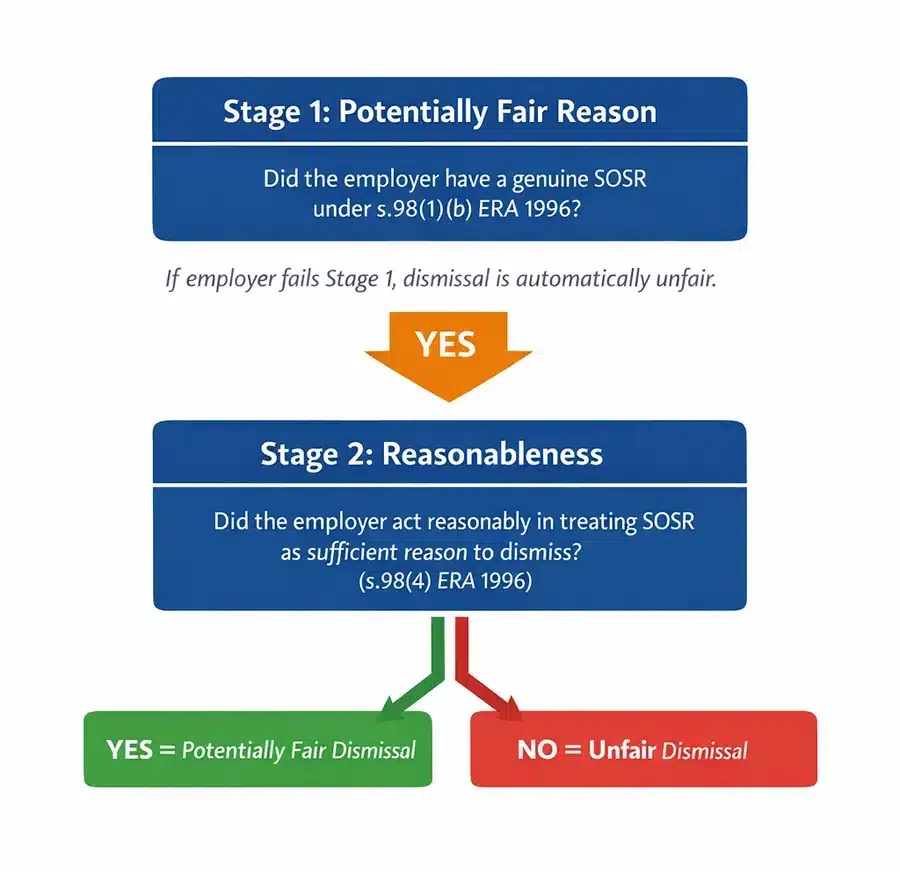
Under section 98 of the Employment Rights Act 1996 (ERA 1996), dismissal is only potentially fair if the employer can show it fell within one of five specified reasons:
- Conduct (misconduct or gross misconduct)
- Capability (performance or health)
- Redundancy
- Contravention of a statutory restriction (where continued employment would break the law)
- Some other substantial reason (SOSR) justifying dismissal of an employee holding the position the employee held
The first four are defined and relatively well-understood. SOSR, established under section 98(1)(b), is not. Parliament left it deliberately open so that tribunals could recognise genuinely substantial reasons that don’t map onto the other categories. Decades of case law have given SOSR some shape, but it remains the most fact-sensitive and context-dependent of the five fair reasons.
Establishing a potentially fair reason under section 98(1)(b) is only stage one. Stage two is the reasonableness test in section 98(4). The tribunal asks whether, in all the circumstances, the employer acted reasonably in treating SOSR as sufficient to justify dismissal. That assessment includes the size and resources of the employer, the procedure followed, and whether dismissal fell within the range of reasonable responses open to an employer in that position. The landmark authority on the range of reasonable responses is Iceland Frozen Foods Ltd v Jones [1982] IRLR 439, and it applies to SOSR cases just as it does to conduct and capability.
One other important rule: where the facts of a case fall squarely within one of the other four categories (conduct, capability, redundancy, statutory restriction), the employer cannot use SOSR as an alternative label. SOSR occupies its own space. It doesn’t provide a route around the procedural obligations that attach to the other categories.
The Seven Most Common SOSR Reasons
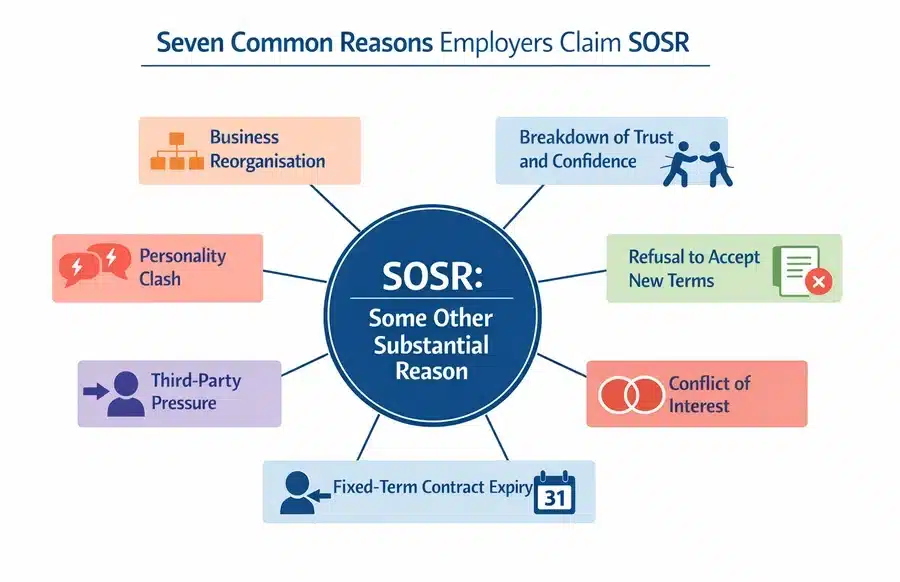
The following reasons have been accepted by tribunals and courts as capable of amounting to SOSR. This is not a closed list, but these are the situations you’re most likely to encounter.
1. Business Reorganisation Not Amounting to Redundancy
Employers sometimes restructure the business in ways that change roles or reporting lines but don’t reduce the overall need for employees. Where there’s no redundancy situation, they rely on SOSR instead. The test, confirmed in Cobley v Forward Technology Industries plc [2003] EWCA Civ 646, is whether there was a sound, good business reason for the reorganisation. A legitimate reorganisation can justify SOSR dismissal if the employer acted reasonably in implementing it and genuinely consulted with the employee about the changes.
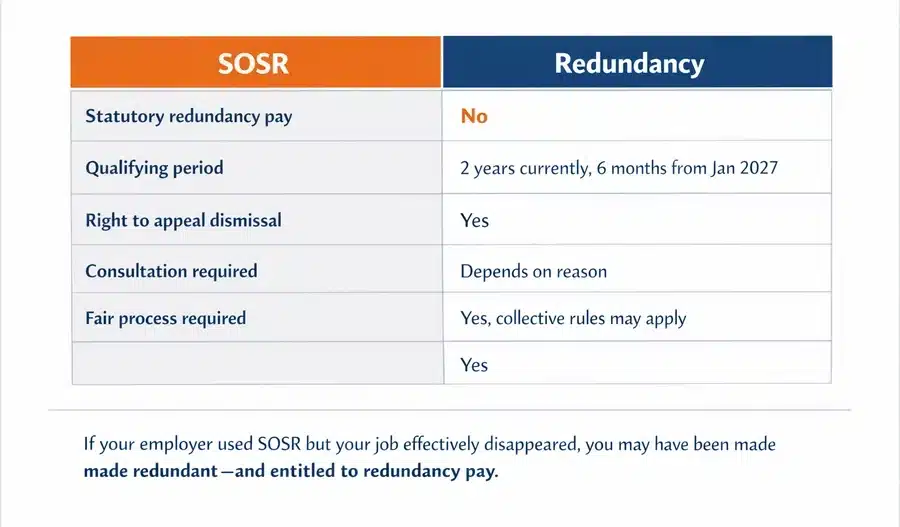
The critical point for employees is this: if the real effect of the reorganisation is that your job has effectively disappeared, or the need for your type of work has genuinely diminished, that’s likely to be redundancy, not SOSR. The distinction matters enormously because redundancy entitles you to statutory redundancy pay; SOSR does not. Tribunals know this and look carefully at what actually happened.
2. Breakdown in Trust and Confidence
The most commonly litigated SOSR category. Where the relationship between employer and employee has broken down to the point where it cannot reasonably continue, that breakdown can amount to SOSR. The leading cases here include Perkin v St George’s Healthcare NHS Trust [2005] EWCA Civ 1174, where the Court of Appeal held that a senior employee’s poor interpersonal style had made continued employment genuinely untenable, and the dismissal was fair even though Perkin had not committed any single act of misconduct.
The employer cannot simply assert that trust has gone and treat SOSR as established. The breakdown must be genuine and substantive, not a label applied to avoid managing a conduct or performance problem properly. In Ezsias v North Glamorgan NHS Trust [2007] EWCA Civ 330, the Court of Appeal made clear that the tribunal is entitled to look behind the employer’s stated reason and examine the real situation. If the employer is using “loss of trust and confidence” as a shorthand for frustration with an employee they haven’t managed properly, the SOSR reason may not be made out at all.
Even where SOSR is established, the employer must still follow a fair process. The Employment Appeal Tribunal confirmed in Governing Body of Tubbenden Primary School v Sylvester [UKEAT/0527/11/LA] that where dismissal is based on a breakdown of trust, the tribunal is not confined to checking that a breakdown occurred. It can and should consider the history of the relationship, whether the employer contributed to the breakdown, and whether a fair procedure was followed before dismissal.
3. Refusal to Accept Changes to Terms and Conditions
Where an employer has a genuine business reason for changing the terms of employment and an employee refuses to accept the new terms, dismissal can be SOSR. The employer dismisses on the old terms and offers re-engagement on the new ones. The tribunal then considers whether there was a sound business reason for the proposed change, whether the employer consulted properly, and whether it acted reasonably overall.
The classic authority is RS Components Ltd v Irwin [1973] ICR 535, which established that an employer can require employees to sign a restrictive covenant to protect legitimate business interests, and refusal to do so can be SOSR. But the principle extends beyond restrictive covenants: pay cuts, change of hours, relocation, and changes to shift patterns have all been the subject of SOSR cases where employees refused to accept the variation.
One thing to watch: if the employer is trying to impose a fundamental change to your contract without your agreement, you may have a constructive dismissal claim if you resign. But if you stay and resist, and then get dismissed, the SOSR route is what the employer will take. The strength of your position depends on how genuine the business need was and how properly the employer managed the process.
4. Conflict of Interest and Protecting Business Information
Where an employee has a relationship with a competitor, works for a rival in their spare time, or has access to confidential information that creates a genuine commercial risk, dismissal may be SOSR. The employer needs to show more than a theoretical concern: there must be a real and tangible risk to the business.
Tribunals look at the employee’s actual access to sensitive information, the closeness of the competing relationship, and whether the employer explored options short of dismissal. Simply asserting that any connection with a competitor justifies dismissal is unlikely to satisfy the reasonableness test. The employer must consider whether redeployment to a less sensitive role, or an agreement to terminate the outside work, could address the risk.
5. Expiry of a Fixed-Term Contract
The termination of a fixed-term contract counts as a dismissal. Where redundancy doesn’t apply (for example, because the contract was covering a permanent employee’s absence on maternity or long-term sick leave, and there was never any reduction in the overall need for workers), the expiry of the contract may be SOSR.
For SOSR to apply here, the employee must have been informed at the outset that the role was temporary and tied to the particular circumstances. Where that was clearly communicated and understood, tribunals are generally willing to find that expiry of the contract was a substantial reason. Where the employer simply avoided using the redundancy label to avoid paying statutory redundancy pay, the picture is different.
6. Third-Party Pressure
In Chubb Fire Security Ltd v Harper [1983] IRLR 311, the EAT confirmed that pressure from a client or customer to remove a particular employee from a contract can, in some circumstances, amount to SOSR. The employer must show that the demand was genuine, that it carried real commercial consequences if ignored, and that it acted reasonably in response to it. Tribunals look closely at whether the employer could have resisted the pressure, whether it investigated the reasons behind it, and whether there were other options available. Simply passing on a client’s demand and dismissing without further enquiry is unlikely to satisfy the reasonableness test.
7. Personality Clashes and Irretrievable Relationship Breakdown
Where the working relationship between an employee and their manager or colleagues has broken down irrecoverably, and the breakdown is not attributable to any specific misconduct, SOSR may apply. This is closely related to trust and confidence SOSR but tends to focus more on interpersonal incompatibility than on a loss of faith in the employee’s character or integrity.
Tribunals expect employers to have made genuine efforts to resolve the conflict before resorting to dismissal. Where the personality clash is between two individuals and the employer makes no attempt at mediation, adjustment of responsibilities, or redeployment, it will be difficult to show that dismissal was within the range of reasonable responses.
The Reasonableness Test: Stage Two
Establishing a potentially fair reason is just the beginning. Section 98(4) of the ERA 1996 requires the tribunal to decide whether the employer acted reasonably in all the circumstances in treating SOSR as a sufficient reason for dismissal. This is evaluated by reference to equity and the substantial merits of the case.
Two things matter most at this stage. First, procedure: did the employer explain the situation to the employee, give them an opportunity to respond, and consider alternatives to dismissal? The Acas Code of Practice on Disciplinary and Grievance Procedures doesn’t technically apply to all SOSR cases (it’s aimed at conduct and capability), but the principle of a fair process carries weight in every dismissal context. Tribunals expect employers to at least inform the employee of the problem, hear their response, and consider whether dismissal is truly necessary.
Second, proportionality: was dismissal the right outcome? Even where SOSR exists, the tribunal asks whether a reasonable employer in the same circumstances could have treated it as sufficient reason to dismiss. Where less drastic alternatives existed and the employer didn’t consider them, that weighs against the dismissal being fair.
When SOSR Becomes Unfair Dismissal

SOSR dismissals fail at tribunal for three main reasons.
Using SOSR to Avoid Proper Conduct or Capability Procedures
The law is clear: where the facts of a case fall within one of the other four categories, the employer cannot use SOSR as an alternative route. If the real reason for your dismissal was poor performance or a specific act of misconduct, your employer should have followed a proper capability or disciplinary procedure, with written warnings, a formal meeting, and a right of appeal. Dressing it up as a “breakdown of trust” or a “business need” to avoid those obligations is exactly what tribunals look for when scrutinising SOSR cases.
The same applies where an employer faces an employee with a long-term health issue and chooses to dismiss for “trust breakdown” rather than managing it through a proper capability process with medical evidence. In McAdie v Royal Bank of Scotland [2007] EWCA Civ 1126, the Court of Appeal addressed the tension between SOSR and capability in stress-related cases, confirming that the label chosen by the employer doesn’t determine the outcome: the tribunal examines what was really going on.
Business Reorganisation That’s Actually Redundancy
This is one of the most significant disputes in SOSR cases. If your employer has used SOSR to dismiss you as part of a restructure, but the real effect is that the need for your work has diminished, your role has disappeared, or you are one of a number of people whose jobs are at risk, the correct categorisation is redundancy. Redundancy brings statutory redundancy pay; SOSR does not. A tribunal that finds the employer mislabelled a redundancy as SOSR may award redundancy pay alongside any unfair dismissal compensation.
Failure to Follow a Fair Process
Even where SOSR is a legitimate and genuine reason, procedural failures can turn a potentially fair dismissal into an unfair one. Failing to warn the employee, refusing to allow them to respond, not considering alternatives, or simply announcing the decision as a fait accompli are all procedural failings that the tribunal will take into account.
Where the process was unfair but the outcome probably would have been the same regardless, the tribunal may apply a Polkey reduction, reducing your compensation to reflect the chance that a fair procedure would have made no difference. However, where the employer never gave you a fair hearing at all, the tribunal has broad discretion on how far to apply that reduction.
“SOSR is the category employers reach for when they know they haven’t got a clean conduct or capability case. Sometimes the reason is genuine and I’ll tell a client honestly that the employer had a point. But often what we find is a performance issue that was never properly managed, or a redundancy the employer didn’t want to pay for. The label doesn’t matter. What matters is what actually happened.”

What Compensation Can You Claim?
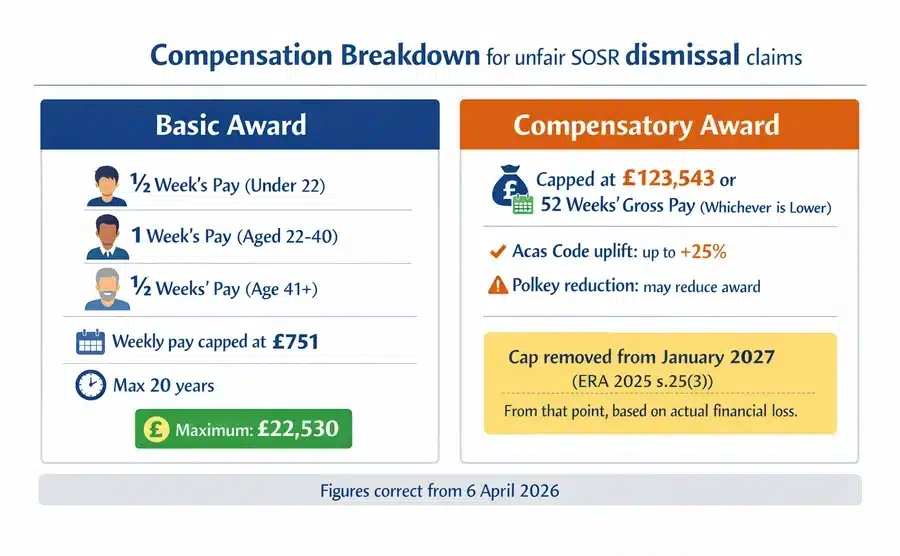
SOSR is an ordinary unfair dismissal. It doesn’t carry the uncapped compensation available in whistleblowing or discrimination cases. The standard compensation framework applies.
Basic award: Calculated the same way as statutory redundancy pay. You receive half a week’s pay for each full year of service under the age of 22, one week’s pay for each year aged 22 to 40, and one and a half week’s pay for each year aged 41 and over. The weekly pay is capped at £751 (from 6 April 2026), service is capped at 20 years, and the maximum basic award is £22,530.
Compensatory award: This is intended to compensate you for your actual financial loss: loss of earnings from dismissal to the tribunal hearing, future loss of earnings if you haven’t found equivalent work, and loss of statutory rights. It is currently capped at the lower of £123,543 or 52 weeks’ gross pay (figures from 6 April 2026). Under section 25(3) of the Employment Rights Act 2025, the statutory cap on the compensatory award is due to be removed entirely from January 2027. If that change is in force when your case is decided, uncapped compensation based on actual loss will apply.
Acas Code uplift: If your employer unreasonably failed to follow the Acas Code of Practice, the tribunal can increase your award by up to 25%. Where you unreasonably failed to follow it, the award can be reduced by the same amount.
Polkey reduction: If the tribunal finds that a fair procedure would not necessarily have led to a different outcome, it may reduce the compensatory award to reflect the percentage chance that dismissal would have occurred anyway. This is the employer’s main defence in SOSR cases where the reason was genuine but the process was flawed.
💬 Think your SOSR dismissal was unfair?
Our employment solicitors can assess your case and advise on your options. Initial advice is free.
Get Free Initial Advice →Time Limits: How Long Do You Have?
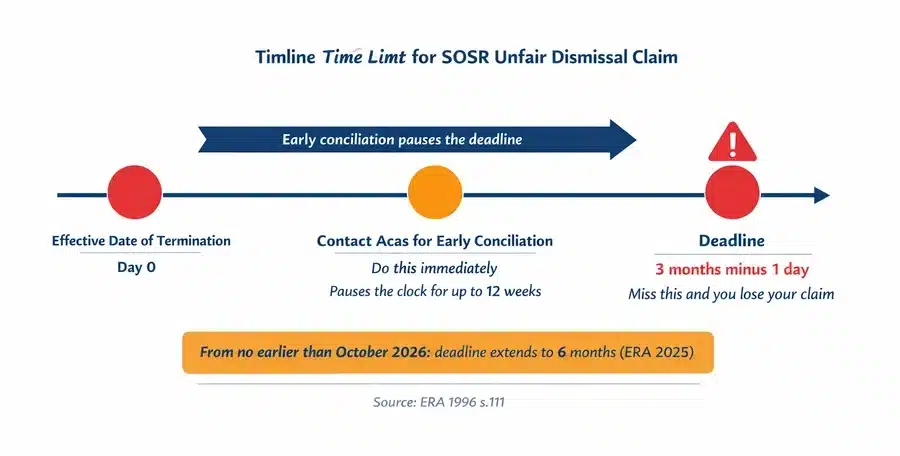
You have three months minus one day from your effective date of termination to present a claim to the employment tribunal (ET). If your last day of employment was 16 April 2026, your deadline is 15 July 2026. Missing this deadline is usually fatal to your claim; tribunals grant extensions only where it was not reasonably practicable to comply in time.
Before you can submit your ET1 claim form, you must contact Acas (the Advisory, Conciliation and Arbitration Service) for early conciliation. Early conciliation pauses the time limit for up to 12 weeks while Acas attempts to broker a settlement. You receive a certificate from Acas when conciliation ends, and you can then submit your claim. The time lost during early conciliation is added back onto your deadline.
If you’re unsure whether you still have time, don’t wait. Speak to a solicitor now. Delays in getting advice are one of the most common reasons people lose valid claims.
Upcoming change: The Employment Rights Act 2025 will extend the time limit for most employment tribunal claims from three months to six months. This change is expected to take effect no earlier than October 2026. Until then, the three-month limit applies.
Frequently Asked Questions
What does SOSR mean in employment law?
SOSR stands for “some other substantial reason.” It is one of the five potentially fair reasons for dismissal under section 98(1)(b) of the Employment Rights Act 1996. It covers dismissals that don’t fall within conduct, capability, redundancy, or statutory restriction. The term has no statutory definition and its scope has been developed through case law over several decades.
Can I be fairly dismissed for SOSR?
Yes. SOSR is a potentially fair reason for dismissal, and tribunals do uphold SOSR dismissals where the reason was genuinely substantial and the employer acted reasonably. However, a potentially fair reason is only half the test. The tribunal also examines whether the employer acted reasonably in treating SOSR as sufficient to justify dismissal, including whether a fair process was followed. Many SOSR dismissals are found to be unfair because the employer failed on the reasonableness stage.
Is SOSR dismissal the same as redundancy?
No, and the distinction matters. Redundancy requires a diminished need for the work itself. Where a business reorganisation doesn’t reduce headcount but changes roles, some employers use SOSR rather than redundancy. If your employer used SOSR but the real effect was that your job effectively disappeared, a tribunal may find you were actually made redundant, which would entitle you to statutory redundancy pay. If you think your dismissal might have been a disguised redundancy, get legal advice.
What procedure does my employer have to follow for an SOSR dismissal?
The Acas Code of Practice on Disciplinary and Grievance Procedures applies directly to conduct and capability dismissals. For SOSR, the position is more nuanced: the Code may not technically apply to every SOSR situation, but tribunals expect employers to follow a fair process regardless. At a minimum, the employer should explain the situation to the employee, give them an opportunity to respond, and genuinely consider alternatives to dismissal before deciding. Failure to do so will weigh heavily against the employer at tribunal.
How much compensation can I get for an unfair SOSR dismissal?
An unfair SOSR dismissal is an ordinary unfair dismissal, so the standard compensation framework applies. This consists of a basic award (up to £22,530) and a compensatory award currently capped at the lower of £123,543 or 52 weeks’ gross pay (from 6 April 2026). That cap is due to be removed entirely from January 2027 under the Employment Rights Act 2025, so cases decided after that point will be assessed on actual financial loss. Compensation may also be increased by up to 25% if your employer unreasonably failed to follow the Acas Code, or reduced if the tribunal finds that a fair procedure might not have changed the outcome. Use our unfair dismissal compensation guide for more detail.
Do I need two years’ service to challenge an SOSR dismissal?
For most SOSR cases, yes: you currently need two years’ continuous employment to bring an ordinary unfair dismissal claim. That threshold will reduce to six months from January 2027 under the Employment Rights Act 2025. The exception is if your dismissal also falls within an automatic unfair dismissal category (such as whistleblowing, pregnancy, or exercising a statutory right), which carries no qualifying period regardless of length of service.
Can SOSR be used to dismiss an employee who refuses a pay cut?
Potentially, yes. Where an employer has a genuine business reason for changing terms and conditions and the employee refuses, dismissal for SOSR can be fair. However, the employer must show that the business reason was real, that it consulted the employee properly, and that dismissal was a proportionate response. If the business reason was weak or fabricated, or the employer went straight to dismissal without consultation, the tribunal is likely to find the dismissal unfair.
💬 Been dismissed for SOSR?
Speak to our employment solicitors for a free initial assessment of your claim. We work on a no win no fee basis.
Get Free Initial Advice →Important: This guide provides general information about SOSR dismissals under UK employment law. It is not legal advice and should not be relied upon as such. Employment law is complex and the rules may apply differently depending on your individual circumstances. If you have been dismissed and are considering bringing a claim, we strongly recommend seeking professional legal advice as soon as possible, given the strict time limits that apply.
Sources and Further Reading
Primary Legislation
- Employment Rights Act 1996, section 98 (potentially fair reasons for dismissal, including SOSR)
- Employment Rights Act 1996, section 111 (time limit for unfair dismissal claims)
- Employment Rights Act 1996, sections 119-124 (basic and compensatory award calculation)
- Employment Rights Act 2025 (qualifying period reduction from January 2027, time limit extension from no earlier than October 2026)
Official Guidance
Key Case Law
- Iceland Frozen Foods Ltd v Jones [1982] IRLR 439 (EAT: range of reasonable responses test)
- RS Components Ltd v Irwin [1973] ICR 535 (NIRC: early authority on SOSR; refusal to sign restrictive covenant)
- Cobley v Forward Technology Industries plc [2003] EWCA Civ 646 (Court of Appeal: business reorganisation as SOSR)
- Perkin v St George’s Healthcare NHS Trust [2005] EWCA Civ 1174 (Court of Appeal: breakdown of trust, senior employee)
- Ezsias v North Glamorgan NHS Trust [2007] EWCA Civ 330 (Court of Appeal: tribunal entitled to look behind SOSR label)
- McAdie v Royal Bank of Scotland [2007] EWCA Civ 1126 (Court of Appeal: stress-related dismissal, SOSR and capability)
- Governing Body of Tubbenden Primary School v Sylvester [UKEAT/0527/11/LA] (EAT: fair procedure required even in trust breakdown SOSR)
- Chubb Fire Security Ltd v Harper [1983] IRLR 311 (EAT: third-party pressure as SOSR)
- Polkey v AE Dayton Services Ltd [1987] UKHL 8 (House of Lords: procedural failures and compensation reduction)
Tom Street
Tom Street is the principal solicitor at Tom Street & Co. Solicitors, specialising in employment law and tribunal claims. He regularly represents claimants in unfair dismissal, discrimination, and whistleblowing cases. View full profile