
Quick Summary
If you’re facing a disciplinary at work, your employer must follow a fair process. The Acas Code of Practice sets out the minimum steps they should take. You have a legal right to be accompanied at disciplinary hearings, and if your employer gets the process wrong, any dismissal that follows could be unfair. A tribunal can increase your compensation by up to 25% if your employer unreasonably fails to follow the Acas Code.
⚖️ This guide is for general information only and is not legal advice. Every case is different. If you’re facing a disciplinary and unsure of your rights, speak to a solicitor.
Key Points
- ✓ Every employer must follow a fair disciplinary procedure before dismissing you or issuing a formal warning
- ✓ The Acas Code of Practice sets the minimum standard. Tribunals can increase compensation by up to 25% if your employer unreasonably fails to follow it
- ✓ You have a statutory right to be accompanied at any disciplinary hearing by a colleague or trade union representative
- ✓ A proper disciplinary involves investigation, written notification, a hearing, a decision, and the right of appeal
- ✓ If you’re dismissed following a flawed procedure, you may have a claim for unfair dismissal
- ✓ From 1 January 2027, the qualifying period for unfair dismissal claims drops from two years to six months
⚖️ Legislation Update
Unfair Dismissal Qualifying Period Drops to Six Months from January 2027
The Employment Rights Act 2025 reduces the qualifying period for ordinary unfair dismissal from two years to six months, effective 1 January 2027. The statutory cap on compensatory awards (currently £123,543 or 52 weeks’ pay) will also be abolished. This means fair disciplinary procedures are more important than ever: millions more employees will be protected, and the financial consequences for employers who get it wrong will be significantly greater.
What Is a Disciplinary Procedure?
A disciplinary procedure is the formal process your employer should follow when they have concerns about your conduct or performance at work. It might be triggered by anything from persistent lateness to allegations of gross misconduct.
The procedure exists to make sure both sides are treated fairly. Your employer gets a structured way to address problems, and you get the chance to understand what you’re accused of, respond to the allegations, and challenge any decision you disagree with.
Under section 3 of the Employment Rights Act 1996, employers are required to provide employees with details of their disciplinary rules and procedures. Many employers include these in their staff handbook or employment contract. If your employer’s procedure is written into your contract, they’re contractually bound to follow it, and a failure to do so could give you a claim for breach of contract on top of any unfair dismissal claim.
There’s a critical distinction between misconduct (behavioural issues) and capability (performance or health-related issues). Some employers use the same procedure for both; others have a separate capability process. Either way, the fundamental principles of fairness still apply.
The Acas Code of Practice
The Acas Code of Practice on Disciplinary and Grievance Procedures is the single most important document when it comes to workplace disciplinaries. Issued under section 199 of the Trade Union and Labour Relations (Consolidation) Act 1992, the current version came into effect on 11 March 2015.
The Code is not technically law. Your employer won’t face prosecution for failing to follow it. But employment tribunals are required to take it into account when deciding relevant cases, and the practical consequences of ignoring it are severe.
Under section 207A of TULRCA 1992, if your employer unreasonably fails to follow the Acas Code and you bring a successful tribunal claim, the tribunal can increase your compensation by up to 25%. The same rule works in reverse: if you unreasonably fail to follow the Code (for example, by refusing to engage with the process), the tribunal can reduce your award by the same amount.
The Code sets out several core principles that your employer should follow. They should raise and deal with issues promptly, without unreasonable delay. They should carry out a proper investigation to establish the facts. They should inform you of the problem and give you a chance to respond before making any decision. And they should allow you to appeal.
“The Acas Code might look like a short document, but it carries real weight. I regularly see employers who have their own detailed disciplinary policy and then completely fail to follow it. That’s one of the quickest routes to an unfair dismissal finding, because the tribunal will hold them to their own standards as well as the Code.”

Step by Step: What Should Happen During a Disciplinary

A fair disciplinary procedure follows a logical sequence. Each stage has a purpose, and cutting corners at any point can undermine the entire process. Here’s what should happen.
Stage 1: The Investigation
Before any formal action is taken, your employer should carry out a reasonable investigation to establish the facts. This is not optional. The Acas Code states clearly that employers should establish the facts before taking action.
An investigation might involve interviewing witnesses, reviewing documents or emails, checking CCTV footage, or examining timesheets. Where practicable, the investigation should be carried out by a different person from whoever will chair the disciplinary hearing. This helps ensure the hearing is fair and the decision-maker approaches the evidence with an open mind.
There is no statutory right to be accompanied at an investigation meeting. The Acas Code does not require it either. Some employers do allow it as a matter of good practice, and if you have a disability or are otherwise vulnerable, it may be reasonable to request a companion even at this stage.
Your employer should keep records of the investigation, including witness statements and any evidence gathered. You should be given access to this evidence before the disciplinary hearing.
Stage 2: Written Notification
If the investigation finds that there is a case to answer, your employer should write to you setting out the allegations. This letter is important. It should include enough detail for you to understand exactly what you are accused of and to prepare your response.
The notification should tell you the date, time, and location of the disciplinary hearing. It should include copies of any evidence the employer intends to rely on. And it should make clear what the potential consequences are, including whether dismissal is a possibility. If the letter says the outcome could be a written warning but your employer then dismisses you, that can undermine the fairness of the whole process.
You should be given reasonable time to prepare. There’s no set rule about how long “reasonable” is, but a day or two is unlikely to be enough if the allegations are serious or the evidence is complex.
Stage 3: The Disciplinary Hearing
The hearing is your opportunity to respond to the allegations. It should be conducted by someone with the authority to make a decision, and, ideally, by someone who was not involved in the investigation.
You have a statutory right to be accompanied at the hearing under section 10 of the Employment Relations Act 1999. We cover this in detail below.
During the hearing, you should be allowed to set out your case, ask questions, call witnesses if appropriate, and respond to the evidence against you. The hearing should not be a rubber-stamping exercise where the decision has already been made. If you get the impression that your employer has already decided the outcome, make a note of anything that suggests this, because it will be relevant if the matter ends up at tribunal.
Stage 4: The Decision
After the hearing, your employer should take time to consider all the evidence before reaching a decision. Decisions should not be made on the spot during the hearing itself.
The possible outcomes of a disciplinary process typically include no further action, a verbal warning, a first written warning, a final written warning, or dismissal. In cases of gross misconduct, your employer may decide to dismiss you without notice (summary dismissal), but even then, they must still follow a fair procedure first.
The outcome should be communicated to you in writing. The letter should explain the decision, the reasons behind it, and any action being taken. If a warning is issued, the letter should state how long the warning will remain on your record. It must also set out your right to appeal and explain how to exercise it.
Stage 5: The Right of Appeal
You should always be offered the right to appeal a disciplinary decision. This is one of the most important safeguards in the process. The Acas Code makes clear that employees should have the opportunity to appeal, and failing to offer one is a common route to a finding of unfair dismissal.
The appeal should, where possible, be heard by someone more senior who was not involved in the original decision. This means a fresh pair of eyes looks at the case. An appeal can consider both the decision itself and whether the procedure was properly followed.
If you are thinking about bringing a tribunal claim, it’s important to exhaust the appeal process first. Failing to appeal when you had the opportunity to do so can result in a tribunal reducing your compensation, even if your employer was clearly in the wrong.
Your Right to Be Accompanied
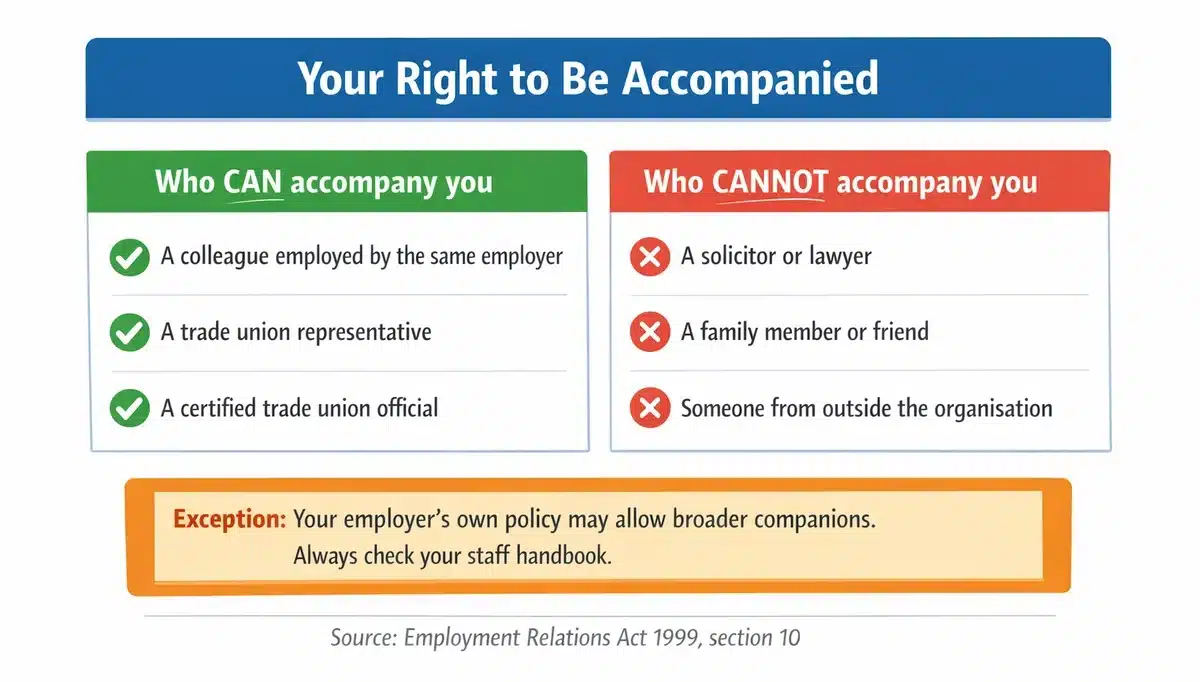
Under section 10 of the Employment Relations Act 1999, you have a statutory right to be accompanied at any disciplinary hearing that could result in a formal warning or dismissal. The same right applies to grievance hearings.
Your companion must be either a fellow worker employed by the same employer, or a trade union representative. A trade union representative can be either an official employed by the union or someone the union has certified in writing as having experience of acting as a companion. You cannot bring a solicitor, family member, or friend unless your employer’s own policy allows it.
Your companion is permitted to address the hearing on your behalf and to confer with you during the hearing. They are not, however, allowed to answer questions on your behalf. In practice, a good companion can make a real difference: they can present your case, sum up your arguments, and provide moral support during what is often a stressful experience.
If your chosen companion is not available at the time proposed for the hearing, your employer must postpone it. Under section 10(4) and (5), you can propose an alternative time, provided it is reasonable and falls within five working days of the original date.
The case of Talon Engineering Ltd v Smith is worth knowing about. The Employment Appeal Tribunal held that while the employer was within its rights under the statutory five-day rule to refuse a postponement, refusing the postponement was still unfair when considering the overall reasonableness of the dismissal under section 98(4) of the Employment Rights Act 1996. The lesson is that technical compliance with the statute is not always enough; the tribunal looks at the bigger picture of fairness.
If your employer refuses to allow you to be accompanied, you can bring a complaint to an employment tribunal. Compensation for this specific breach is up to two weeks’ pay. More significantly, if you are dismissed for exercising or seeking to exercise your right to be accompanied, that dismissal is automatically unfair under section 12 of the Employment Relations Act 1999, with no qualifying period required.
Suspension During Disciplinary Proceedings
Your employer may decide to suspend you while the disciplinary investigation takes place. This is particularly common in cases involving allegations of gross misconduct, or where your continued presence in the workplace might interfere with the investigation or pose a risk to colleagues.
Suspension should always be on full pay unless your contract explicitly provides otherwise. It should not be used as a punishment. The Acas guidance is clear: suspension is a neutral act, not a disciplinary sanction.
That said, suspension can feel anything but neutral. Being told to leave the workplace, hand over your laptop, and stay away from colleagues is deeply unsettling, even if it’s described as a precautionary measure. Employers should only suspend when it is genuinely necessary, and they should keep the period of suspension as short as possible.
If your employer suspends you without reasonable grounds, or suspends you for an unreasonably long period without reviewing whether suspension is still necessary, this could amount to a breach of the implied term of mutual trust and confidence. That, in turn, could give you grounds for a constructive dismissal claim.
What If Your Employer Gets It Wrong?
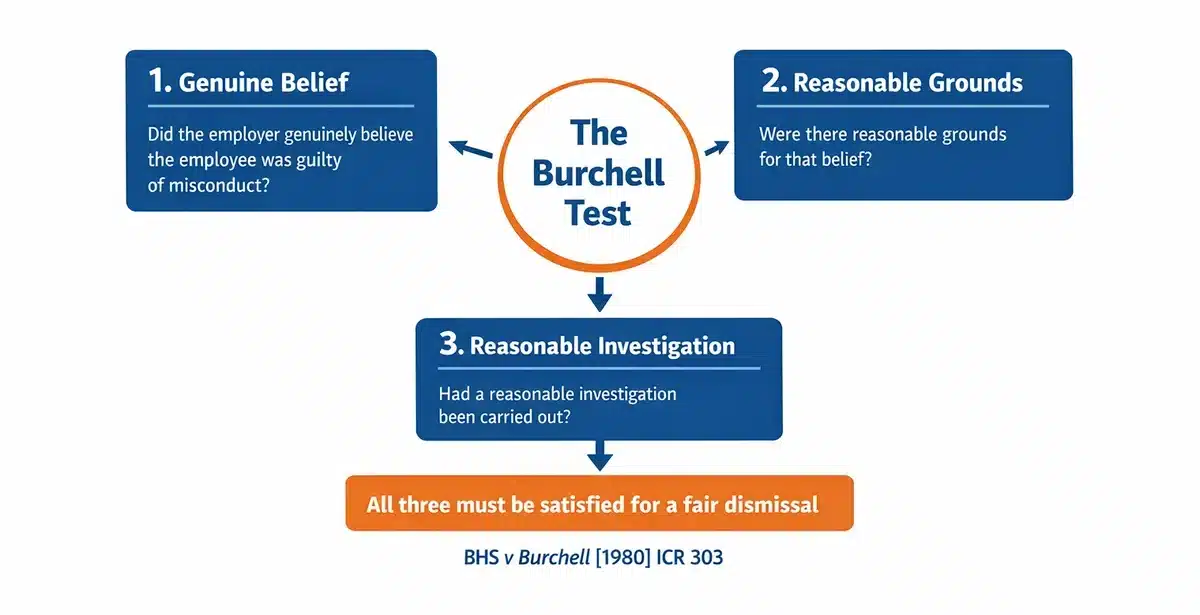
When a disciplinary procedure leads to dismissal and the employee believes the process was flawed, the tribunal applies a well-established test to decide whether the dismissal was fair.
The starting point is the Burchell test, established in British Home Stores Ltd v Burchell [1980] ICR 303. The tribunal asks three questions about the employer’s conduct:
- Did the employer genuinely believe the employee was guilty of misconduct?
- Did the employer have reasonable grounds for that belief?
- Had the employer carried out as much investigation as was reasonable in the circumstances at the time the belief was formed?
The tribunal does not retry the case or decide whether the employee was actually guilty. What matters is whether the employer acted reasonably in forming its belief, based on a reasonable investigation. The standard is the balance of probabilities, not the criminal standard of proof.
Alongside the Burchell test, the tribunal applies the “range of reasonable responses” test from Iceland Frozen Foods Ltd v Jones [1982] IRLR 439. This means the tribunal does not ask whether it would have dismissed the employee, but whether the decision to dismiss fell within the range of responses that a reasonable employer might have taken. Different reasonable employers might reach different conclusions on the same facts.
Procedural fairness is equally important. Even if your employer had good reason to believe you were guilty of misconduct, a failure to follow a fair procedure can still make the dismissal unfair. Common procedural failings include:
- Not investigating properly before moving to a hearing
- Failing to provide you with the evidence against you in advance
- Denying your right to be accompanied
- Having the same person investigate and chair the hearing
- Pre-determining the outcome before the hearing takes place
- Not offering you the right to appeal
Where the employer unreasonably fails to follow the Acas Code, the tribunal can apply a 25% uplift to your compensation. In Slade v Biggs, the Employment Appeal Tribunal confirmed that the maximum 25% uplift can apply to injury to feelings and aggravated damages awards as well, and endorsed a four-step approach for tribunals when calculating the appropriate uplift.
When a Disciplinary Can Lead to Unfair Dismissal
Under section 98 of the Employment Rights Act 1996, an employer must show both a potentially fair reason for dismissal and that they acted reasonably in treating that reason as sufficient to justify dismissal. Conduct is one of the five potentially fair reasons listed in section 98(2)(b).
To bring an ordinary unfair dismissal claim, you currently need two years’ continuous employment with your employer. From 1 January 2027, this drops to six months under section 25 of the Employment Rights Act 2025. If you were dismissed for exercising a statutory right (like the right to be accompanied) or for a reason connected to whistleblowing or discrimination, no qualifying period applies.
The maximum compensatory award for unfair dismissal is currently capped at £123,543 or 52 weeks’ gross pay, whichever is lower. This figure applies where the effective date of termination falls on or after 6 April 2026, under the Employment Rights (Increase of Limits) Order 2026. The Employment Rights Act 2025 abolishes both caps from January 2027, meaning compensation will be based on actual financial loss with no upper limit.
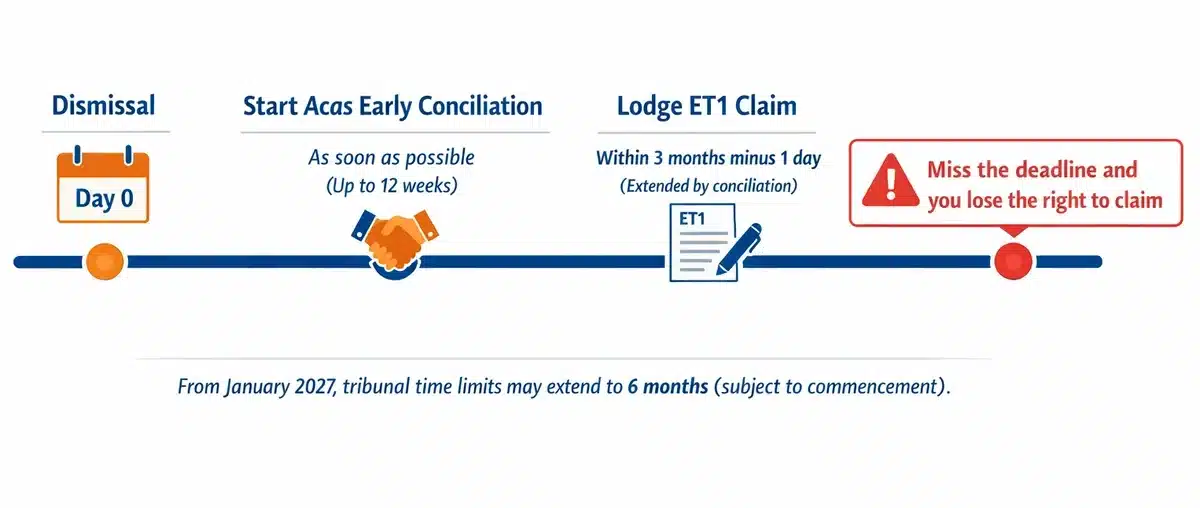
If you have been dismissed following a disciplinary and believe the process was unfair, you must act quickly. The time limit for bringing an unfair dismissal claim is three months minus one day from the effective date of termination. You must start Acas early conciliation before issuing a claim, which pauses the clock. Early conciliation now lasts up to 12 weeks.
💡 Not sure if your dismissal was fair?
Use our free compensation calculator to get an estimate of what your claim could be worth
Calculate Your Compensation →Raising a Grievance During Disciplinary Proceedings
You can submit a grievance at any point during the disciplinary process. This sometimes happens when you believe the disciplinary itself is unfair, or when the real issue is something your employer has done wrong, such as bullying or discrimination.
The Acas Code does not require your employer to pause the disciplinary while a grievance is investigated, but it does say the employer should consider whether to do so. In practice, if your grievance relates directly to the disciplinary (for example, you believe you’re being targeted because of a protected characteristic), it will often make sense for the employer to deal with the grievance before concluding the disciplinary. If they don’t, and the grievance turns out to have merit, the disciplinary outcome is more likely to be overturned at appeal or found unfair at tribunal.
Whatever happens, put your grievance in writing and keep copies of everything. If you later need to bring a tribunal claim, your grievance will form part of the evidence and will show the tribunal that you tried to resolve the issue internally.
Common Employer Mistakes in Disciplinary Procedures

After years of representing employees in disciplinary and unfair dismissal cases, certain patterns come up again and again. These are the mistakes I see employers making most often:
Skipping or rushing the investigation. Some employers treat the investigation as a formality rather than a genuine fact-finding exercise. They’ve already decided what happened and the hearing is just going through the motions. A tribunal will see through this.
Using the same person to investigate and decide. The Acas Code recommends that, where practicable, different people should handle the investigation and the hearing. When the same manager does both, there’s a risk that the decision-maker has already formed a view before hearing the employee’s side of the story.
Not sharing the evidence. You should receive copies of all evidence your employer intends to rely on before the hearing, with enough time to review it properly. Springing new evidence on you in the hearing room is a serious procedural failing.
Pre-determining the outcome. If HR has already drafted a dismissal letter before the hearing takes place, or if the decision-maker has made comments suggesting the outcome is a foregone conclusion, this can make the entire process a sham.
Failing to offer an appeal. Every disciplinary procedure should include the right to appeal. Failing to offer one is almost always going to contribute to a finding of procedural unfairness.
Applying disproportionate sanctions. Dismissing someone for a minor first offence when a written warning would have been appropriate is a classic example of a decision falling outside the range of reasonable responses. The sanction should match the seriousness of the offence.
Ignoring their own policy. If your employer’s disciplinary policy says they’ll follow certain steps and then doesn’t, the tribunal will take a dim view. Employers are held to their own standards, not just the minimum requirements of the Acas Code.
“The most common problem I see is employers who have already made up their minds before the hearing even starts. The investigation is done by the same person who chairs the hearing, the outcome letter was drafted before the meeting, and the whole thing is just box-ticking. That’s not a fair process. That’s a sham, and tribunals will treat it as such.”
Frequently Asked Questions
Can I be dismissed at a disciplinary hearing?
Yes, dismissal is a possible outcome, particularly in cases involving gross misconduct. But your employer must still follow a fair procedure before reaching that decision. Even in gross misconduct cases, they should investigate, notify you of the allegations, hold a hearing, and offer an appeal. Dismissal without following these steps is likely to be unfair.
Can I bring a solicitor to a disciplinary hearing?
The statutory right under section 10 of the Employment Relations Act 1999 only covers colleagues and trade union representatives. You cannot bring a solicitor, family member, or friend unless your employer’s own disciplinary policy specifically allows it. Some employers will agree if you ask, particularly if the allegations are very serious, so it can be worth making the request.
What happens if I don’t attend my disciplinary hearing?
If you don’t attend, your employer can reschedule the hearing. If you fail to attend without good reason after reasonable efforts to accommodate you, the employer may proceed in your absence and make a decision based on the available evidence. If you’re unwell or have a genuine reason for not attending, let your employer know in writing and request a postponement.
How long should a disciplinary warning stay on my record?
This depends on your employer’s policy. Typically, a verbal or first written warning might stay on file for six to twelve months, and a final written warning for twelve months. Your employer should tell you how long the warning will remain active. Once it expires, it should not normally be taken into account in future disciplinary decisions.
Can I resign during a disciplinary process?
You can resign at any time, but doing so does not necessarily end the disciplinary process. Some employers will stop the procedure, while others will continue it to a conclusion. If you resign because of how your employer is handling the disciplinary, you may be able to claim constructive dismissal, but only if you can show a fundamental breach of your employment contract.
Does the Acas Code apply to capability dismissals?
Yes. The Acas Code covers disciplinary situations involving both misconduct and poor performance. If your employer has a separate capability procedure, the basic principles of fairness in the Code still apply. Whether the issue is described as “conduct” or “capability,” the employer must investigate, inform you, hold a hearing, and offer an appeal.
What is the 25% Acas Code uplift?
Under section 207A of TULRCA 1992, if your employer unreasonably fails to follow the Acas Code and you win a relevant tribunal claim, the tribunal can increase your compensation by up to 25%. The maximum uplift is reserved for the most serious cases of non-compliance, but it doesn’t need to be “exceptional” to warrant it.
💬 Facing a disciplinary at work?
Our employment solicitors can advise you on your rights and help protect your position
Get Free Initial Advice →Important: This guide provides general information about disciplinary procedures at work. It is not legal advice and should not be relied upon as such. Employment law is complex and the rules may apply differently depending on your circumstances. If you are facing a disciplinary, have been dismissed, or are considering bringing a tribunal claim, we strongly recommend seeking professional legal advice.
Sources and Further Reading
Primary Legislation
- Employment Rights Act 1996, section 98 (fairness of dismissal)
- Employment Rights Act 1996, section 3 (employer’s duty to provide disciplinary information)
- Employment Relations Act 1999, sections 10-13 (right to be accompanied)
- Trade Union and Labour Relations (Consolidation) Act 1992, section 207A (power to adjust awards for Acas Code non-compliance)
Statutory Code and Official Guidance
- Acas Code of Practice on Disciplinary and Grievance Procedures (effective 11 March 2015)
- Acas guidance: Discipline and grievance at work
- GOV.UK: Disciplinary procedures and action against you at work
Key Case Law
- British Home Stores Ltd v Burchell [1980] ICR 303 (the Burchell test for misconduct dismissals)
- Iceland Frozen Foods Ltd v Jones [1982] IRLR 439 (range of reasonable responses)
- Talon Engineering Ltd v Smith (postponement of hearing and overall fairness)
- Toal v GB Oils Ltd UKEAT/0569/12/RN (employee’s choice of companion)
Tom Street
Tom Street is the principal solicitor at Tom Street & Co. Solicitors, specialising in employment law and tribunal claims. He regularly advises employees facing disciplinary proceedings, helping them understand their rights and challenge unfair outcomes. Tom represents claimants in unfair dismissal, discrimination, and whistleblowing cases across England and Wales. View full profile