
Quick Summary
Gross misconduct is conduct so serious it justifies immediate dismissal without notice, but only if your employer follows a fair procedure and can satisfy the Burchell test. Even if you did commit an act your employer labels gross misconduct, you may still have a claim for unfair dismissal if the investigation was flawed, the procedure was unfair, or dismissal was outside the range of reasonable responses. Time limits are strict: you must act within three months minus one day of your dismissal.
⚖️ This guide is for general information only and is not legal advice. Every case is different. If you’re unsure, speak to a solicitor.
Key Points
- ✓ There is no statutory definition of gross misconduct. What counts depends on context, your role, and what your employer can reasonably argue.
- ✓ Your employer must still follow a fair disciplinary procedure, even for the most serious conduct. Skipping this step is one of the most common ways employers lose unfair dismissal claims.
- ✓ The Burchell test requires your employer to show genuine belief in your guilt, reasonable grounds, and a reasonable investigation. Fail on any one of these, and the dismissal may be unfair.
- ✓ You can still claim unfair dismissal even if you did commit the act, particularly where the process was unfair or dismissal was disproportionate.
- ✓ Compensation in an unfair dismissal claim can reach £123,543, though reductions apply for contributory fault and procedural defects.
- ✓ The time limit is three months minus one day from the date of dismissal. Do not delay.
⚖️ Legislation Update
Three Major Changes Coming Under the Employment Rights Act 2025
The Employment Rights Act 2025 makes three significant changes that directly affect this page:
- Qualifying period reduced to six months: from 1 January 2027, the two-year qualifying period for ordinary unfair dismissal will fall to six months. Until then, the current two-year requirement applies.
- Time limit extended to six months: the three-month minus one day claim window will extend to six months, from no earlier than October 2026 once commencement regulations are made.
- Compensatory award cap abolished: also from 1 January 2027, the current £123,543 cap on compensatory awards will be removed. Awards will be limited only to 52 weeks’ gross pay or actual loss, whichever is lower.
None of these changes are yet in force. If you’ve recently been dismissed, do not wait for them. Act now under the current rules.
💡 Want to know how much your unfair dismissal claim could be worth?
Use our free compensation calculator with current 2026/27 figures.
Calculate Your Compensation →What Is Gross Misconduct?
Gross misconduct is conduct so serious that it fundamentally destroys the trust and confidence at the heart of the employment relationship. When an employer concludes that an employee has committed gross misconduct, it may be entitled to dismiss that employee immediately, without giving notice. This is known as summary dismissal.
There is no single statutory definition of gross misconduct anywhere in UK employment law. The Employment Rights Act 1996 (ERA 1996) gives employers the right to treat conduct as a potentially fair reason for dismissal under section 98(1)(b), but it does not draw a line between ordinary misconduct and gross misconduct. That distinction is left to employers, Acas guidance, and ultimately employment tribunals to assess case by case.
The practical consequence of a gross misconduct finding is significant. Unlike ordinary misconduct, which typically requires a series of warnings before dismissal is justified, gross misconduct can justify immediate dismissal at a first hearing, provided your employer has followed a proper procedure. Whether your employer has actually done that is a separate question entirely.
Do You Qualify to Claim Unfair Dismissal?
Before anything else, check whether you meet the qualifying period. To bring an ordinary unfair dismissal claim, including one arising from a gross misconduct allegation, you currently need two years of continuous employment with the same employer. If you have been employed for less than two years, you will not normally have an unfair dismissal claim regardless of how flawed or unfair the process was.
There are important exceptions. No qualifying period applies to automatically unfair dismissal claims. If you were dismissed for making a protected disclosure (whistleblowing), for asserting a statutory right, or for a reason connected to pregnancy, maternity leave, or another protected characteristic under the Equality Act 2010, you may have a claim from day one of employment. If you think your gross misconduct dismissal was a pretext for one of these protected reasons, the qualifying period is irrelevant.
This is changing. The Employment Rights Act 2025 will reduce the qualifying period from two years to six months, effective 1 January 2027. Until that date, the two-year requirement applies in full.
Common Examples of Gross Misconduct
While there is no definitive list, the following types of behaviour are commonly treated as gross misconduct across most industries and workplaces:
- Theft, fraud, or deliberate dishonesty (including falsifying records, expenses, or timesheets)
- Physical violence, threatening behaviour, or intimidation
- Serious acts of harassment, bullying, or discrimination
- Serious breach of health and safety rules that put others at risk
- Gross negligence causing or likely to cause significant harm
- Deliberate damage to company property
- Serious insubordination (refusing to follow a lawful and reasonable instruction)
- Being under the influence of alcohol or drugs at work in a safety-critical role
- Serious misuse of company IT systems or confidential data
- Bringing the company into serious disrepute
Many employers include a list of examples in their staff handbook or employment contract. However, as established in cases such as Sibley v Consignia plc, the presence of an act on such a list does not automatically make it gross misconduct in all circumstances. Context always matters. Swearing, for example, might be gross misconduct for a doctor’s receptionist and entirely normal background noise in a busy warehouse.
“One of the most common myths I encounter is that if something is listed in the staff handbook as gross misconduct, the employer’s hands are tied and dismissal is automatic. That is not how the law works. The tribunal will look at the full picture: the workplace culture, the employee’s record, whether others were treated consistently, and whether dismissal was truly proportionate.”

Your Employer Must Still Follow a Fair Procedure

The most important thing to understand about gross misconduct dismissal is this: the seriousness of the alleged conduct does not excuse your employer from following a proper process. Even where the facts are not seriously in dispute, a failure to follow the Acas Code of Practice on Disciplinary and Grievance Procedures can make a dismissal unfair under section 98(4) of ERA 1996.
The Acas Code requires employers to:
- Carry out a thorough investigation before any decision is taken
- Notify you in writing of the allegations and provide copies of any evidence
- Hold a disciplinary hearing at which you have a genuine opportunity to respond
- Allow you to be accompanied by a trade union representative or a colleague
- Communicate the outcome in writing, with reasons
- Offer you a right of appeal against the decision
If your employer fails to follow the Code without good reason, a tribunal can increase any compensation award by up to 25% under section 207A of the Trade Union and Labour Relations (Consolidation) Act 1992.
The Right to Be Accompanied
Under section 10 of the Employment Relations Act 1999, you have a statutory right to be accompanied at any disciplinary hearing by a trade union official or a fellow worker. This right applies from the very first day of employment. If your employer refuses to allow a companion or refuses to postpone the hearing to accommodate your chosen companion, that can be a serious procedural flaw.
The Right of Appeal
An employer who does not offer a right of appeal against a gross misconduct dismissal is almost certainly failing the Acas Code. The appeal is not a formality. It must be a genuine reconsideration of the decision. A rubber-stamp appeal by the same manager who made the original decision will not satisfy the requirement.
The Burchell Test: What Your Employer Must Prove
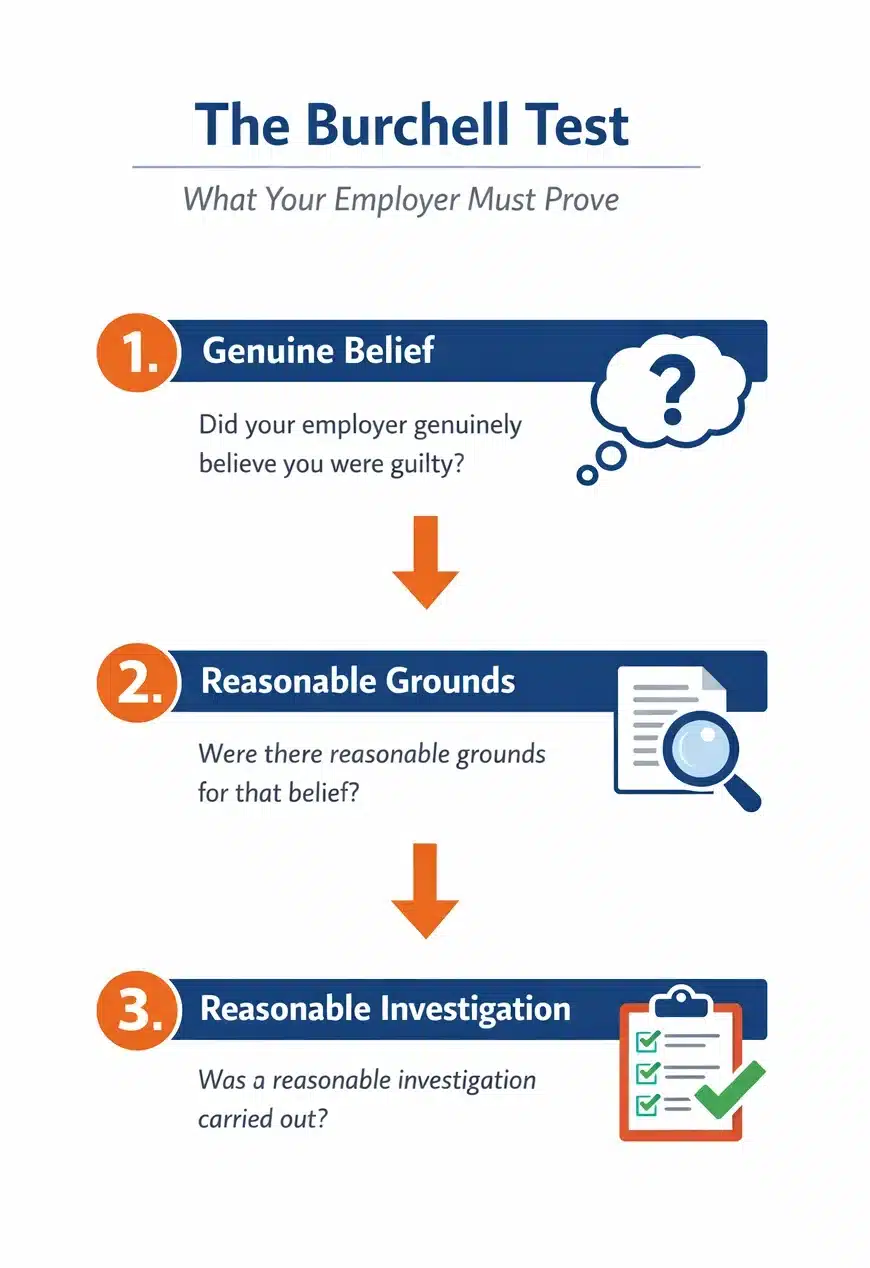
The central legal test for misconduct dismissals comes from the Employment Appeal Tribunal’s decision in British Home Stores v Burchell [1978] IRLR 379. Although the case concerned a belief in dishonesty, tribunals apply the same three-stage test to all conduct dismissals, including those involving gross misconduct.
To justify a dismissal for conduct, an employer must show all three of the following:
Stage 1: Genuine Belief
The employer must have genuinely believed, at the time of dismissal, that the employee committed the act in question. This is a subjective test: did this employer actually believe it? Crucially, the employer does not need to prove guilt beyond reasonable doubt, as in a criminal court. A genuine belief, even an incorrect one, can be enough if the other two stages are met.
Stage 2: Reasonable Grounds
The belief must be based on reasonable grounds. A hunch, a personal dislike, or reliance on a single untested allegation will not be sufficient. There must be something to back up the employer’s conclusion: witness accounts, documentary evidence, CCTV footage, or other objective material that a reasonable person could rely on.
Stage 3: Reasonable Investigation
The employer must have carried out as much investigation as was reasonable in the circumstances before reaching its conclusion. This is where many employers come unstuck. Common failures include:
- Not interviewing witnesses or only speaking to those who support the employer’s case
- Refusing to allow the employee access to evidence (such as CCTV footage) that might exonerate them
- Rushing to a conclusion without following up on the employee’s explanation
- Failing to investigate mitigating circumstances
- Delegating the investigation to someone with a personal interest in the outcome
If you believe your employer failed at any stage of the Burchell test, that is the core of your unfair dismissal argument. You can read a full breakdown on our dedicated Burchell Test guide.
The Range of Reasonable Responses
Even if an employer satisfies the Burchell test, a dismissal can still be unfair if it falls outside the range of reasonable responses. This principle comes from the Employment Appeal Tribunal’s decision in Iceland Frozen Foods v Jones [1982] IRLR 439 and has been consistently applied ever since.
The test asks: could a reasonable employer, in this employer’s position, have chosen dismissal? The tribunal does not ask whether it would have dismissed the employee, or whether dismissal was the right outcome. It asks whether dismissal was within the range of options open to a reasonable employer. Dismissal may be one option within that range. So might a final written warning, a demotion, or a transfer.
Where gross misconduct is borderline, or where there is a genuine argument that dismissal was disproportionate in the circumstances, a tribunal may find that a reasonable employer would not have dismissed, even if the Burchell test was technically met.
Factors that can push dismissal outside the range of reasonable responses include:
- A long, unblemished service record with no previous disciplinary issues
- Inconsistent treatment of other employees who committed similar acts
- Significant personal mitigation (mental health difficulties, personal circumstances)
- The employee’s genuine remorse and acknowledgement of wrongdoing
- The employer’s own contribution to the situation
Dismissed Without Notice: Is That Legal?
If gross misconduct is properly established and a fair procedure is followed, your employer can dismiss you without giving or paying notice. This is known as summary dismissal. Your contractual notice entitlement, including your statutory minimum notice under section 86 of ERA 1996, can both be forfeited where genuine gross misconduct is found.
However, the key phrase is “if properly established.” Where the disciplinary process has been flawed, where the Burchell test has not been met, or where the conduct does not actually amount to gross misconduct, dismissal without notice is likely to be both unfair dismissal and wrongful dismissal. Wrongful dismissal is a contractual claim for the notice pay you should have received. You can bring both claims together in the employment tribunal.
Can You Claim Unfair Dismissal Even If You Committed the Act?
Yes. This surprises many people, but it is entirely possible to succeed in an unfair dismissal claim even where the conduct actually occurred. The fairness of a dismissal is assessed separately from whether the employee is factually guilty.
A dismissal may be unfair despite genuine misconduct if:
- The employer did not carry out a reasonable investigation (Burchell stage 3)
- The employer did not genuinely follow the Acas Code procedure
- Dismissal was outside the range of reasonable responses
- Other employees who behaved similarly were not dismissed (inconsistency of treatment)
- The employer had an ulterior motive for dismissing (for example, using gross misconduct as a pretext to dismiss someone who had made a protected disclosure)
What Happens to Compensation If You Were Partly to Blame?
Tribunals can reduce compensation in two ways where the employee’s own conduct was a factor.
First, a Polkey reduction (from Polkey v AE Dayton Services Ltd [1987] UKHL 8) applies where the tribunal finds that, even with a fair procedure, dismissal would have been the likely outcome anyway. The tribunal will estimate the percentage chance of that outcome and reduce the compensatory award accordingly. This can result in a significant reduction, sometimes to nil, where the misconduct is serious.
Second, a contributory fault reduction under section 123(6) of ERA 1996 allows the tribunal to reduce both the basic and compensatory awards by whatever proportion it considers just and equitable where the employee’s conduct contributed to the dismissal.
Both reductions are applied after any other calculations, including the Acas Code uplift.
What Compensation Can You Receive?
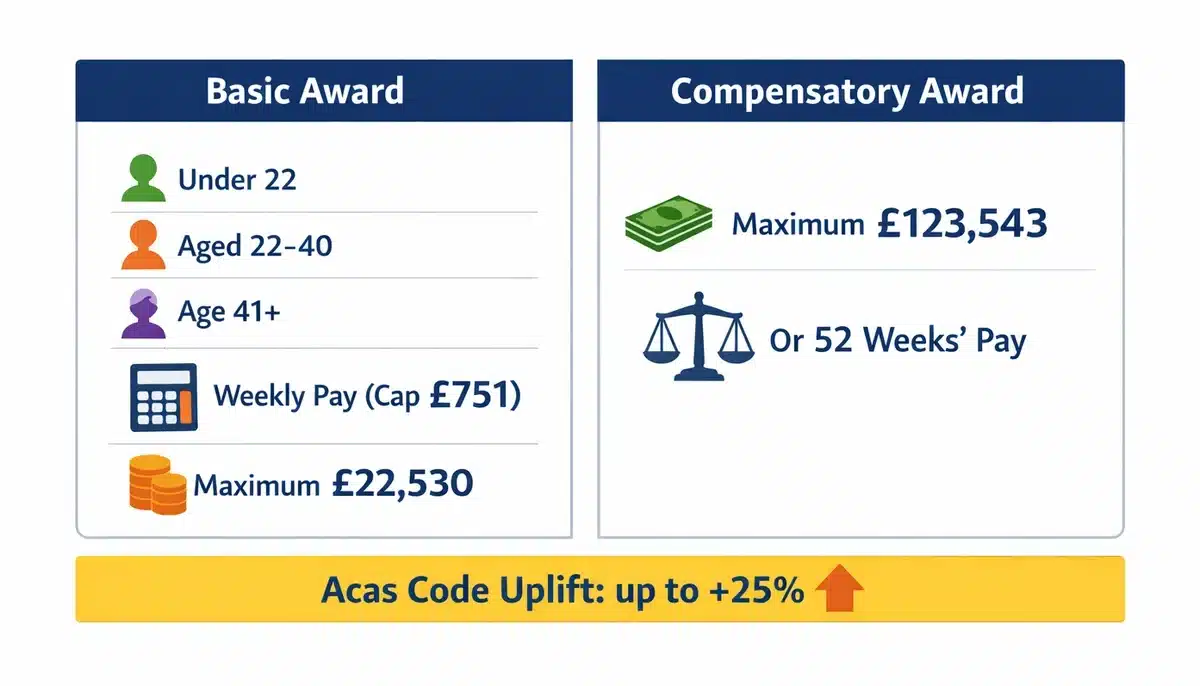
An unfair dismissal award has two parts.
Basic Award
The basic award is calculated using the same formula as statutory redundancy pay. It is based on your age, your length of service, and your weekly pay (capped at £751 for the 2026/27 tax year). The maximum basic award is £22,530. The tribunal cannot normally reduce the basic award for contributory fault below a certain level in gross misconduct cases.
Compensatory Award
The compensatory award covers your actual financial losses: lost earnings, benefits, pension contributions, and future losses if you remain out of work. It is capped at £123,543 or 52 weeks’ gross pay, whichever is lower. The cap can be a significant constraint for higher earners.
Unfair Dismissal Compensation Caps (2026/27)
| Award | Cap / Maximum | Notes |
|---|---|---|
| Basic award | £22,530 | Weekly pay capped at £751; max 20 years service |
| Compensatory award | £123,543 or 52 weeks’ pay (lower of) | Reduced for Polkey and contributory fault |
| Acas Code uplift | Up to 25% | If employer unreasonably failed to follow Code |
Source: Employment Rights (Increase of Limits) Order 2026 (SI 2026/310)
Note that if your dismissal also involves unlawful discrimination or a protected disclosure (whistleblowing), the compensation is uncapped. This is an important consideration if your gross misconduct dismissal was used as a pretext to remove you because of a protected characteristic or because you had blown the whistle.
Time Limits: Do Not Miss the Deadline
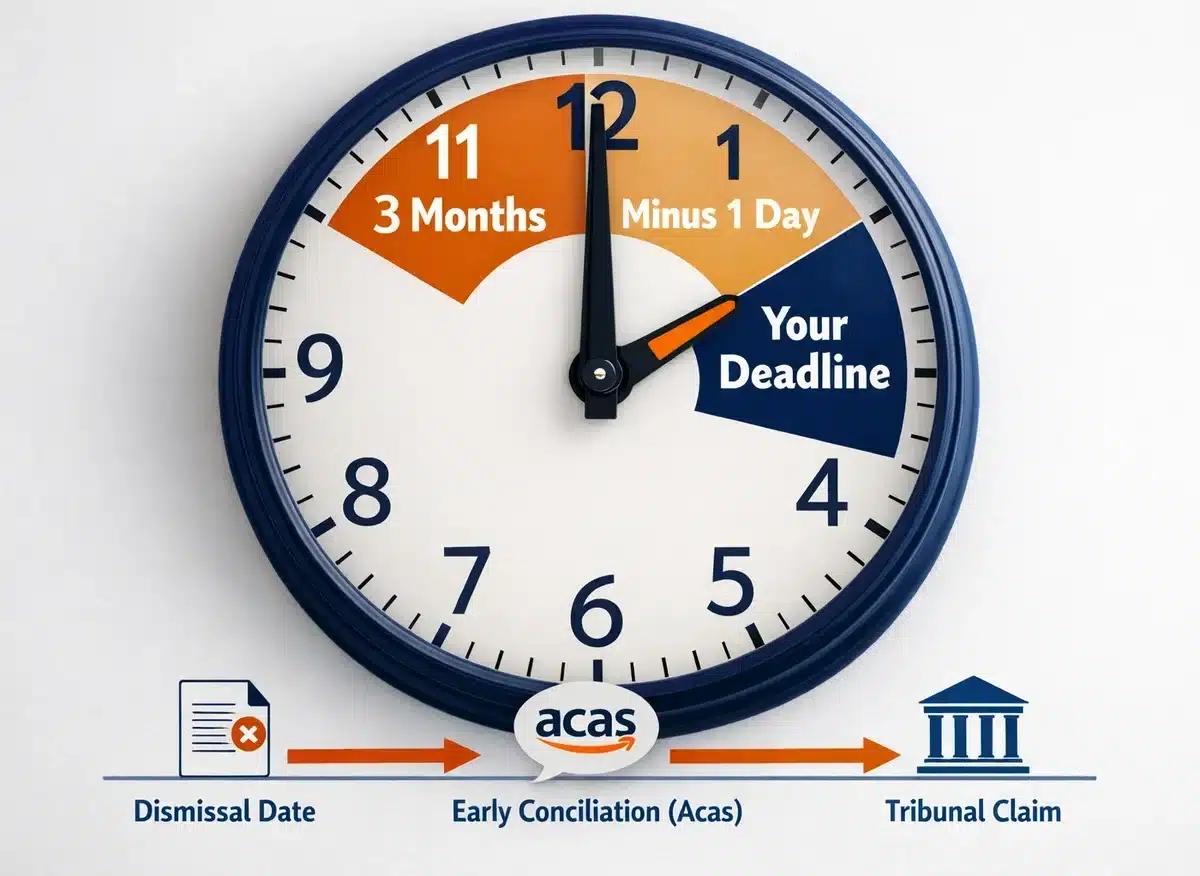
The time limit for bringing an unfair dismissal claim is three months minus one day from your effective date of termination (EDT), usually the date your employment ended. Missing this deadline is nearly always fatal to a claim. Tribunals extend it only in very limited circumstances where it was not reasonably practicable to bring the claim in time.
Before you can issue a tribunal claim, you must first notify Acas (the Advisory, Conciliation and Arbitration Service) of your intention to bring a claim. This is called early conciliation. Acas will contact your employer and attempt to resolve the dispute. The process can last up to 12 weeks (extended from 1 December 2025). The time limit is paused while early conciliation is ongoing, then extended to allow you time to issue the claim.
Given how quickly three months passes after a dismissal, you should seek legal advice as early as possible.
What to Do If You Have Been Accused of or Dismissed for Gross Misconduct
Practical Steps
Get your documents together immediately. Gather your employment contract, staff handbook, any correspondence about the allegations, notes from disciplinary meetings, and the dismissal letter. These are the foundation of any claim.
Note the exact date of your dismissal. This is your EDT. Count forward three months and subtract one day. That is your deadline. Early conciliation pauses this clock, but only once you have notified Acas.
Use your right of appeal if you have not already. An internal appeal is not just a procedural step: a successful appeal reverses the dismissal. Even an unsuccessful one strengthens your tribunal position if the process was unfair.
Think carefully about what the employer got wrong. Did they investigate properly? Did they give you all the evidence before the hearing? Was the decision to dismiss proportionate given your record and the circumstances?
Take legal advice without delay. A solicitor can assess whether your employer met the Burchell test, followed the Acas Code, and acted within the range of reasonable responses, and advise whether a claim is worth bringing.
Frequently Asked Questions
What counts as gross misconduct at work?
There is no single legal definition. Gross misconduct is generally understood as conduct so serious that it destroys the employer-employee relationship and justifies immediate dismissal. Common examples include theft, violence, fraud, serious harassment, gross negligence, and serious health and safety breaches. However, context matters enormously. What amounts to gross misconduct in one workplace may not in another, depending on the role, the industry, and the standards the employer has communicated to staff.
Can I be sacked for gross misconduct without any warning?
Gross misconduct is one of the few situations where dismissal without a prior warning can be fair. Unlike ordinary misconduct, it does not require a series of written warnings. But your employer must still carry out a proper investigation, hold a disciplinary hearing, allow you to respond, and offer a right of appeal. A dismissal without any process at all, even for serious misconduct, is almost certain to be unfair.
What is the Burchell test?
The Burchell test comes from British Home Stores v Burchell [1978] IRLR 379. It requires an employer to show three things to justify a conduct dismissal: first, that it genuinely believed the employee committed the misconduct; second, that it had reasonable grounds for that belief; and third, that it had carried out a reasonable investigation before reaching its conclusion. All three stages must be satisfied. If any one fails, the dismissal may be unfair regardless of whether the employee actually committed the act.
Can I claim unfair dismissal if I did commit gross misconduct?
Yes. The fairness of a dismissal is assessed separately from factual guilt. You can succeed in an unfair dismissal claim even if you committed the act, provided your employer failed the Burchell test, did not follow the Acas Code, or acted outside the range of reasonable responses. Your compensation may be reduced to reflect your contribution to the dismissal, but a finding of unfair dismissal is still possible and sometimes the full award is justified.
How much compensation will I get for unfair dismissal for gross misconduct?
Compensation has two parts. The basic award is calculated from your age, length of service, and weekly pay (capped at £751), up to a maximum of £22,530. The compensatory award covers actual financial losses, capped at £123,543 or 52 weeks’ gross pay. Both awards can be reduced for contributory fault and by a Polkey reduction if the tribunal concludes that dismissal would have been the fair outcome anyway, even with a proper procedure. If the employer failed to follow the Acas Code, awards can be increased by up to 25%.
What should I do if I’ve been accused of gross misconduct?
Take the process seriously from the start. Gather all relevant evidence, prepare a clear written response to the allegations, and attend the disciplinary hearing with a companion (you have a statutory right to bring a trade union representative or colleague). Request copies of all evidence your employer intends to rely on before the hearing. If you are dismissed, use your right of appeal. At every stage, keep a written record. Seek legal advice as soon as possible.
Can my employer dismiss me without a disciplinary process?
No. Even for the most serious misconduct, your employer must follow a fair procedure before dismissing you. Skipping the process, even when the evidence against you seems overwhelming, risks an unfair dismissal finding. Some employers attempt to rush or short-circuit the process where they have made up their minds before the hearing begins. That is itself a procedural failing that tribunals take seriously.
What if gross misconduct is listed in my employment contract or handbook?
An employer can include examples of gross misconduct in its contract or handbook, and employees should be aware of these. However, a list is not a guarantee that dismissal is automatic for every item on it. Tribunals will still assess whether dismissal was within the range of reasonable responses in the circumstances. If the employer has never enforced the rule, tolerated similar behaviour in the past, or treated one employee differently from another, that context can affect the outcome.
Dismissed for Gross Misconduct? Get Advice Today.
We act exclusively for employees. If you believe your dismissal was unfair: whether the investigation was flawed, the process was rushed, or dismissal was out of all proportion. we can assess your claim on a no win, no fee basis.
Legal Disclaimer
This guide provides general information about gross misconduct and unfair dismissal law in England and Wales. It is not legal advice and does not create a solicitor-client relationship. Employment law is fact-specific; the outcome in your case will depend on your individual circumstances, the evidence available, and how a tribunal assesses the conduct of your employer.
Tom Street & Co. Solicitors is authorised and regulated by the Solicitors Regulation Authority (SRA No. 566718). If you need advice specific to your situation, please contact us directly. The law stated reflects the position as of 15 April 2026.
Sources and Further Reading
Legislation
- Employment Rights Act 1996: sections 94, 98, 111, 119-124
- Employment Rights Act 2025: time limit extensions (commencement pending)
Official Guidance
Key Cases
- British Home Stores Ltd v Burchell [1978] IRLR 379 (EAT)
- Iceland Frozen Foods Ltd v Jones [1982] IRLR 439 (EAT)
- Polkey v AE Dayton Services Ltd [1987] UKHL 8
Tom Street
Principal Solicitor, Tom Street & Co. Solicitors | SRA No. 566718
Tom Street is an employment solicitor specialising exclusively in employee-side claims. He has advised on hundreds of unfair dismissal cases, including those involving gross misconduct allegations. Tom Street & Co. is authorised and regulated by the Solicitors Regulation Authority.